LinkedIn Engagement Strategy for B2B Founders
Most people read the numbers wrong. When organic reach dropped roughly 50% year-over-year through 2025, the assumption was that LinkedIn was dying as a distribution channel. It wasn't. Engagement per post went up around 12% in the same period. The audience got smaller and more attentive simultaneously. Which sounds contradictory until you actually think about it. Consider a concert venue that halved its capacity but sold out every night — fewer seats, but every person in the room actually wanted to be there.
That shift happened for a specific reason. LinkedIn replaced its old ranking model with a new AI system called 360Brew. It doesn't evaluate a single post in isolation. It reads your full profile and your entire posting history before deciding how widely your content travels. That's a genuinely different game than what existed two years ago.
What it means in practice:
- Consistent voices posting in a clear lane get more reach, not less. Sporadic posting on unrelated topics gets suppressed.
- Dwell time is now a ranking signal. If people stop and actually read, distribution compounds. Content that gets scrolled past gets buried.
- Engagement pods and automated comments are detected and penalized. Real back-and-forth gets prioritized.
- Posts generating genuine conversation now circulate for two to three weeks. A year ago, the effective shelf life was about 24 hours.
LinkedIn also killed hashtag pages in late 2024. Using more than five hashtags now actively hurts your distribution. The text-wall posts, the random scheduling, the hashtag stuffing that worked two years ago. They don't just underperform now — they actively suppress your reach.
The underlying logic makes sense once you see it. The algorithm is optimizing for what looks like genuine professional exchange. Which, if you're a founder trying to build trust with buyers, is exactly what you should already be doing anyway. So honestly? The shift is less of a problem and more of an overdue correction.
Personal Profiles as the Primary Distribution Engine for B2B Companies
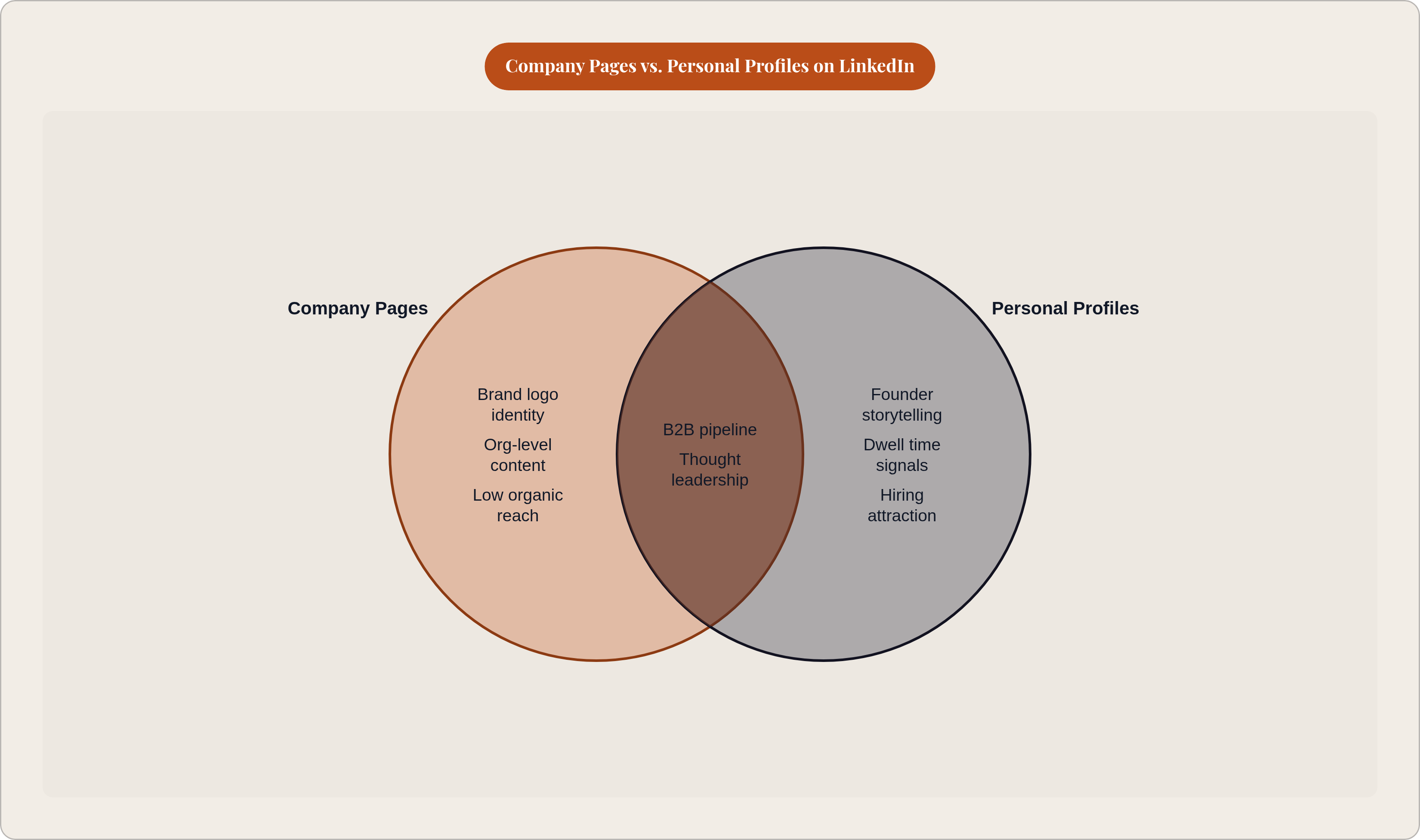
Company pages have quietly lost most of their organic reach. Investing primarily in a brand page is now a structural disadvantage, not just a suboptimal choice. Personal profiles drive dramatically more engagement than company accounts, and people on LinkedIn are far more likely to engage with content from a person than from a logo. That shows up clearly in the distribution numbers.
For a B2B founder, this means your personal profile is your company's best marketing channel. Not a nice-to-have. The actual primary channel.
Your profile is also doing work while you're not posting. It's either actively selling to investors, customers, and future hires around the clock, or quietly losing deals in the background. A few specifics worth understanding: profiles with a photo get dramatically more views and messages than those without. Your About section should read like a snapshot of who you are and what you stand for, written in first person, not recited like a résumé.
People connect with people. That's the distribution mechanic. Your profile setup is the first trust signal anyone encounters before they've read a single post you've written. Getting it right isn't vanity. It's infrastructure.
The Formats and Cadence That Move People from Scroll to Conversation
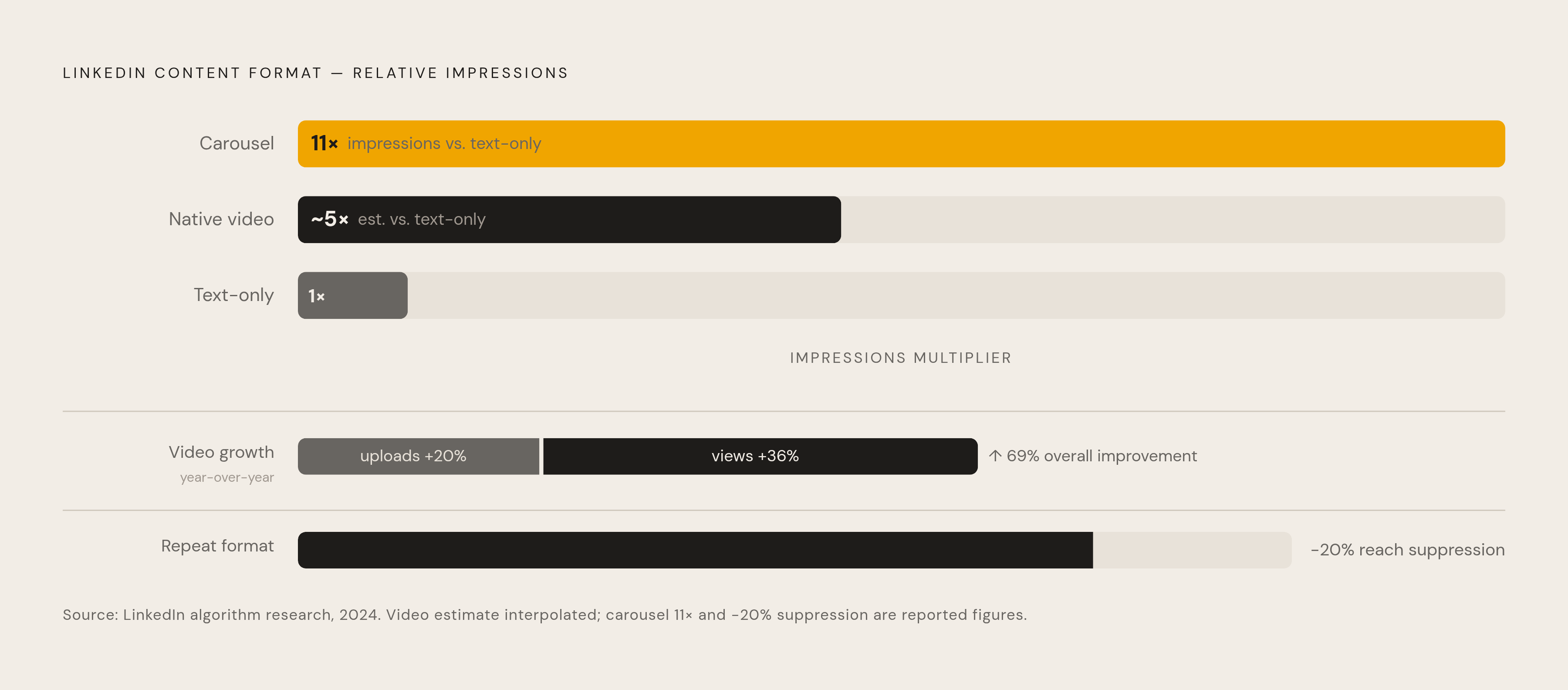
The format data tells a fairly clear story, so here's what it shows.
Carousels generate more than 11 times more impressions than text-only updates. Multi-image carousels lead LinkedIn in engagement rate and outperform single images on click-through. Native video performance improved roughly 69% year-over-year. Video uploads grew 20%, but views grew 36%. The format is growing faster than people are producing it, which is an opening right now. Vertical video generates significantly more impressions than horizontal, which makes sense given that more than half of LinkedIn users are on mobile.
On post length, the range that consistently outperforms is roughly 1,200 to 2,500 characters. Not a hard rule. Just where conversational posts find their footing.
On cadence:
- Two to five times per week on a personal profile. Tuesday through Thursday mornings perform best for initial distribution.
- Rotate formats. Posting the same format back-to-back suppresses reach by around 20%.
- Respond to comments within the first 60 to 90 minutes. Early engagement signals quality to the algorithm, and those comment threads are often where actual pipeline conversations start.
One more thing worth flagging. AI-generated posts average significantly fewer interactions than human-created content. The algorithm can tell. So can your audience. Every format choice should trace back to the pipeline goal. Carousels that break down a framework get saved and shared by decision-makers. Video builds familiarity that shortens sales calls, sometimes considerably, because buyers feel like they already know how you think before they've ever spoken to you.
What Kinds of Stories Actually Move B2B Buyers Toward a Conversation
Posts that follow a personal story plus business lesson structure generate three to four times more engagement than pure how-to content. That gap is too large to treat as noise.
Open with an observation, not a thesis. Something like "I've noticed something in recent weeks" gets read. "Studies show" gets scrolled past. Small edit, real effect.
B2B storytelling doesn't mean dumping personal anecdotes into your feed. It means presenting professional content in a way that feels relatable across roles and industries. The posts that consistently perform best are candid accounts of mistakes and lessons. Tactical how-tos rarely land the same way. People connect with the person first, then trust the expertise second.
There's a framing that earns attention when it's backed by real experience: "Most people in this space believe X, but I've found Y to be true, and here's why." Contrarian positioning works when it comes from somewhere genuine. It falls apart when it's manufactured for clicks, and audiences can usually tell which one they're reading.
Your founder origin story is one of your most valuable marketing assets. The challenges, the moment of conviction, the doubt you probably didn't tell your investors about. That arc is compelling because it transforms your brand from a company into a person someone wants to root for. Tell it once in full, usually in your About section or a dedicated post, then reference it in fragments repeatedly over time.
Build three recurring content pillars that connect your expertise to the problems your buyers actually face. That consistency is what makes a profile feel like a credible source rather than just another feed that showed up one day and disappeared six weeks later.
How Thought Leadership Reaches the Buyers Who Never Announce Themselves
More than 40% of B2B deals stall not because of price or product fit, but because of internal misalignment within buying groups. The person you're pitching to isn't the only person making the decision. The other stakeholders, the CFO, legal, procurement, are almost never in your calls. They're somewhere else in the building, forming opinions about your company based on whatever they can find.
The Edelman-LinkedIn B2B Thought Leadership Impact Report found that nearly 80% of these hidden buyers say they're more likely to advocate for a vendor during an RFP process if that vendor consistently produces high-quality thought leadership. Most also say strong thought leadership makes them more receptive to outreach from that vendor in the first place.
Here's how that actually plays out. Your champion reads your post. They forward it to the skeptical CFO. It lands in a Slack channel before a vendor review meeting. Your content is now doing persuasion work in a room you were never invited into, with people you've never spoken to, before you even know the evaluation is happening. That's not a hypothetical. That's what the buying process looks like at most mid-market and enterprise companies right now.
This is why engagement metrics don't capture the full picture. A post with moderate likes gets forwarded to three decision-makers who never commented, never reacted, and are now materially warmer on your company. You didn't shorten the sales cycle during the call. You shortened it six weeks earlier, with a post.
Why Founders Who Are Hiring or Fundraising Feel the ROI of Consistent Engagement First
Here's what actually shifts when a founder has been posting consistently before going into a fundraising process. Investor conversations change character. Instead of spending the first call convincing someone the space is real, you start hearing things like "tell me more about how you're thinking about X." The content has already done the credibility work before anyone showed up to the meeting.
Fundraising timelines compress noticeably because investors who have been following your thinking for months arrive past the skepticism phase. You're not starting from zero on every call.
The hiring dynamic works the same way. Candidates evaluate founders before the first conversation, just like buyers do. A founder who shares hiring philosophy and company-building lessons publicly attracts candidates who already believe in the mission before applying. That reduces recruiting costs and early-stage misalignment. The people who do reach out are self-selected in a useful way.
The caveat most founders miss: meaningful impact from a LinkedIn presence takes 12 to 24 months to compound. Founders who wait until they're actively fundraising or hiring are already 6 to 12 months behind. The benefits also aren't separate channels. The audience you build while hiring feeds the investor conversations in your next round. The credibility established during fundraising shortens the next sales cycle. It's the same asset working in multiple directions at once.
Where the Ghostwriting and Operator-Model Fits Into a Founder's Content Engine
The founders who have the most to gain from consistent LinkedIn presence are usually the least available to produce content. That tension is real, and it's not going to resolve itself through better time management.
Ghostwriting, done well, doesn't replace the founder's perspective. It extracts and systematizes it. Good ghostwriting starts with a long voice interview that captures how the executive thinks, what they care about, and how they naturally talk. That process produces a style guide specific to that person. After a few posts built from it, most founders say the content sounds like them. It does, because it is them, just structured by someone whose job is to structure things clearly.
The ethics question comes up regularly, and it's legitimate. It holds up when the ideas, perspective, and experience are genuinely the founder's. The ghostwriter is a communications partner, not an inventor of views the founder doesn't hold. That distinction matters. Where it breaks down is when a writer applies high-performing LinkedIn templates across a dozen different clients without grounding anything in the specific founder's actual experience and context. That approach will grow a follower count. Pipeline generation is the only metric that matters here.
A hybrid model works well in practice. The founder writes key points themselves, sets aside time each week to review what's performing, and personally responds to comments. The team handles scheduling, formatting, and optimization. The division of labor keeps authenticity intact without demanding full production time from the person who has the least of it.
One clear warning: AI ghostwriting is not the same thing as working with a skilled operator. AI has no taste, no accountability, no understanding of your specific situation, and no ability to advise you on what should and should not be said publicly. The algorithm already penalizes it. So does your audience. Hiring an AI to build your thought leadership is like hiring a parrot to give your keynote — it might produce recognizable words, but nobody's walking away convinced.
How to Know Whether Your LinkedIn Engagement Is Actually Working as Pipeline
Stop tracking follower counts and impression totals as success metrics. They're inputs, not outputs.
What actually tells you whether it's working:
- Inbound conversation rate. Are people reaching out to you directly, unsolicited?
- Quality of connection requests. Are they decision-makers in your ICP, or mostly other vendors and founders?
- How sales calls open. If someone leads with "I've been following your content," that's pipeline attribution you can trace.
- Whether investor or candidate conversations arrive pre-warmed. That's the compounding effect becoming visible.
Buyers who have been reading your content for weeks arrive at a first call with trust already established. They close at higher rates than cold outbound. That's not a theory. It's a natural consequence of being someone a buyer has already spent time learning from before they ever spoke to you.
On timeline: expect three to six months of consistent effort before pipeline effects become measurable. Months seven through twelve often produce disproportionate returns relative to the work going in.
What consistent actually looks like:
- Two to five posts per week, formats rotated, on a predictable schedule.
- You personally active in comments, not as a brand voice, but as a person with actual opinions who occasionally disagrees with someone.
- Content tied to your three pillars, not a random stream of whatever felt relevant that morning.
Every post is a touchpoint with a decision-maker who isn't ready to buy today. When they are ready, they'll remember who they were already learning from.