Cold Outreach Messages That Get Responses From Senior Professionals
How to personalize cold outreach on LinkedIn so senior executives actually reply.

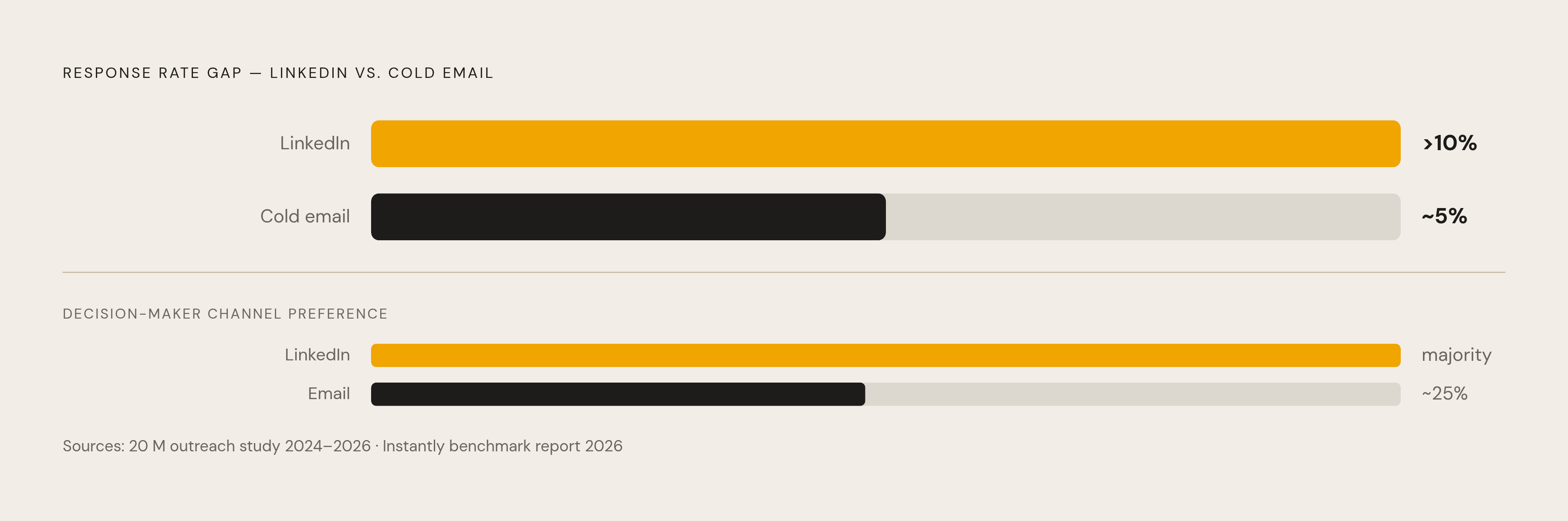
Cold outreach messages get replies from senior professionals when they give someone a reason to care now. LinkedIn is the exception to a worsening cold-email market, with average response rates above 10%. But the platform is not a shortcut. For founders and executives, the winning approach is fewer, more relevant messages, supported by a profile that gives recipients a reason to trust the sender.
Why senior professionals have stopped responding to cold outreach everywhere except LinkedIn
A founder sends dozens of messages, adjusts the opening line, sends another batch and gets almost nothing back. The natural suspect is the copy. But a sharper sentence cannot rescue an email that never reaches the inbox, or one that looks like everything the recipient has learned to delete. The channel itself has become part of the problem.
Instantly’s 2026 cold email benchmark report shows that average response rates fell sharply over several years and hit a new low in 2026. AI-generated outbound has flooded inboxes, while Gmail and Outlook have tightened authentication requirements involving DMARC, DKIM and SPF. Poorly configured domains can be throttled before a person sees the message. Delivery is only the first hurdle to clear. Hunter.io’s State of Cold Email finds that a large majority of decision-makers cite over-aggressive messaging and irrelevance as leading reasons cold emails fail.
A study of 20 million LinkedIn outreach attempts in 2024–2026 found that average response rates were above ten percent, more than double cold email’s. That does not make every senior executive available. LinkedIn stands apart because its professional setting makes it a fitting place for strangers to get in touch with people whose work gives them a reason to talk.
Why LinkedIn is structurally different from email for senior professionals
LinkedIn gives a cold message three advantages, namely visibility, a profile the recipient can inspect and a setting built around professional contact. Its notifications surface differently from promotional email. Recipients check the platform in shorter, more intentional windows. The message enters a different kind of queue. That improves its chance of being considered, though it still has to earn attention.
The sender also arrives with a professional identity attached. Before replying, a senior professional can examine who the person is, what they have built and who they know. A profile that people trust leaves them with fewer doubts than an email from a name they do not know. The recipient is not limited to the sender’s claims. Posts shared often, a clear point of view and proof of what the sender knows give them something else to judge.
Hunter’s report finds that LinkedIn is the preferred outreach channel for a majority of decision-makers, compared with roughly a quarter who prefer email. Professional intent helps explain that preference. People open LinkedIn expecting to hear from others about work, so a thoughtful message can fit. For founders and executives, this makes their visible presence part of the message’s reception.
Why most LinkedIn cold outreach still fails despite the platform advantage
An average response rate is not a personal guarantee. Signal-based outreach with tight personalization performs far better than generic volume outreach, which can fall well below the platform average. Seniority makes the difference more pronounced. C-level executives at larger organizations receive the most outreach and respond at a fraction of average rates. Their filters demand a stronger reason to engage.
The fastest way to squander LinkedIn’s advantage is to pitch-slap someone on first contact. A product pitch or calendar link tells a senior recipient that the sender wants their time before showing why the message matters to them. An overlong message creates a related problem by demanding too much attention up front. Response rates for shorter InMails are 22% higher than for longer ones. Nobody has a few minutes between meetings and hopes to find a presentation dressed up as a hello.
The size of the request can sink otherwise relevant copy. Hunter’s data shows that open-ended calls to action outperform hard meeting requests with decision-makers. A first message needs to start a conversation. The recipient should have an easy way in. Writing a relevant message therefore starts with finding a reason this person might want to have this conversation now.
What signal-anchored outreach looks like in practice
Before writing, spend one minute looking through the recipient’s LinkedIn profile for recent posts, mutual connections, company news and background they share with the sender. This is not a hunt for decorative trivia. The aim is to find a current business event that explains the approach. A generic reference to their industry does not do that work.
A leadership change creates one such opening because a newly hired VP or CRO may be evaluating the existing stack and approach. Timing is part of the signal. Outreach within days of a role change performs better than contact weeks later, when the same announcement is less useful as an opening. The message should connect to the work of taking on the role, rather than treating congratulations as a thin wrapper around a pitch.
Funding gives another reason to reach out, because companies scale GTM and hire after they get funding. The stage determines the angle, so funding alone is not a complete explanation of need. Public strategic commentary can sharpen that angle. If a CEO mentions “sales efficiency” on a public call, a relevant message can reference that stated priority. Hiring patterns offer another view of where the company is directing its effort.
A recent post or comment gives the sender a topic the recipient has already chosen to discuss. Refer to the idea in the post, going beyond saying that the post exists. Even an imperfect interpretation gives the recipient something concrete to correct.
How to structure the message itself for a senior audience
Use four parts in order, which are a personalized hook, a credibility signal, a value proposition and a soft call to action. Each part answers a different question for the recipient. Why this approach, why this sender, why engage and what happens next. Keep the progression easy to follow in a short attention window.
Start with one sentence about the signal. It might reference a post, a new role or a strategic move by the company, but it should not begin with the empty observation that a profile was discovered. Follow with one clear, verifiable reason the sender is worth hearing from. One relevant fact is enough for that job. A biography would make the recipient excavate the useful part.
Give the value proposition one or two sentences explaining what the recipient might gain, tied to the likely priority behind the signal. Then close with a low-friction question, such as “would it be worth a quick exchange?” The ask should invite a reply without demanding a commitment. A calendar link asks the recipient to give up time before they know what they might gain from the conversation.
Keep connection requests concise, with slightly more room for InMail. Hunter’s data finds that messages with personalization based on several specific details get far more replies than non-personalized messages. That is not permission to cram in every discovery. Choose details that support the same business reason for reaching out. The result should read as written for one person.
Why follow-up is where most senior-professional outreach is abandoned too early
Silence after a first message is not a verdict. A typical prospect needs multiple touchpoints before responding, and senior executives require even more because their attention is contested at scale. Stopping right away treats a message that went unnoticed as a firm no.
Hunter’s sequence data shows that a sequence of three messages more than doubles total replies compared with one message. But repetition alone is not the mechanism to copy. Follow-ups that add no new value receive significantly lower response rates than those that do. A further message needs another useful angle or piece of information. Otherwise, the person gets the same request and one more notification.
Before sending, draft at least two further messages, each contributing something different rather than nudging the recipient to reread the first. The LinkedIn analysis supports a sequence beginning with a connection request, followed by InMail if there is no acceptance within seven days. That treats the platform as a sequence of opportunities. Persistence belongs in the design, but each contact still has to justify itself.
How a founder's own LinkedIn presence changes what cold outreach can accomplish
A founder’s profile can answer questions the message has no room to address. When the recipient clicks through, consistent publishing gives them a point of view, evidence of domain expertise and signs of real engagement. The message has supporting evidence within reach to help establish credibility. Without that presence, even carefully written outreach asks a few sentences to do all the trust-building.
Companies whose founders post consistently have meaningfully higher outbound close rates because prospects already recognize who they are. The brand reduces the trust deficit that cold contact otherwise has to overcome. Familiarity is doing commercial work in this setting. It is not simply a nicer-looking backdrop for the same sales process.
The 2025 Edelman-LinkedIn B2B Thought Leadership Impact Report says this content also reaches people who work in finance, legal, compliance and procurement. These “hidden buyers” may have little or no interaction with sales teams, yet spend substantial time reading thought leadership and use it to evaluate vendors. A founder’s posts can therefore reach people outside the direct conversation. The person replying to the message is not necessarily the only person forming a judgment.
Fundraising follows a related pattern, as investors research a founder before a meeting. Outreach initiates the process, while an active presence gives that research substance. A founder’s LinkedIn content program should be treated as part of business development. A polished message can open a door. The profile helps people decide if they want to keep it open.
The practical checklist for a LinkedIn cold outreach message that earns a reply
Before sending, apply seven checks to the message and the presence behind it. First, inspect the sender profile for a professional photo, a headline that shows value rather than just a title, and visible relevant content. Second, identify the specific, timely signal that makes the approach appropriate now. An industry observation does not pass this test. The opening needs a reason for contacting this particular person.
Third, check the order of the message, moving from hook to credibility, value and soft ask. Keep each part short enough that it is worth the time it takes to read. Fourth, make sure the call to action can be answered in one sentence, without a calendar link or a thirty-minute commitment. Fifth, remove generic pain statements and phrases such as “companies like yours.” If a find-and-replace could send the message elsewhere intact, the personalization has not done enough.
Sixth, have at least two follow-ups drafted before the first message goes out, each with a different angle or new information. Seventh, confirm that recent posts are visible on the sender’s profile so the recipient has something current to evaluate. These checks belong together because the reply decision involves more than the text in the inbox.
The founders who get replies are sending better messages to fewer people, backed by a presence that does part of the work before the conversation begins.