LinkedIn Headline Formulas for Executives Not Job Hunting
Executives waste LinkedIn's most-seen real estate by listing their job title.

Most executives leave their LinkedIn headline set to their job title, on the theory that the field is only for people hunting jobs. Wrong theory, and an expensive one, since that line is the most-read sentence attached to your name on the largest professional network on the planet. Treat it like an autofill setting and you lose the exact relationships you're supposedly on there to build.
Nobody explains this at onboarding, so here's the math instead. LinkedIn has well over a billion registered members and hundreds of millions show up in a given month. Four out of five of them make business decisions somewhere inside their org. That's a room full of buyers, investors, and reporters, and your headline is the outfit you're wearing every single time your name shows up on somebody's screen.
The search algorithm weighs the headline five times heavier than other profile fields for search visibility. About section, job history, all of it still counts for less, because that's just how the field gets indexed, and there's no negotiating with it.
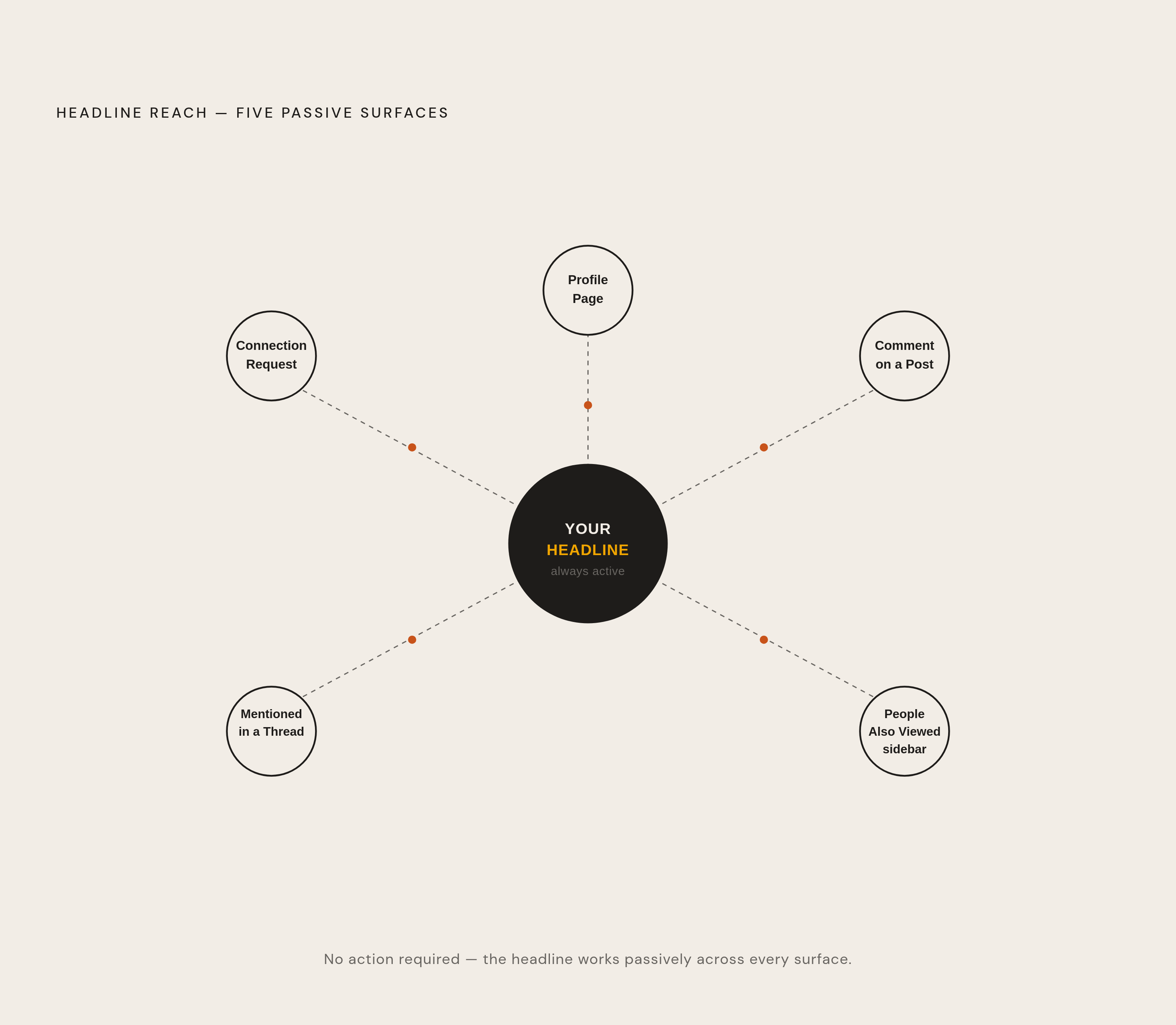
And it travels. Comment on a post, send a connection request, get mentioned in a thread, show up in someone's "People Also Viewed" sidebar: the headline rides along every time, whether you meant for it to or not. Nobody clicks into your About section by accident, because they click through only after the headline already did its job.
Here's the detail almost nobody's caught up on. LinkedIn quietly stretched the headline limit from 120 characters to 220 back in late 2024. Profiles that crack 100 characters pull noticeably more search impressions than shorter ones, and most people are still writing well under that. Bit like showing up to a stadium gig and bringing the mic from your living room.
Specific, credible headlines get clicked, while vague ones get scrolled past without a second look. People really do move fast on this platform. Think of the headline as a filter, not a flag on a pole. Done right, it pulls in the customer researching your company, the investor vetting your background, the reporter hunting a source, and it waves off everyone who isn't a fit, quietly, without you lifting a finger.
The four things a non-job-seeking executive actually needs the headline to do
An executive's headline has exactly one job, and most headlines are doing a completely different one.
It has to earn a stranger's trust in about two seconds flat. It has to say what category of value you bring: what domain, what problem, what scale. It has to tell the reader who you're actually for, because a customer, an investor, and a future hire each need a different flavor of trust from the same nine words. And it has to open a door: a speaking invite, an advisory ask, a partnership conversation, an applicant who did their homework before hitting apply.
Notice what's missing from that list, since passing an applicant tracking system isn't on it, and neither is keyword-stuffing for a recruiter's saved search. Those are job-board tactics, and if your headline still reads "Experienced Leader | Results-Driven | Team Player," you're optimizing for a game you stopped playing years ago, one nobody's grading you on anymore.
Job-seeker formulas don't just fail to help here, they actively work against you. "Open to opportunities" under a sitting CEO's name doesn't read as humble. It reads like a typo in your own authority, honestly, and I've seen it happen to people who should know better.
The headline is always-on positioning. It's working at 2am while you're asleep and it's working during a board meeting where you're not even glancing at your phone. Build it for the relationships you want next, not a job description of the one you already have.
The core formula structure that works for executives: Role + Domain + Proof of scale
Strip it down and you get three parts: role, domain, meaning who you serve or the exact problem space you live in, and proof, the piece that makes a total stranger believe the first two.
Domain is what narrows things. "CFO" tells a reader almost nothing, while "CFO, M&A and Risk Management" tells them exactly which conversation to start. Proof is what closes the sale: "CFO | M&A, Risk Management | Delivered Hundreds of Millions in Growth" is a full pitch in nine words, no filler, every word carrying weight.
The failure mode shows up constantly, and you've seen it a hundred times: "thought leader," "change agent," "passionate innovator." Throat-clearing dressed up as content, taking up space while saying nothing. People spot the gap between a real claim and a decoration fast, the way you'd clock a knockoff watch across a room without even trying.
Use the extra room LinkedIn gave you. Front-load two or three role keywords for search, then close with an outcome line for the human being who's actually reading, so both jobs get done in one headline. No tidy metric handy? Borrow proof from somewhere else: a company you built that people recognize by name, a category outcome like "two exits" or "Series B to IPO," a domain where your name already carries weight without any help. Proof doesn't have to be a number, but it does have to be checkable, and that's the only rule.
Three headline variations tuned to different executive goals
The Authority Signal. Built for anyone chasing media, podcasts, the speaking circuit. Lead with your lens on the domain, not just the title, then close with a credibility marker a stranger recognizes on sight: "CEO | Building B2B SaaS in emerging markets | Forbes contributor, SaaStr speaker." Bait for inbound press, and it works because it tells a producer what you'll talk about before they've read another line.
The Investor-Facing Headline. Built for founders fundraising or building loudly in public. Investors read the profile before the call, so this one has to move fast: category, traction, identity, done. "Founder & CEO | AI-powered compliance for mid-market banks | Seed-backed, scaling to Series A" tells an investor what you sell, who buys it, where you stand, before the first email reply even lands. Skip the mission-statement filler, because "Reimagining the future of finance" tells an investor absolutely nothing they can underwrite.
The Talent-Attraction Headline. Built for executives actively hiring. Top candidates research leadership before they touch the apply button, so structure it as Role + What the Team Is Building + a signal of culture. "CTO | Building the infrastructure layer for climate data | 12-person team, Series A, remote-first" recruits before the job posting even loads. Specificity is the whole filter here; it pulls in exactly the people who want that exact thing and waves off everyone else, no extra effort required.
The contrarian-positioning formula and when executives should use it
There's a fourth pattern, and it's sharper than the rest: "Most people in [industry] believe [X]. I've built [Y] by doing the opposite." Name the conventional wisdom, name your contrarian lens, show the receipts.
Works because LinkedIn's algorithm has shifted toward rewarding a real point of view over generic status updates. A headline staking out an actual stance earns the engagement the platform's built to amplify right now, and it doubles as a trailer for the content you should already be posting anyway.
One catch, and this part's non-negotiable: the stance has to be real. Have you actually done the thing, at real scale, with something behind it? If yes, the specificity reads as earned. If no, it reads as posturing, and sophisticated readers clock posturing fast, the way a bartender clocks a fake ID before the kid's even finished handing it over.
Not for everyone, either. If your main audience is investors or a board mid-due-diligence, a contrarian headline can read as polarizing at exactly the moment you need to look stable instead. Save the sharp edges for audiences that actually reward them.
What a strong headline cannot do alone — and what the profile needs to back it up
The headline earns the click. The rest of the profile has to cash that check, and plenty of executives write a genuinely great headline, then leave the About section reading like a resume summary someone wrote in 2011 and never opened again.
Think about who's actually on the other end of that click: an investor sizing up a founder before the first meeting, a candidate deciding whether to leave a stable job for yours, a reporter deciding if you're quotable. All of them are looking for consistency, not one strong sentence propping up the rest. A mismatched About section, an empty Featured tab, a profile gone quiet for eight months, any one of these undoes the trust the headline just built.
LinkedIn's also moved the About section higher up the page, so it's one of the first things a visitor sees right after the headline lands. Write it in first person, an actual leadership narrative with proof of scale baked in, instead of a third-person summary that reads like your own eulogy, written a decade early.
Fully completed, regularly active profiles generate far more opportunities than the incomplete, dormant ones sitting right next to them on someone's search results. That's the gap between a profile that works while you sleep and one that just sits there collecting dust. The Featured section matters here too: notable interviews, published articles, speaking clips, these are what actually convert someone from "read the headline" to "sent the message." A strong headline over a thin profile is worse than a modest headline over a rich one, if you had to pick, since the gap between what you claim and what you can show is what reads as fake, and people smell it faster than you'd like.
Why the headline is the first move in a content strategy, not the last
The headline is a public claim about what you stand for. Everything you post after it either backs that claim up or quietly undercuts it, and readers catch the contradiction faster than most executives assume.
The numbers here are hard to wave off. 73% of decision-makers trust an organization's thought leadership more than its marketing materials, and 60% say strong thought leadership makes them willing to pay a premium for it. The headline gets someone onto your profile, while the content is what earns the premium once they're standing there.
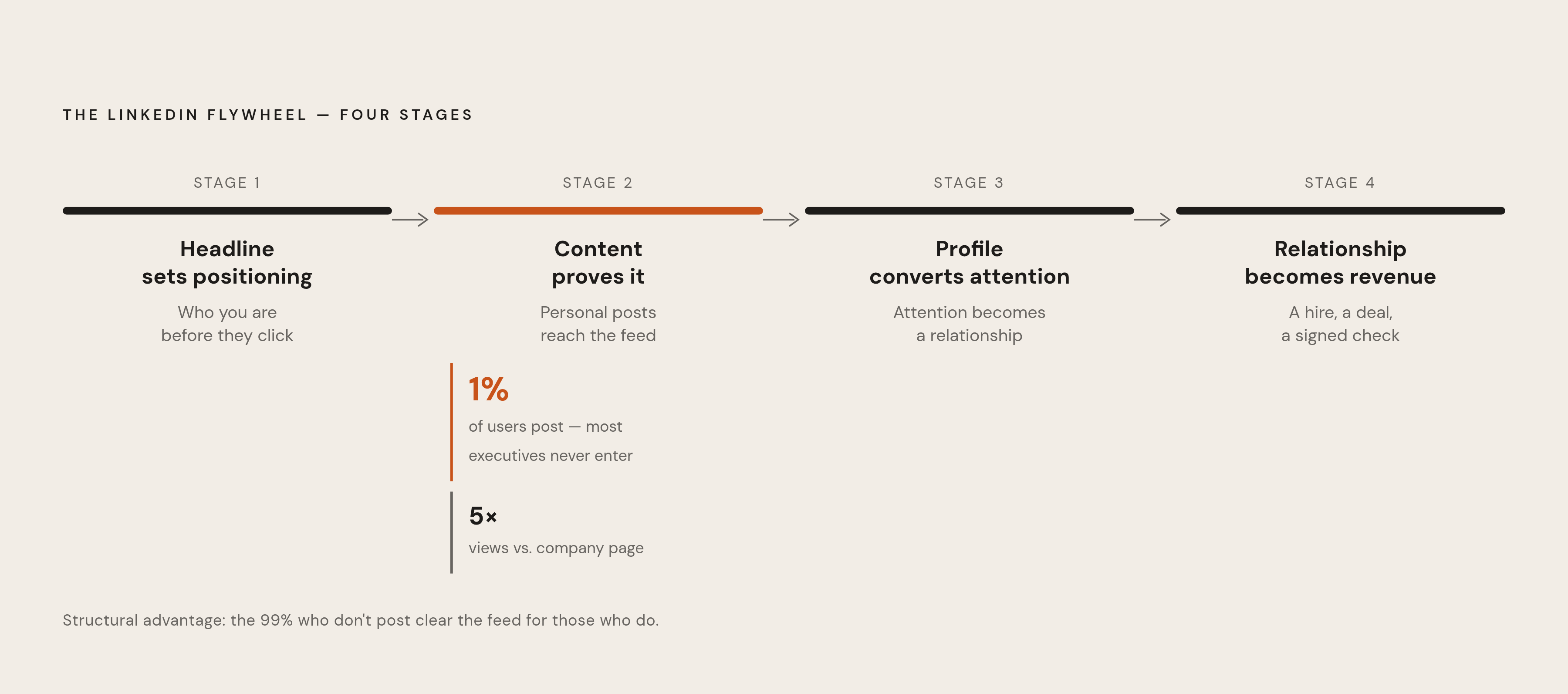
Personal content on LinkedIn also pulls something like five times the views and engagement of company page posts, and only about 1% of LinkedIn's user base posts with any regularity at all. That's a supply-and-demand gap most executives never bother to touch, which means the handful who do show up are working with a structural advantage that, frankly, nobody's even competing for.
So here's the order things actually happen in. Headline sets the positioning, content proves it's true, and the profile turns that attention into a real relationship. Somewhere down the line, the relationship turns into revenue, a hire, or a signed check. A good headline is the opening line of a story, not a label you set once and forget about. The job after that is answering the question the headline raised, post after post, until the story and the headline are finally telling the same truth.