LinkedIn Algorithm Signals That Suppress or Amplify Reach
LinkedIn's algorithm now prioritizes dwell time and conversation depth over likes.
In October 2025, LinkedIn's engineering team confirmed something that reframes the whole game: the algorithm now runs on large language model-based semantic understanding. It does not pattern-match keywords anymore. It reads your post and decides what it actually means.
The numbers behind that are genuinely disorienting. LinkedIn narrows roughly 300 million posts down to around 2,000 candidates per user. LLM embeddings match content to professional interest cohorts. The platform is not guessing who will like your post based on surface signals. It is routing your content based on what your content is genuinely about.
That routing happens in three sequential phases. Knowing where a post fails is more useful than any general advice about "better content."
Phase 1 fires within minutes of publication. A quality classifier looks at content substance, formatting signals, and author credibility. The question it is asking is blunt: is this worth showing to anyone at all?
Phase 2 is the early engagement window. The first 30 minutes after you publish set the initial distribution scope. Strong signals in that window trigger second- and third-degree reach. Weak signals and the post is already dead before most people ever had a chance to see it.
Phase 3 is where the Depth Score builds. Over the following 24 to 48 hours, the algorithm tracks how deeply people actually engaged. Not just whether they clicked a reaction. How long they stayed. The Depth Score either expands distribution or quietly contracts it.
Founders miss this constantly. A post can clear Phase 1 and stall in Phase 2. It can clear both and still plateau because Phase 3 came up empty. Knowing which phase failed tells you what to fix. Writing the content off as "just not that good" is usually the wrong diagnosis. It is also the least useful one, because it sends you back to writing when the problem was somewhere else entirely.
Dwell time and why it now drives more distribution than likes
This is the signal that does the most work and gets the least credit.
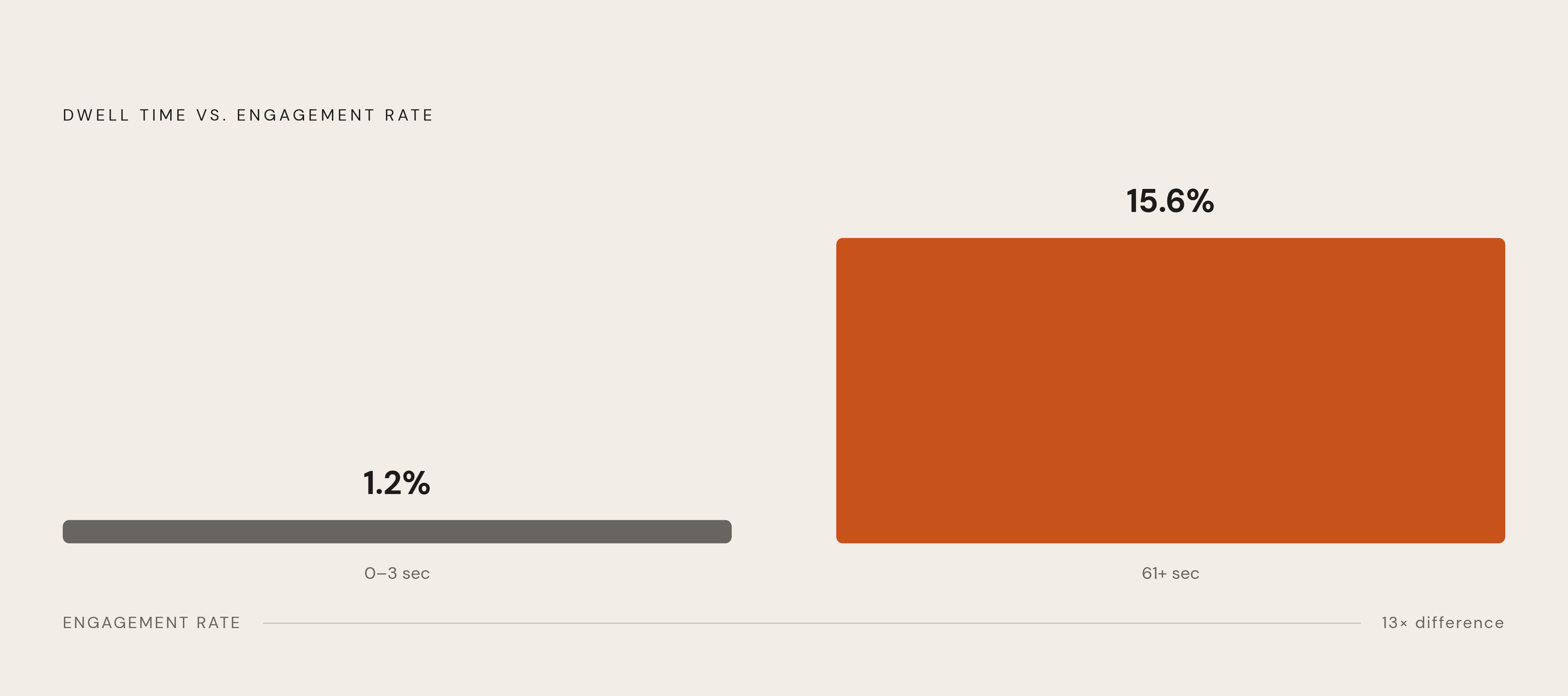
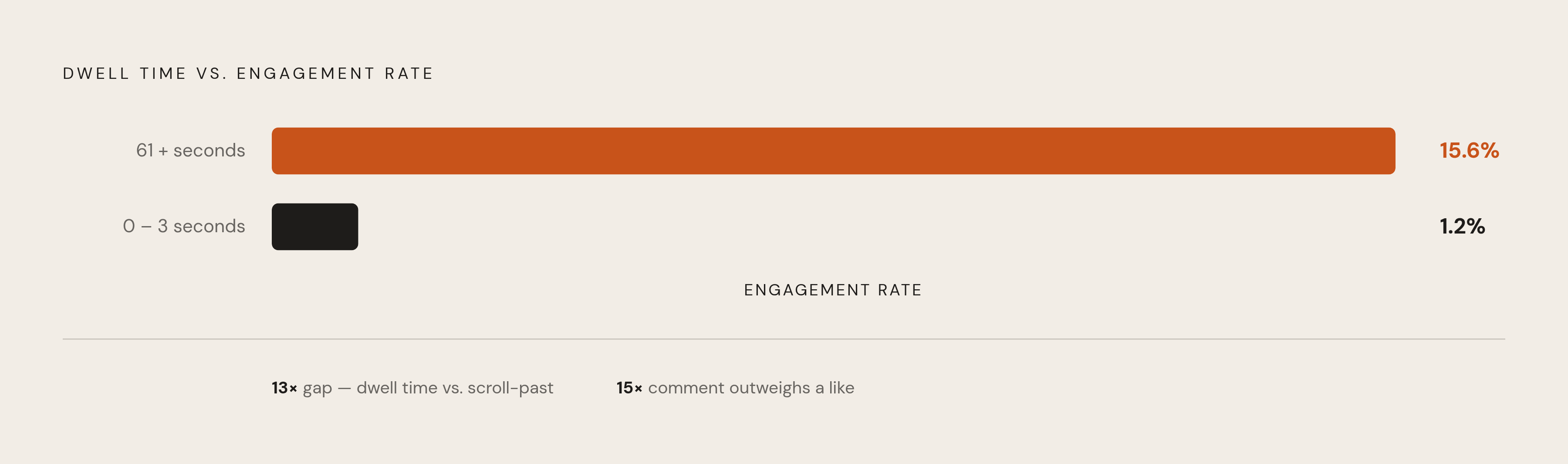
Posts with 61 or more seconds of dwell time achieve engagement rates around 15.6%. Posts with zero to three seconds average around 1.2%. That gap is the Depth Score expressing itself in real numbers, and it is not close.
Dwell time is invisible. There is no button for it. It accumulates quietly while a reader pauses, scrolls back up, re-reads a sentence, or sits with something before deciding how to react. It is LinkedIn's closest approximation of a signal that says: this person actually read this, not just saw it.
What creates it:
- An opening line that stops the scroll instead of blending into it
- A structure that rewards reading further. Numbered frameworks, lists that build on each other, a narrative that actually pays off
- Content that makes someone stop and think before they know how to react
Here is the part that trips people up. Optimizing for likes points effort in the wrong direction. A short, punchy, emotionally loaded post can collect likes while completely failing the dwell test. Likes carry minimal algorithmic weight compared to comments and dwell time. Industry estimates put the comment-to-like multiplier at around 15x. The exact figure gets debated. The direction does not. A post built for fast reactions will feel like it is working while the algorithm has already moved on.
What comment quality actually signals to the algorithm — and what it doesn't
Comments are LinkedIn's strongest active engagement signal. But the platform stopped just counting them a while ago.
Multi-reply threads carry significantly more weight than a pile of single-line reactions. The algorithm is trying to detect real conversation. Three or four people extending an argument, pushing back, or asking a genuine follow-up is a fundamentally different signal than twenty people typing "Great insight!" in sequence, even if the comment count looks similar.
What the algorithm reads as substantive: a response that adds perspective, asks a real question, or extends the argument. Something with actual semantic content that fits the post's topic.
What it reads as noise: generic affirmations, emoji-only responses, one-liners that could appear under literally any post ever published. These register as weak or neutral. They do not move distribution.
The practical reality here is that a broadly relatable post invites broadly generic responses. A post with a counterintuitive claim, a specific named decision, or a real result gives people something to actually react to. That is the comment section that moves distribution. Inspiration bait collects applause. Specific, opinionated content collects conversation.
Your own behavior in the comments matters too. Replying extends thread depth. Replies also trigger notifications that pull people back into the thread, which compounds the signal. Posting and disappearing is leaving reach on the table. It is also just a weird thing to do when someone took time to respond to you.
The first-30-minute window and how to use it deliberately
The algorithm shows a new post to roughly 2 to 5% of your network in the first hour. But in mid-2025, the critical evaluation window tightened from 60 minutes down to 30. Most people registered that change about as much as they register a terms-of-service update.
Posts with strong first-30-minute engagement reached four to seven times the audience of posts with equivalent total engagement spread over six hours. Same amount of signal. Different concentration. Dramatically different result.
This is a seed audience problem, not a content problem. The post itself is fixed at publication. What varies is whether the right people see it fast enough to trigger Phase 2. If your most engaged connections are offline when you publish, the window closes before the signal can build. Solid content, wrong moment, poor distribution.
What actually helps:
- Post when your most engaged connections are online. Monday through Thursday, 8 to 10 AM in your target audience's timezone is consistently the highest-density window.
- Let a small number of genuine colleagues know something worth reading is up. Not a pod. Just people who would engage because they actually find it relevant.
- Reply to early comments immediately. Build thread depth inside the window while it is still open.
One more thing the window explains: posting multiple times within 24 hours suppresses the second post's reach. The algorithm has not finished evaluating the first post's engagement arc, and now there is a second post competing for the same seed audience. More content posted faster is often exactly the wrong move. That is counterintuitive. It is also just how it works.
How topic consistency and profile alignment determine whether the algorithm knows where to send your content
Before the LLM-based matching system can route your content anywhere, it has to categorize you as a creator. If you post on everything, it cannot. And content that cannot be categorized does not get routed anywhere useful.
This is not a soft brand recommendation. It is a distribution mechanic. Posting consistently on a defined topic set gives LinkedIn a stable signal for audience matching. It knows who to show your content to. Posting across leadership lessons, product launches, personal milestones, market commentary, and whatever felt interesting that week makes you algorithmically shapeless. Individual posts can be well-written. If the algorithm cannot file you anywhere, they will still underperform.
Profile alignment is a separate lever that most founders ignore entirely. Your headline, About section, and experience entries feed the algorithm's author credibility assessment in Phase 1. A founder posting B2B growth content with a profile that still reflects a career in an unrelated field creates a mismatch. The content is genuinely good. The author signal is confused. The algorithm has trouble deciding where to send it.
When profile and content point in the same direction, LinkedIn has what it needs to place you. The personal brand infrastructure is not cosmetic. It is infrastructure for distribution.
A useful audit: look at your last 10 posts. Do they point toward a coherent topic area? If not, the algorithm is routing each one inconsistently, regardless of how good any individual post is.
The suppression signals most founders are triggering without realizing it
Nobody talks about this section because the penalties are silent. The platform does not send a warning. It just quietly stops distributing your content.
External links in the post body. The reach penalty for including off-platform links is real. Estimates range from 30% to 60% suppression. Both figures point to the same behavior: LinkedIn deprioritizes content that routes users away. The fix is boring and it works. Put the link in the first comment.
Engagement pods. LinkedIn overhauled pod detection in 2025. The system now tracks comment velocity, account relationship history, and the semantic content of comments simultaneously. The pattern it flags: multiple accounts commenting within seconds of publication using generic phrases. The response is not a suspension. The platform simply stops distributing the content. Users in pods often do not realize they have been penalized because no one tells them. The posts just quietly stop going anywhere.
Low-effort AI content. The algorithm now detects generic language, template-like structure, and absence of specific detail. Posts flagged as low-effort AI receive reduced reach. Personal specifics, named situations, and opinions grounded in actual experience register as human signals and are actively rewarded.
Negative passive signals. Users scrolling past your posts, hiding them, or ignoring similar content repeatedly all accumulate as suppression signals. A post that gets ignored does damage beyond itself. It makes the next post start from a worse position.
Hashtag overuse. More than five hashtags now triggers a penalty. This is the opposite of what worked in earlier LinkedIn eras, and a lot of people have not updated their approach.
Engagement bait. Direct asks for likes, shares, or follows are detected and penalized. "Comment YES if you agree" reads as compliance-farming. The algorithm wants real conversations, not collected responses.
A below-1% engagement rate is worth knowing as a diagnostic threshold. It does not just mean underperformance. It signals active algorithmic suppression or a meaningful content-audience mismatch. Something is specifically wrong when you see it consistently.
Which content formats get more reach in 2026 and why the gap exists
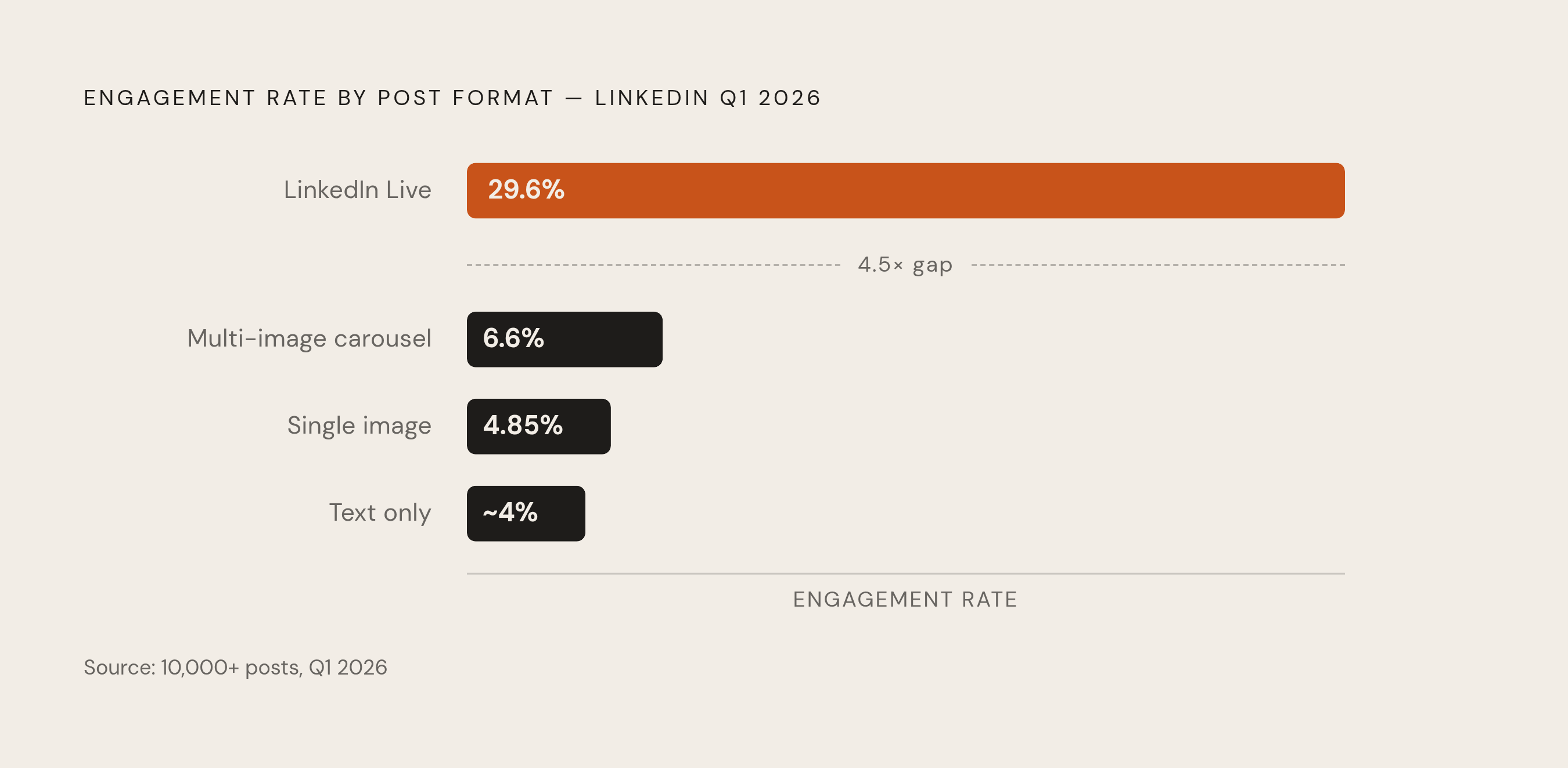
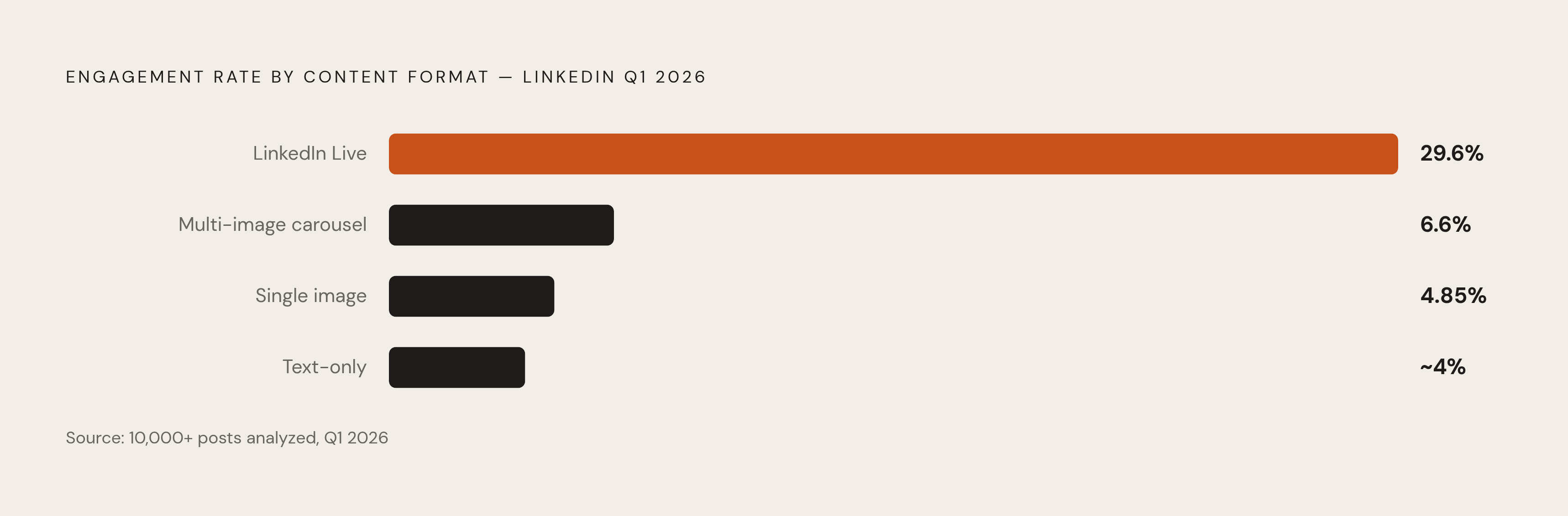
Format analysis from 10,000-plus posts in Q1 2026 shows a clear hierarchy, and the gaps are bigger than most people expect:
- LinkedIn Live: 29.6% engagement. Real-time interaction generates the densest comment signal the platform can measure. Nothing else is close.
- Multi-image carousels: 6.6%. High dwell time is built into the format. Each slide a reader advances extends time-on-post, and the algorithm notices.
- Single images: 4.85%.
- Text-only posts: around 4%. Lower raw engagement numbers, but text generates more substantive comments within existing networks, which matters more than the top-line rate suggests.
Video drives five times higher interaction rates for awareness-stage distribution. LinkedIn also reported its third straight quarter of double-digit growth in video uploads in Q1 2026. The format is performing well and getting more competitive at the same time.
Educational content, the kind that delivers real expertise and actionable knowledge, gets three to five times more reach than personal updates or promotional posts. The algorithm's preference for expertise-driven content is format-agnostic. But format amplifies it.
One underused behavior worth knowing: LinkedIn now surfaces older posts, sometimes several weeks old, when they are more relevant to a user's professional interests than newer content. High-quality evergreen posts have genuine long-tail distribution value. Thinking only in terms of individual posts misses this completely.
Format choice should follow the signal goal. If dwell time is the bottleneck, carousels and structured long-form text serve it. If comment depth is the bottleneck, a text post with a specific, arguable claim will often outperform a visually polished format that generates passive scrolling instead of actual responses.
Why reach is ultimately a distribution problem, not a content volume problem
The most common response to declining reach is posting more. It is almost always the wrong call.
Posting multiple times within 24 hours suppresses the second post before the first one has even finished its evaluation cycle. More content posted faster competes with itself. Three to four posts per week is the cadence that works for founders and executives. Concentrated enough to build topic consistency. Spaced enough to let each post complete its arc.
Follower count's weight as a ranking signal dropped meaningfully in late 2025. Smaller accounts with high engagement started outreaching larger accounts with passive audiences. A founder with a few thousand genuinely engaged followers in the right cohort can outperform someone with 30,000 followers posting inconsistently to an algorithmically scattered audience. Size stopped being a shield.
The 2% engagement rate is the floor worth targeting for organic posts. Below 1%, the algorithm reads the content as mismatched to its audience and contracts distribution further. Each weak post makes the next one a little harder. It compounds in the wrong direction.
What all of this adds up to is a system that rewards consistency, specificity, and timing over sheer output. A founder who writes on a defined topic, has a profile that reflects that topic, posts at the right time, generates dwell time and real comment threads, and avoids the suppression traps is running a distribution strategy, not just doing content. The candidates, investors, and customers you need to reach are forming credibility judgments based on what they see from you on LinkedIn before any conversation starts. That makes reach something worth getting right, not just something worth doing more of.