LinkedIn Content Pillars for Thought Leadership Accounts
Strategic pillars build lasting audience trust, not just content calendars.

Ask a founder about their content pillars and you'll get something like: "industry trends, company news, and personal stories." Organized. Tidy. And almost completely useless as a growth strategy.
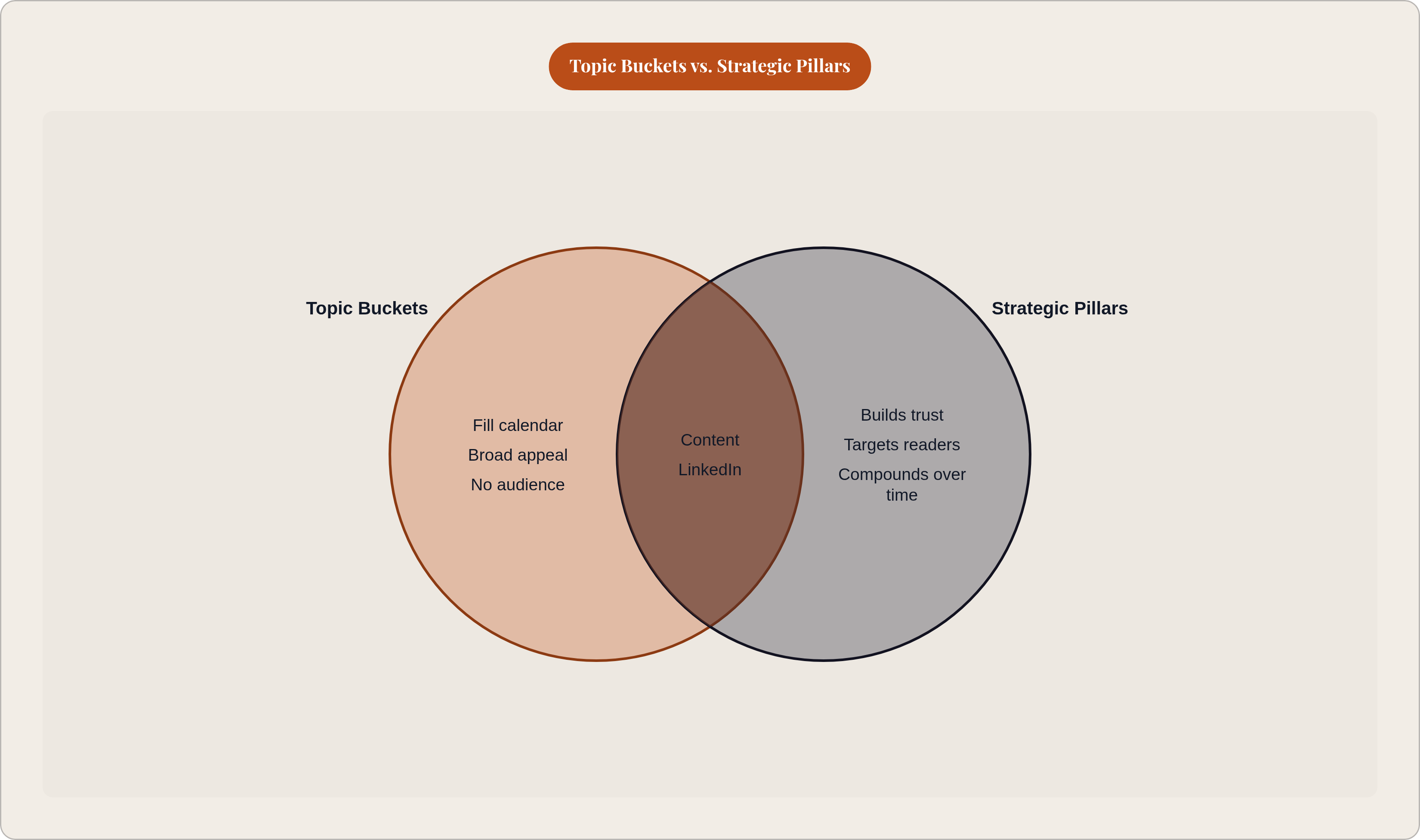
Topic buckets describe what you write about. They don't tell you who you're writing for or what you need that person to believe by the time they're done reading. A topic bucket fills a calendar. A strategic pillar builds a specific relationship with a specific type of person over time. That's not a semantic difference. It's the whole game.
Here's the real distinction:
- Topics describe content
- Pillars describe audiences and the trust you're building with them
LinkedIn's B2B Institute research puts numbers to this. At any given moment, 95% of your potential buyers aren't actively shopping. They're not comparing vendors. They're just living their professional lives. Topic-bucket content wastes those readers because nothing in it is designed to build anything that lasts. Strategic pillars serve the 95% by compounding trust over time. So when a reader finally enters buying mode, you're already the name they remember.
There's a profile-level version of this too. A founder with clearly defined pillars signals operational clarity. Profiles that read like résumés (list of titles, bullet points about past roles, zero indication of where this person is headed) tell the reader nothing worth caring about. Vision documents attract followers. Résumés attract recruiters.
How to Identify Which Outcomes Your Pillars Need to Serve Before You Choose Any Content Topic
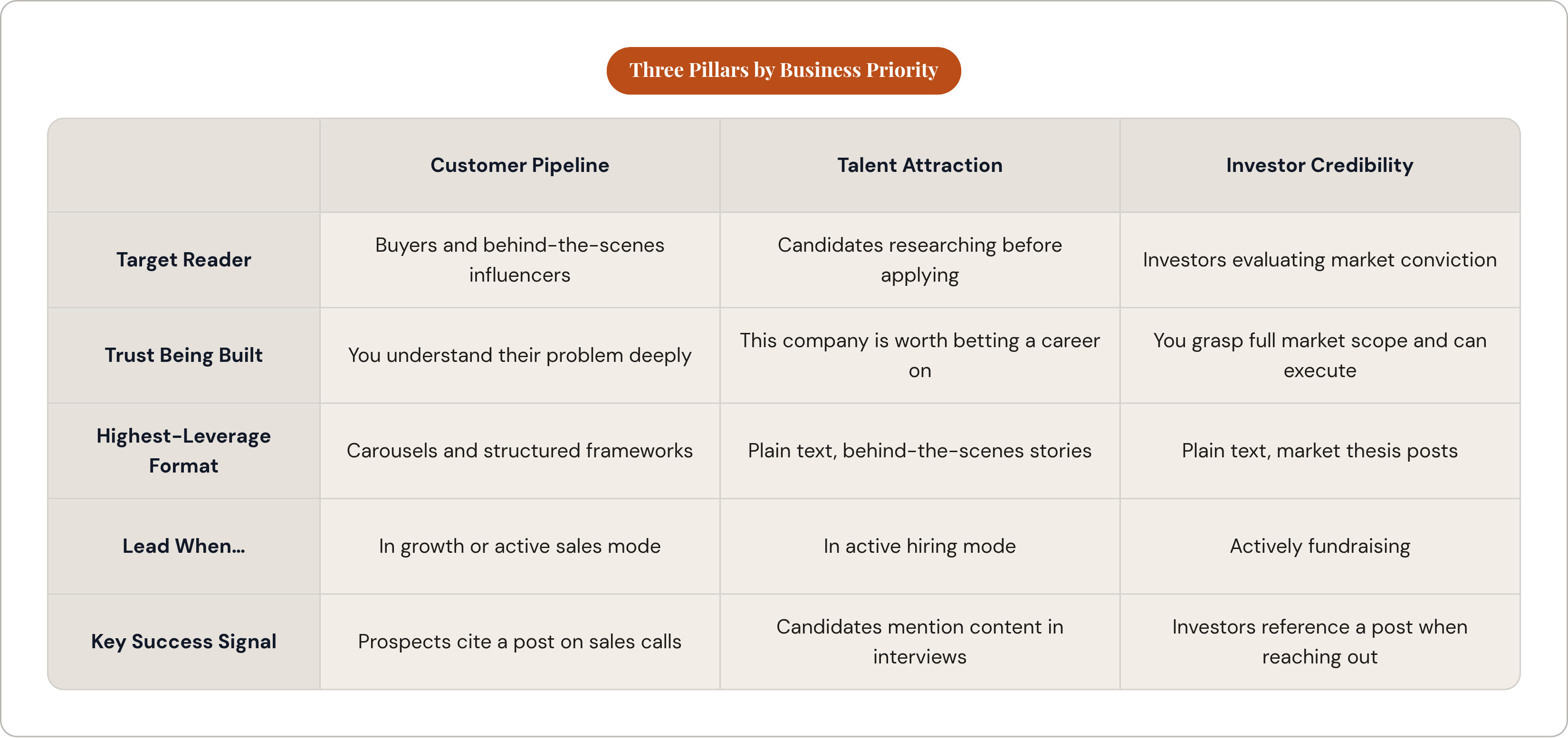
Before you pick a single topic, you need to know what the account is actually supposed to do for the business. There are three primary outcomes a founder's LinkedIn presence can drive:
- Customer pipeline. Getting buyers to trust you before they're ready to buy.
- Talent attraction. Getting candidates to believe in the company before they apply.
- Investor credibility. Getting investors to see you as a category-level thinker before you ask for money.
Each one requires a different reader to trust you in a different way.
Customers need to believe you understand their problem and have a credible path to solving it. Candidates need to believe in your vision and your leadership style, and they need to answer a question no job description ever answers: is this company worth betting my career on? Investors need evidence that you understand the full scope of the market, have real conviction about where it's going, and can actually execute. Three different readers. Three completely different things they're evaluating.
Content that tries to speak to all three at once usually speaks clearly to none of them. Every founder I've seen try to "keep it broad" ends up with an account that means nothing to anyone specific. The feed just sort of exists.
Start with a simple map. Take your current business priorities and match each one to the audience most likely to accelerate it. Closing a round? What does an investor need to read from you right now? Opening three roles? What is a strong candidate trying to figure out before they apply? Entering a new market? Which buyers need to know you exist before your sales team ever calls them?
Only after that mapping does pillar selection become a real strategic choice. Before it, you're writing about whatever felt interesting that morning.
The Customer Pipeline Pillar — Building Credibility With Buyers Before They're Ready to Buy
The target reader for this pillar isn't always the person on your sales call. More often it's the people behind that person. Finance leads, legal, compliance, procurement, operations stakeholders who influence the decision but never appear as your primary contact. They're doing their own research, quietly, before they ever show up in a conversation. They've usually already formed an opinion by the time you meet them.
Edelman and LinkedIn's 2025 research found that 71% of these behind-the-scenes buyers say thought leadership is more effective than traditional marketing at demonstrating a vendor's potential value. Sixty-four percent trust it more than product sheets when assessing capabilities. And 86% favor perspectives that challenge their existing assumptions. These readers don't want to be sold to. They want to be made smarter.
Which means the customer pipeline pillar should never read like a sales pitch. It earns its place by demonstrating genuine understanding of the reader's world. The formats that actually do this:
- Reframing a widely held industry assumption you believe is wrong. This is the highest-leverage move available to a founder. It signals you're thinking a level above the obvious, and it's the kind of thing people forward to colleagues.
- Sharing a framework or process that makes the reader's job easier, with no product mention required. Give value first. Every time. The reciprocity compounds.
- Analyzing a market shift and drawing an implication that isn't obvious yet. If everyone already knows it, it's recap rather than insight.
The payoff is real. Edelman's research found that 54% of decision-makers say thought leadership prompted them to research products or services they weren't previously considering. Eighty-six percent say they would invite organizations producing strong thought leadership to participate in an RFP. You're not just building awareness. You're getting on shortlists before a formal process even begins.
Roughly 80% of content on an executive account should focus on education, insight, and perspective. No more than 20% should reference the company directly. The moment this pillar starts feeling like a marketing channel, it loses the thing that makes it work.
The Talent Attraction Pillar — What Candidates Read Before They Decide Whether to Apply
Strong candidates don't apply cold. They research. They look at the founder's profile, scroll through recent posts, and try to answer a question no job description can answer: what would it actually be like to work here?
Research consistently shows that employees are significantly more likely to trust their company when senior executives are active on social media. That trust signal starts before someone is even an employee. It starts when they're still deciding whether to click apply.
This pillar looks different from the customer pillar in one important way. The customer pillar demonstrates expertise in the reader's world. The talent pillar invites the reader into your world. Both require authenticity, but the lens shifts completely.
Content that works here:
- How you actually think about building a team. What you look for. What a past hiring mistake taught you. This is one of the most underrated posts a founder can write. It tells candidates exactly how they'll be evaluated, and the ones who read it and still apply are often the ones you actually want.
- Behind-the-scenes of a real decision. Not just the outcome. The reasoning. What you weighed. What you almost did differently. Transparency like this signals leadership quality without ever having to claim it.
- Your culture or operating principles, told as a story. Not a values list. Not "we move fast and care about people." A specific story that shows what happens to your culture when it gets tested.
- Building in public. A product milestone. A hard quarter. A course correction you had to make. Real progress, including the uncomfortable parts, tells candidates you're honest and the company is real.
Founders who skip this pillar usually tell themselves they'll focus on it when they have open roles. That's backwards. This pillar builds an audience of interested potential candidates before you have a role to fill. When you do post a job, the people who see it already know who you are. That changes both the quality of applicants and how fast they move. It's a recruiting channel with no per-click cost. It's also the one most founders leave sitting on the table.
The Investor Credibility Pillar — What Category-Level Thinking Looks Like in a Post
Investors read a founder's LinkedIn with a different question in mind. They're not asking "can this person help me?" or "would I want to work here?" They're asking something harder: does this founder actually understand the full scope of the market they're building in, and do they have the clarity to go after it?
Most founders answer that question by accident, if at all.
Content that builds investor credibility has a specific character. It's the most concentrated of the three pillars. Not polished for its own sake. Just clear. The formats that work:
- Market thesis posts. Why you believe a specific shift is happening, and what it means for the industry over the next three to five years. Not a trend recap. Your actual conviction about where things are going, stated plainly.
- The problem at category level. Not "our product solves X." The problem the entire category exists to address, framed in a way that helps investors understand the size and shape of the opportunity.
- Honest assessments of what isn't working in the space. Investors have seen too many decks with hockey-stick projections. A founder who can clearly name what's broken, and why existing solutions miss the mark, reads as someone who actually understands the market. Intellectual honesty builds more investor trust than optimism does. Every time.
There are documented cases where consistent LinkedIn presence shifted fundraising conversations from "convince me this works" to "how can I get involved," compressing timelines that would normally take six months or more. CEOs have also used content and profile presence alone to initiate conversations with major foundations and large organizations that would otherwise require extensive warm introduction chains.
The timing implication is the one founders get wrong most often. Building real investor credibility through content takes 12 to 24 months to create meaningful impact. Founders who start this pillar only when they're actively raising have already missed the window. Build it before you need it, when you have no agenda other than thinking clearly in public.
How to Weight and Sequence the Three Pillars Given Where You Are in the Business
Running all three pillars at equal weight is a mistake. Spreading evenly usually means none of them reach critical mass. Where you are in the business should dictate where the emphasis goes.
If you're actively fundraising: Lead with the investor pillar. Keep the customer pillar steady as social proof that the market is real. Let the talent pillar be present but light. Investors are evaluating market conviction. That needs to be the loudest signal in your feed right now.
If you're in active hiring mode: Lead with the talent pillar. Keep the customer pillar present, because candidates evaluate company traction before they apply. The investor pillar can anchor category leadership in the background.
If you're in growth or sales mode: Lead with the customer pillar. Keep the talent pillar steady, because you'll always need people. Use the investor pillar to build long-term credibility with a future fundraising horizon in mind.
A useful content mix across all three pillars: roughly 60% educational content, 30% thought leadership perspective, and 10% engagement-oriented formats like polls. Apply that ratio within each pillar, not just across the account as a whole.
On sequencing: avoid rotating pillars randomly across the week. Cluster content by pillar so the algorithm learns which audience to serve each type to. Mixing investor-level market analysis with behind-the-scenes hiring stories in alternating posts confuses the signal. The algorithm is constantly learning from engagement patterns. Give it something coherent to learn from.
On cadence: sustainable posting frequency for most founders sits somewhere between two and five times per week. Daily posting often degrades quality and triggers reach cannibalization, where newer posts suppress the reach of posts from the day before. A three-pillar account posting three times per week can give each pillar regular rotation without any single pillar going dark for more than a week.
Format Choices That Reinforce Pillar Strategy (and the One That Most Founders Overlook for CEO Accounts)
Format is not decoration. It's part of the signal.
The benchmark data on carousels is clear. Native document format (PDF carousels, typically eight to twelve slides) leads LinkedIn in average engagement rate. They hold dwell time. They work for structured frameworks and methodologies. That makes them a natural fit for the customer pipeline pillar, where you're walking someone through a process or a structured analysis.
Here's the thing that surprises most founders. Text-only posts under 1,300 characters consistently outperform carousels for CEO profiles specifically. One documented experiment found text posts averaged 47 comments compared to 12 for carousels on the same founder account. Comments carry more algorithmic weight than likes or impressions in the current environment. And opinionated text posts from founders with a clear point of view drive more conversation than polished carousels, because they invite a response. A carousel presents. A well-written text post provokes.
For pillar strategy, the practical breakdown:
- Customer pipeline: carousels and document formats for frameworks, structured analysis, and process walkthroughs
- Investor and talent pillars: plain text, direct voice, no slide design required. Conviction and vision read as more authentic in plain language. A paragraph from a founder about why they believe a market is about to break open hits differently than the same idea formatted into bullet points on a gradient background.
Match the format to the pillar's goal. Depth and structure for customer education. Directness and voice for everything else.
The Execution System That Makes a Three-Pillar Cadence Sustainable Without Daily Effort
The most common breakdown in founder content strategy isn't wrong pillars. It's inconsistency caused by treating content creation as a reactive daily task. You open LinkedIn, stare at the compose box, write something vaguely relevant, post it, and then avoid posting again for two weeks because the whole thing felt like more effort than it was worth.
That's a production problem, and it's fixable.
Batching is the simplest fix. One 30-minute session at the start of the week produces three or four drafts. Publishing them across the week creates consistent presence without requiring daily creative output. The posts don't know when they were written. Your audience doesn't either.
Idea capture as infrastructure is what makes batching actually work. Founders who post consistently aren't generating ideas on demand. They're capturing raw material in real time. A note during a client call about a question they keep hearing. A reaction to something they read that morning. An observation from a team meeting that clarified something they'd been thinking about for weeks. The drafting happens separately, but the source material was captured the moment it was fresh.
The interview-based content process is worth knowing if a founder's schedule is genuinely compressed. A communications partner asks structured questions about company and industry trends in a 45-minute monthly session. The conversation gets recorded, transcribed, and used to build first drafts. The founder reviews and approves. Operational lift is shared. The voice and thinking remain entirely theirs.
On that note: voice fidelity matters more than most founders expect. Content that fails to match how the founder actually speaks gets filtered out by audiences faster than the numbers suggest it should. Readers notice when the register shifts. The cost isn't just reach loss. It's credibility loss. The most common failure in agency-managed accounts is a homogenized tone across multiple clients that strips out the specific industry nuance that makes thought leadership credible in the first place. It starts sounding like a content brand. That's not what people are following you for.
The last piece is a rolling 90-day content roadmap tied to actual business milestones. A product launch, a hiring push, an industry conference. When the content plan is anchored to real events in the business, the reactive posting trap mostly disappears. You're not asking "what should I write about today?" You're asking "what's coming in the next 90 days, and how does my content build toward it?"
What a Pillar-Structured Account Looks Like After 90 Days (the Signals That Tell You It's Working)
Most founders check impressions and follower count. These are the wrong metrics. They measure reach. Reach without the right audience is just noise at scale.
The signals that actually tell you the pillars are working don't live in a dashboard. They show up in your DMs, your sales calls, your interview notes, and your fundraising conversations. And when they show up, they're pretty hard to miss.
Customer pillar working:
- Inbound DMs or connection requests from decision-makers at target accounts
- Being cited in RFP invitations
- Sales prospects referencing a specific post during discovery calls. When a buyer walks into a call having already read your thinking, the conversation starts in a completely different place. That's the clearest signal there is.
Talent pillar working:
- Candidates mentioning your LinkedIn content during interviews
- Inbound applications from people who followed you before the role was ever posted
Investor pillar working:
- Warm introductions from investors who have been following the account
- Investors referencing a specific post as the reason they reached out
Come back to the 95% math. At any given moment, 95% of your potential buyers are not in-market. The same logic holds for candidates and investors. Most of them aren't ready to act yet. But they're reading. They're forming opinions. They're deciding whether to keep following you or quietly move on.
What you're actually building, post by post, is not an audience. It's a reputation. One that shows up before you do.