LinkedIn Posting Best Practices for Executives

LinkedIn's algorithm is not mysterious. It's just easier to understand once you stop trying to trick it.
By 2025, LinkedIn's AI model evaluates your entire profile before deciding how far a post travels. Not just the post itself. Your full presence, engagement history, and credibility signals all factor in. A thin profile with no engagement history caps your reach no matter how sharp the writing is.
The attention mechanics are pretty specific. Posts held for around four or five seconds get basic distribution. Posts where someone actually lingers, seven seconds or more, get pushed to a broader audience. Which means your first two lines aren't a stylistic choice. They're a distribution lever. If the opening doesn't earn a pause, the post doesn't travel.
Engagement weighting follows the same logic. A thoughtful comment carries roughly three times the algorithmic weight of a like. A share carries five times. Ten substantive comments will outperform a hundred likes on actual reach. So the goal isn't passive approval. It's sparking a conversation worth having. Opinions, questions, something slightly uncomfortable. Those compound harder than announcements do.
What I find genuinely interesting about all of this is that the algorithm's logic mirrors basic communication logic. Earn attention. Reward real engagement. Spread ideas that provoke thought. LinkedIn didn't build a system to game. They accidentally built a machine that rewards people who have something to say — like a stage that only lights up when the speaker is actually worth hearing. The executives who understand that stop fighting the platform and start using it.
The content mix that high-performing executive accounts actually follow
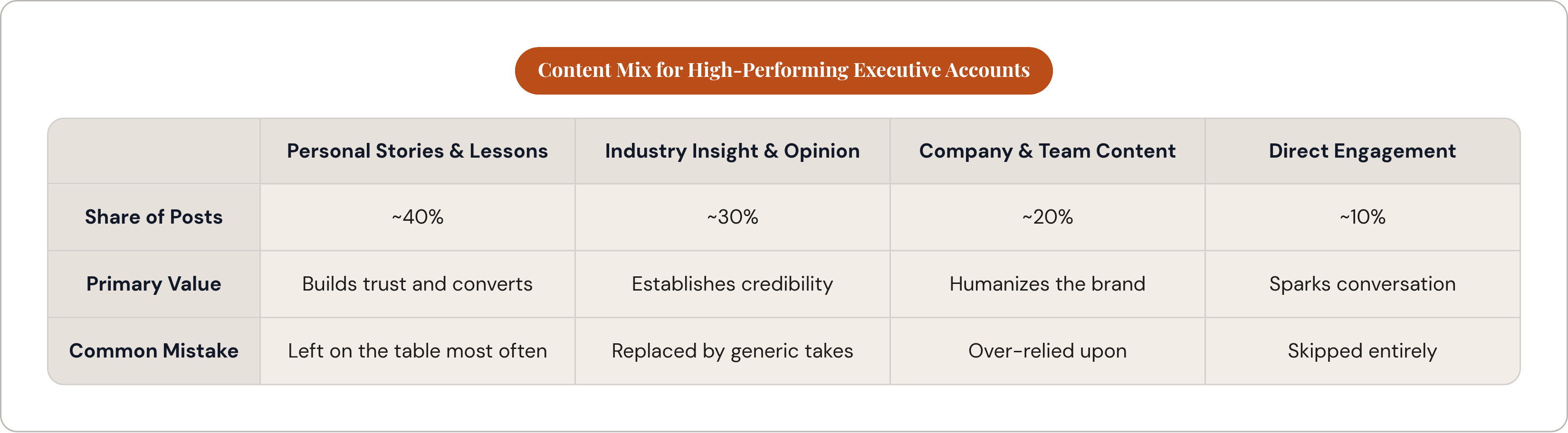
Analysis of high-engagement CEO accounts on LinkedIn surfaces a pretty consistent pattern. Something close to 40% personal stories and lessons. Around 30% industry insight and opinion. About 20% company and team content. And roughly 10% direct engagement, responding, asking questions, actually starting conversations.
That 40% personal share is where most executives leave the most value sitting on the table. It's also the content that builds trust, and trust is what actually converts. Investors, candidates, buyers. None of them move because they saw a company announcement. They move because they feel like they understand how someone thinks. There's a meaningful difference between knowing someone's title and knowing how they operate when things go sideways.
A good rule of thumb is roughly 80% of posts educating, informing, or offering perspective. No more than 20% referencing the company directly. Content that teaches earns attention. Content that only promotes spends it — and a feed full of self-promotion is like a store that only ever runs ads for itself: after a while, nobody walks in.
Most executives who post too rarely, or with too little variety, make the same mistake. They post only announcements, only wins, only polished milestones. That reads like a press room. Press rooms have their place. It's just not on a personal executive profile.
Format and frequency choices that consistently earn attention from the right audience
Text-only posts, kept reasonably short, consistently perform well for executive accounts. They read as a real person thinking out loud rather than a marketing asset that escaped the brand guidelines document.
Native LinkedIn video sees strong engagement, but the format that actually works isn't a polished corporate production. A CEO talking into their phone about a lesson from a client meeting will outperform a professionally edited brand video most of the time. When something looks expensive, people unconsciously wonder who approved it. When it looks like someone just talking, they listen. The format signals the authenticity of what's inside it.
Frequency matters for a practical reason. Posting consistently, three to five times a week, builds the momentum that algorithmic recognition and network effects then amplify. Christina Ross at Cube reached around 3 million views in four months on that cadence. A post published today can generate inbound interest 18 months from now. The founders who win this build the system before they need the results, not after.
Connection-building is also part of the distribution system and it's chronically underrated. Personalized connection requests, short ones under 100 characters, see meaningfully higher acceptance rates than blank requests. The comment-first strategy, leaving a couple of substantive comments on someone's posts before sending a request, drives recognition and lifts acceptance further. Small behavior. Disproportionate effect.
Why authentic voice is now a structural competitive advantage, not just a preference
By 2026, estimates suggest that more than half of long-form LinkedIn posts are AI-generated, and AI-written comments have surged. The feed is saturated with templated, indistinguishable content. Posts that sound like a committee used a prompt about "thought leadership" and called it a day.
That saturation is actually good news for executives willing to do it differently. The bar for genuinely useful content has dropped because most content is mediocre. An executive who posts with specific data, real experience, and a clear point of view has something most content factories cannot replicate. This is structural, not stylistic.
B2B buyers trust executive thought leadership significantly more than traditional marketing. The voice that earns that trust is personal, specific, and consistent. Not polished and generic.
Authentic voice isn't unpolished or unedited. It's specific. Grounded in real experience. Written in a register that sounds like the actual person. You know within two sentences whether a real person wrote something or whether a brand guidelines document got loose and wrote a post.
One useful exercise is contrarian positioning. "Most people in [industry] believe [conventional wisdom], but I've found [specific experience shows otherwise]." That structure forces genuine perspective. It requires drawing on what the executive actually knows, rather than restating what everyone already agrees on. Which is the whole point.
How story structure turns an executive's experience into content that gets remembered
Facts inform. Stories stick. Research in cognitive psychology shows stories are dramatically more memorable than plain facts. The implication for executives is direct: a well-told lesson from a bad client call is more valuable than a polished summary of an industry report nobody asked for.
Two story structures work consistently.
Problem → decision → result. What went wrong, what they chose to do, what it cost or earned. This strips away the hero narrative and focuses on judgment. Readers don't need the executive to have won every time. They need to see how that person thinks when things get hard.
Conventional wisdom → personal experience → reframe. What the industry assumes, what the executive has actually seen, and why the gap matters to the reader. This is the contrarian format in narrative form. It works because it gives people something to disagree with or share.
Failure and comeback narratives consistently outperform win announcements. Lows make highs meaningful. Sharing obstacles builds credibility with anyone facing similar challenges, which, realistically, is most of the people reading.
The About section is a chronically underused origin story. Most executives write a job description. What the section should do is tell the moment-of-decision story: why they built this, what problem they couldn't ignore, what they're working toward. That's the story stakeholders actually want. Nobody scrolls an About section hoping to read a resume.
The best practical sourcing insight is this: the best content doesn't come from a content calendar. It comes from extracting what the executive told a client, investor, or team member last week that made them lean forward. Those conversations are already happening. The posts are already there. They just haven't been written down yet.
The concrete business returns executives see when they operate this system consistently
CEO content on LinkedIn generates meaningfully more engagement and higher lead conversion rates than company pages. That gap is the whole argument. The executive's personal presence does work the brand page simply cannot.
The revenue case has been documented. Guillaume Moubeche combined outbound with LinkedIn content and took two years to reach $1 million ARR, then accelerated to $28 million ARR by year six. That's a compounding curve, not a straight line. Chris Walker's Refine Labs attributed tens of millions in pipeline and closed revenue directly to founder-led LinkedIn content. Those aren't vague claims about brand awareness. Those are specific figures tied to a specific channel.
Fundraising works differently when the executive has already built public credibility. A fintech founder who posted consistently shifted their Series A conversations from "convince me" to "how do I invest," shortening the raise considerably. Investors who have followed a founder's public journey have already seen them operate under pressure, make decisions, and communicate clearly. The pitch meeting becomes confirmation, not discovery.
Talent is the quieter return. A strong majority of job candidates prefer companies with visible leadership teams that regularly share expertise. For executives actively hiring, the LinkedIn presence runs as a recruiting asset in the background at all times, without additional effort.
All three of these, pipeline, fundraising, and hiring, depend on the same thing: timing. The executive who built the system before they needed the results had the asset ready when the moment came. That's the whole compounding argument in one sentence.
What separates executives who sustain this system from those who abandon it after two months
Most executives who start posting on LinkedIn quit within two months. The ones who sustain it aren't more talented or more disciplined. They just think about it differently.
The compounding logic only works if the system keeps running. Six months is roughly the minimum before network effects and algorithmic recognition produce predictable returns. Quitting at month two means walking away from infrastructure you already paid for in time and effort, right before it starts paying back. It's like planting a tree, watching it survive winter, and pulling it out in spring.
The real structural problem is execution. Most executives already know that consistent visibility matters. The bottleneck isn't intent. It's time and system.
The executives who sustain it share a few behaviors. They treat posting as communication strategy, not a marketing task. Each post is a deliberate signal to a specific audience. They extract content from conversations already happening, client meetings, board updates, hiring interviews, rather than staring at a blank page trying to invent something from scratch. And they recognize that knowing what to say is a different skill from writing it down well. So they build accordingly.
The ghostwriting question deserves a direct answer. The gap between what an executive knows and what the market sees is one of the most underused assets in a business. A content partner's job isn't to fabricate authority. It's to make existing authority visible. A meaningful and growing share of funded startup founders use some form of ghostwriting support. That's not a shortcut. It's a recognition that the execution barrier is real and the returns are worth removing it. The best leaders have always had communications partners. LinkedIn just made the need more obvious.
Executives who see this as a strategic communication system watch every post build into something the business can actually use. Executives who see it as a marketing experiment run the experiment for two months, don't see immediate results, and move on. Those two groups aren't separated by talent. They're separated by what they think they're building.