LinkedIn Profile Optimization for Inbound Lead Generation
Updated LinkedIn profiles with better keywords generate 3x more inbound leads.
LinkedIn has 1.2 billion members globally. Around 310 million show up every month. That is not a niche professional directory. That is the largest concentration of business decision-makers on the internet, and they are browsing actively. B2B decision-makers spend an average of 17 minutes a day on the platform. Reading, evaluating, forming opinions about people they have never met.
So what changed in the last two years? A few things, and they matter.
LinkedIn's algorithm got smarter. A recent update shifted how the platform weighs profiles in search results. Keyword density in your headline and About section now carries more weight than it used to. Profiles with no recent activity or incomplete sections get quietly deprioritized. If you last touched your profile in 2024 or earlier, you are already losing ground to people who noticed the shift and adjusted.
The old stuffing tricks stopped working, too. Cramming "B2B SaaS founder" into every sentence used to help. Now it actively hurts you. The algorithm reads for semantic context. It understands what you mean, not just which words you repeated.
One more thing worth sitting with: roughly 95% of business buyers are not actively looking for a service at any given moment. They are browsing. Forming impressions. Getting a feel for someone before they ever have a need. This comes from Edelman and LinkedIn's 2024 research, and it reframes what your profile is actually for. A profile that earns trust during that passive window is worth more than one optimized purely for the moment someone is ready to buy. You want to be findable, yes. But you also want to be the person someone already has a positive impression of when they finally do have the problem you solve.
That is a different job, and most founder profiles are not built for it.
What "optimized for inbound" actually means across the five profile sections that do the work
Optimized profiles are 40 times more likely to receive qualified leads and opportunities, per Cognism. But "optimized" is doing a lot of work in that sentence. Here is what it actually means, section by section.
Headline
Most founders default to "CEO at [Company]." That tells a stranger almost nothing. It fails to communicate who you help, what problem you solve, or why they should keep reading.
A headline that converts does three things: names the audience you serve, names the problem you solve, and names the outcome you produce. A simple format that works: "Helping [specific type of person or company] achieve [specific outcome] through [your method or approach]." The right person reads that and immediately recognizes themselves. The wrong person self-selects out. Both are useful outcomes.
Your headline also carries the most weight in LinkedIn's semantic search. It is the first line visible in search results and in connection requests. Think of it as the subject line of an email no one asked to receive — if it does not earn the click, nothing else gets read.
About section
This is not a biography. Think of it as a landing page. It should open with your prospect's problem, not your career history. Nobody who just clicked your profile cares that you were at McKinsey in 2014. They care whether you understand their situation.
A well-built About section covers four things, in order:
- Who you help
- What you help them do
- Proof that it works (specific, not vague)
- One clear call to action
Research from MPR found that clients who fixed weak keyword coverage in just the headline and About section reported roughly a threefold increase in inbound messages within 60 days. Two sections. Sixty days. A strong return on a few hours of work.
The About section is also where your voice either earns trust or loses it. Credentials tell someone what you have done. Voice tells them whether they want to work with you.
Experience section
Each role entry should demonstrate a pattern of capability, not document a job history. There is a real difference between "led growth initiatives" and "grew ARR from $2M to $8M in 18 months." One tells a story. One fills space.
Specific numbers and named outcomes signal confidence and accountability. They give the reader something concrete to evaluate. Vague descriptions ask the reader to trust you without giving them any reason to. That is a big ask from someone who has known you for about 45 seconds.
Featured section
This is the highest-leverage section most founders either leave blank or fill with a link to their company homepage. It should work like the call-to-action section at the bottom of a sales page. A useful structure:
- One piece of thought leadership that shows your point of view
- One case study or proof of results
- One direct link to a meeting booking page or lead magnet
A qualified prospect who has read through your profile and is genuinely interested will look here next. If they find nothing, that momentum dies. If they find a clear next step, they usually take it.
Services page
Most founders are unaware this exists. LinkedIn indexes Services Pages separately in search results, which means your profile can surface in searches it would otherwise never appear in. It also allows non-connections to send you a proposal request directly, which removes a meaningful friction point for cold inbound.
Setting up a Services Page takes less than an hour. Most founders have not done it. Go figure.
How thought leadership content turns a static profile into an active lead pipeline
A perfectly optimized profile that no one visits is still a dead end. Content is what surfaces you to people who did not know to search for you in the first place.
Edelman and LinkedIn's 2024 research found that 75% of executives explored a product or service they were not originally considering after engaging with thought leadership content. That is demand creation before the buyer has even defined their need. It is a different kind of leverage than SEO or paid ads, and most founders are leaving it entirely on the table.
The same research found that 73% of decision-makers prefer thought leadership over marketing collateral when assessing a company's capabilities. Your posts are doing qualification work a sales deck would otherwise have to do. At scale. Without you being in the room.
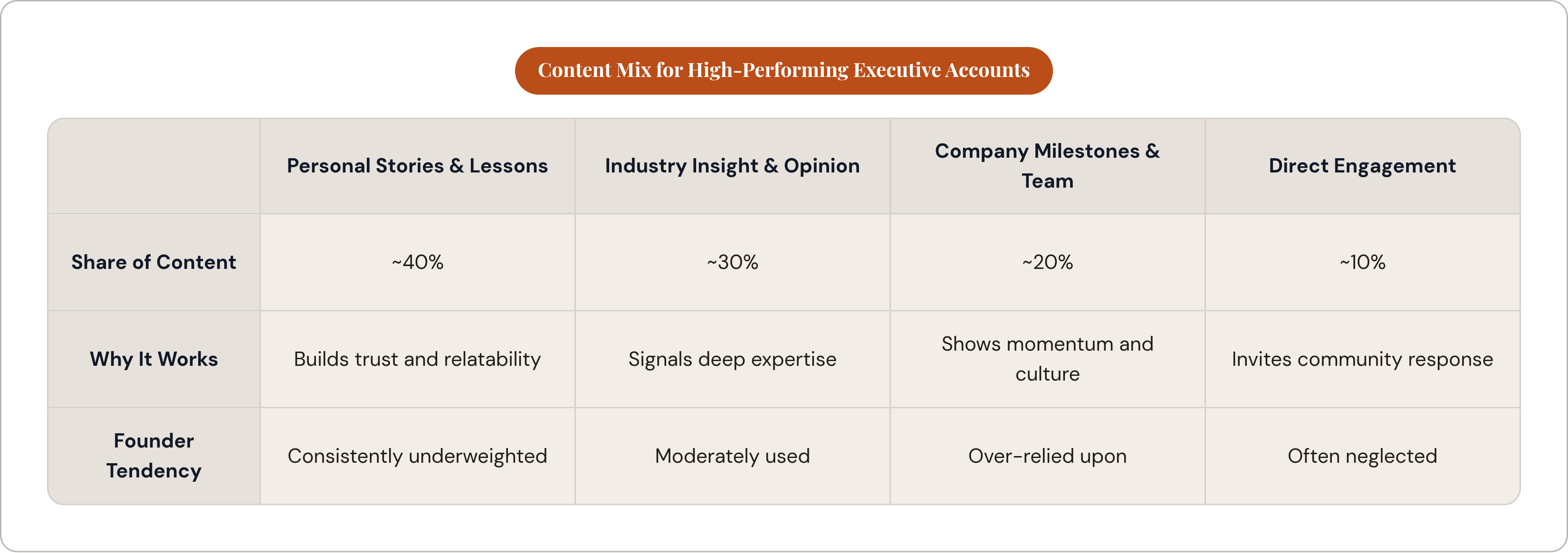
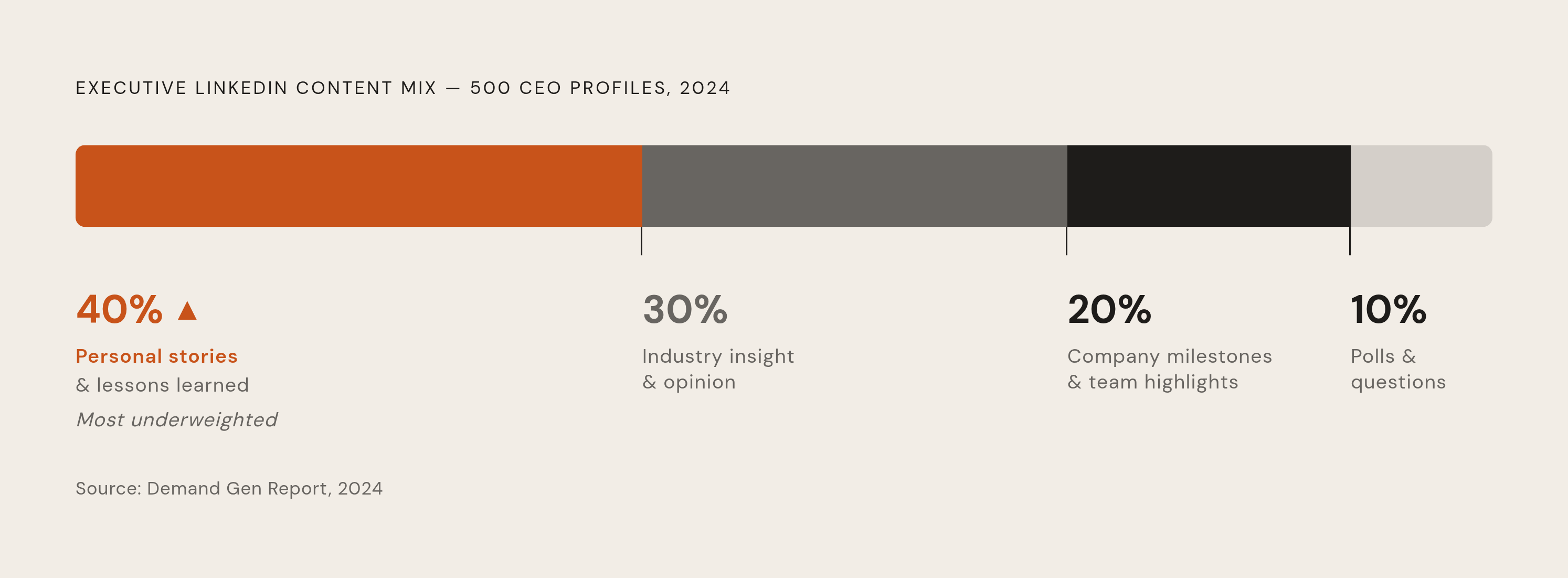
A 2024 analysis of 500 CEO profiles by Demand Gen Report found that the highest-performing executive accounts used a consistent content mix:
- About 40% personal stories and lessons learned
- About 30% industry insight and opinion
- About 20% company milestones and team highlights
- About 10% direct engagement like polls, questions, and commentary
That 40% personal-and-lessons category is consistently what founders underweight. It is also the hardest to produce under time pressure, because it requires you to actually stop and reflect. You cannot batch it. You cannot repurpose it. You have to actually sit with something and think about it. More on why that is a problem in a minute.
Format matters, too. Text-only posts under about 1,300 characters read like a real person thinking out loud. Buyers who are skeptical of polished corporate content are far more likely to engage with something that feels human. The format sends a signal before anyone reads a word.
And consistency compounds. LinkedIn's own data shows that executives who post regularly grow their engagement by nearly 40%. Content shared by individual executives generates eight times more engagement than the same content shared by a company page. The personal profile is the distribution engine. The company page is a distant second.
The pipeline this builds is often invisible until it suddenly is not. A lot of early customers come from people who quietly read a founder's posts for three to six months before reaching out. The relationship was built before they ever raised their hand.
The content types that convert browsers into inbound leads for founders specifically
Not all content builds pipeline equally. The posts that actually generate inbound for founders fall into a few specific patterns.
Contrarian industry takes. A post that pushes back on conventional wisdom positions you as someone with genuine conviction. The right buyer stops scrolling. It signals that you understand the problem at a level others do not. A simple frame: "What most [industry] companies get wrong about [core challenge]."
Behind-the-scenes company decisions. Hires, bets, mistakes, pivots, and the reasoning behind them. Buyers use this content to evaluate your judgment before agreeing to work with you. Investors use it to assess whether you are a serious, thoughtful operator. This category earns a disproportionate amount of trust precisely because it is rare. Most founders only share wins. Sharing the messy parts of the journey is uncomfortable, which is exactly why it works.
Customer outcome teardowns. Anonymized specifics. The problem, the approach, the result with numbers. This functions as a case study without the formality of a PDF. It reads like a story, not a sales document.
Milestone posts. Hiring, launching, raising, hitting a metric. These signal momentum to investors, customers, and talent simultaneously. The posts that perform best here are not polished announcements. They include the doubt alongside the win. Real journey content consistently outperforms the press-release version.
Two examples worth paying attention to: Jessica Schultz, founder and CEO of Amplify Group, has said she does no cold outbound and maintains a healthy pipeline driven primarily by referrals and inbound from LinkedIn thought leadership and her newsletter. Jay Singh, CEO of Casper Studios, drives roughly 90% of inbound leads organically through LinkedIn after committing to founder content.
The pattern in both cases is the same. Content earns trust over months. The profile converts when the buyer is ready. No trick involved. Just consistency, and the willingness to be specific about things most people leave vague.
What the profile and content strategy produces beyond direct leads
Weber Shandwick's 2024 research found that 44% of a company's market value is tied to CEO reputation. The LinkedIn profile is not just a sales tool. It is a valuation input. That reframe changes how you should think about the time it takes to build one.
Fundraising. VCs research founders on LinkedIn before the first conversation. A strong founder profile shortens the path to institutional interest because it establishes credibility before the pitch. OBA PR documented a fintech founder who built a visible personal brand through consistent content and media appearances. Series A conversations shifted from "convince me this works" to "tell me how I can invest." The fundraising timeline moved from six months to eight weeks.
Talent. Elite candidates evaluate whether a founder's vision aligns with their career goals before they apply. A strong profile communicates that vision before the first interview. The people you want to hire are vetting you the same way your customers are. A weak profile costs you candidates you never even knew you were competing for.
Media and credibility. Cision's 2023 State of the Media report found that 76% of journalists use LinkedIn to find sources and research stories. A visible founder profile converts into interview requests, podcast appearances, and speaking engagements. Earned media then feeds the inbound funnel, which builds more visibility. It compounds in a way that paid distribution simply does not.
Crisis resilience. Weber Shandwick's 2024 data also found that executives with established digital presences recovered from company crises 41% faster. The goodwill built by consistent content functions as a reserve before you ever need it. You cannot build that reserve in the middle of a difficult news cycle. You can only spend it.
The execution gap: why most founders have strong credentials and weak profiles
The framework is not complicated. Most founders who read this will immediately recognize that their profile is underperforming. The barrier is not informational. It is operational, and it is very real.
Running a company is full-time. Consistent content production on top of that requires extraction, reflection, and scheduling. None of those happen naturally at the end of a hard week. They get pushed to the bottom of the list because they feel less urgent than everything else demanding your attention. It is a bit like knowing you should go to the gym — the information is not the problem; the calendar is.
Adam Robinson's experience is a useful reference point. He built a following that generated 21 million LinkedIn views and grew his company to $4M ARR through aggressive content. He was also spending 65% of his time on that content work. That ratio is unsustainable for most founders. Trying to replicate it without a support structure is how founders burn out and go silent for two months, which is exactly the wrong move given how the algorithm treats inactive profiles.
The content mix data points to the same tension. The 40% personal-and-lessons category that drives the most engagement is also the hardest to produce under pressure. It requires actual reflection, not just repurposing. You cannot batch it with product updates. It asks something different from you, and that something is time you probably do not have lying around.
Edelman and LinkedIn's 2024 research found that despite clear ROI on thought leadership, most organizations still report it as under-resourced, misused, and unmeasured. The same gap exists at the individual founder level. The knowledge is available. The execution is where it breaks down, almost every single time.
The consequence of leaving this unsolved is not neutral. LinkedIn's algorithm penalizes inactive profiles over time. Inconsistency actively depresses search visibility rather than just stalling growth. So the question is not whether to build the profile as a funnel. The question is how to do it without it becoming a second full-time job.
How ghostwriting fits into a founder's LinkedIn strategy without compromising authenticity
The authenticity objection comes up every time. Founders worry that content written by someone else will sound unlike them. They worry audiences will notice. That trust will collapse.
Here is what actually happens in practice: the best ghostwriting is extraction, not fabrication. A skilled collaborator draws out your actual thinking, your real stories, your genuine convictions, and structures them for the format and the algorithm. The thinking is yours. The editing is collaborative. The voice stays intact, assuming the person you are working with is any good at their job. A good ghostwriter does not put words in your mouth. They take the words out of your head and get them onto the page — like a translator who already speaks your language.
This is not a new arrangement. Speeches from heads of state, op-eds from CEOs, books published under executive names. These have always been collaborative. Nobody questions whether a speech was authentic because a speechwriter helped shape it. LinkedIn content is no different in principle, even if it feels more personal in format.
What a modern LinkedIn ghostwriting engagement actually looks like in practice:
- Regular conversations to pull out genuine perspective and story
- Content that reflects the founder's actual voice, positions, and lived experience — not generic industry takes written to fill a calendar
- Full review and approval before anything posts
The market has moved in this direction. The LinkedIn ghostwriting space has grown substantially since 2024, driven by founders recognizing that organic LinkedIn content outperforms paid ads for B2B pipeline. A meaningful share of funded startup founders now use some form of ghostwriting or content partnership.
The profiles that actually perform — the ones generating inbound leads, investor interest, and the talent attraction described throughout this piece — are rarely built and maintained by a founder working alone. Having the framework in your head is one thing. Having a functioning content operation is another. Most founders have the former. The ones winning on LinkedIn figured out how to build the latter without it consuming them entirely.