LinkedIn Newsletter vs. Regular Posts for Founder Reach
Posts drive discovery; newsletters drive loyalty and revenue.
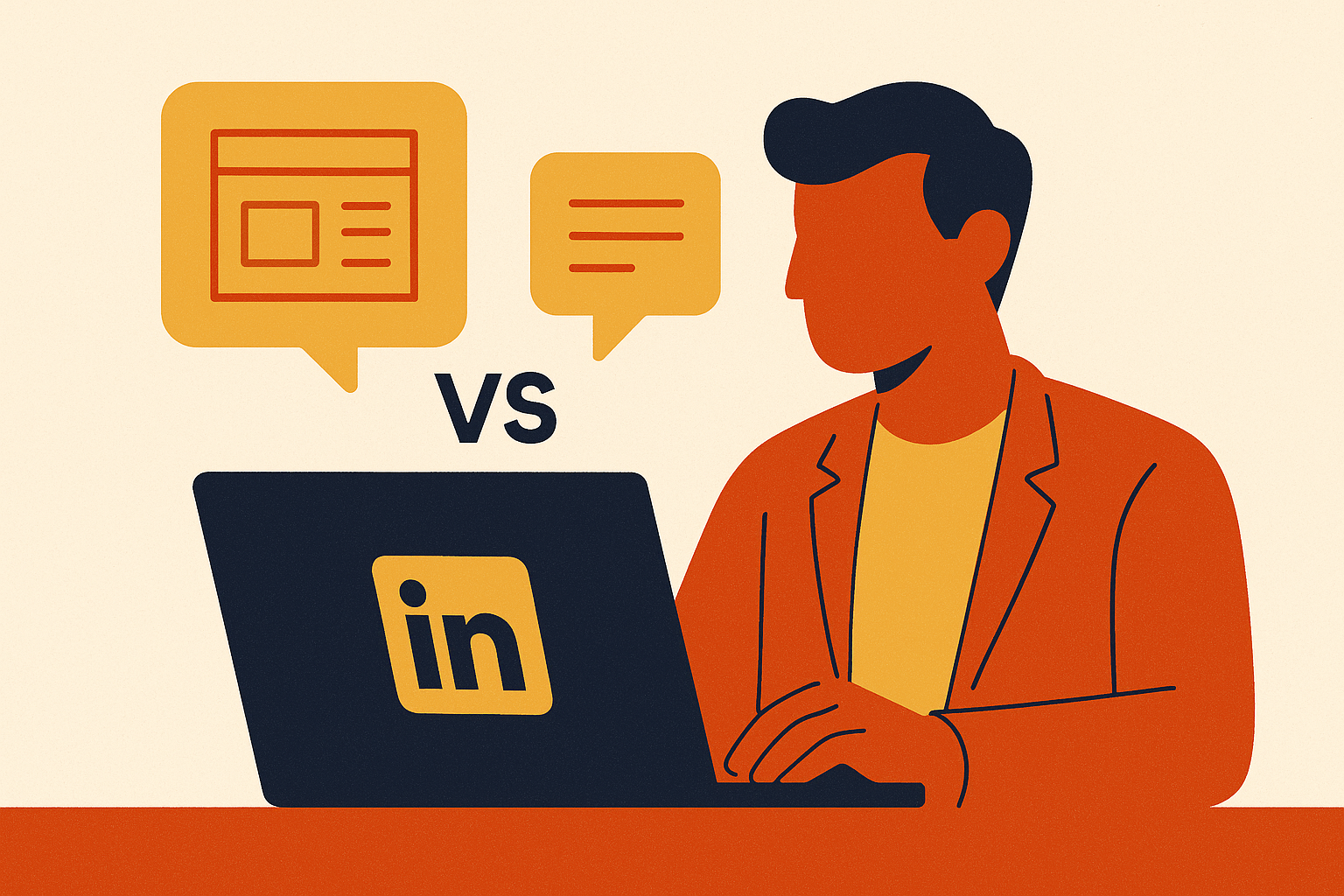
LinkedIn newsletters and regular posts do two completely different jobs. Most founders run them like the same job, and that's the whole reason a year of consistent posting still ends with a few thousand casual followers and zero pipeline. Posts get you seen by strangers. Newsletters keep the people who already know you coming back. Skip one, and you've built half a machine.
To state it directly: if you're only going to build one of these well, build the newsletter. Posts are rented attention. The newsletter is the only piece of this you actually own.
What regular posts actually do for a founder's reach, and where they run out of road
Posts are how strangers find you. The algorithm reads a post, matches its topic to people who don't follow the founder yet, and pushes it into their feed. That's the whole job: discovery. Nothing more, and definitely not retention, no matter how good the post is.
That job got harder heading into 2026. Recent platform analysis found regular posts now reach somewhere around 5 to 7% of a founder's own follower base. Views down 50% year-over-year. Engagement down 25%. That's not a slow drift, it's a cliff, and company pages fell off it even harder: down to roughly 1.6% reach per post, from about 7% back in 2021.
So skip the company page. Put the effort into the founder's personal profile instead, since it already generates 8 times more engagement than the company page ever will. Think of the company page as the storefront and the founder as the person standing outside handing out samples. People trust the person handing out samples. Nobody trusts a building.
The March 2026 Authenticity Update made the old shortcuts actively backfire. Engagement bait got killed off, automation pods got penalized, and polls (once an easy grab) fell to 3.50-4.50% engagement. What gets rewarded now is dwell time, meaning how long someone actually stops scrolling to read the thing, plus specific detail and first-person experience. Posts with external links take roughly a 60% reach hit. So a link does not belong in a regular post. Full stop, no exceptions, put it in the comments if you must.
Format still matters within that constraint. Socialinsider's 2026 analysis of 1.3 million posts put documents at 7.00% engagement against 4.30% for plain text. A PDF carousel isn't a nice-to-have here, it's doing measurably more work than a paragraph ever will.
And the clock starts the second a post goes live. LinkedIn tests every post against 2 to 5% of a founder's network in the first hour. Miss that window and the post is basically done: only about 5% of underperforming posts ever recover broader reach. Posts are a fast, loud, top-of-funnel tool, and that speed is exactly why they can't hold an audience by themselves. That's an inherent feature rather than a flaw to fix. It's the design.
What LinkedIn newsletters actually do, and why the delivery mechanism is built differently
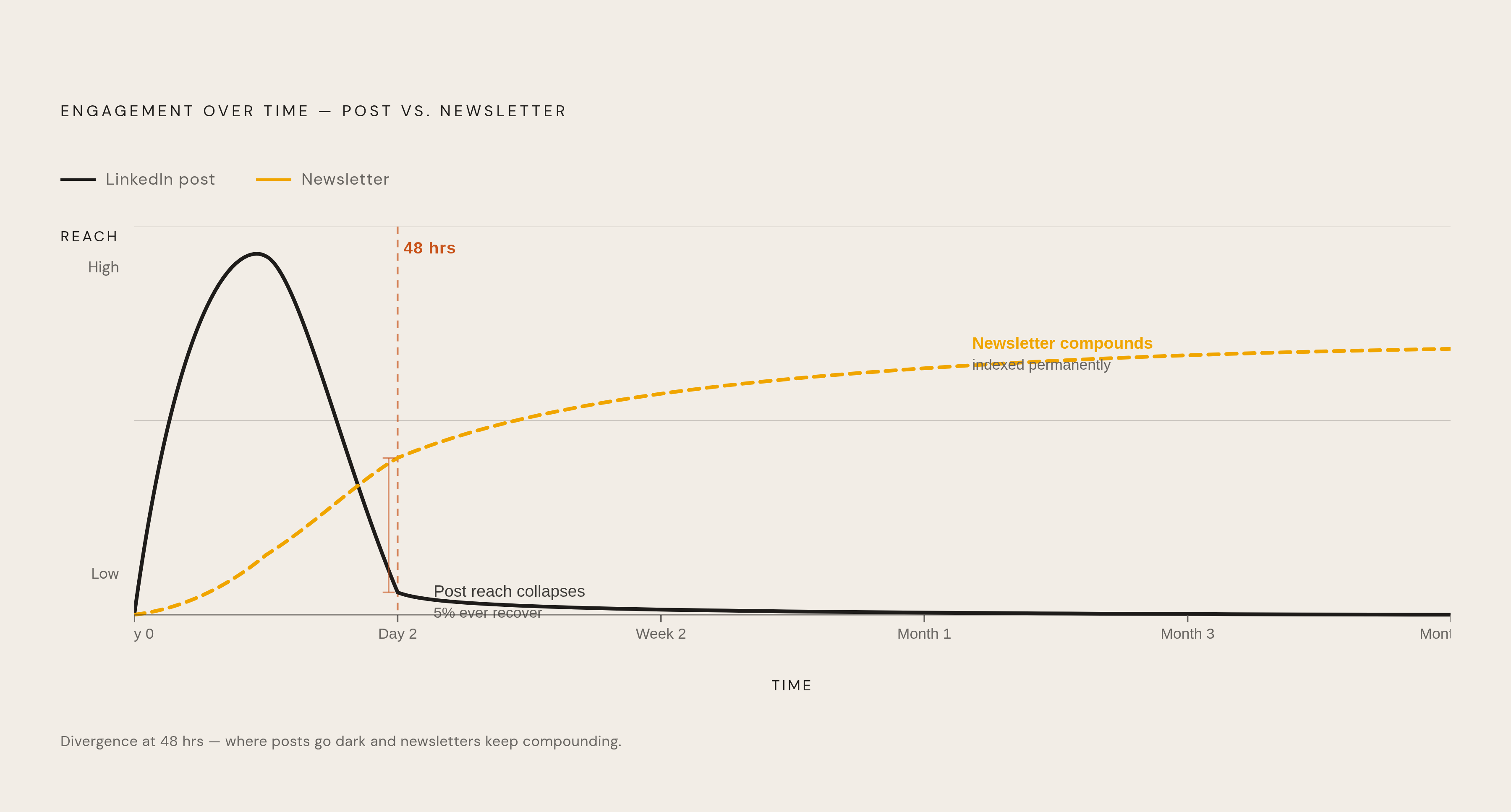
Newsletters skip the feed. Every edition fires three separate notifications, an email, a push alert, an in-app ping, to every subscriber, regardless of what the algorithm feels like rewarding that week. Posts get filtered. Newsletters get delivered. That's the whole difference, in one sentence, and it's the one that actually matters.
A regular post has a shelf life of about 24 to 48 hours before the scroll buries it for good. A newsletter edition keeps generating engagement for weeks afterward. That's not a difference of degree. One format decays. The other compounds, quietly, in the background, while the founder is off doing something else.
Links behave differently too, which matters more than it sounds like it should. Posts with external links take a significant reach hit, so the newsletter is the right home for anything driving traffic, such as a podcast episode, a signup page, or a website. Every edition also lives permanently on its own page, indexed by Google, findable through a search six months later instead of depending on someone catching a lucky scroll at the right hour.
The format is still growing, and fast. Subscriptions are up 150% year-over-year, with more than 450 million subscribers across the platform. The viral mechanic still applies on top of that: when a subscriber likes or comments on an edition, it shows up in their own connections' feeds. So a newsletter gets the network spread of a post, plus guaranteed delivery layered on top. Best of both, basically.
Open rates on well-run newsletters run 35 to 40%, and subscribers convert to paying customers at 2 to 3 times the rate of audiences with no newsletter relationship, per Influenceflow. 98% of LinkedIn's top 100 newsletters come from individuals, not brands. That's not a coincidence, that's the whole platform telling you where trust actually lives. Richard Branson's "Ask Richard," a monthly Q&A, reached 5.6 million subscribers on format consistency alone. Readers knew exactly what they'd get every time they opened it, which is most of the job right there.
One mechanic is worth planning a launch around specifically. Per PR News Online, launching a newsletter fires a notification to the founder's entire follower base, once. After that first blast, growth turns semi-automatic (LinkedIn starts prompting new followers to subscribe going forward). But that opening notification only fires one time, ever. Which means the launch edition matters more than nearly anything published after it, and treating it like a placeholder is the single most common way founders waste the format.
What it takes to get access and publish a first edition worth launching
Getting access isn't hard on paper: 150 followers, some recent original content, compliance with LinkedIn's community policies. Creator Mode used to be a toggle people had to flip manually. LinkedIn folded those features into all eligible profiles by default back in March 2024, so most of the "getting access" conversation is already moot.
What actually gets rewarded is a track record, not a follower count. LinkedIn is watching for founders who've posted consistently over months, not someone who bought a batch of followers last Tuesday and wants a newsletter launched by Friday.
Spend that launch edition carefully, since it's the one shot that reaches the entire follower base at once. Wasting it on a generic "welcome to my newsletter" post is like renting a billboard on the highway just to explain what a billboard is. The first edition needs to show the topic, the voice, and the pace immediately, not announce that a newsletter is coming soon.
On the technical side, editions support video covers, embeds from YouTube, SlideShare, and other supported providers, up to 125,000 characters, full Google indexing, and (since February 2025) send and open-rate analytics. Cadence is capped at one edition per day, so founders can choose whatever recurring rhythm fits their content. Weekly suits founders with a steady stream of ideas. Monthly suits the ones doing heavier, research-driven work who'd rather ship one strong edition than four thin ones.
Consistency beats frequency here, no contest. A monthly newsletter that shows up like clockwork on the third Tuesday will beat a weekly one that vanishes for six weeks at a stretch, every single time.
How to write newsletter editions that subscribers actually read and return for
Length matters less than people assume. Most editions work best somewhere between 450 and 800 words, with occasional deep dives stretching toward 2,000 when the topic actually earns it. The strongest performers tend to be between 800 and 1,500: long enough to say something real, short enough to finish over one cup of coffee.
Focus matters more than length, though, and this is where most newsletters quietly die. The ones that grow tend to hammer one topic, or one repeating format, edition after edition. A newsletter built around one specific topic tends to attract readers who actually want exactly that, while one covering a little bit of everything struggles to give any audience a reason to keep coming back. There are already 28 million LinkedIn members subscribed to at least one newsletter, and none of them signed up to kill time. They signed up for something specific, and they expect to get exactly that, edition after edition.
Real stories beat generic advice, with no exceptions. A specific decision, a specific mistake, a specific number, beats a theoretical framework about "leadership principles" every time it's tried. Ending on a question instead of a tidy conclusion tends to spark replies, and replies are what keep an edition alive after the algorithm has moved on to something else.
Timing isn't decoration either. Testing shows Tuesday through Thursday mornings, roughly 8 to 10 AM, produce the strongest engagement for professional audiences, and one source saw a 35% engagement lift just from shifting publish time from afternoon to Tuesday morning. A workable structure, per contentin.io: a headline that earns the click, a personal hook or a surprising fact up top, two to four sections with specific tactics, one discussion question, a sign-off that stays identical every time. Readers like knowing the shape of a thing before they open it, the same way they know what they're getting when they open a familiar magazine column.
The same principle that rewards specificity in posts applies to newsletters. Editions with real detail and honest anecdotes earn more engagement from subscribers, and that engagement surfaces the edition further into the feed. Generic advice gets buried here the same way it gets buried in regular posts. There's no format where vague performs.
How posts and newsletters work as a system rather than a choice
Posts and newsletters aren't rivals fighting over the same job, and treating them like competitors is the actual mistake underneath most of this. Posts handle discovery: reaching people who don't know the founder yet, testing which ideas land with a cold audience. Newsletters handle retention: turning that discovered audience into subscribers who opted in and keep showing back up on their own.
One newsletter edition can fuel an entire week of posts. A single deep-dive issue splits into a text post, a document carousel, maybe a short video clip, each one built for whichever format the algorithm happens to be rewarding that week, while the newsletter holds the full argument together in one permanent place.
The loop feeds itself, and it's worth tracing the whole thing through. Posts grow the follower count. LinkedIn nudges those new followers to subscribe to the newsletter. The newsletter deepens the relationship, which makes the next post more likely to get real engagement instead of getting scrolled past without a second glance. A founder with a known, consistent newsletter also becomes a recognizable name inside a niche, which helps the algorithm's topic-matching push future posts into new networks faster.
Cadence works best when the two don't compete for the same hours. Three or more posts a week keeps a founder visible in the feed day to day. One newsletter edition a week, or a month, depending on how much depth the content needs, gradually builds the archive that supports all of that. They run on separate clocks. Plan them on separate clocks, instead of scrambling to fill both the night before.
Links follow the same logic as everything above: keep them out of posts, or drop them in the comments, to dodge the reach penalty that comes with external links in posts, and save them for the newsletter, where they cost nothing at all. Depth follows the same split, too. High-dwell post formats (documents at 6.6% engagement, video at 5.90%) are built for a quick, punchy idea that lands in under a minute. A 2,000-word argument belongs in the newsletter. Cramming it into a feed post asks the format to do the one job it actively gets penalized for doing.
Why this format system matters most for founders who are hiring, fundraising, or building in public
The business case stopped being optional a while back. Research has found that a founder's thought leadership directly shapes B2B purchase decisions, and a significant share of B2B buyers have researched a product after reading thought leadership content, with many going on to buy.
Investors run the same homework before they ever sit down at the table. Investors routinely research a founder's social media before taking a meeting. A newsletter archive hands them a permanent, searchable record of how a founder actually thinks, which is something a single feed post from six months back, buried under everything since, simply cannot offer.
Hiring runs on identical logic. Strong candidates look up the people running the company before they apply, and a founder with a steady newsletter signals stability in a way a sporadic feed presence can't fake, no matter how polished any one post looks in isolation.
Retention ties all three together, and it's the part that's easy to underrate. An investor or a candidate who's read a newsletter for three months straight walks into the meeting already warm, not cold. LinkedIn is widely recognized as the dominant platform for B2B social leads, and the newsletter is where that early trust actually hardens into something that survives a hard question in the room.
None of this happens overnight, and pretending otherwise just sets founders up to quit right before it starts working. Most see a real bump in visibility within a few months of posting consistently, but the kind of recognition where people already know the name before the first meeting takes six to twelve months, sometimes longer. That's the argument for starting the newsletter now, alongside the posting habit, instead of shelving it as a someday project. Run both together, and a founder builds two assets at once: algorithmic reach that keeps bringing new people in the door, and an owned subscriber list that no algorithm update can quietly take away.
Sources
- LinkedIn Newsletter Tips & Strategy to Stand Out in 2026
- Master LinkedIn Newsletter Strategies For Growth in 2026
- LinkedIn Algorithm 2026: What Works Now (Documents, Newsletters, Video)
- LinkedIn Statistics 2026: 140+ B2B Marketing Data Points
- What Types of LinkedIn Posts Get the Most Engagement?
- LinkedIn Newsletter Strategy Guide 2026 | InfluenceFlow
- contentin.io