Executive LinkedIn Branding vs. Company Page Strategy
Executives who build personal brands outperform company pages on LinkedIn's algorithm.

LinkedIn's ranking model weights peer-to-peer interaction more heavily than brand-to-audience broadcasting. People comment on people. Not on logos. That preference feeds a compounding advantage for personal profiles: when a post generates early engagement, the algorithm extends its reach. Company pages rarely generate that early signal. They rarely clear the gate.
This is not a phase. The platform moved away from rewarding raw engagement volume and toward rewarding relevance, depth, and demonstrated expertise. In late 2025, LinkedIn added Saves and Sends to post analytics, which tells you something important: the behaviors the algorithm now prizes are the ones where someone bookmarks your content or privately sends it to a colleague. Not surface reactions. Empty likes mean nothing. Company pages that kept the lights on by cranking out high-volume AI-pattern content have had that shortcut actively throttled.
The organic reach collapse for company pages is structural. The conditions that once let a well-run company page compete with a personal profile no longer exist.
Now, the widely circulated numbers. You have probably seen figures claiming that personal profiles generate some dramatic multiple more reach than company pages. The most dramatic versions trace back to a single vendor analysis that got re-cited across the industry without anyone independently replicating it. More conservative measurements from broader data sets still show a real and significant gap. Treat any single precise figure with skepticism. Focus on the direction and consistency of the evidence instead. The direction is unambiguous.
One important nuance: raw reach is not the only metric that matters. A smaller company page audience is often more commercially intentional. People who follow a company page are often already evaluating that vendor. A post seen by many is not automatically more valuable than a post seen by a few highly qualified buyers. Founders who understand that distinction can use it strategically, rather than treating reach numbers as the whole story.
What a Company Page Is Actually Built to Do Well
The organic reach collapse does not make a company page optional. It makes it a specialist tool rather than a broadcast channel.
Some things only exist on company pages:
- LinkedIn advertising runs exclusively from a company page. Any founder running paid campaigns needs a maintained page, full stop.
- Career pages and job listings live on the company page. LinkedIn's hiring products require one.
- Product pages, follower analytics, and premium analytics features are company-page-only.
- The Follow button that investors and prospective hires use to track a company lives on the page.
Then there is the credibility layer. Investors, enterprise buyers, and serious candidates check the company page as part of due diligence. A sparse or abandoned page sends a signal the founder probably does not intend. Funding announcements, press milestones, and product launches that need a permanent and findable home belong there.
The company page is infrastructure, not content. Its value is largely in what it enables, not in what it broadcasts organically.
How to Assign Roles Without Splitting Your Focus
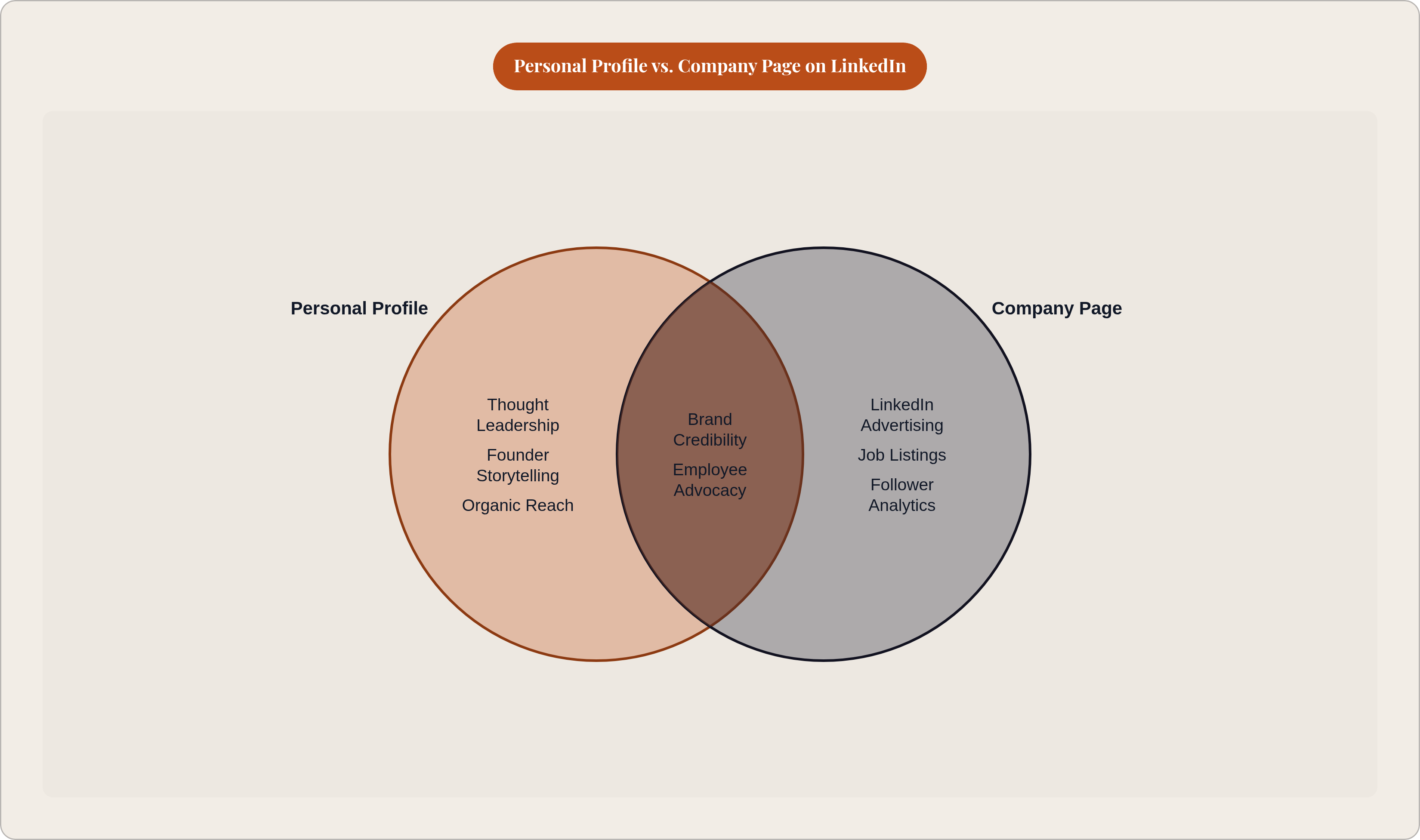
The strategic error most founders make is treating the personal profile and the company page as two versions of the same thing, and then trying to run both at full intensity. That splits attention without doubling results.
The right model is one primary channel and one supporting infrastructure layer.
The personal profile carries the organic strategy. Thought leadership, market takes, founder story, hiring signals, investor narratives. This is where pipeline gets built, trust gets earned, and the audience that eventually converts into customers, hires, and investors actually forms. Posting cadence, content quality, and consistency matter here. This is where your energy goes.
The company page handles infrastructure and amplification. Keep it maintained and credible. Active enough that a visitor doing due diligence does not find a dead account. Use it as the anchor for paid campaigns that retarget audiences built through personal-profile content. Host official announcements, job postings, and press coverage here rather than burying them in a feed that will not distribute them anyway.
Employee advocacy bridges the two. When employees reshare or comment on company page content, the algorithm extends that content's reach substantially. Structured advocacy programs multiply company page impact without incremental ad spend. If you have a team, the founder is not the only personal profile available to amplify brand content.
One risk worth planning around: a LinkedIn presence built entirely on a founder's personal profile is a single point of failure. If the founder steps back, the presence evaporates. Building some minimal company page equity and coaching other leaders to post is an organizational hedge. It does not undermine the personal-profile-first strategy. It protects it.
The Founder's Personal Brand Is Part of the Sales Process Whether They Intend It or Not
B2B buyers complete most of their evaluation before making any contact with a vendor. During that pre-contact phase, they are researching individuals, not just companies. Before a prospect agrees to a call, they have already found the founder on LinkedIn, read recent posts, and formed a preliminary credibility judgment.
That judgment is now part of your sales process whether you have invested in it or not.
B2B decision-makers consistently report being more likely to trust a company whose senior leaders are visibly active and credible online. They prefer content from individual people over brand accounts. That preference is consistent enough to treat as a planning assumption, not an interesting data point.
The fundraising version of this is equally concrete. A large share of investors research founders on social media before taking a meeting. There is a documented correlation between founder LinkedIn audience size and the investment levels they attract. The audience is a credibility signal, not a vanity metric. And the Featured section of a LinkedIn profile is one of the highest-leverage, most underused assets for founders who are actively fundraising. Pinning a funding announcement, a media clip, or a customer success story means every profile visitor sees it immediately.
For early-stage founders, the personal brand substitutes for institutional credibility that has not been built yet. No ten-year track record, no analyst coverage, no Fortune 500 client list. The founder's visible presence is the available signal.
Tyler Denk's build-in-public approach at beehiiv is one of the cleaner examples of this working at scale. He spent years posting about what was actually happening inside the company, the real numbers, the real decisions, the real friction. By the time beehiiv opened a new investment round, it filled quickly. The audience had already formed conviction long before the round was announced. The fundraise was downstream of the brand. Not separate from it.
What Kind of Content Actually Builds Trust and Translates Into Business Outcomes
LinkedIn in its current phase rewards individual executive voice over polished brand publishing. That shift has been consolidating since 2021 and is now the dominant content paradigm on the platform.
The content types the algorithm currently extends:
- Long-form narrative posts and stories of failure and learning. Not surface-level updates.
- Counterintuitive market takes the founder is willing to defend, including positions some readers will disagree with.
- Data-backed perspectives on a specific category or market. Not generic business wisdom.
- Build-in-public content. Real numbers, real milestones, real setbacks. The human story behind the startup rather than the polished product reveal.
Non-technical founders who build in public consistently see higher engagement on business-narrative posts compared to feature announcement posts. The audience wants the human story, not the press release.
A useful way to think about content mix:
- Market insights and counterintuitive takes should be the majority of your posting volume.
- Founder journey content, real failures and real lessons, belongs in the mix regularly.
- Company milestones as momentum signals. Hiring, launching, raising, hitting metrics. This is signaling, not bragging.
- Vision and values, occasionally and not constantly.
What separates high-performing thought leaders from competent posters is not talent. It is a clear, ownable point of view on category questions. Cautious neutrality produces low engagement. Substantive engagement with comments matters too, because the algorithm rewards two-way conversation, and the relationship-building value of responding is separate from the reach benefit.
And then there is consistency. The founders who win on LinkedIn are not the ones who posted brilliantly once. They are the ones who showed up long enough for compounding to work.
How Ghostwriting Fits Into a Personal-Profile-First Strategy Without Compromising Authenticity
The market for LinkedIn ghostwriting has grown substantially since 2024, driven by founders recognizing that organic LinkedIn content outperforms paid ads for B2B pipeline. That growth reflects a genuine shift in how founders think about the channel.
Here is the authenticity paradox that most people miss. Founders who write their own posts can actually produce less authentic content than those who work with a skilled ghostwriter.
When a founder sits down alone to write, they self-censor. The supplier story, the failed launch numbers, the real cost of a bad hire gets filtered out as too risky. They default to safe, corporate-sounding observations that could come from anyone. Which is exactly what LinkedIn's algorithm now deprioritizes.
A skilled ghostwriter extracts the story the founder would never publish alone and shapes it into content the founder is proud to stand behind.
How effective ghostwriting relationships actually work:
- The communications partner develops drafts based on conversations with the executive. Interviews, observations from meetings, perspectives captured from other forums.
- Drafts go back to the executive for review and approval. The executive's voice is preserved. The operational lift is shared.
- The ideas must originate with the founder. The ghostwriter's role is structure, voice, and extraction. Not opinion invention.
The ethical framework the industry has converged on is straightforward. Ghostwriting is ethical when the ideas are real, the voice is the founder's own, and the founder owns and will defend every post. That standard applies to CEOs, politicians, and authors who have worked this way for decades. Disclosure is not obligatory. Most founders do not disclose and the consensus holds that this is acceptable. Founders for whom radical transparency is a core brand value can mention a content partner and often find it strengthens rather than undermines trust.
On AI as a ghostwriting shortcut: the data shows that most professional ghostwriters use AI for research and support rather than content generation. LinkedIn's algorithm actively penalizes AI-pattern content. Founders who cut corners with AI output face a distribution penalty on the very channel where the stakes are highest.
One practitioner credibility problem worth naming: agencies without operators who have actually built real audiences cannot reliably extract a founder's authentic voice, or know which story angles will land in 2026. The most effective ghostwriting relationships involve people who have generated real reach through their own posting. They know from experience what the algorithm rewards and what the audience responds to, because they have tested it on themselves. Forj Media is one of the shops that operates this way, working with founders on content calendars and storytelling frameworks that treat the personal profile as the primary growth engine while using the company page as a supporting credibility layer.
How to Know Whether the Personal-Profile Investment Is Actually Working
This is where a lot of founders go wrong. They optimize for the wrong signals.
The metric shift LinkedIn made in late 2025 is the clearest signal the platform has given about what it values now. Adding Saves and Sends to post analytics was not a cosmetic update. It told founders which behaviors actually indicate content is working.
Not reactions. Impressions alone tell you little. Content people save to return to. Content people send to a colleague.
Those are the signals of genuine utility. When someone saves your post, they found it worth keeping. When someone sends it, they thought of a specific person who needed to see it. Those behaviors indicate your content is doing real work, not just clearing the feed.
The metrics that actually matter for a personal-profile strategy:
- Saves and Sends per post. These are your primary quality indicators now.
- Inbound connection requests from relevant profiles. Not vanity followers. People in your target buyer or investor category who found you and reached out.
- Profile views from target accounts. LinkedIn shows you who viewed your profile. If your ideal customers are showing up there, something is working.
- Direct messages from qualified leads. If your content is building the right kind of trust, it converts into conversations. Not always quickly. But it converts.
- Qualitative feedback in comments and DMs. "I sent this to my whole team" is a data point. It tells you which angles land.
What founders should not over-index on: follower count as a primary success metric. A smaller, more engaged audience of the right people outperforms a larger, passive one. The goal is not an audience. The goal is a pipeline.
The other thing to watch is compounding. LinkedIn rewards consistency over time and the results are not linear. Founders who post for three months and see modest results sometimes stop just before the curve bends upward. The audience that took a year to build distributes your next post to thousands of people who already trust you.
That is not an argument for patience as a virtue. It is an argument for measuring the right things so you do not quit before the investment pays out.