Building in Public as a Fundraising Signal
Investors decide on founders months before the pitch deck lands in their inbox.
Fundraising math broke sometime in the last few years. Rounds are fewer and bigger now, and they crawl along almost twice as long as they used to. The founders getting the best terms all share one thing: investors already feel like they know them before the first call.
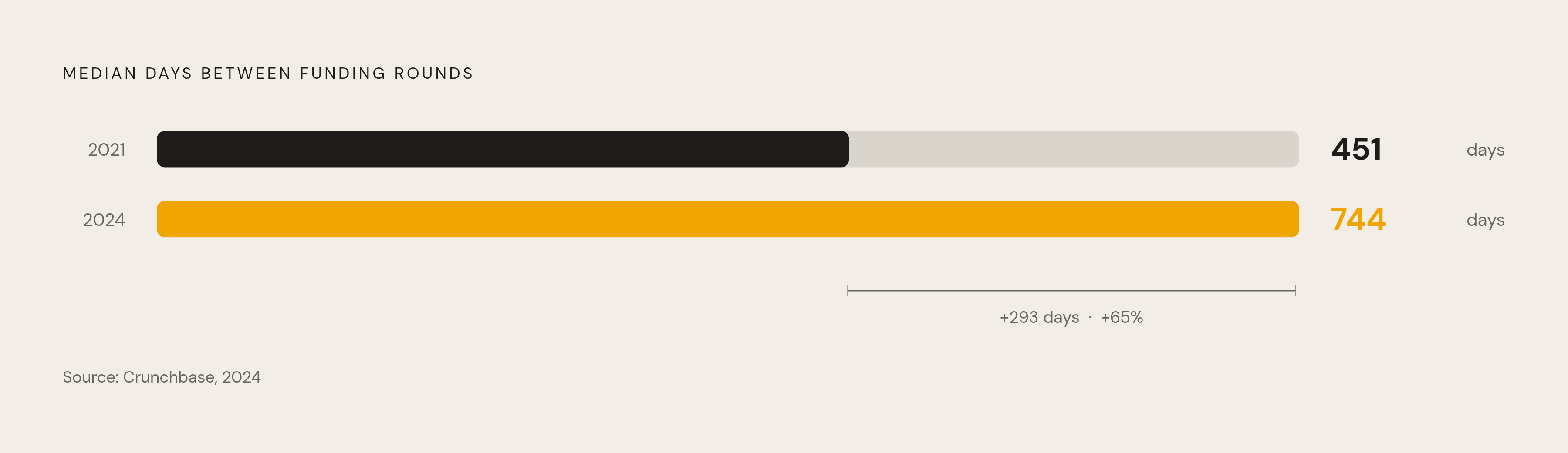
Carta's Q1 2024 numbers showed funding rounds dropped 29% while total capital stayed roughly flat, meaning the same pot got split among fewer spoons. Median time between rounds stretched from 451 days in 2021 to 744 days by the end of 2024, per creditforstartups.com, so founders now spend nearly twice as long stuck in the gap between raises, just waiting around. About half the $425 billion deployed globally in 2025 went to AI companies alone, which makes the whole market look healthier than it feels if you're not building one of those.
VCs aren't spreading bets wider. They're piling into fewer founders they already trust, and decks matter less than they used to. What matters more is whether the investor had an opinion of you before they sat down.
Why 90% of deals never start from a cold pitch
Only 10% of VC deals come from a cold founder pitch. The vast majority come from the investor's own network, referrals, or deals they sourced themselves. Gompers et al. found this in their HBR survey of 885 VCs, and a 2025 Waveup study of 56 active VCs landed in roughly the same place, which tells you it's not a fluke of one sample.
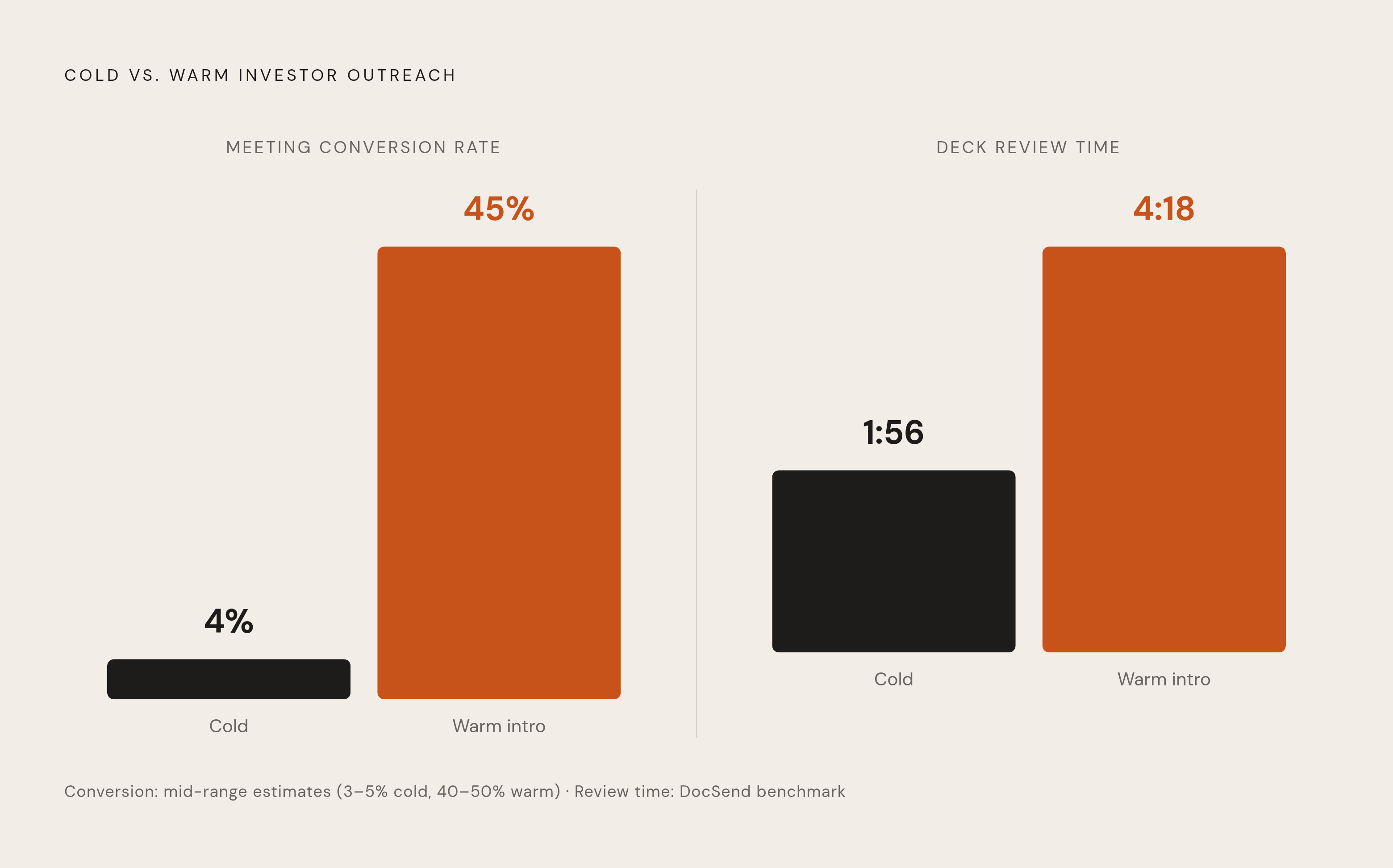
The conversion numbers make the gap worse than it sounds. Warm-intro decks convert to meetings at 40 to 50%, while cold decks convert at just 3 to 5%, according to DocSend's 2024 data. That's not two versions of the same game, that's two different sports being played on the same field.
Attention's gotten stingier too. Investor review time on decks fell 24% since 2021, down under three minutes on average. Cold seed decks get 1 minute 56 seconds of someone's eyeballs, while warm-intro decks get 4 minutes 18 seconds, more than double.
The pitch meeting isn't really where deals get made anymore. It's a checkpoint, where trust that already exists gets confirmed, or trust that never existed gets exposed fast. By the time your deck lands in an inbox, the investor's formed an opinion of you already. The actual fundraising happened months earlier, in whatever signal you were putting into the world without realizing it counted for anything.
What building in public actually is — and what it isn't
Building in public means showing the real behind-the-scenes of running your company: wins, screwups, real metrics, pivots, in your own voice, consistently, over months. It's simple to describe, yet weirdly hard to do without it curdling into something else.
A few things it's not, since people keep getting this wrong. There's no script sitting under a genuine build-in-public practice, no crisis comms layer smoothing things over after the fact, so treating it like a PR campaign misses the point entirely. Follower count is a side effect, not the goal; chasing it is exactly backwards. The value shows up in the quiet, boring months between launches, not during the big announcement. It's a lousy launch strategy if that's all you're using it for.
Underneath it, the mechanism is simple: trust builds when someone watches you think over time. An investor who's read six months of your posts has watched you reason through real decisions in real time. A deck is written to convince someone, while a post, done honestly, reads like thinking out loud, and that difference is what makes it land.
Nobody's closing a round off a single LinkedIn post, and if someone tells you otherwise, they're selling something. Six to twelve months of posts, though, quietly changes what an investor believes about you before you've said a word to them directly.
How consistent public presence converts to investor familiarity
Founders who've built in public for six to twelve months aren't cold contacts by the time they raise. The relationship's been running the whole time, just in one direction.
CopyAI is a decent example. The company grew from $1 to $50,000 in monthly revenue partly by sharing metrics and milestones as they happened, in public, warts and all. By the time a formal pitch process existed, the track record had already done a chunk of the convincing. Webflow ran something similar on its way to a $2 billion valuation, using open talk about struggles and pivots as fuel for its community instead of something to bury in a footnote. The honesty about iterating became part of the signal investors picked up on.
Founders who commit to this report the same handful of outcomes over and over, per seedscope.ai: more inbound from investors, shorter stretches between first contact and term sheet, fewer meetings wasted re-explaining basics to someone who's never seen their work before it landed in their inbox.
One fintech case makes the shift concrete. Per OBA PR, a founder who built a public presence watched Series A conversations flip from "convince me this works" to "tell me how I get in," and the raise went from a 6-month slog to 8 weeks. That's the entire gap between an investor meeting you cold and an investor who decided you were worth backing before the call started.
Rally Ventures puts a number on this: the same company, told with better storytelling, can be worth 50% more. The fundamentals haven't changed. Sophisticated investors still need to understand your vision before they can price it correctly, and story is part of how the business gets valued in the first place, not decoration sitting on top.
Why LinkedIn is where investor-facing signal compounds fastest
Investors are already there, posting: 55% of Forbes Midas List VCs post on LinkedIn at least monthly, per Milltown Partners' 2024 data, basically tied with X at 54%. The real difference is context. Engagement on LinkedIn carries a professional weight that X doesn't replicate, no matter how good your tweet is.
Scale backs it up. LinkedIn passed 1.1 billion users globally by early 2025, with monthly active users projected past 600 million by the end of 2026. Clicks grew 28% year over year as of 2025. A huge share of B2B decision-making conversation lives here now, not in some conference hallway.
Here's the part most founders miss: your personal profile beats your company page by a mile. Personal profiles generate 2.75 times more impressions and 5 times more engagement than company pages, so founders looking for distribution should treat their own profile, not their startup's logo, as the asset worth building.
75 to 85% of all B2B leads from social media come through LinkedIn. If you're building in B2B SaaS, enterprise, fintech, or healthcare, your audience is already there, scrolling right now. (X still wins for developer tools, crypto, consumer tech, and AI-native investor circles, so pick the platform based on who you're actually trying to reach, not habit.) Here's the number that should stop you though: only 3% of LinkedIn users post more than once a week. Show up consistently and you're already ahead of 97% of the platform before you've optimized a single word.
How LinkedIn's algorithm rewards founder credibility in 2025
LinkedIn's 360Brew AI model, rolled out in 2025, quietly rewired how distribution works. The algorithm weighs your accumulated credibility, profile completeness, posting consistency, and engagement quality before it decides how far any single post travels. Your history works in the background every time you hit publish, whether you notice it or not.
Attention span is the other lever, and it's a short one. The algorithm tracks how long someone pauses on your post before scrolling past. Hit 4.5 seconds and you get basic distribution, but hit 7 seconds or more and you trigger a second wave of expanded reach. Not a lot of runway to make your case, but that's the game now.
Engagement quality beats volume, full stop. A thoughtful comment carries 3 times the algorithmic weight of a like, and a share carries 5 times the weight, so a post sitting at 10 real comments will outperform one sitting at 100 likes, every time, on actual reach.
Format matters here too. Personal profile posts average a 3.85% engagement rate overall, per Socialinsider's 2025 numbers, but carousels and document posts reach 6.6 to 7%. Posts that show real thinking, a lesson from a product decision that flopped, a real number with honest context wrapped around it, hold attention longer than a polished announcement ever will. Content that reads like a press release gets the same fast scroll, no engagement, no reach treatment as a cold deck.
What a pre-fundraise content cadence looks like in practice
Start six to twelve months before you plan to raise. The audience you build in that window is the actual asset, and the posts themselves are just the mechanism. Wait until the raise kicks off and you've missed the window for that asset to compound.
Three to five posts a week is the effective range for most B2B SaaS founders trying to build real investor signal without burning out their exec team in the process. If that feels like too much right out of the gate, two per week for 90 days is the floor. Go below that and you won't see compounding show up at all.
What actually goes into those posts? A few things work, consistently, across founders. Real traction updates, with honest context around the number rather than just the number itself, covering what caused it and what you're doing next. Decision-making transparency: the why behind a call, what you weighed, what you'd change now with hindsight. Market and category thinking, which shows you understand the space you're in, not just your own roadmap. And honest failure posts, which earn the most trust of anything on this list, because they're the hardest thing to fake convincingly.
The inbound follows a predictable pattern, per lexiconn.in data. Profile views from relevant sectors pick up in the first 60 days, real business conversations that didn't exist before start showing up around 90 days, and by six months your inbound mix has measurably shifted. The fundraise payoff is real too: founders combining this kind of presence with a solid data room raise in 3 to 4 months, versus 5 to 7 months for founders leaning on cold outreach alone, per peony.ink.
One more thing worth knowing, because it changes how you think about the effort. LinkedIn posts don't expire the way a tweet does, and a post you publish today can surface in an investor's feed 18 months from now, out of nowhere. This behaves more like compound interest than a campaign with an end date.
The case for a communications partner in high-stakes visibility work
Here's the actual problem founders run into. The people who most need to be visible right now, the ones raising, hiring, building a company in public, are also the people with zero spare hours to sit down and write three posts a week. Running a company and building a public track record at the same time is a scheduling problem before it's anything else.
Ghostwriting carries a legitimacy question, so let's answer it instead of dancing around it. Leaders in politics, business, and publishing have used communications partners for as long as those fields have existed, and nobody thinks less of a CEO for having a speechwriter draft the big talk. The real question isn't whether the founder typed every word. It's whether the thinking underneath those words belongs to them.
Good ghostwriting pulls out real experience, specific decisions, actual numbers with context, not generic takes dressed up in corporate polish and passed off as insight. The goal is a post that sounds exactly like the founder, because it reflects how that founder actually thinks, with someone else helping get it onto the page clearly.
Who you choose matters more than most people assume going in. An agency that's built its own audience using these exact methods brings a different kind of judgment than one that just runs a content calendar and hopes for the best. One knows what earns a real comment from an investor-caliber reader, while the other is guessing, and guessing shows up in the numbers eventually.
Some firms offer this kind of practitioner credibility, founded by operators with backgrounds in strategy consulting and tech who have built substantial personal audiences across LinkedIn, YouTube, and Substack, and who use the same methods for founder clients that they used to generate their own reach.
Whoever you end up working with, look for the same handful of things: a real track record of building audiences in a relevant professional context, a process that starts by pulling out how you actually think rather than dropping you into a template built for someone else, and success measured against business outcomes, not vanity numbers that look nice in a monthly report and mean nothing come raise time.
Why visibility compounds and cold outreach doesn't
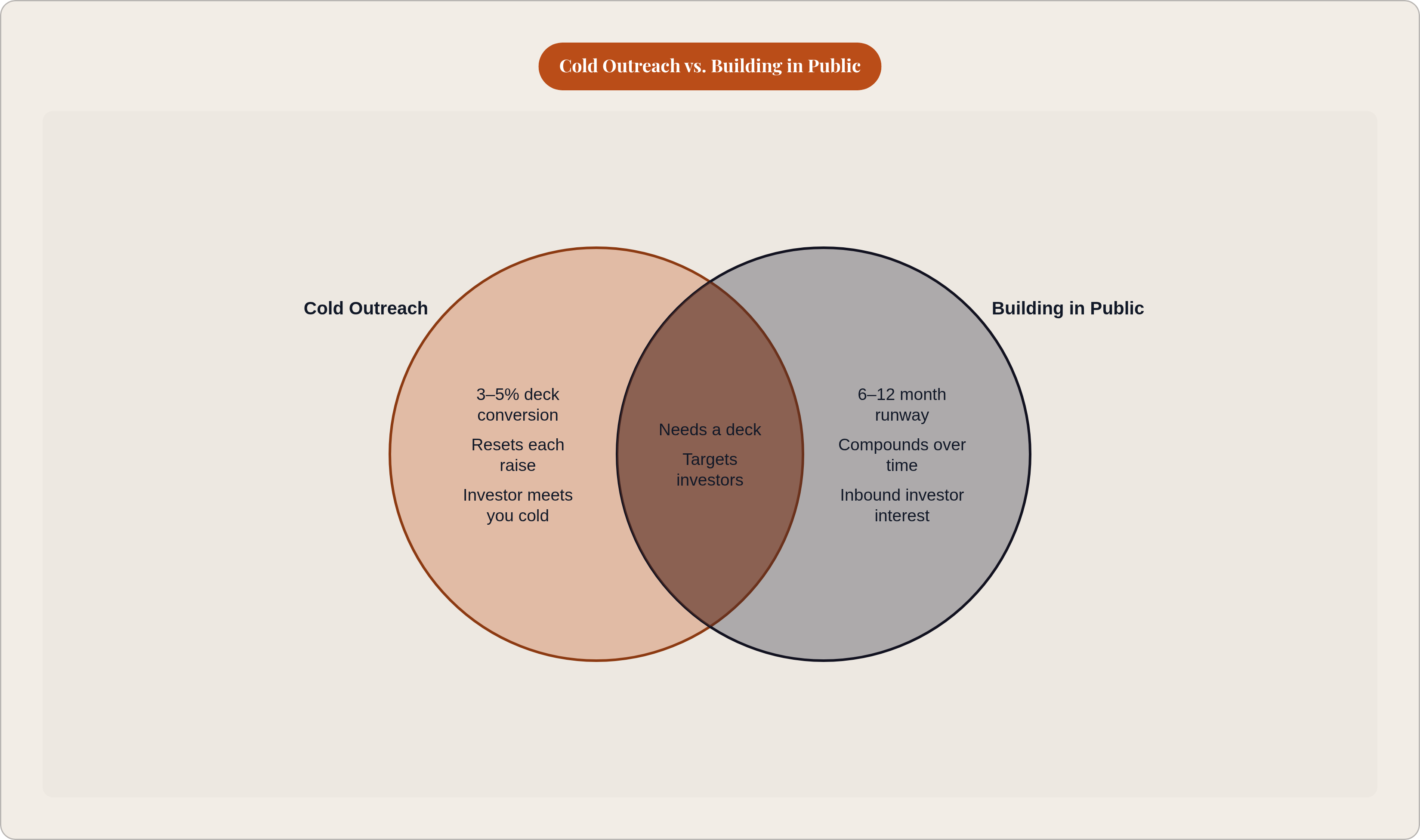
Cold outreach resets to zero every time you run it. Each new raise starts from scratch, with that same miserable 3 to 5% conversion rate waiting at the door. Building in public works on a different timescale, since it leaves behind a public record that keeps working long after you've stopped actively posting.
The trust gap shows up in real numbers, not vibes. Per DSMN8 data, campaigns featuring senior executives produce meaningfully higher trust ratings for the company behind them. A majority of decision-makers choose a business based on its thought leadership, and a large share say they'll pay a premium when a founder has real, earned authority in their space. That's a pricing advantage sitting in plain sight.
The compounding mechanism is worth spelling out, because it's easy to wave your hands at it. Every post adds to a searchable, attributed record with your name on it, and that record cuts down due diligence friction, since investors who've followed your journey already know how you think, how you read the market, and whether you learn from mistakes or just repeat them. The warm relationships built through consistent posting don't stop at fundraising, either. They lower the bar for enterprise sales conversations, for recruiting, for partnership talks, using the same mechanism through a different door.
There's a real cost to waiting on this. Start building in public after your raise has already begun, and the six-to-twelve-month lead time means the payoff lands on your next round, not the one you're currently running. Deciding to build in public is, whether you frame it this way or not, a decision about the raise after this one.
Rounds are fewer, bigger, and slower to close, and none of that snaps back to normal anytime soon. The founders raising on the best terms are the ones investors already feel like they know before the ask gets made, and LinkedIn is where that familiarity gets built, months before anyone opens a deck.