Storytelling Frameworks That Resonate With Early-Stage Investors
Earn investor belief by leading with the problem, founder conviction, and why now.

Pre-seed and seed investors fund belief, not spreadsheets. There's no revenue to model yet, no retention curve worth squinting at, so the pitch itself is the only evidence in the room. Harvard's Innovation Labs found people connect with stories before they connect with numbers, and most investors decide within five minutes whether a pitch earns the rest of the meeting. If you've spent the last month polishing your data room, I've got bad news: that's not what's being judged.
Every early meeting runs on three questions, whether anyone says them out loud or not. Why should I care about this problem? Why are you the one who can solve it? Why now, of all times?
They don't carry equal weight. Question one is the gate, and miss it, and the other two get answered to an audience that's already mentally packed up, no matter how sharp those answers actually are.
NFX has written about what happens next: investors show up wanting a CEO. They want the vision, the itch, the reason you personally give a damn, right at the top. Founders who open with roadmap slides are answering a question nobody's asked yet, and by the time features come up, the investor's already decided whether they're leaning in or checking email.
Build backward from that order. Each part of the pitch answers one question, in sequence, and if you jump to "why now" before you've earned "why should I care," you lose the thread, along with the room.
The frameworks that structure early-stage investor narratives
No single framework fits every founder. These are sorted by what they're built for, not by which one I like best.
Hero's Journey works for vision-heavy pre-seed and consumer plays. Someone runs into a broken world, gets changed by the fight, comes back with the fix. ServiceTitan's Vahe Kuzoyan grew up inside his parents' service business, and that detail never separated from the company's pitch. ServiceTitan went public in December 2024 at a multibillion-dollar valuation. The framework earns its keep because it welds founder-market fit to product logic instead of splitting the two across separate slides.
Problem-Agitate-Solve fits B2B SaaS, where the problem is real but nobody's felt its full weight yet. Name it, sit in the discomfort of it, then land the solution as the obvious next move. Most founders rush the agitate step, naming the problem and sprinting past it before the investor's actually felt it.
Before-After-Bridge suits legacy-workflow rip-outs. Show the before, show the after, put your product in the middle as the bridge. Tempus AI used exactly this to frame oncology before and after structured clinical data, and it went public at a $6 billion valuation.
Why-How-What flips Simon Sinek's usual consumer framing for technical founders who default to feature-dumping. Lead with the belief, then the method, then the product, which is easy to say but genuinely hard to pull off when you've spent three years thinking in specs instead of stories.
POPP (Problem, Opportunity, Plan, Proof) maps directly onto the three investor questions. Less a pitch style, more an audit: run your deck against these four buckets and see which one's thin.
None of these frameworks does the work for you, and that's worth remembering before you go pick one off the shelf. A container is a container, and what goes inside it, the specificity of the problem, the credibility of the team, whether you actually believe what you're saying, is what carries the room.
Founder-market fit as narrative anchor, not resume line
Investors at this stage are hunting for one thing: the person whose life made this company feel inevitable. That's the real answer to "why would you give this a decade, even once it turns miserable?"
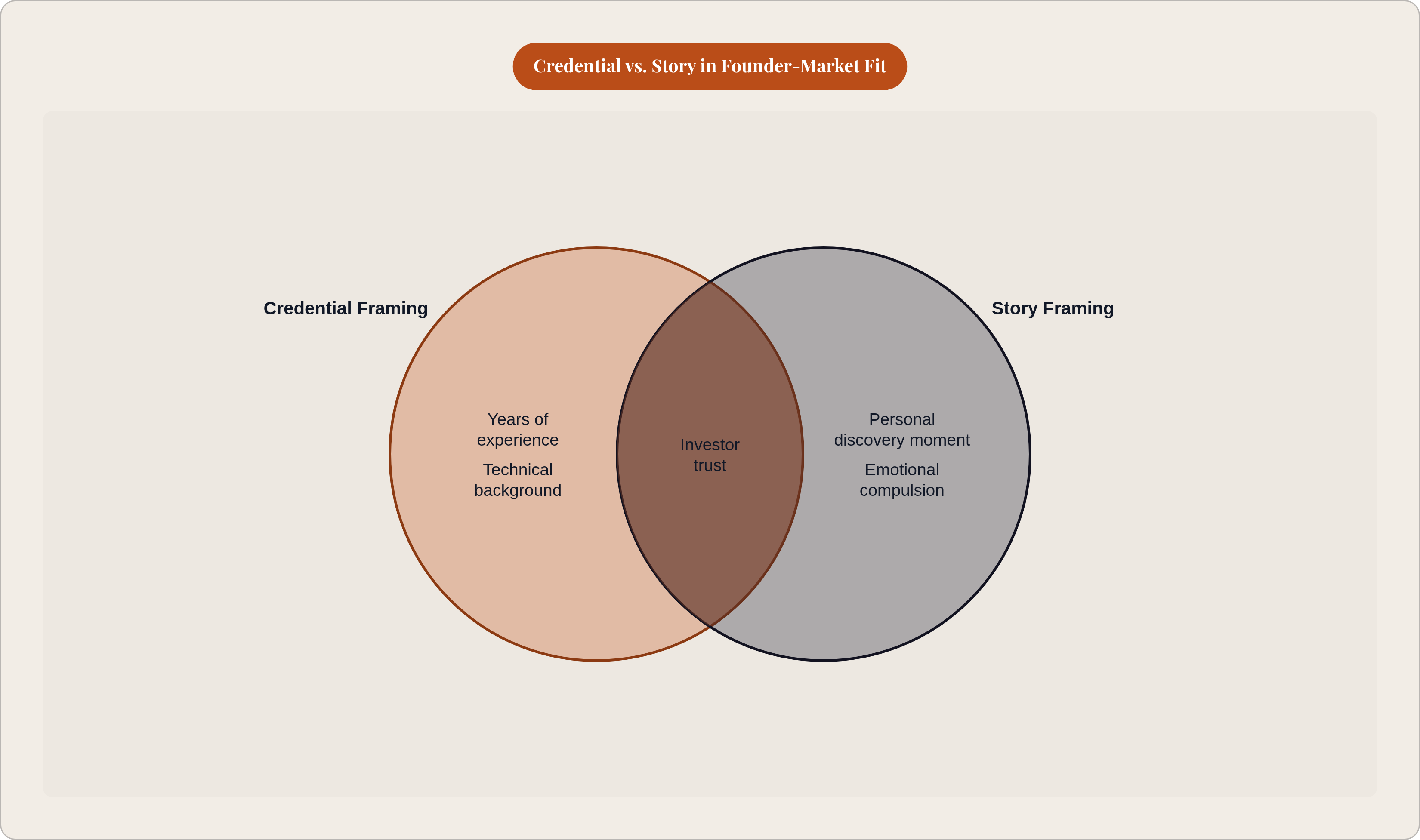
Founder-market fit as credential and founder-market fit as story tend to land very differently, and only one of them tends to raise money.
Credential sounds like: "I spent eight years in healthcare IT." Fine, qualified, also forgettable, and forgettable doesn't close rounds.
Story sounds like: "I watched my mother get bounced between three hospital systems that couldn't share her records, and realized the problem was never technical. It was incentives." That founder reads as compelled, and compelled is rare while qualified is everywhere.
Hippocratic AI raised a $141 million Series B at a $1.6 billion post-money valuation on a pitch where the founders' clinical and AI backgrounds read as destiny. Harvard's research backs this up: the pitches that stick are the ones that show the discovery, the moment the problem got personal, not just the data sitting behind it.
Here's a quick test. Can you tell your origin story in two minutes without saying your product's name once? If the answer's no, the conviction underneath the pitch probably isn't finished cooking yet.
Market inevitability framing and the category-replacement claim
Most founders pitch a better version of something that already exists. The stronger move argues the whole category is broken, foundation and all.
That reframes the investor's question entirely. "Is this better than the incumbent" becomes "can the incumbent's whole approach even solve this," and win that second argument, the first one stops mattering.
Perplexity AI argued search, as a format, can't answer how people actually need information anymore; in 2024 it closed over $500 million at a reported $9 billion valuation. Anduril ran the same play against legacy defense contracting, framing itself as software-native against a paradigm built for a different decade, and rode that argument from $30.5 billion past $60 billion.
This is a risky bet, and it's worth naming plainly instead of dressing it up. It trades a product argument for a timing argument, and if the investor doesn't buy your timing, no amount of product polish saves you. Pair it with a real "why now": a regulatory shift, a technology unlock, some behavioral change that made the old category suddenly brittle. This framing isn't for everyone, but if you're building something genuinely new and you keep calling it "better" when the more accurate word is "different," you're underselling yourself.
The narrative failures that kill credible pitches
These aren't polish problems. Investors catch them fast because they're trust problems.
Claiming zero competition is the fastest way to lose the room, full stop, and it reads as either lazy homework or a market too small to bother chasing. Credible founders name the competition outright and explain exactly why those approaches fall apart.
Inconsistent story across channels is another one. Deck says one thing, one-pager says something close but not quite, LinkedIn says a third version entirely. Investors check LinkedIn and X now as a matter of course, treating them as an extension of the pitch itself, and a mismatch reads as either confusion about who you are or an attempt to shapeshift for whoever's in the room. That helps neither reading.
Refusing to name obvious risks reads as unaware at best, evasive at worst. Research from Gold Egg Check on investor assessment patterns backs this up: naming the risk and showing the mitigation builds more trust than pretending the risk doesn't exist.
Burying the vision under process is the CEO-versus-COO problem from earlier, showing back up. Drown investors in unit economics before they've bought the vision, and momentum dies before it starts, which is why NFX is blunt here: vision and timing come first, operations later.
Desperate framing doesn't help either. "We only have two spots left" reads as scarcity theater, not urgency. Dropping customer logos nobody in the room recognizes doesn't work as social proof, either; it just invites more questions than it answers.
How the pitch extends beyond the meeting into the founder's public narrative
The decision almost never happens in one meeting. Most early-stage checks take several touchpoints before conviction locks in, and the pitch meeting is just one stop along that path.
Investors read LinkedIn and X as a continuation of the pitch, treating it as part of the same evaluation. If your public voice waters down what you said in the room, that gap creates friction right when you need momentum instead. A founder who can walk through the problem and the market-inevitability argument live should be able to write the same thing in 250 words online. If that's harder than it sounds, the story probably hasn't fully settled in your own head yet.
The compounding part gets underrated. An investor who isn't ready to write a check today keeps watching your public content anyway, and that's how conviction builds without a second meeting ever getting scheduled. A single well-placed post can surface investor interest months later, while a pitch deck sitting in a folder just sits there, doing nothing.
The numbers back this up. Personal LinkedIn profiles generate roughly 2.75 times more impressions than company pages, which makes the founder's own voice the real distribution asset. Edelman and LinkedIn's joint research on B2B thought leadership found 71% of B2B decision-makers trust that kind of content over traditional marketing, and investors are decision-makers by definition, whether they'd admit it in a meeting or not.
If you're actively fundraising, now's the time to build that habit, not after the round closes.