How Investor-Focused Founders Measure LinkedIn Content Success
Investors measure your LinkedIn content by whether it moves them to take a meeting, not by likes.

Fundraising founders track LinkedIn wrong. They watch impressions, follower count, likes, the usual dashboard candy, and feel good when the number ticks up. None of that tells you whether an investor trusts you enough to take a meeting, and that's the only metric that actually matters here. Almost nobody measures it.
Vanity metrics look great and produce nothing. A post can rack up thousands of views, get reshared by forty other founders, and still generate zero investor interest. Lots of eyeballs, no movement whatsoever. Meanwhile investors are doing homework on you long before they agree to a call, and the only question worth asking is what they found and whether it made them trust you.
What investors are actually doing on LinkedIn before they take a meeting
LinkedIn is the first stop in due diligence now. Ground zero for whether an investor takes you seriously before you've said a word to them out loud.
A GP or associate scrolling your profile isn't there to be entertained. They're checking for judgment, for whether your story holds together across twenty posts instead of just one, and for whether you seem self-aware enough to know what you don't know yet. That last part matters more than founders think.
The algorithm has made this weirdly literal. It cross-references what you post against your stated professional background, so a founder whose content maps to their actual domain reads as credible to the machine and the human both. Post outside your lane too often and the system throttles you quietly, no warning, no email. Funny enough, that's exactly what a skeptical investor is doing in their head anyway, just slower and with more coffee.
There's research behind the instinct too: business decision-makers report trusting companies more when leadership shows up as visible and authentic online. Investors are decision-makers. They just run a different spreadsheet than the one you're picturing.
Generic hot takes kill trust fast. So does a story that shifts depending on which post you're reading, or a polished corporate tone with zero personal specificity in it anywhere. Investors are pattern-matching across your content rather than simply consuming it. One good post barely registers on its own, but twenty consistent ones, that's where the real work happens.
The three investor signals that LinkedIn content can actually produce
Everything else is an input. These three are outputs, and they're the only three that count for anything.
First: inbound DMs from GPs or associates, unprompted, meaning the investor found your post on their own instead of you cold-emailing them into a corner. One inbound DM from a relevant GP beats ten thousand impressions from people who were never going to write you a check.
Second: warm intros that trace back to your content. A mutual connection makes the intro and mentions, almost as an aside, "I've seen you posting, you two should talk." Your writing already did the social-proof work before the intro happened, and by the time the investor's on the call, they've built a mental model of you without you lifting a finger.
Third: a diligence conversation where someone quotes a specific post back at you. An investor says, mid-meeting, "I saw what you wrote about X." That's about as clean an attribution line as this business gets, and it means your writing shaped how they framed you before you'd even sat down across from them.
Why thought leadership moves investors when traditional outreach doesn't
At seed stage, the financial model is basically an educated guess wearing a spreadsheet as a costume. Investors know this going in. What they're actually buying is your judgment, how you see the future and whether you can drag a company toward it against its will if you have to.
A cold email proves you can write a cold email. That's it, that's the whole proof. A body of sharp, consistent posts proves how you actually think, which is a much harder thing to fake over twenty posts than over one.
Research on B2B thought leadership backs this up with a detail worth sitting on: buyers weigh someone's individual thought leadership above their company's brand recognition more often than not. Your writing can outperform your logo. The same research found a large share of "hidden buyers," people not even in market yet, grow more receptive to outreach after running into strong thought leadership somewhere online. GPs who weren't looking for you get moved anyway.
I worked with a fintech founder two years back who cut his fundraise timeline nearly in half just by posting consistently for the six months before he opened the round. Nothing fancy, no growth hacks, just showing his thinking in public on a schedule he actually kept. By the time he opened the round, three investors had already DM'd him, and he didn't chase a single meeting. That's rare, and I want to be honest about that; most founders don't get three inbound DMs before they've said a word. It's still the direction everything tilts when you do this right.
The content behaviors that produce investor signals versus the ones that don't
Specificity wins, every time, no exceptions I've seen. Name the exact customer, the exact friction point, the exact moment the problem clicked. Vague founder platitudes like "we're obsessed with the customer" are the LinkedIn equivalent of elevator music. Technically present. Gone the second it stops.
Narrative consistency matters just as much, maybe more. The story in your posts should match the story in your deck, which should match what comes out of your mouth on a call. Line all three up and the investor's brain does the trust math without you having to ask for it.
A little vulnerability helps too, oddly enough. Admitting what you don't know yet reads as self-awareness, and self-awareness reads as leadership, which is backwards from what most founders assume walking in. The ones who pretend to have it all figured out tend to trip alarms instead of building confidence.
Generic trend takes get buried by the algorithm and ignored by investors, for the same underlying reason: no judgment on display, just noise wearing a URL. Feature announcements and company updates land in the same bucket. Investors read them as broadcast rather than as thinking out loud, and they clock the difference in about two seconds.
Format matters more than founders expect walking in. A few posts a week with something real to say beats daily filler, and it's not close. Carousels and document posts pull better engagement than plain text, mostly because people spend longer looking at them, and the algorithm reads dwell time as real interest instead of a passing scroll. Watch your comment-to-impression ratio too; it tells you more about genuine resonance than raw likes ever will.
Building the attribution layer: how to trace an investor conversation back to a post
Most founders will tell you their content is "working." Almost none of them can tell you which post did the work, or when, or why that one and not the other nine.
Fix it with one habit. Ask every new investor conversation how they first came across you, and write the answer down somewhere you'll actually look at again later. Track it for months, because it isn't glamorous but it's the closest thing to ground truth you're going to get in a game this fuzzy.
A few secondary signals round out the picture. Watch for profile view spikes in the 24 to 48 hours after a post goes live, then check who's actually looking, any investors or fund associates in there worth noting. Watch for connection requests from people adjacent to investor networks right after you post. Reposts or comments from inside the investor community count double, since they're a signal and a distribution event happening at once.
The real test: are intros getting warmer, do meetings run shorter because trust already exists walking in, do investors bring up your content unprompted on diligence calls. Follower growth and total impressions work fine as a background health check, but they carry almost no weight on investor-facing impact.
Patience isn't optional here, it's structural. Founders posting consistently tend to see real engagement show up around the one-month mark, but the signals that actually move a raise, the DMs, the warm intros, usually don't land until two or three months into steady, decent posting. Anyone promising faster is selling you something.
The compounding dynamic that makes early investment in this system disproportionately valuable
Narrative capital stacks. Every post is another data point sitting in the pattern an investor sees when they eventually look you up, and they will look you up, that part isn't optional either.
Personal profiles outperform company pages on engagement by a wide margin now, which tells you exactly where the real asset lives: your voice, not your logo. Company page reach has collapsed to the point where only a sliver of followers see any given post. Founders leaning on the company page for investor visibility are, functionally, shouting into a closet and hoping someone walks by.
The compounding math, in plain terms: a founder with a year and a half of consistent posting behind them walks into a raise with real public evidence backing them up. A founder who starts the week the round opens has a pitch deck and a prayer, nothing else. Same round, wildly different starting position, and no amount of hustle in month one closes a gap that took eighteen months to build.
This isn't only an investor play either. The same content that catches a GP's eye catches a future hire's eye too, one system quietly serving two audiences at the same time. It stretches further than fundraising and recruiting, honestly: buyers say reading executive-authored content makes them trust a company and its leadership more. Your posts are doing trust work with investors, candidates, and customers simultaneously, whether you're tracking any of it or not.
What a practical investor-signal measurement cadence looks like in practice
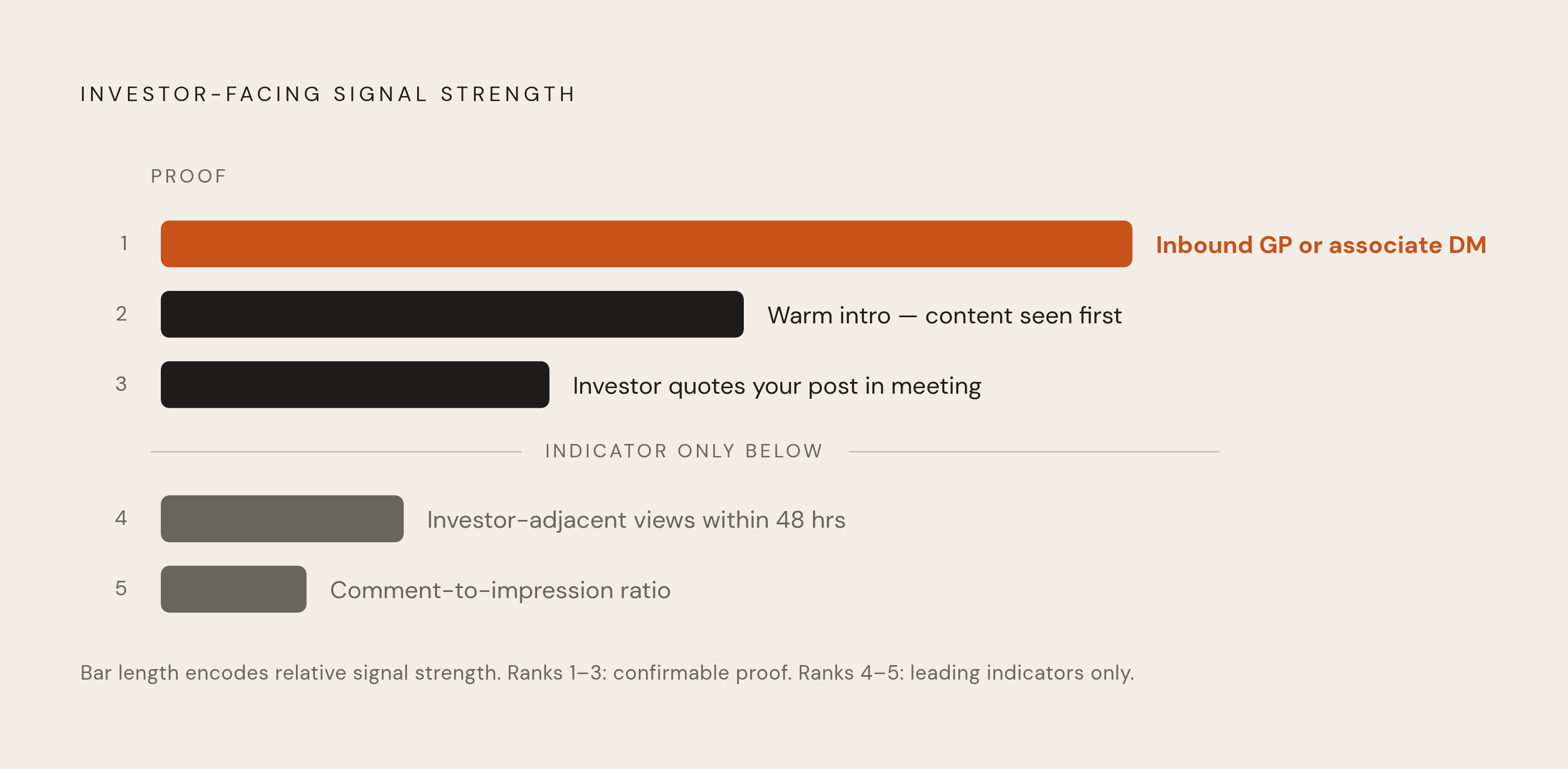
Weekly: what you published, the comment-to-impression ratio on each post, profile views broken out by role or company through LinkedIn's own analytics, any investor-adjacent connection requests that showed up.
Monthly: inbound DMs from investors, warm intro requests, any meeting where someone referenced a post unprompted, any mention of your content inside an existing investor update.
Quarterly, actually sit down and look at it instead of letting the spreadsheet gather dust somewhere. Which themes produced the most signal? Was there a consistent narrative frame underneath the posts that landed? What's worth cutting?
Rough order of what matters, if you need something to sort signal from noise:
- An inbound meeting request or DM from a GP or fund associate. Top of the list, not close.
- A warm intro where the person making it says they saw your content first.
- An investor quoting a specific post back at you in a meeting.
- Investor-adjacent profile views or connection requests inside 48 hours of posting.
- Comment-to-impression ratio on investor-relevant posts, a leading indicator at best, proof of nothing on its own.
Running all of this solo while also running a company is a real weight. The strategy, the writing, the weekly grind of staying consistent, stacked on everything else already sitting on a founder's plate. Some founders bring in outside help for the execution side, and that's fine; the job of whoever helps is to carry the grind without flattening the voice that made the signal work in the first place. Lose the voice and you've just built a nicer version of the noise everyone already ignores.
The clearest measure, in the end, is whether the raise took less time, whether the first meeting felt warmer than it had any right to, and whether the investor trusted your judgment before they'd opened the deck. Dashboards can't capture most of that, and they never were going to.