Personal Brand ROI Metrics for Founders
Track the four business functions where founder brand compounds returns over time.

Founders constantly compare their LinkedIn presence to a paid ads program. Then they get frustrated when the math doesn't work the same way. It won't. There's no clean attribution line from a post to a closed deal. That's not a flaw in the model. That's just how this works.
Think of personal brand less like a campaign and more like a reputation you're building in public on purpose. It pays out across multiple business functions at once, and the returns get bigger the longer you hold it.
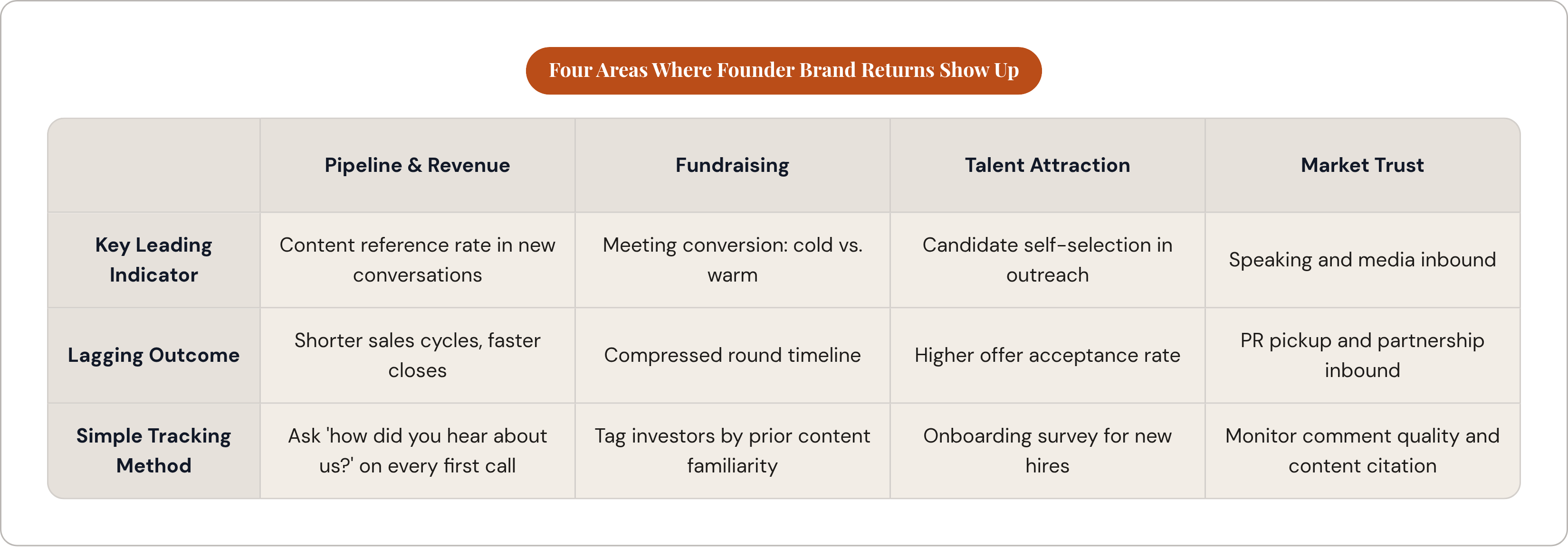
There are four places those returns show up:
- Pipeline and revenue. Inbound quality, deal velocity, shorter sales cycles.
- Fundraising. Investor awareness, faster round timelines.
- Talent attraction. Better applicants, higher offer acceptance.
- Market trust and credibility. Thought leadership, PR, partnerships.
Each category has leading indicators you can see in weeks and lagging outcomes that compound over months. That distinction matters more than most founders realize. If you check for lagging outcomes in week three, you'll conclude the program isn't working when it's still warming up. You'll pull the plug on something that was about to pay.
These categories also bleed into each other constantly. Brand you build for fundraising helps recruiting. Brand you build for recruiting helps sales. It's not four separate bets. One bet, four directions.
One real constraint worth naming upfront: because founders interact with people across multiple contexts, attribution is always partial. You're looking for directional signal, not courtroom-level proof. If you wait for perfect attribution, you'll be waiting forever, and nothing will get measured.
The pipeline metrics that show whether your content is generating business
The most important leading indicator for pipeline is not how many people saw your post. It's whether the people reaching out already know why they're reaching out.
That's the real signal: self-qualification. When someone messages you and opens with "I read your post about X and we're dealing with exactly that problem," they've already done half the sales work before the first call gets scheduled.
Here's what to track:
- Content reference rate. What percentage of new conversations mention a specific post or piece of content? Tracking this loosely over a quarter tells you more than any vanity metric.
- Inbound vs. outbound origination ratio. Are more deals starting with someone coming to you? Does that ratio shift as content accumulates?
- Sales cycle length. Consistent thought leadership pre-establishes credibility before the first conversation. That shows up in fewer objection-handling rounds and faster closes. Track average cycle length before and after a sustained content period.
- "Convinced before the call" quality. Prospects who've read your thinking arrive with less skepticism. They've already bought into the problem framing. Hard to put a number on, but you feel the difference after three calls in a row where nobody asks you to justify why the problem exists in the first place.
The practical way to track this costs nothing. Ask "how did you hear about us, or what made you reach out?" at the start of every first conversation. Informal is fine. Tag any answer that references LinkedIn content. Ninety days of that and you have real data.
There's also a subtler signal worth watching: referral quality. A warm intro from someone who follows your content is different from a generic cold intro. The referring person has context. They're vouching for fit, not just making an introduction.
And here's something that catches founders off guard. In complex B2B sales, the people who influence a deal (procurement, legal, finance) are often consuming thought leadership before they're visible anywhere in your pipeline. Your content is reaching buyers you don't even know are watching yet.
How fundraising timelines and investor behavior shift when a founder has a visible brand
Investors research founders before they take a meeting. That's not a maybe. Your LinkedIn presence isn't supplementary to the pitch. It precedes it.
What are investors actually looking for when they land on your profile?
- Clarity of thinking. Can you explain a complex idea simply, without the deck doing the heavy lifting?
- Consistency of conviction. Do you have a real point of view, or is everything carefully hedged into meaninglessness?
- Community signals. Are credible people engaging with your content seriously, or is it crickets?
- Narrative alignment. Does what they find on your profile match what's in your deck?
That last one matters more than founders expect. If your deck says you're building for enterprise and your LinkedIn content reads like you're talking to SMBs, that's a flag. Investors notice mismatches. They rarely tell you directly.
The most measurable fundraising metric is round timeline. Founders with established brands consistently describe entering investor conversations at a different starting point. Less "convince me this is real" and more "how do I get in." That compression in the early stages of a raise is real and trackable. Compare the time from first contact to term sheet across different warm-intro paths. Segment roughly by whether the investor had pre-existing familiarity with your content. Even a loose "they knew my work" vs. "they didn't" sort gives you useful signal over the course of a raise.
A secondary metric worth watching is meeting conversion rate. What share of first investor calls convert to a second? Does that differ for investors who followed you versus those who came in cold? Over a full fundraise you'll have enough data points to see a pattern.
One important nuance on stage: at pre-seed, investors are largely buying the founder. Narrative clarity and visibility matter most. At Series A and beyond, your brand supports the thesis but doesn't substitute for business metrics. Know which game you're playing.
The compounding timeline problem is worth naming directly. Brand you build during a raise is almost always too late. The value comes from trust and awareness accumulated in the months before you open the process. This is probably the single biggest mistake founders make with LinkedIn. They treat it like a sprint when it is, stubbornly, a slow burn.
Recruiting metrics that connect a founder's content to talent pipeline quality
When a founder posts consistently, something useful starts to happen: candidates research the company through the founder's profile. They arrive at an application or first conversation already aligned to the mission, already familiar with how the company thinks, already self-sorted.
That's a better candidate before a recruiter has even touched them.
The mechanics are pretty intuitive once you see them. Candidates evaluate where they want to work the same way investors evaluate where they want to bet. They look at the founder. They read the posts. They form a view. Most of this happens before anyone's exchanged a single email.
Metrics to track:
- Inbound application volume on key roles. Does volume shift after a hiring post or a high-reach piece of content? Even a directional change is worth noting.
- Candidate self-selection quality. Do inbound candidates reference your public content in their outreach? When someone opens with "I've been following your posts on X topic and it's exactly what I care about," that's the system working.
- Offer acceptance rate. Candidates who arrive mission-aligned accept offers at higher rates with less negotiation friction. Track this category separately from candidates who came through sourced outbound.
- Time-to-fill on senior or specialist roles. Hard to isolate, but a differentiated inbound channel helps most precisely where sourcing is hardest.
The values-alignment effect is the real compounding asset here. When your content makes your company's operating philosophy visible (how you make decisions, what you're building toward, what you don't tolerate), candidates self-filter before a recruiter gets involved. The wrong people opt out early. The right people opt in already convinced.
A simple tracking practice: ask every new hire in their first week whether they encountered your LinkedIn content before applying. Put it in the onboarding survey. Even a handful of "yes" responses per quarter are meaningful signal.
The wider context: a large share of organizations still report genuine difficulty filling full-time roles. A founder's brand is a differentiated recruiting channel in a market where most hiring funnels are fishing from the exact same sourced pool.
The trust and credibility metrics that don't show up in a CRM
Trust is the sneaky one. It accumulates invisibly, then converts suddenly, and the chain of cause and effect isn't always obvious in the moment. The question isn't whether it's building. The question is what leading indicators tell you it's building before it converts into something you can actually point to.
Here's something worth sitting with. A strong majority of B2B decision-makers view thought leadership as a more credible signal of capability than product marketing materials. What a founder writes about how they think is more persuasive than what the company says about its product. That's a real asymmetry, and founders consistently underuse it.
Proxy metrics for trust accumulation:
- Speaking and media inbound. Are journalists, podcast hosts, or conference organizers reaching out unsolicited? These are third-party endorsements. Someone outside your orbit decided you were worth amplifying. That means something.
- Comment quality on posts. Emoji reactions are vanity. Substantive comments from peers, potential partners, or potential customers are signal. Are you getting those, or are you getting fire emojis from people you went to college with?
- Profile view composition. LinkedIn's native analytics surface which professional titles are viewing your profile. Are the right titles showing up consistently? Directional, not precise, but genuinely useful.
- Content citation. Are other creators or publications referencing your posts or building on your ideas? Citation is one of the oldest trust signals in existence. It applies on LinkedIn the same way it applies in academic journals or trade press.
The company reputation effect is real and worth naming. When a founder is active and credible online, it changes how the company's brand is perceived more broadly. This shows up in PR pickup, partnership inbound, and how enterprise buyers characterize the company in later-stage diligence conversations.
Fair warning: trust metrics can't isolate your personal brand as the only variable moving. Other things shift at the same time. That's fine. Track the direction of these metrics over a consistent content period and use them to make resource decisions. Perfect causation isn't available. Useful directional signal is.
Building a simple measurement system that founders will actually use
The system does not need to be sophisticated. It needs to be consistent. That's the whole thing.
A minimal viable tracking stack:
- A monthly inbound log. Track every inquiry that references LinkedIn content: sales, recruiting, investor, media. A shared doc works. A CRM tag works. A sticky note works less well, but it still beats nothing.
- LinkedIn native analytics. Profile views by week. Post reach segmented by job title. Follower quality (track the title composition of new followers, not just the raw count). LinkedIn surfaces all of this for free.
- A UTM link on your profile. Put a simple UTM parameter on the link in your LinkedIn bio pointing to your website. You'll capture traffic attribution without any complex tooling. Takes about five minutes to set up.
- A quarterly source review. For every new deal, hire, and investor conversation in the quarter, spend five minutes tagging whether LinkedIn content played a role. "Yes," "no," or "uncertain." That's enough resolution to make decisions.
The 90-day checkpoint: consistent execution typically produces visible directional signal somewhere between three and six months. An inbound shift, a change in follower quality, a first content-attributed conversation. If none of those appear after sustained effort, the content strategy needs review. The measurement system is probably fine.
What to report to yourself and your co-founders: not impressions. The ratio of content-attributed conversations to total pipeline, and how that ratio changes quarter over quarter. That's the number that actually belongs in a growth conversation.
One discipline required: the system only works if you look at it. Monthly is enough. The point is to make the brand a real line item in how you think about growth, not a side project living outside the actual business.
What separates a content program that compounds from one that stalls
The measurement system is good at revealing a problem. It can't fix one. If inbound doesn't shift after sustained, consistent effort, the issue is almost always the content strategy itself.
The variables that determine whether a program compounds:
- Consistency. Irregular posting breaks two things at once: the platform's algorithmic distribution and your audience's trust loop. You don't have to post every day. You do have to post reliably enough that people expect to hear from you.
- Authentic voice. Content that surfaces real founder perspective, real decisions, and real stories outperforms polished corporate messaging. Not because authenticity is a virtue, but because it's what LinkedIn audiences actually engage with. Generic sounds like marketing. Specific sounds like a person.
- Strategic specificity. Content aimed at a named audience (the Series A CFO evaluating your category, the senior engineer who cares about a specific technical problem, the investor focused on a specific vertical) generates more qualified inbound than content optimized for broad reach. Counterintuitive, but consistently true.
- Founder involvement depth. The ideas, experiences, and stances have to come from the founder. Execution can be supported. The raw material cannot be fabricated. If the thinking isn't real, the audience figures that out eventually, and there's no recovering from it gracefully.
On the ghostwriting question: using a content partner to maintain consistency and sharpen execution is similar to using a communications director or a speechwriter. The founder's thinking is the product. The craft is support. This is a resourcing decision, not a credibility question.
The compounding timeline is uncomfortable but real. Meaningful brand equity builds over months to years. The measurement system's job during the early period, when returns feel invisible, is to give you enough signal to stay committed. Not to prove the program is working yet. Just to make it possible to keep going until it is.
Founders who track brand metrics the way they track pipeline are the ones who sustain the program long enough to see the compounding effect. And that's the only version of this that actually works.