Building an Executive Brand While Running a Company
Executive brands generate inbound deals, shorter sales cycles, and top talent.

Let's just get this out of the way: an executive brand is a business asset. It has measurable outputs. Those outputs have nothing to do with feeling important at conferences or watching your follower count tick up.
What it actually produces:
- Inbound deal flow from people who already understand what you do before they call
- Shorter sales cycles because buyers arrive half-convinced
- Talent who already believe in the mission before the first interview
- Investor conversations where you're not starting from zero every time
The mechanism is buyer behavior, and it's pretty simple. In B2B, most purchasing decisions are shaped long before a buyer ever contacts a vendor. They read stuff. They watch things. They form opinions quietly, on their own time, when no salesperson can reach them. Thought leadership lands in that window. By the time a visible founder gets on a call with a prospect, a significant chunk of the persuasion work is already done.
Fundraising runs the same play. A founder with a clear, public point of view changes the entire posture of investor conversations. The room stops asking "convince me" and starts asking "how do I get involved." I've been in both versions of that meeting. One of them is genuinely enjoyable. The other one makes you want to reschedule your flight home early.
Candidates do this too. They research founders before accepting offers. A founder who has actually said something real about the market in public, who has a perspective you can read before your first conversation, attracts people who are already pre-aligned. That's worth more than any recruiting pitch your HR team writes.
The piece most founders miss is the compounding part. A post you publish today can generate a lead or spark a conversation eighteen months from now. Paid campaigns die the second you stop paying. Content doesn't. It keeps working while you're doing everything else. There's no clever trick to that. It's just how compounding works, and it applies here the same way it applies everywhere else.
LinkedIn as the specific arena for operator-founders in the current moment
Platform choice matters as much as content quality. Spreading yourself thin across four platforms so you can feel like you're everywhere is a great way to be nowhere. For B2B founders, the platform is LinkedIn. That's not a hot take. It's just where the numbers are.
The largest share of B2B social leads comes from LinkedIn, by a margin that makes the comparison slightly embarrassing for every other platform. But the more interesting structural advantage goes one level deeper.
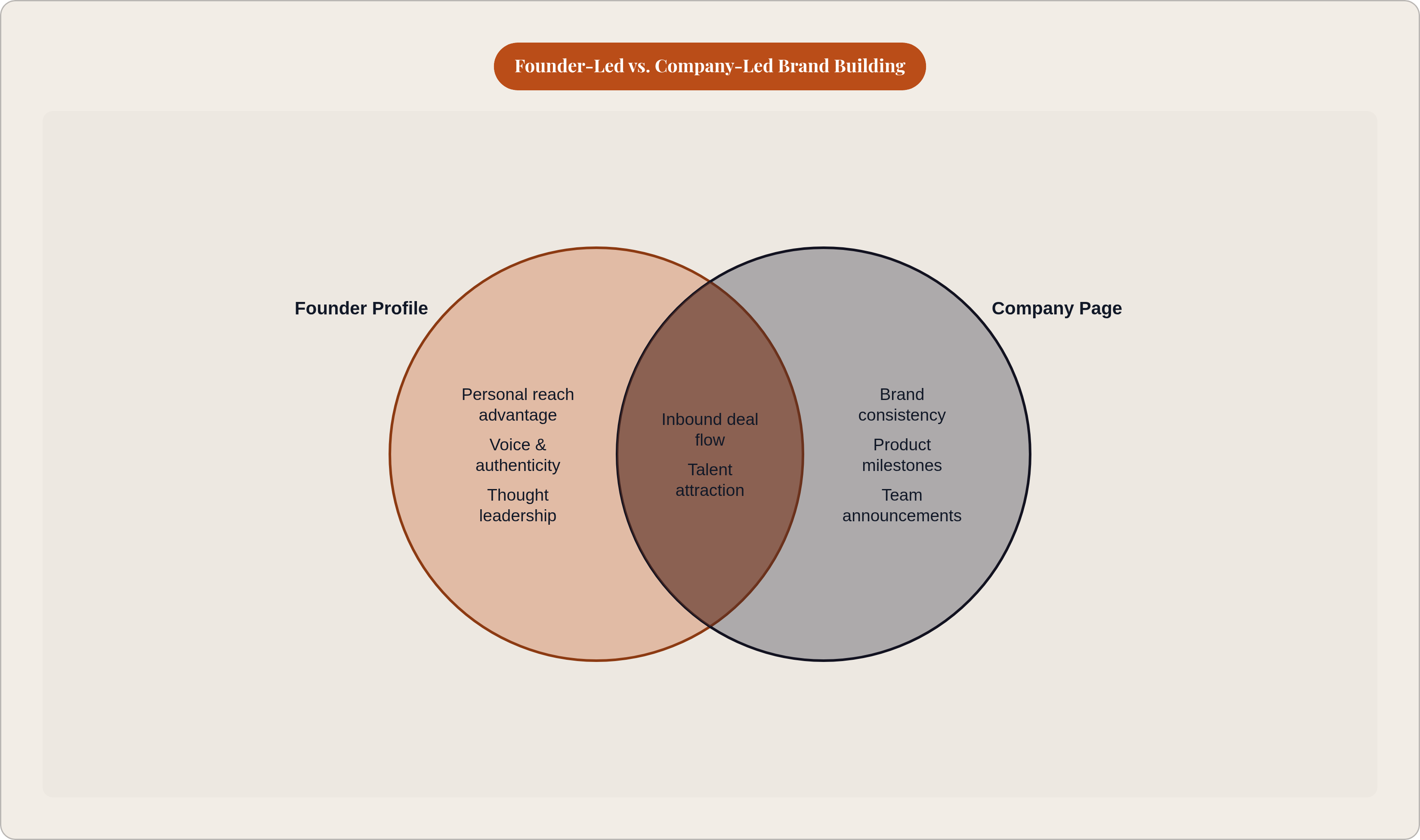
Personal profiles generate significantly more reach and engagement than company pages. This isn't a content quality thing. It's baked into how LinkedIn decides what to show people. That's a structural reason to do founder-led content rather than handing it off to a marketing team and hoping the company account does the work. The company account consistently underperforms, and has for years now.
Then there's the participation gap, which is honestly kind of wild when you see the numbers. The overwhelming majority of LinkedIn users never post anything. Consistent presence, with an actual opinion in it, puts a founder ahead of almost the entire platform before a single word is optimized. The bar isn't as high as it looks from the outside. Most people have quietly decided not to clear it at all, which makes things easier for anyone who shows up.
One more thing worth knowing for 2025: LinkedIn now evaluates profile credibility before deciding how far your content travels. Your profile is infrastructure, not a bio. A weak profile is a ceiling on your reach no matter how good your posts are. Fix it before anything else.
How the algorithm actually distributes a founder's content in 2025
The algorithm isn't a mystery. It has a logic, and once you understand it, you can work with it instead of around it.
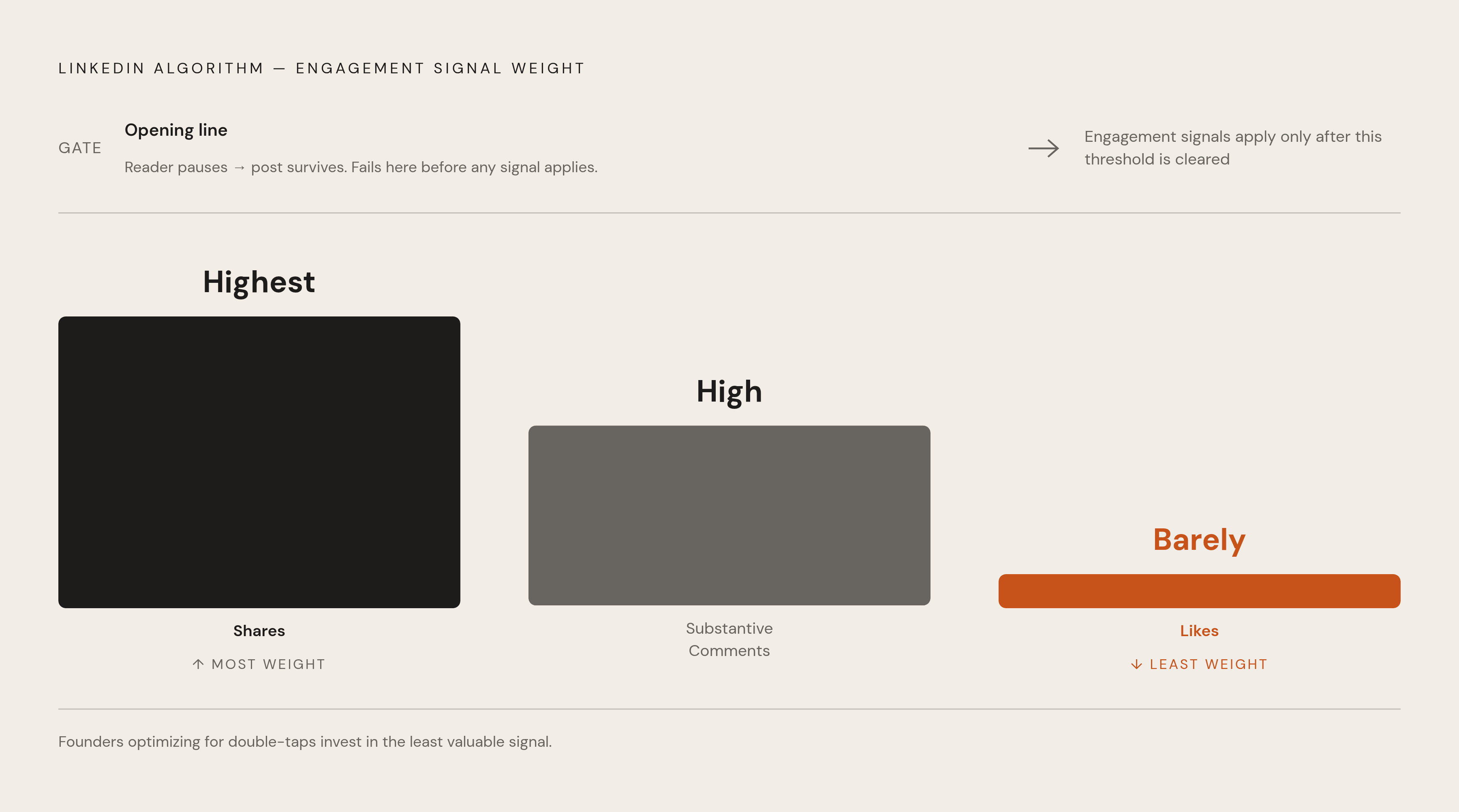
Early distribution is triggered by how long people pause on a post before scrolling. What that means practically is that the opening line is the single highest-leverage element of any post. If the first sentence doesn't earn the second one, nothing else gets seen. The rest of the post is irrelevant.
Posts that hold attention past a certain threshold get pushed to a broader audience. This is why posts sometimes "take off" after starting slowly. They crossed a threshold. There's no dark magic to it.
What actually signals wider distribution:
- Substantive comments carry far more algorithmic weight than likes
- Shares carry more than comments
- Likes alone barely register from a distribution standpoint
This changes what a "successful" post looks like. Posts that invite a real reaction, that take a position or name a tension most people feel but don't say out loud, outperform posts that are easy to scroll past and easy to double-tap. Safe content performs safely. Which means it barely moves.
On cadence: three to five posts per week works for most founders. More is not better if "more" means publishing half-baked thinking just to hit a number. Volume without substance is noise at scale, and LinkedIn users are already swimming in that.
The 90-day minimum is real, even if it's annoying to hear. Founders who check results at four weeks are measuring noise. Compounding requires sustained input before it shows up as signal. That patience is part of the strategy, not a consolation prize for slow starts.
The operating system that makes brand-building sustainable without adding a job
The reason most founders deprioritize brand-building isn't laziness. It's that they frame it as a separate creative process they have to stack on top of everything else. That framing makes it feel impossible, because it kind of is. The fix is simpler than it sounds: stop treating it as a separate thing. Extract content from work that already happens.
The content is already inside your week. You're just not catching it.
- Decisions you made and why you made them. That reasoning is a post.
- Problems that surfaced in team meetings and how they got worked out. That's a post.
- Customer conversations that expose a misconception you keep running into. Absolutely a post.
- Hiring conversations that forced you to articulate what your company actually believes. Post.
The capture habit is what makes all of this work. A voice memo after a call. A note app running in the background. A Slack message to yourself when something strikes you. The thinking is already happening inside your normal week. It just evaporates if nobody catches it.
A concrete weekly rhythm:
- One or two protected blocks for content review and approval. Not creation. Review and approval.
- A point-of-view filter. Every post should be useful to the specific market you're selling into. Not a take on AI trends, not a productivity tip. Something your buyer actually needs to hear.
- Batching. Review a week's worth of content in one sitting instead of reacting to it daily. Daily reaction is how content becomes an interruption.
Before any of this: fix your LinkedIn profile. The headline, the featured section, the about section. Every post you publish drives traffic back to your profile. A weak profile is a leaky funnel, and you're wasting distribution you already earned.
The split that makes this sustainable is straightforward. The founder provides the thinking. Someone else handles the craft and the scheduling. That's where ghostwriting fits in.
How ghostwriting fits inside this system without undermining authenticity
Ghostwriting, in this context, means a skilled writer translating a founder's existing knowledge, voice, and experience into something publishable. Not making things up. Not filling in blanks with generic LinkedIn wisdom. Taking what's actually in the founder's head and getting it out in a form that works on the platform.
This is not a new or sketchy practice. Leaders and executives have worked with communications partners for a very long time. What matters is whether it's done well.
The onboarding process that makes it work:
- Voice documentation. Vocabulary preferences, structural tendencies, topics that are off-limits.
- Interview-based extraction. The writer draws out what the founder actually knows, rather than inventing a persona and hoping it sticks.
- Ongoing calibration. A good ghostwriting relationship gets more accurate over time, not less, because the writer develops a real model of how the founder thinks and talks.
Three things that make the arrangement work ethically:
- The ideas trace back to the founder's actual experience. Nothing fabricated.
- The voice sounds like the founder at their best, not like a character performing "thought leader."
- The founder reviews, approves, and can defend every post if someone brings it up in conversation.
The quality signal that tells you whether it's working is simple: do the posts sound like the founder in real life? When they don't, the process has failed. That's the line between a real ghostwriting relationship and a content mill cranking out generic takes with someone else's name on them.
The best ghostwriting arrangements are built around this distinction specifically. Writers who have grown their own audiences using the same methods they apply for clients bring something different than generalists hoping to reverse-engineer someone's voice from a LinkedIn profile and a brief intake call.
What founder stories actually need to do, and how to build them
Most founders lead with the company's features and milestones. This is a mistake. Nobody cares about your milestones until they understand the tension that made them necessary. Leading with what you built before you've established why it matters is like starting a movie with the credits. Technically the information is there. Nobody's paying attention yet.
Stories that work are built on specificity, not summary. The detail that makes a reader feel like they were actually in the room. Not the polished retrospective that papers over what it actually felt like.
A structure that holds up:
- Problem. The specific gap or friction the founder witnessed before the company existed. Name the industry. Name the scenario. Name the feeling if you can.
- Breakthrough. The insight or decision that changed the direction. Often a failure or a pivot, not a win. Wins are kind of boring. Pivots are interesting because something had to break first.
- Vision. Where this leads. Not a product roadmap. A world the audience actually wants to live in.
Failure is narrative currency, and founders who don't spend it are leaving credibility on the table. Sharing setbacks, wrong turns, and the moments where things broke is what builds the kind of trust that polished positioning can't manufacture. Audiences read resilience as a signal for future performance. The founder who has never struggled publicly looks either lucky or dishonest, and it's usually pretty clear which one.
The customer-as-hero framing is worth internalizing. The best founder content positions the reader or the customer as the protagonist, with the founder as the guide who has already been through the terrain. That's more useful and more compelling than self-congratulation.
The same core story adapts depending on who's in the room:
- Investors: Lead with mission and market validation before you touch financials.
- Candidates: Lead with the problem being solved and who the team becomes by working on it.
- Customers: Lead with the friction they already recognize before you introduce what you built.
Stories outperform data as LinkedIn content because emotional resonance is what makes something shareable. A post a reader forwards to a colleague is worth more than a stat they nod at and scroll past. Data supports a story. It doesn't replace one.
What a working brand-building rhythm looks like at six months
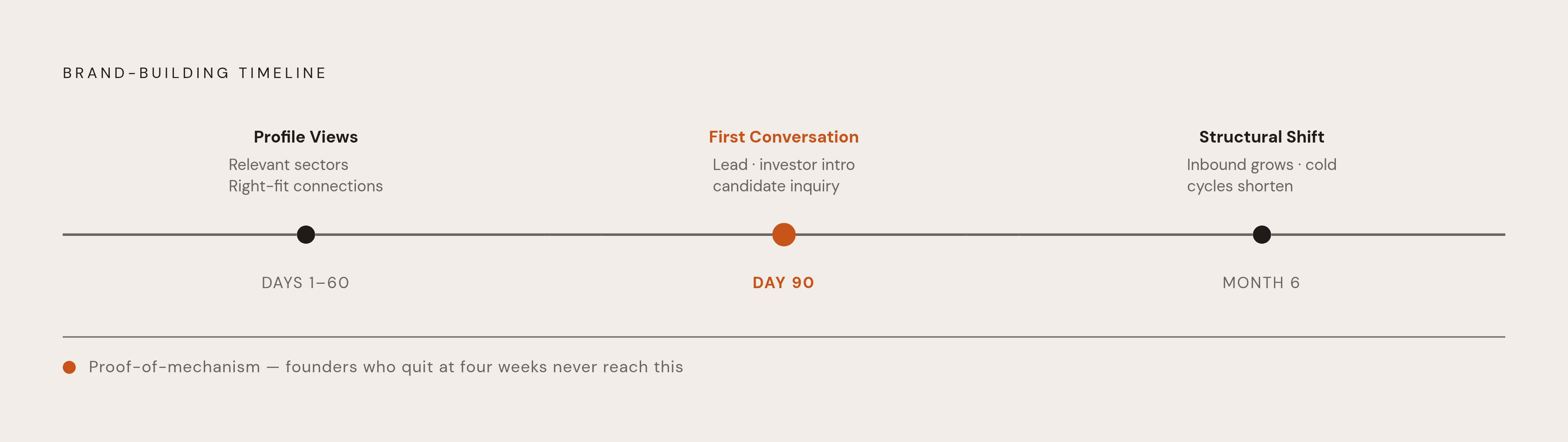
Six months is the right frame for evaluating this. The compounding effect takes a minimum amount of time before it shows up anywhere meaningful. Founders who check at four weeks and conclude it doesn't work ran an incomplete experiment and stopped before the data showed up.
What the timeline actually looks like:
First 60 days. Increased profile views from relevant sectors. Inbound connection requests from the right types of people. These aren't vanity metrics. They're early signals that the right audience is finding the content.
Around 90 days. At least one real business conversation. A lead, an investor introduction, a candidate inquiry. Something that didn't exist before and that traces back directly to a post or a profile view. It will feel small. It isn't small. It's proof that the mechanism works.
Around six months. The structural shift. The mix of inbound versus outbound starts to change. Cold outreach cycles get shorter. Deals and conversations begin differently. Brand-building stops feeling like an obligation and starts looking like a line item that actually produces something.
The most important thing that changes by this point isn't any specific metric. It's the founder's posture. Brand-building stops being the thing on the shelf. It becomes part of how the company acquires trust, talent, and attention. It just becomes how things work.
The system is learnable. The timeline is predictable enough to plan around. The part nobody wants to say out loud is that most founders know this and still wait, usually because they're waiting for a slow week. Let me know how that goes.