Turning Founder Failures Into High-Performing LinkedIn Posts
Authentic failure stories outperform polished wins on LinkedIn's algorithm.

Founder failures beat founder wins on LinkedIn, and it's not close. Admit the launch tanked, the hire flamed out, the pitch got laughed out of the room, and suddenly people stop scrolling. This piece breaks down why that happens and how you turn it into something repeatable instead of a one-off confession.
Most founders do the opposite of what actually works. They lead with the resume, announce the win, project the authority. Makes sense on paper, backwards in practice.
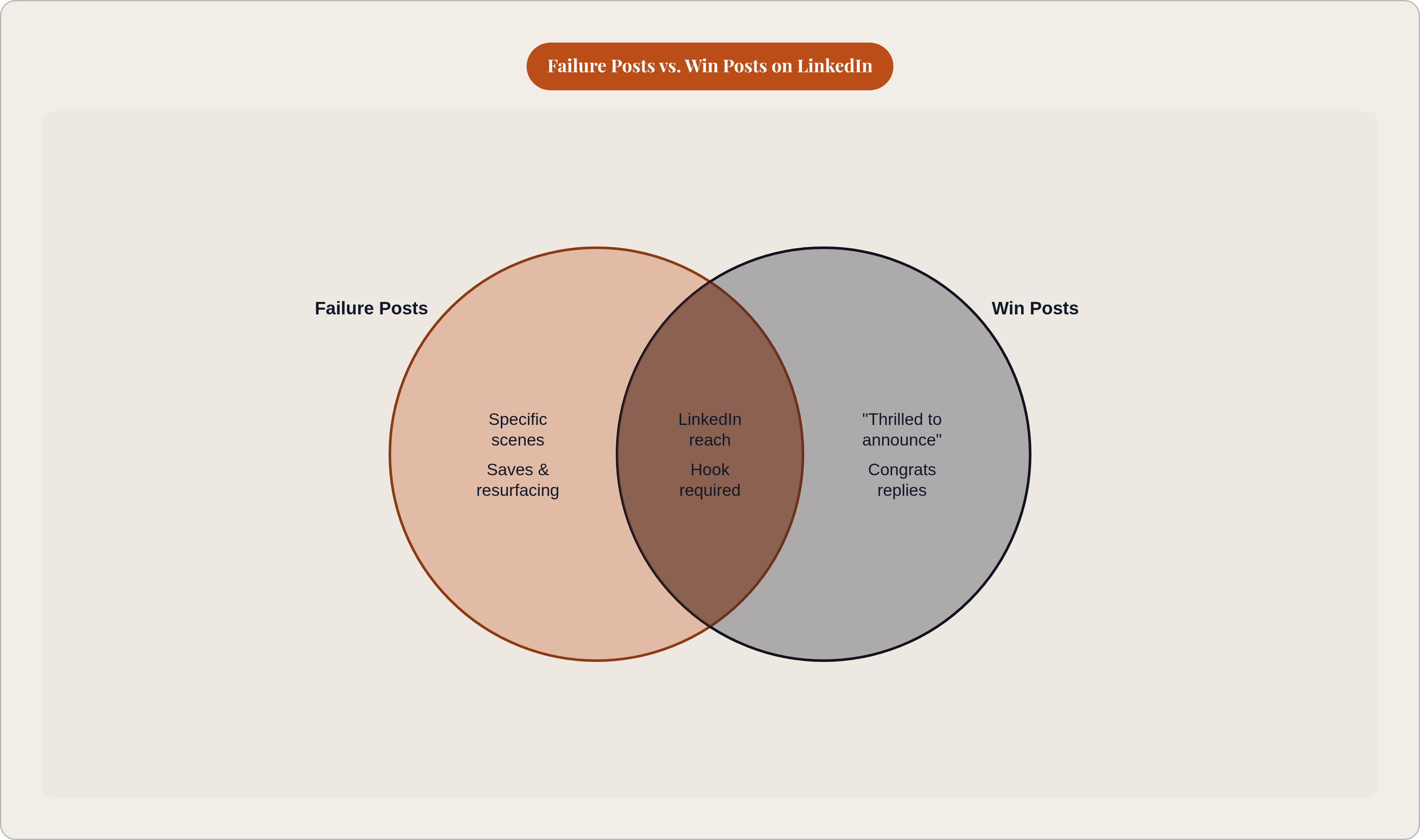
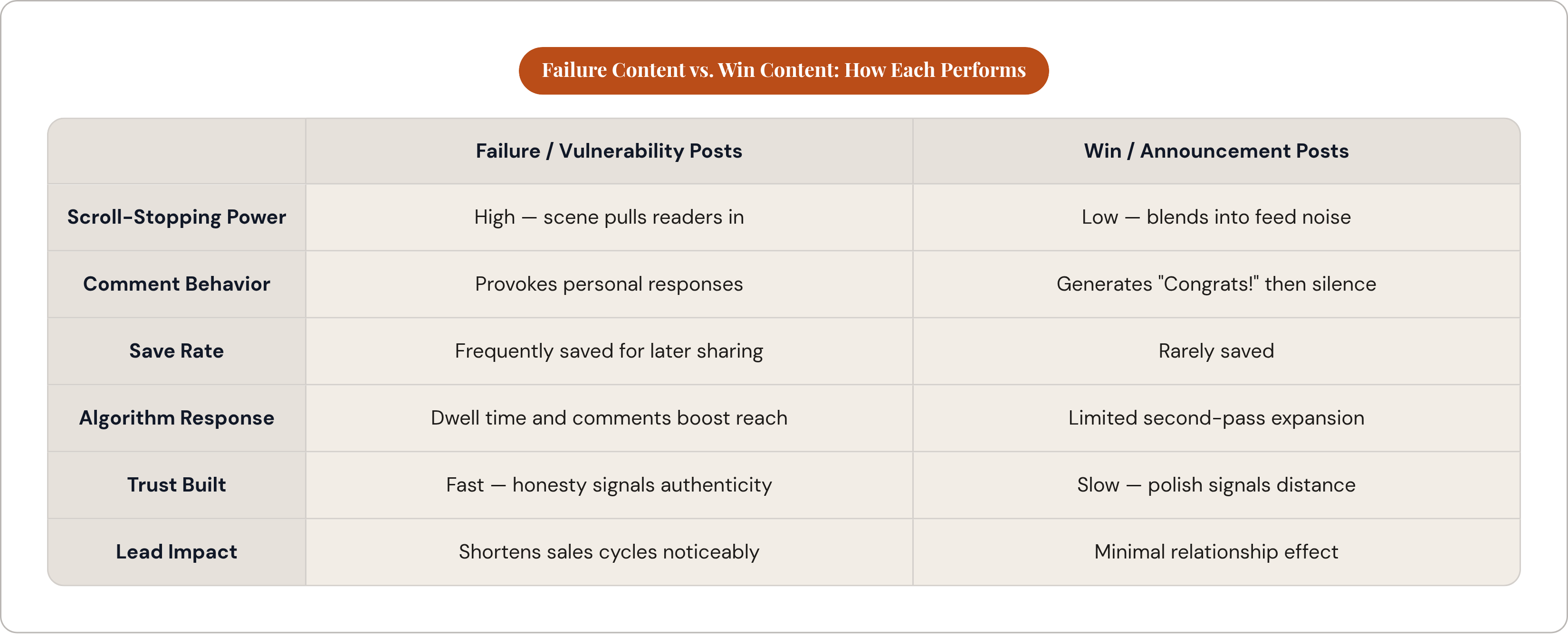
Think about your feed right now. It's wall-to-wall "thrilled to announce" posts, and they all sound the same after a while, don't they? A supplier who ghosted you two days before launch, a hire you knew was wrong in the interview but talked yourself into anyway, that's a scene. Scenes stop people. Stats just blend into the wallpaper.
There's real mechanics behind this, not just a hunch. Personal profiles pull 2.75x more impressions and 5x more engagement than company pages, and company pages only reach about 1.6% of their own followers, so the actual lever sits with the founder's face, not the logo. Add to that: only around 3% of LinkedIn's roughly 310 million monthly users post more than once a week. Show up consistently and you're already ahead of 97% of the platform. You don't need to be clever, you need to be there.
Vulnerability works because it's specific, and specific things are hard to argue with. "We failed to align on strategy" is forgettable. "I fired my co-founder over email at 11pm because I was too much of a coward to do it in person," nobody scrolls past that one. It's not therapy, it's not a performance, it's just proof a person, not a brand, wrote the post. People connect with people, and nobody's ever sent a company a birthday card.
One caveat: this isn't a license to manufacture drama. Fake vulnerability smells exactly like fake everything else does, and the whole thing rests on the story being true. If it didn't happen, leave it alone.
How LinkedIn's current algorithm reads and rewards failure-format posts
LinkedIn quietly rewrote the rules in 2025. The 360Brew model now checks the credibility of the profile behind a post before deciding how far it travels, and it's not just grading your content anymore, it's grading you.
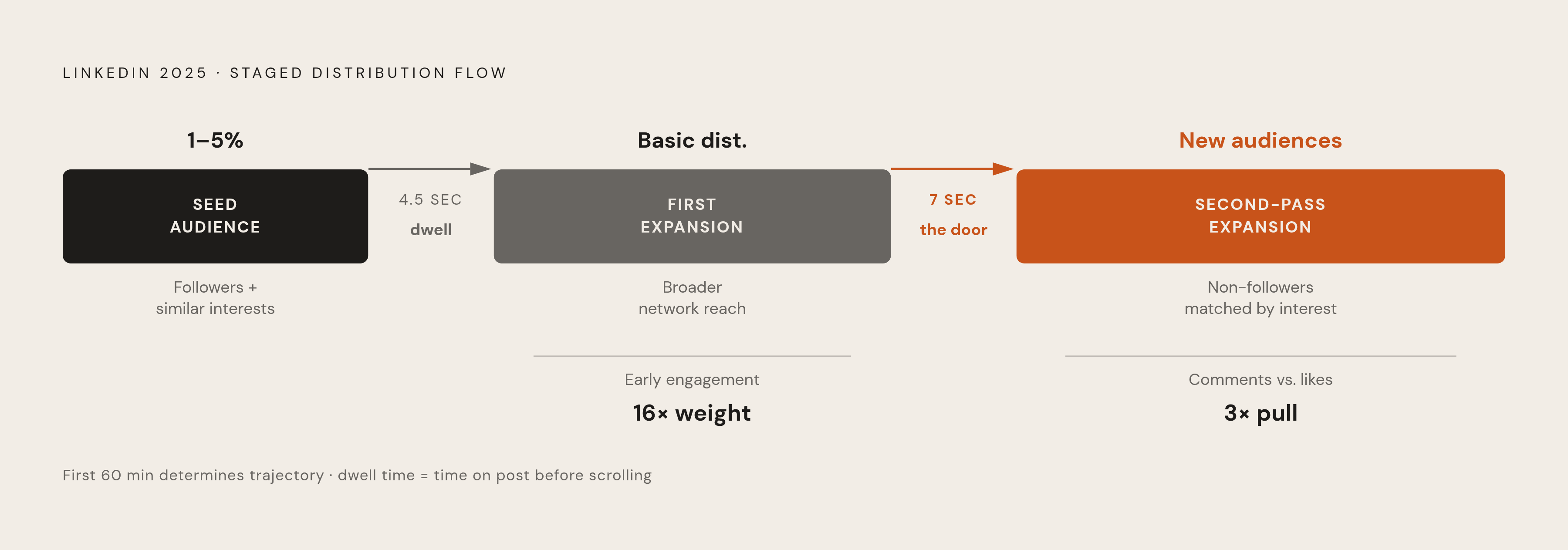
Dwell time is the gatekeeper nobody talks about at dinner parties. Hit 4.5 seconds and you get basic distribution. Cross 7 seconds and the system kicks off a second-pass expansion, pushing the post to people who've never followed you. A concrete, human opening scene holds attention in a way a statistic simply can't, and this matters more now that follower-first reach has dropped to somewhere around 10 to 20% of total reach. Most of the people seeing your post have no idea who you are yet, and the hook is carrying the entire load.
Comments outweigh likes by a wide margin, roughly 3x the algorithmic pull. Failure stories generate comments almost automatically, because people see themselves in the story and can't help but respond, share their own version, or ask what happened next. A win post gets "Congrats!" and then silence. Congrats is a dead end, and a comment is a conversation.
Early engagement now carries something like 16 times the weight it used to, and that first hour works like a bouncer at the door, deciding whether the post gets amplified or quietly shown out. Failure posts, because they provoke an immediate gut reaction, start that hour with a head start built in.
The algorithm's also gotten better at spotting the fakes. Engagement bait, the "comment YES if you agree" stuff, now eats an estimated 40% distribution penalty. That's a full reversal from 2022 and 2023, when bait tactics still worked fine, and honest storytelling isn't just the nicer choice these days, it's the one that performs.
Saves matter too, and they carry weight longer than a like ever does. A save tells LinkedIn the post has staying power, which triggers resurfacing over the following weeks. Lesson-forward failure posts get saved constantly, because people want to come back to them, maybe send them to a friend going through the exact same mess.
The story sandwich: a repeatable structure for failure posts that earn reach
Here's the format. Open with a scene, widen into a broader point, back it with evidence, close with something the reader actually walks away with. Four layers, each doing its own job.
The opening scene buys you the dwell time before a single like registers, and it has to survive fast: "See More" cuts posts off around 210 characters. The broader point tells the reader this isn't just a diary entry, it's headed somewhere. The evidence layer builds your credibility quietly, without you standing up and announcing your own resume. Story earns the lesson, lesson earns the data, never the other way around. The closing insight is the part people save or think about on the drive home.
Length matters more than most founders assume. Failure stories need room, somewhere between 200 and 350 words, to build tension and actually pay it off. Too short and the story never gets past headline stage. Too long and you'd better have earned it; posts over 2,000 characters do post the highest average engagement, but only when the structure justifies the extra real estate. Otherwise you're just rambling with good intentions and a longer scroll bar.
This isn't a confession booth, either. The failure is the doorway, not where you're supposed to live. End on "and that's when I realized I needed therapy" and you've written a journal entry, not a LinkedIn post. Land on the forward-looking insight instead.
Compare this to what most founders actually publish: safe, sanded-down observations that could've come from anyone with a login. "Leadership is about listening." Sure, and water is wet. The story sandwich forces specifics that generic content can't fake, because generic content, by definition, has nothing to hide behind.
The best founder accounts worth studying do exactly this — they don't gloss over the failures or the pivots or the moments that could've sunk the company. They name them, with detail, and that detail is the whole reason the posts land. You can't fake that kind of specificity, and readers clock the difference in about half a second.
Where founders find the failure stories worth telling
Founders self-censor constantly, usually without even noticing they're doing it. The supplier who shipped a batch of defective units. The real, embarrassing numbers behind a launch that flopped. The hire everyone privately knew was a mistake within a month, but nobody said anything until quarter two. These stories get edited out before the founder even sits down to write, and that instinct is exactly backwards.
A few categories keep producing the strongest material. Operational failures: a process that snapped under scale, a launch with terrible timing, a partnership that fell apart mid-deal. Hiring failures: the wrong hire everyone saw coming a mile off, a management call that quietly demoralized the whole team for months. Strategic failures: a market assumption that turned out dead wrong, a pivot made six months too late (or six months too early, which is somehow worse). Fundraising failures: the pitch that got rejected, and what the rejection actually taught you once the sting wore off. Worth knowing here that this kind of content genuinely moves buyers; per the Edelman-LinkedIn B2B Thought Leadership Impact Report (2025), 95% of hidden decision-makers say it makes them more open to being approached by a company.
Stuck on what to write? Three questions tend to crack it open. What decision from the last 12 months would you make differently, and what would you tell a founder standing exactly where you stood? What assumption did you walk in with on day one that turned out completely wrong? What's the story you've told out loud a dozen times at dinner but never written down, because it felt too risky to actually publish?
Run every idea through a simple test: could this have happened to literally any founder? If yes, it needs more detail. The bar is a story only you could've written, because it happened in your business, with your numbers, on your worst Tuesday.
None of this works as a one-off, by the way. Failure stories are one leg of a bigger content system, sitting alongside tactical frameworks, sharp takes on your industry, posts about hiring and team-building. Together they build an actual point of view. Alone, a single failure post is just a nice story that fades in three days and gets replaced by someone else's nice story.
The hook is the post: how the first line determines whether anyone reads the rest
The algorithm clocks dwell time before anyone likes or comments anything, and your first line either buys the pause or it doesn't.
A few hooks reliably flop. The credential front-load ("As a founder with 10 years in SaaS...") reads like a LinkedIn bio, not a story. The announcement ("Excited to share that we just closed our Series A") is fine as information and terrible as a hook. The generic lesson ("Failure is the best teacher") is true the way fortune cookies are true: accurate, and completely invisible in a scrolling feed.
What actually works is dropping straight into the moment. "We had 48 hours to replace hundreds of thousands of dollars in inventory. Here's what that actually looked like." That's a hook. Or state the twist up front: "Losing our biggest client in Q3 was the best thing that happened to us. I didn't think so at the time." Now the reader needs to know why, and they'll stick around to find out. A specific number helps too, used sparingly, not to impress anyone but to make the stakes feel real.
Keep that 210-character cutoff in mind at all times. Everything that matters has to land in the first two lines, before "See More" swallows the rest of your post into a gray link nobody bothers clicking.
The biggest mistake founders make is saving the good part for the end without earning the walk there. If the opening doesn't create some tension, nobody scrolls down to find out what happened next, and walking away has to feel like leaving money on the table.
Converting readers into leads: what to do after the story lands
Here's a trap a lot of founders fall into. They write a genuinely great story, then kill its own reach by dropping a link straight into the post body. External links carry an estimated 40 to 60% distribution penalty, according to multiple content analysts, and that link to your landing page is quietly strangling the exact reach that made the post worth writing in the first place.
The fix is simple, if a little counterintuitive. Keep the post body clean, no links anywhere, and drop the link (landing page, newsletter, calendar invite, whatever it is) into the first comment, pinned the second you publish. Then use your closing line as the actual call to action: something like "If you're dealing with this right now, reply and I'll tell you what we tried." That pulls the right people into your comments, which is exactly where you want them sitting.
That comment section isn't just a nice-to-have, either. It's a lead-gen surface in disguise. Since thoughtful comments carry roughly 3x the weight of a like, responding to every real comment in the first hour does two things at once: it feeds the algorithm, and it builds the actual relationship with the actual human on the other end.
Don't skip the profile itself. Every post is a driveway leading somewhere, and if the house at the end of it (your headline, your featured section) doesn't say anything useful, you're funneling all that attention into a void. Fix your profile before you publish anything, not after the traffic shows up with nowhere to go.
Patience matters more than founders want to hear. Meaningful engagement tends to show up around weeks four to six. Qualified leads and inbound messages usually start landing in months two to three, not week one. Per HubSpot research, a consistent LinkedIn presence sustained past 90 days produces a 45% average increase in inbound inquiries from target-segment connections. Not overnight, but it compounds, the way most things worth doing do.
There's a trust effect worth naming too. When a prospect already follows your posts, the first sales call doesn't start from zero, it starts from "I already like this person." Founders active on LinkedIn have been reported to see sales cycles running 30 to 40% shorter. Failure content speeds this up specifically, because trust built on honesty moves faster than trust built on polish ever will.
Why founders stop posting failure content — and the systems that prevent it
Here's the pattern almost every founder falls into. They quit around week three, right before the four-to-six week mark where engagement actually starts to show up. It's not bad luck, it's a documented, repeatable timeline, and most people bail right before the payoff arrives.
Part of it is self-censorship creeping back in through the side door. You publish something vulnerable, feel a little too exposed, and the next week you retreat to something safe and forgettable. Without a system, that retreat happens on autopilot, every single time. The fix isn't willpower, it's removing the decision from the moment of publishing altogether, so tired-you doesn't get a vote.
A few habits keep the whole thing running without burning you out completely. Batch two hours a week, separate from everything else on your plate, to produce five to seven posts plus rough outlines for anything longer. Spend three hours a month mapping failure themes and lesson arcs, so your weekly sessions are execution, not staring at a blank cursor wondering what to write about. And carve out 15 minutes a day for engagement, replying to comments, interacting with other people's posts, since that's exactly the early-engagement behavior the algorithm watches for in that first hour.
On frequency: 3 to 5 posts a week is the sustainable range. Daily posting tanks quality fast, and once a week is too slow to build any real momentum. Richard van der Blom's 2025 research points to 2 to 5 times a week as the sweet spot for consistent performers.
None of this works without a spine underneath it. Failure stories with no point of view are still just noise, dressed up nicer than the rest of the noise. A founder selling to a VP of Marketing shouldn't post broadly about "startup life." They should repeatedly teach that specific audience how modern B2B teams create demand, and where the old playbooks quietly break down. Failure stories are one format inside that frame, not a replacement for having a frame at all.
Worth knowing: LinkedIn runs a staged test on every post, showing it to somewhere between 1 and 5% of your followers plus non-followers with similar interests, all inside the first 60 minutes. Hook quality and the speed of early engagement decide whether the post breaks out of that test group or dies quietly inside it.
When to write your own failure posts and when to use a ghostwriter
Writing your own posts has one advantage nothing else replicates: real-time authenticity. If you can write, and you've got the time to batch content, you build a feedback loop most founders never get around to, watching what you publish shape what you learn from how people actually respond to it.
The model breaks in a couple of predictable spots, though. Most founders can tell you the story fine over coffee, they just can't structure it on a page. They know what happened but not how to build a story sandwich out of it. And self-censorship is brutally hard to beat alone, since the stories that feel too risky to publish are usually, infuriatingly, the ones that perform best. A good ghostwriter's real job is pushing back on that instinct, not typing faster than you could.
Ghostwriting itself runs mostly extraction and only a small fraction actual writing: voice capture, structured interviews, audits of what you've already posted, a style guide documenting how you actually talk versus how you think you sound on paper. The writing, honestly, is the smallest part of the job.
On the ethics of it: ghostwriting is a legitimate, long-standing tool, not a shortcut around honesty. The ideas and the lived experience have to be yours, and the structure and the prose are what a ghostwriter adds on top. Per the Edelman-LinkedIn B2B Thought Leadership Impact Report (2025), 73% of decision-makers view thought leadership as a more trustworthy way to judge a company's capability than its product materials, which is exactly why the truth underneath the story matters more than whose fingers hit the keyboard.
Not all ghostwriting is equal, either. Someone who's never built their own audience is guessing at what works, running templates and hoping something sticks. Practitioners who've actually generated distribution using these methods, the story sandwich, the hook mechanics, the comment strategy, apply them with real confidence, because they watched the numbers move on their own accounts first.
Forj Media runs on that practitioner model: structured interviews, voice audits, story mining pulled from a founder's actual experience, turning it into failure-format posts that sound like the founder because they are the founder's thinking, just shaped into a structure the platform rewards. The team's put up 700K-plus impressions and reached 267K-plus members on LinkedIn using these exact methods on their own accounts, before ever running them for a client.
So which path fits you? If the constraint is time, a ghostwriter solves it. If the constraint is knowing which stories matter and how to shape them, a ghostwriter solves that too. And if the constraint is the nerve to publish the story that still feels a little too honest, sit with that one a while, because that's usually the post that actually works.