Extracting a Founder Origin Story for LinkedIn
Learn which questions unlock the real story founders are too close to see themselves.
Founder origin stories don't come pre-written. You have to dig for them, the same way you'd dig for a good bottle of wine at the back of a cellar nobody's cleaned out since 2019. This piece is a walkthrough of that dig: the questions to ask, the junk to throw out, and what to do with the good stuff once you find it.
Here's the thing nobody tells founders: you are the worst possible person to write your own story. You're too close to it, and you've told the "why we started this company" version so many times, at so many pitch meetings, that it's been sanded down into something smooth, safe, and completely forgettable.
Most founders default to the company timeline. Founded in 2019, raised a seed round in 2021, launched product two in 2022, and it reads like a Wikipedia stub. Worse is the "About Us" trap, that paragraph every company has that describes what it does with the emotional temperature of a tax form. Polished, sure, but also dead on arrival.
The actual story, the one worth telling, is usually about a problem you were solving for yourself or somebody you loved before you ever called it a "market opportunity." That story is in there, and it just needs to be excavated, not invented, and if a founder tells you they "don't have a story," what they really mean is nobody's asked them the right question yet.
What a LinkedIn origin story actually needs to do
Your LinkedIn profile works like a landing page now, whether you designed it that way or not. A prospective client, an investor, a candidate deciding whether your job posting is worth a reply, all land on your profile before any of that happens, and they decide in seconds whether to keep scrolling or bounce.
Stanford University research found storytelling increases recall by up to 22 times compared to plain facts, and that's not a nice-to-have stat to sprinkle into a deck. It means your origin story is the thing people actually remember about you, long after they've forgotten your job title or your product's tagline.
On LinkedIn specifically, the story has a job to do, and sounding interesting is only part of it. It needs to signal credibility before a sales call ever gets booked, and it needs to make the reader think, this person gets my problem, without you ever saying "I understand your pain points" (please don't ever say that). It has to separate you from the fifteen other founders in your category who all sound like they went to the same LinkedIn finishing school, and it needs to establish expertise without you listing out your credentials like a diploma wall.
Investors check LinkedIn before meetings, and candidates do too. A strong origin story tells both groups that you can represent this company in public, not just run it behind closed doors, and that you're worth working for beyond the equity math.
Aim for seven qualities when you're evaluating what you've pulled together: authentic, believable, purposeful, relatable, memorable, inspirational, shareworthy. Use those as a gut check, not a formula. Keep the About section version tight, 200 to 300 words, though a standalone post can breathe a little more, but "breathe" doesn't mean "ramble."
The three story types founders should distinguish before extracting anything
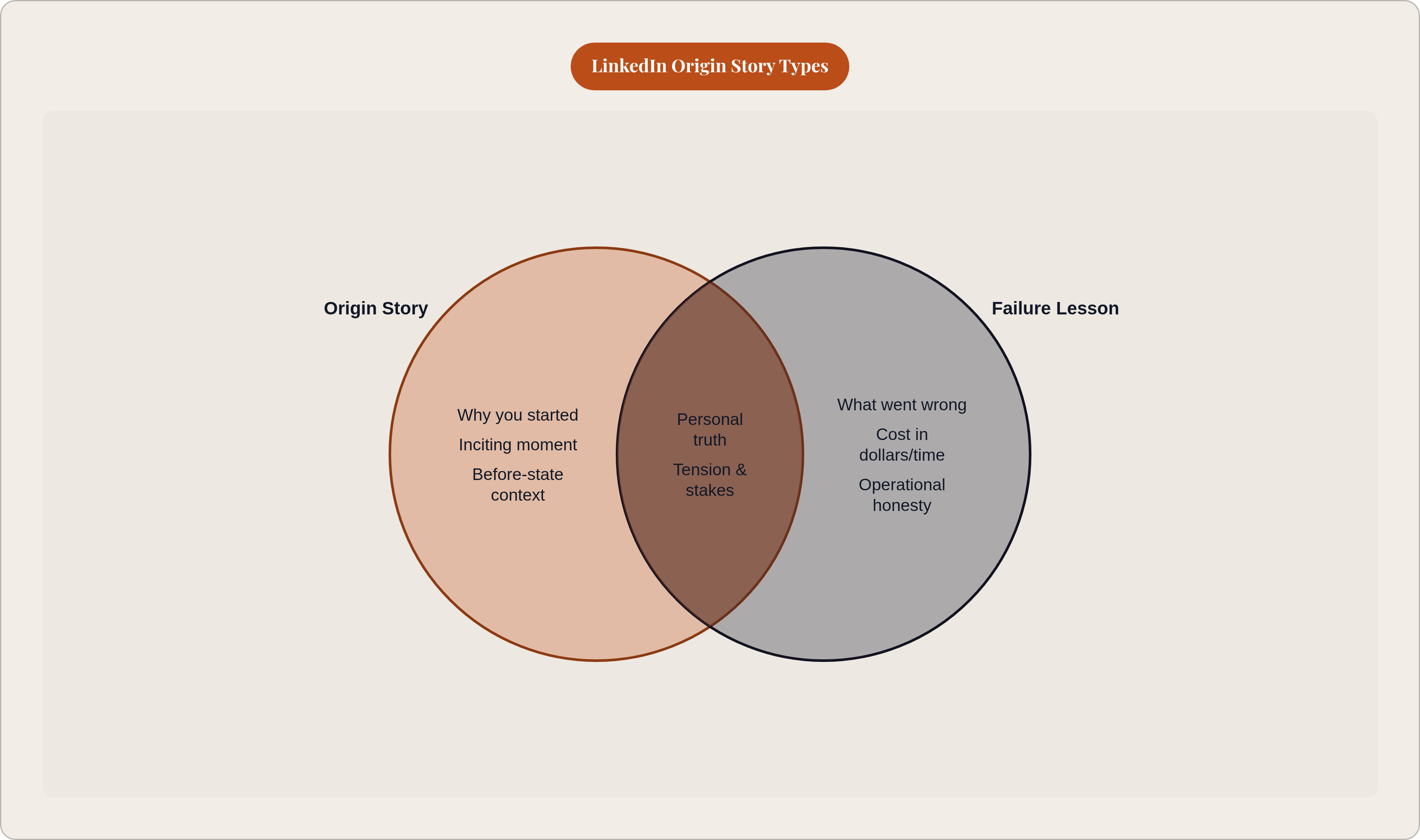
There are three story types that consistently work for founders on LinkedIn, and confusing them is where a lot of content goes sideways.
The origin story answers why you started, after hitting a specific wall. The failure lesson is the operational honesty piece: what you got wrong, and what it cost you in dollars, time, or people. The customer transformation story flips the lens outward: a client came to you with a problem, here's what changed for them.
Personal stories outperform promotional posts by 38%, but personal isn't the same as good, and structure is what separates a story that builds your reputation from one that reads like you're using your feed as a therapist's couch. A post without a clear takeaway is venting with good lighting. A post with one positions you as someone who's actually learned something.
This piece is about the origin story specifically, because it's the load-bearing wall. Once it's in place, your failure posts, your customer wins, your hot takes on your industry, all of it starts to feel like it's coming from the same coherent person instead of a random content calendar. Skip the origin story and everything else you post just floats.
The pre-extraction setup: what to do before the first question is asked
There are two ways to pull this material out. Self-guided, where you journal or reflect solo with a set of prompts, or interview-led, where someone skilled asks follow-up questions until the real thing surfaces. Both need the same homework done first.
If you're the founder, start with a rough timeline of the five to ten hardest professional decisions you've made. Sit with the decision itself, in all its uncomfortable ambiguity, before you get to the outcome. Then find the exact moment you realized the problem you eventually built a business around was real, before you had the vocabulary to call it a "market opportunity." Go dig through old emails, old Slack threads, notes from year one, since specificity lives in artifacts more reliably than in memory, because memory has a well-documented habit of editing itself to make you look smarter than you were at the time.
If you're the one running the interview, do your reading first. Go through the founder's existing About section, any press they've done, old posts, and you're looking for what story has already been told, and how flattened it's become in the retelling. Pay attention to the parts that sound generic or credential-heavy, since those spots are usually hiding the real story right underneath, like a rug thrown over a stain.
One more thing worth saying out loud before you start: this conversation should not feel like a pitch rehearsal. If the founder walks in ready to perform their elevator pitch, you've already lost the thread. Tell them upfront that some questions will feel oddly specific, even irrelevant, things like "Where were you when you made that decision?" or "What were you afraid of?" Those questions are the whole point.
The core extraction questions and why each one works
Four clusters, moving from the surface down to the stuff people don't usually say out loud.
Cluster 1: the before-state. Ask what the founder was doing the year before they started the company, and what was actually wrong with it. Ask who else around them had the same problem and was just living with it, unbothered, like it was weather. This grounds the story before the founding moment even happens, so the contrast that follows actually lands.
Cluster 2: the inciting moment. Was there one specific moment, a meeting, a conversation, a failure, where the founder knew something had to change? What did they say to themselves, or to someone else, in that moment that they've never said publicly? This is where the actual story lives, distinct from the strategic rationale built afterward to make the decision sound smarter than it felt at the time. If you get a vague answer like "I saw a gap in the market," don't accept it, and push instead on where they were physically standing, and what they were doing with their hands, since a kitchen table at 11pm is a place, but a gap in the market isn't.
Cluster 3: the decision under uncertainty. What did they stand to lose? Who tried to talk them out of it, and what exactly did that person say? What did they believe that almost nobody around them believed at the time? This is where the tension lives, and tension is the entire reason a story is readable instead of just informative. Strip the tension out and you're left with a resume bullet wearing a story's clothing.
Cluster 4: the through-line to today. What's still true now that was true on day one? If they had to explain the company to someone who only knew their personal history, not the industry, what would they say? This ties the founding moment to who they are right now, which is what makes the whole thing feel complete instead of like a nostalgia trip.
Run through all four clusters twice. The first pass gets you the polished version, the one the founder's told a hundred times, and the second pass is where the guard drops and the real language shows up.
Identifying what's worth keeping from the raw material
After a good extraction session, you'll have way more material than you need. That's normal, and the job now is curation, not transcription, which are very different skills.
Look for a few specific signals. Specificity: a named place, an actual conversation, a dollar figure or a deadline that was genuinely on the line. Tension: something the founder stood to lose, or a belief nobody else shared, or a choice that wasn't obvious at the time. A direct line to the present: does this moment still explain something about how the company runs today, or what the founder actually values? And emotional truth, which is the hardest to describe but the easiest to spot, is the moment the founder tells with just a little more texture than everything around it, and that extra texture is a tell worth trusting.
Cut the rest, and cut without sentimentality. Chronological completeness is the enemy here. Aim for one sharp, specific moment that carries the whole weight of the story rather than a biography. Build around the authentic moment of change, frustration, clarity, honest failure, not around company milestones that read like a résumé.
Here's the test that catches almost everything that's still too generic: could any other founder in your industry tell this exact same story? A yes means you're not done, so go back to the questions.
Structuring the extracted material into a LinkedIn-ready origin story
Once you've got the raw material sorted, the structure itself is simple. Three parts, in this order.
The before-state comes first, one or two sentences establishing who you were and what world you were operating in before everything changed. It grounds the reader fast. Then the inciting moment, the specific event or realization that cracked that before-state open, written in scene, not summary. Don't tell us you "realized something needed to change." Show us the room you were standing in. Last comes the through-line: how that moment explains what the company does now, and what you still believe. Done right, this doesn't read like a pivot. It reads like the only possible ending to the sentence that came before it.
Keep the About section version between 200 and 300 words. If you're posting the standalone version, the first line matters more than any other sentence you'll write that week. LinkedIn's distribution now rewards dwell time, so hitting roughly seven seconds of read-time on that first line triggers a second wave of reach. That means the opening line has to create a gap, a tension, a surprising claim, an honest admission, something the reader needs closed before they'll scroll past it.
Whatever you do, protect the voice. Extraction gets you the founder's real language: their phrasing, their rhythm, the way they actually talk when nobody's watching. The writer's job is to shape that into structure without sanding off the parts that sound like a person instead of a press release.
Once it's written, put it in two places: the first half of the About section, so it hits before someone decides whether to hit follow, and pinned at the top of the feed, so every new visitor to the profile sees it before anything else.
How to use the origin story as a repeatable content asset, not a one-time post
Here's the good news: this story doesn't expire. New followers haven't heard it yet, and longtime followers actually go deeper each time they see it reframed. Nobody's sitting there keeping a tally of how many times you've mentioned your founding story, and they're too busy scrolling past pictures of someone's "humbled and grateful" award announcement.
A single extraction session almost never produces just one post. It gives you the inciting moment as a standalone story, the belief that drove you to start reframed as an opinion piece, the tension with the people who told you not to do it turned into a lesson post, and the through-line to today built into your current vision piece. That's four distinct posts from one hour of good questions.
Then republish across formats. A narrative post this month, a short video next month, a mention on somebody's podcast, a pull quote dropped into a newsletter. This is how new audiences, who've never seen version one, actually catch up to where you already are.
Building a recognizable presence takes 12 to 24 months to show real results, and origin story material is the seed you plant at the start of that window, the thing that keeps compounding long after the first post stops getting likes. Companies with multiple senior leaders posting regularly see up to 38% higher digital impact, and 92% of stakeholders say they trust a company more when its senior leaders show up online as actual people. That's the whole game.
If you're working with a ghostwriter or a content partner, the extraction session is the most valuable hour of the entire engagement, full stop, and it's the raw material that a skilled operator can turn into months of posts without ever losing your voice in the process. At Forj Media, extraction is the foundation of every client engagement we run, the same approach Matt Huang used to build an audience of over 200,000 across LinkedIn, YouTube, and Substack. Same method, applied to surface each founder's specific story, then deployed at whatever pace their audience and goals actually call for.