When Executives Should Start Building a Personal Brand
Executives should start building visibility now, not when they need it most.

Most executives hear "personal brand" and picture something they want nothing to do with. Cringe LinkedIn posts. Influencer aesthetics. Fundraising theater dressed up as thought leadership. That reaction is fair, because a lot of what passes for executive content online is exactly that.
But that's not what we're talking about here.
For an executive, a personal brand is a consistent, visible point of view that causes the right people to form a confident impression of you before any conversation starts. Think of it like a handshake that happens before you're even in the room. Investors, candidates, potential customers — they're already forming opinions about you whether you show up or not. The only question is whether you're shaping those opinions or leaving them to chance.
The difference between influencer-style personal branding and executive personal branding comes down to this: an influencer is optimizing for reach and audience monetization. An executive is optimizing for trust with a specific, relatively small group of people. You're not trying to go viral. You're trying to make sure the right 50 people have already formed a favorable impression before you reach out to them.
For early-stage founders especially, the company brand and the founder brand are nearly impossible to separate. You are the signal the market reads. A 2024 Weber Shandwick study found that 44% of a company's market value is tied directly to CEO reputation. That number isn't aspirational. It means the brand is already affecting your valuation, actively or not.
And here's the thing about building a personal brand purely as a fundraising tactic: sophisticated investors can tell. It reads as transactional. A brand built around genuine expertise and a consistent point of view creates durable trust that fundraising, hiring, and sales can all draw on at different times, for different reasons.
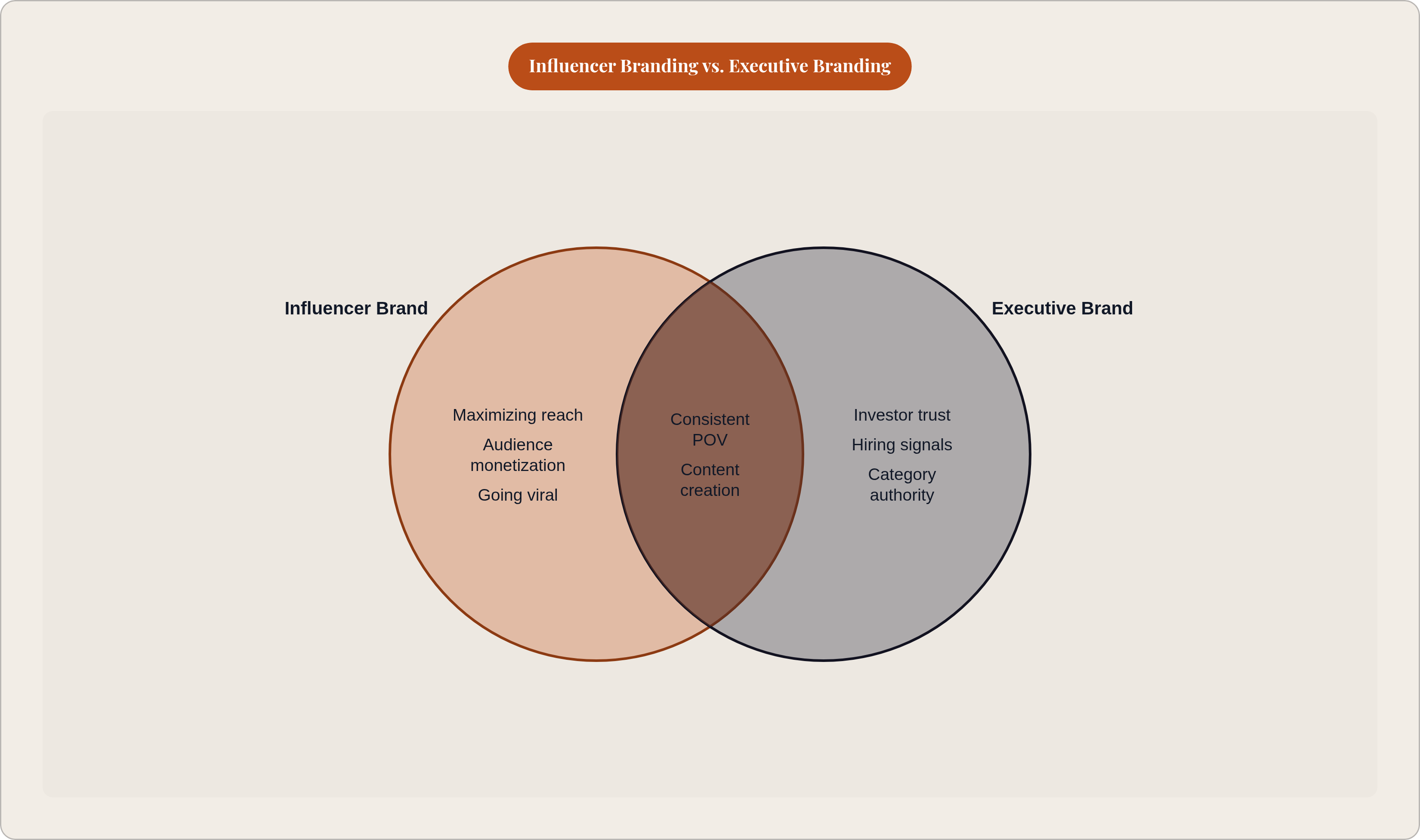
Three Business Inflection Points Where Starting Immediately Becomes Highest-Leverage
Not every moment is equally urgent. But three situations compress the return window so dramatically that "I'll start soon" becomes a genuinely costly call.
Fundraising
A significant majority of investors research founders on social media before meetings. The due diligence happens before the pitch, not during it.
A founder with no visible presence is asking investors to take a leap of faith. A founder with a developed, consistent point of view has already answered half the trust questions before the first call. There's a real difference between a conversation that starts at "convince me you're worth my time" and one that starts at "I've been following your thinking. How do I get involved?"
The brand you build 12 months before a raise is doing real work during the round. The brand you start building during the round arrives too late, and everyone in the room can feel it. You can't plant a tree and eat the fruit the same afternoon.
Hiring
Top candidates research founding teams before they apply. A founder with no LinkedIn presence isn't a neutral signal. It reads as a yellow flag. Sometimes a red one.
Thought leadership content also functions as a filter. Candidates who find you because of something you wrote, and then apply based on how you think, tend to be better fits. They require less convincing. They already share some version of your worldview. When you're hiring fast, that matters more than most founders expect.
Executives with developed personal brands consistently see more candidate interest than those without. And a large majority of stakeholders say they're more likely to trust a company whose senior leaders are actively visible on social media. That applies to prospective hires just as much as it applies to investors.
Building in Public and Owning a Category
If you're trying to define a new category or shift how buyers think about an old problem, you need to be the credible voice explaining why the old way is broken. That requires accumulated presence. An 18-month archive of consistent, specific, well-reasoned thinking about the problem space. Not a single post. Not a PR push.
Your early posts about a problem establish your prior art. By the time competitors start posting about the same thing, you already have 18 months of perceived authority behind you. That head start doesn't happen by accident, and it doesn't happen fast. The Edelman-LinkedIn Thought Leadership Impact Report makes this concrete: a large share of decision-makers say compelling thought leadership makes them more open to outreach and more willing to explore products they weren't previously considering. The category you're trying to own is being won in the content layer, not just the product layer.
Why LinkedIn Is the Right Platform to Build on First
LinkedIn has more than a billion users globally. The overwhelming majority of those members are involved in business decisions in some meaningful way. The investors, candidates, and B2B buyers from the previous section aren't primarily spending time on other platforms. They're here.
LinkedIn's algorithm also actively favors personal profiles over company pages. Personal profiles generate significantly more engagement than company pages per post. That means your voice, specifically your founder voice, reaches more of the right people than your brand account does. Build the company page. But know that the algorithm is rooting for the human.
The B2B buying reality supports this too. Buyers research vendors and founders on LinkedIn before they take any meeting. Being absent isn't neutral. It is a negative signal.
There's also a durability to LinkedIn connections and follower growth that activity on other platforms doesn't produce for B2B founders. A comment thread on LinkedIn turns into a DM, turns into an intro, turns into a meeting in a way that activity on other platforms rarely does for someone selling to enterprises or raising institutional capital. LinkedIn is the right first platform because its audience is the exact audience that makes the outcomes above possible.
What Consistent Posting Actually Looks Like and What It Produces Over Time
Three posts per week is the practical floor for compound audience growth. Fewer than that produces reach that doesn't build meaningfully month over month. Consistency matters more than any single post. A lot more.
The text-only post is the most underused and most effective format on the platform. A well-constructed 200-word post with a strong opening line routinely outperforms produced graphics or posts with external links. You don't need a creative team. You need a point of view and a first sentence that earns the second one.
Content should anchor to two or three clear themes:
- The problem your company exists to solve
- Your specific perspective on how the industry is wrong or incomplete
- What it actually looks like to build in your space
These pillars prevent the blank-page paralysis that causes founders to go quiet after a good start. When you know what you're writing about, you don't have to reinvent the topic every time you sit down.
The compounding effect is real, and it's slow at first. That's the part most founders aren't ready for. In month one, a post reaches a few hundred people. By month 12, the same quality post reaches a meaningfully larger network, because each previous post has deposited credibility, followers, and algorithmic trust. Your day-to-day thinking is the content. The big announcements land harder when the audience already exists.
How Ghostwriting Fits Into a Founder's Content Operation Without Compromising Authenticity
Most founders who know they should be posting don't do it because drafting takes time they genuinely don't have. That's not a discipline problem. It's a capacity problem.
The ethical line in ghostwriting is in the substance, not the typing. A ghostwriter publishing true stories in the founder's authentic voice is more honest than a founder polishing fabricated narratives themselves. The question is whether the content is true to how you think, not who did the typing.
Here's what the process actually looks like in practice:
- A conversation to understand how you think and speak
- A style guide built from that conversation
- Posts developed from voice notes or brief recorded conversations each month
- Most founders report that within a few posts, it reads like them
The voice note method is underrated. A 15-minute recording on a commute becomes a week of content. Your thinking, structured and published, without requiring you to sit down and stare at a blank document at 10pm.
On disclosure: the majority of founders using ghostwriters treat it like any other professional service. No different from working with a CFO, a designer, or a communications advisor. Some acknowledge a "content partner" if directly asked. Some are fully transparent. All three approaches are common. Executive communications have always been collaborative. Solo authorship is the exception in professional contexts, not the expectation.
LinkedIn ghostwriting typically runs $2,000 to $8,000 per month depending on scope. For a founder actively raising or building a team, the trade-off is usually not a hard one.
The Practical First Step for a Founder Who Is Ready to Start Now
The most common failure mode is treating the start as a bigger decision than it is. Waiting to define the perfect brand before writing a single post. Waiting for the raise to close. Waiting for Q1. The waiting is the trap.
Reframe the first 90 days as research, not performance. The goal is to find out which topics generate genuine response from the people who matter to your business. You are not expected to have it figured out. You are expected to start finding out. Those are different things.
Here's what that looks like in practice:
- Audit your LinkedIn profile. Your headline should communicate the value you deliver, not just your job title.
- Identify two or three specific beliefs you hold about your industry that differ from conventional wisdom. These become your first content pillars.
- Commit to three posts per week for 12 weeks before you evaluate results. Compounding requires enough runway to observe.
- Decide now whether you're building the content operation internally or with a partner. Both work. Ambiguity leads to nothing getting published, which is the worst outcome.
The founders who wish they had started earlier almost universally say the same thing: they didn't realize how long the runway needed to be until they were already in the middle of a raise or a hiring push. By then, the credibility they needed was still months away from existing.
The 12 to 24 month timeline isn't a reason to feel behind. It's a reason to stop deliberating.