Positioning a Founder's Expertise on LinkedIn
Specific expertise attracts the right buyers, not fewer buyers overall.

Getting specific attracts more of the right people. Not fewer people overall. That part surprises most founders the first time they hear it.
Here is the difference in practice. "I help companies grow." Who does that help? Everyone and no one at the same time. Now try: "I help enterprise SaaS companies cut their customer acquisition cost by rebuilding the handoff between sales and customer success." That one lands. It names a real problem. It implies someone who has actually lived inside that problem, not just read about it. And it immediately tells the reader whether or not they belong in this conversation.
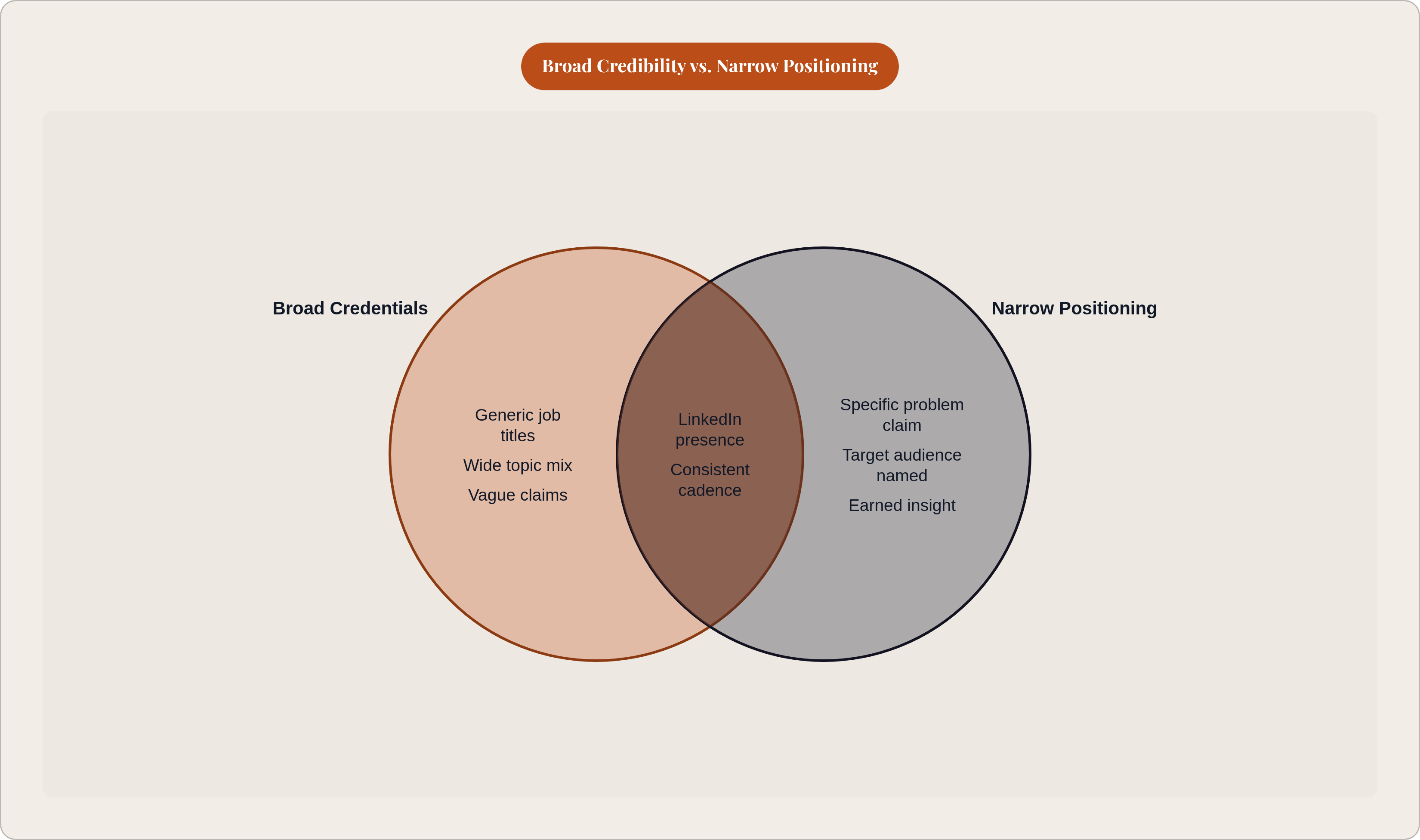
A narrow claim does something a broad credential stack simply cannot. It tells decision-makers which specific problem you have standing to address. It makes you memorable inside one category instead of forgettable across five. It gives followers a reason to come back, because they know exactly what they signed up for.
The 2025 Edelman-LinkedIn B2B Thought Leadership Impact Report, which pulled from nearly 2,000 global professionals, found that 73% of decision-makers consider thought leadership a more trustworthy basis for evaluating capability than product sheets or marketing materials. Real number. But the trust only transfers when the thought leadership is coherent. A clear, repeated point of view on one problem is like a lighthouse — it only guides ships because it stays fixed. A rotating mix of whatever topics are trending that week produces none of that coherence, and decision-makers notice faster than you'd expect.
Think of it as a strategic spine. Every post, every comment, every piece of engagement should reinforce the same core claim, even when the surface topic shifts week to week. A founder selling to VP Marketing who posts interchangeably about productivity, AI, and startup culture is producing noise. The spine is the specific problem this founder has seen, solved, and can teach others to navigate.
Positioning is an editorial commitment, not a one-time profile edit. You choose a lane every week, sometimes in situations where the easier thing would be to just post whatever feels timely. That is the actual discipline required.
How to Identify the Problem Space Worth Owning
The wrong starting question is "what am I good at?" That produces a list. What you need is a claim. The better question is this: what problem do you understand better than almost anyone because of the specific path you actually took to get here?
Three inputs surface the right answer.
The decisions only you have had to make. The early calls, the weird constraints, the moments where there was no playbook and you had to make something up and live with the outcome. Those moments produced insight nobody else has, because nobody else was in that room.
The conversations that keep repeating. Prospects, investors, new hires. What do they keep asking you about? Recurring questions are a map. They show you where the market already perceives authority in you, even before you've deliberately claimed it.
The mistakes you can now teach around. There is a real difference between "I read about this problem" and "I lost six months learning this the hard way." The latter is what makes a positioning claim credible. Earned insight carries weight that observed insight does not.
Apply the narrowing test. Can your claim survive a "so what?" from a skeptical decision-maker who has already sat through a hundred founder pitches this quarter?
- "I help companies grow" survives nothing.
- "Former VP at a major SaaS company with 15 years of experience" also survives nothing, because it answers the wrong question entirely.
- "I help enterprise SaaS companies cut their CAC by rebuilding the sales-to-CS handoff" survives, because it names a real problem, implies real experience, and speaks directly to one specific reader.
One distinction worth making: a niche is a category. Fintech, B2B SaaS, healthcare logistics. A positioning claim is a specific problem you have standing to address within or across that category. Founders often think they are positioning when they are really just picking a vertical and calling it done. Those are different moves, and the results look very different six months later.
The story behind the claim is evidence, not decoration. A claim without the story is just an assertion. The story is what makes it credible enough to stick.
Translating the Claim into a Profile That Does the Positioning Work
Three profile elements carry most of the weight. Everything else is secondary.
The headline. This is the only text visible before someone clicks. It has to communicate the problem you solve and for whom, not the title you currently hold. A useful structure: what you help, the specific outcome or problem, the specific reader. Compressed into one line. If you cannot get the claim into one line without losing the meaning, the claim is not narrow enough yet.
The About section. Open with the problem you are obsessed with. A career timeline is the wrong opening move. Nobody opens a LinkedIn About section hoping it starts with 2009. The career history earns credibility, but only after the reader understands why any of it matters to them. Lead with the problem, support it with the story, and end with a clear next action. What should the right person actually do after reading this? Tell them explicitly, because they won't guess.
The Featured section. This is the conversion layer. A lead magnet, a case study, a piece of content that shows the claim working in practice. A collection of old press mentions adds nothing here. Neither does a link to the company homepage. Evidence that the specific problem gets solved, from someone who has solved it, is what belongs in this section.
One thing founders frequently miss: LinkedIn's 360Brew AI model, which rolled out in 2025, evaluates profile credibility before deciding how far your posts travel. A vague or generic profile creates both a conversion problem and a distribution problem. A weak profile actively suppresses your reach even when the post itself is strong. Profile positioning and content positioning are now the same operational problem, and fixing one without the other is a waste of time.
Building a Content Cadence That Compounds the Positioning Claim Over Time
One well-positioned post does not build authority. Repeated, coherent signals on the same problem space do. A post published today can generate inbound leads eighteen months from now. That is not a campaign with a start date and an end date. It is an asset.
Cadence matters as a signal, not just as a volume play. Only 3% of LinkedIn's 1.3 billion members post more than once per week. Consistent, on-claim presence puts a founder ahead of the overwhelming majority of the platform before a single post gets optimized. Two posts per week, sustained for 90 days before drawing any conclusions. The compounding effect is invisible before it becomes obvious, and quitting during the invisible phase is the most common mistake founders make.
What each piece of content should actually do:
- Teach something specific about the problem space. Generic inspiration without specificity is noise, and there is already plenty of noise.
- Show your reasoning, not just your conclusions. The reasoning is what builds intellectual authority. Conclusions alone are just opinions.
- Invite a response from the exact reader you want in your pipeline. Comments from the wrong audience feel good and mean nothing.
On the question of scheduled versus live posts: schedule the baseline cadence, but leave one slot per week for something timely. A real customer conversation. A market shift you just noticed. A product decision you made this week and are still thinking through. Moment-driven posts often outperform polished ones because they carry the texture of something that actually happened. Polish is not the goal. Authenticity to the claim is.
Engagement is part of the positioning program, not a separate activity you do when you have extra time. Twenty minutes per day commenting on posts from your target audience and relevant peers is not optional if you are serious about building reach. Thoughtful comments carry roughly 3x more algorithmic weight than likes. Shares carry around 5x. Optimizing for real responses over passive reactions is both an algorithmic strategy and a positioning one, at the same time.
How the Algorithm Rewards Coherent Positioning and Punishes Noise
LinkedIn's 2025 algorithm update moved the platform toward professional value and meaningful engagement. Raw posting frequency no longer drives distribution the way it once did. For a well-positioned founder, that is good news. For someone posting without a clear claim, it is a quiet catastrophe, the kind that is hard to diagnose because the numbers just slowly stop moving.
The dwell-time mechanics are what make the hook and the topic matter so much:
- Hitting the 4.5-second threshold earns basic distribution.
- Hitting 7 or more seconds triggers expansion to a broader audience.
- A founder writing for one specific reader generates genuine dwell time. A generic post optimized for maximum appeal generates scrolls.
Profile credibility now functions as a distribution gate. The 360Brew model reads your profile before amplifying your posts. An inconsistent or vague profile suppresses reach regardless of how good the individual post is. Fix the profile first. Everything downstream depends on it.
On personal profiles versus company pages: company pages receive roughly 2.75 times fewer impressions than personal profiles. The founder's voice is structurally advantaged by the platform itself, and that advantage compounds when the voice is coherent and recognizable. Frequent and unfocused is actually worse than infrequent and sharp, because the algorithm now penalizes noise and rewards signal. You can observe this in the distribution numbers. It is not a theory.
A tightly positioned founder posting twice a week on a clear problem space will consistently outperform a high-volume, unfocused strategy. The algorithm is explicitly rewarding the same approach this whole article is describing, which is either a satisfying coincidence or a sign that the approach was correct before the algorithm caught up.
What Positioned Expertise Converts Into at the Business Level
Authority built through consistent, narrow expertise converts into inbound business without cold outreach. You become the person known for solving a specific problem. People with that problem find you. They already trust you before they send the first message, which changes the entire sales conversation. Think of it this way: positioning is less like advertising and more like gravity — you stop chasing and start attracting.
Jay Singh, CEO of Casper Studios, reported driving 90% of inbound leads organically through LinkedIn after investing seriously in founder content. That is not luck. That is the trust-to-revenue mechanism working as designed.
The decision-maker attention is genuinely there to be captured. Per the 2025 Edelman-LinkedIn B2B Thought Leadership Impact Report, 52% of decision-makers and 54% of C-suite executives spend more than an hour each week actively reading thought leadership content. They are looking for trusted voices. And 95% say thought leadership directly influences purchasing decisions. If you are not treating your LinkedIn presence as a revenue lever, you are leaving real money on the table, which sounds dramatic until you run the math.
The Fundraising Dimension
Positioned expertise shortens investor timelines. 84% of investors research founders on social media before meetings. Hard Numbers research found that CEOs with the largest LinkedIn audiences also attracted the highest levels of investment. When a fintech founder built credible public presence through consistent LinkedIn activity, Series A conversations reportedly shifted from "convince me" to "how do I get involved," and the fundraising timeline shortened from six months to eight weeks. The profile is due diligence material. Most founders are not treating it that way, and it shows in the meetings.
The Hiring Dimension
Founders building in public signal company culture and leadership credibility to prospective hires before a single job description goes live. 92% of stakeholders say they are more likely to trust a company whose senior leaders are active on social media. Your LinkedIn presence is a recruiting asset that costs nothing beyond the time you are already spending on business development.
The Timeline Reality
Meaningful business impact typically shows up within three to six months of consistent implementation. Full compounding takes twelve to twenty-four months. Set that expectation before you start, so you commit rather than bail during the stretch when nothing visible is happening. Month six is usually where the inbound starts. Month twelve is where it stops feeling fragile.
When and How Ghostwriting Fits into an Expertise Positioning Strategy
Here is the part nobody enjoys discussing. Quality LinkedIn content requires four to six hours per week. Most founders do not have four to six hours per week to give to LinkedIn. This is a time problem, not a discipline problem. Most SaaS CEOs who attempt to write their own LinkedIn content stop within three weeks. The strategy did not fail because it was wrong. Execution broke down because the hours were not there, and the hours were not going to magically appear.
Ghostwriting solves the execution problem without compromising the positioning claim. But it gets misunderstood enough that it is worth being direct about what it does and does not change.
What ghostwriting does not change: whose ideas, experiences, and point of view appear in the content. Those must come from the founder. The ghost is not inventing a persona. They are amplifying a real one.
What ghostwriting does change: who does the actual writing work. The structuring, the editing, the cadence management, the formatting for the platform. A good ghostwriter extracts authentic founder thinking and shapes it into content that performs. That is a craft skill. It is also a significant time unlock for a founder who has a business to run.
The Ethical Question Founders Actually Ask
"Is this dishonest?" The ethical line is not whether the founder typed the words. It is whether the content reflects genuine thinking and real experience. A founder who uses a ghostwriter to publish true stories, real decisions, and hard-won lessons is being more honest than one who writes every word but fabricates the experiences. The version that actually crosses the line: outsourcing to AI without the founder's knowledge or involvement, then presenting the output as authentic thought leadership. That produces content disconnected from real experience, and it shows, usually faster than the founder expects.
What to Look for in a Ghostwriting Partner
Not all content support is the same. For expertise positioning specifically:
- Look for someone who has built an audience using the same methods, rather than a generalist content agency running templates at volume.
- The process should start with extracting your actual point of view, not with a pre-built content calendar that was probably built for someone else first.
- Founder approval before anything publishes. Auto-publishing without review breaks the fundamental contract between a founder and their audience.
- Retainer structures vary widely. A reasonable benchmark for professional-grade ongoing content and strategy is $1,000 to $5,000 or more per month. The right question is not the cost. It is whether the partner can protect and amplify your positioning claim without diluting it.
The right partner operates from a practitioner model, meaning the people doing the work have built real audiences using the same methods they use for clients. A generic content agency can produce content. Building a strategic spine is a different thing entirely, and it requires a practitioner lens that most generalist shops do not have.
The Compounding Return on Showing Up Consistently
There is no elegant way to say this. The founders who win on LinkedIn are the ones who do not stop.
They are rarely the most talented writers. They made a narrow claim, built a profile that backed it up, and then showed up consistently enough for the compounding to actually kick in. Two posts a week times fifty-two weeks is one hundred and four pieces of content. Each one reinforcing the same claim. Each one building credibility with the same audience. Each one making the next one slightly more trusted before it is even read.
The founders who quit in month two never see month six. Month six is usually where the inbound starts. Month twelve is where it stops feeling like a gamble. Month twenty-four is where it becomes a company asset that outlasts any single campaign, product launch, or funding round.
Start with the profile. Make the claim. Show up. Everything else in this article is detail work around those three steps.