LinkedIn Ghostwriting for Executives — How It Works
Personal branding now outperforms company pages by several times over on LinkedIn.

Here's something most marketing teams quietly know but won't say out loud: your company page is basically invisible.
LinkedIn's algorithm sends the overwhelming majority of feed distribution to personal profiles. Company pages get a fraction of that. Organic reach for branded pages has been declining for years, and what worked in the early 2020s genuinely doesn't work anymore.
Personal profiles generate far higher engagement than company pages. Not a little higher. Several times higher. Executive-authored content routinely outperforms the same company's branded posts by a wide margin. Buyers consistently say they trust companies more when the senior leaders are visibly active online. And executives themselves estimate that a significant chunk of their company's perceived market value traces back to the CEO's personal reputation. Not the logo. The person.
What this means in practice depends on where you are:
- Hiring? Your profile is the recruiting surface candidates actually look at.
- Fundraising? Investors are reading your posts before they open your deck.
- Selling? Buyers are forming opinions before your first call.
The personal profile is the highest-leverage content surface a founder has access to right now. Think of it as a megaphone sitting in a room full of your exact target audience — and a company page is a flyer taped to the outside of the building.
What the 2026 LinkedIn Algorithm Actually Rewards — and What It Quietly Buries
LinkedIn's ranking system went through a real overhaul entering 2026. It shifted from a network-distribution model toward an interest-based, relevance-driven feed. A lot of people are still running plays from 2022 and wondering why nothing lands.
The core shift is that the system now weights depth. Not just whether someone tapped a reaction, but how long they actually spent with your post. Shallow engagement no longer buys distribution the way it used to.
A few things that now get penalized:
- Engagement bait. Posts engineered to harvest likes without genuine interest get detected and suppressed.
- Engagement pods. LinkedIn's AI has gotten good at spotting reciprocal engagement patterns. Pods are effectively dead as a strategy.
- Posting out of your lane. The algorithm cross-references your content against your background, title, and listed skills. Consistent off-topic posts get deprioritized.
What the algorithm actually rewards is less exciting to talk about but more useful to know: specific, expertise-grounded posts published consistently, fewer strong pieces per week rather than a daily flood of forgettable ones, and content with genuine staying power. High-value posts resurface weeks after publication when they match a reader's professional interests. Recency stopped being the dominant signal.
On format, carousels drive strong engagement from existing followers. Video gets impressions but converts to pipeline less reliably. Text posts, particularly opinion and story-driven ones, are the most direct pipeline drivers. Which format serves you depends on what you're actually trying to accomplish that week.
Why Most Executives Don't Post Consistently — and What Ghostwriting Actually Solves
Let's stop pretending the problem is laziness.
Most executives know LinkedIn matters. They've known for a while. The real problem is bandwidth and one specific skill they were never trained for: turning expertise into writing that other people actually want to read.
Knowing your industry cold and knowing how to make that knowledge readable and resonant are two separate skills. They barely overlap. It's like being a world-class chef who's never been asked to write the menu — the food is extraordinary, but translating it into words that make strangers hungry is a different craft entirely.
Executives who do try to post often get stuck in what I'd call the corporate memo trap. Formal, lecture-style writing that keeps readers at arm's length instead of pulling them in. That's the opposite of what the algorithm rewards and the opposite of what earns a following.
Ghostwriting's actual job is to convert the executive's existing knowledge, opinions, and experience into consistently published, voice-matched content. It outsources the execution. The expertise stays where it is.
This isn't new, by the way. Speechwriters. Communications directors. Editorial partners. Leaders working with writers has been standard practice for decades. LinkedIn is a new channel, not a new concept. The ethical line is authorship of the ideas, not who typed the draft. As long as the executive's perspective is driving the content and they're reviewing and approving it, the work remains authentically theirs.
The market for this service has grown fast. Hundreds of agencies now operate globally where only a handful existed a few years ago, largely because the need became impossible to ignore.
The Discovery and Voice Extraction Process That Precedes Any Writing
Most people assume ghostwriting starts with writing. It doesn't, and when it does, you can usually tell.
The ratio of listening and mapping to actual drafting is heavily weighted toward the front end. Good ghostwriting is mostly extraction.
A structured intake session runs sixty to ninety minutes. The ghostwriter is trying to understand a few specific things: what the executive genuinely believes the industry gets wrong, how they talk with peers informally rather than how they write in emails, what they want to be known for, and which experiences and opinions are actually theirs versus recycled industry talking points.
From there comes what I'd call voice archaeology. The ghostwriter digs through past posts, internal presentations, emails, Slack messages, anything the executive produces when they're not performing. They're looking for phrasing patterns, recurring opinions, and the tonal registers that surface when someone isn't trying to sound smart.
The output is a written voice guide. Documented tone. Recurring themes. Phrasing preferences. Formats the client responds to and content they'd hate. That guide governs every draft produced after it. It's what makes consistency possible without the executive re-explaining themselves every single week.
Strong practitioners build this before writing begins. Not through trial and error on the first few drafts. The executive's participation in this phase can't be substituted by AI or writing talent. The ghostwriter's job is to draw out the thinking and codify it, but the thinking has to be in the room.
How Editorial Strategy Connects Content to Business Goals Rather Than Just Filling a Calendar
A voice guide tells you how to write. Editorial strategy tells you what to write and why it matters right now.
It's the layer between "we know how this person sounds" and "we know what to publish this week." Without it, you end up with a content calendar that looks organized and produces nothing.
Topic selection maps directly to current business priorities. Hiring a specific role? You're publishing content that attracts that candidate. Raising a round? You're building the narrative investors will find when they search your name. Entering a new market? You're establishing credibility before the pitch meetings start. The content isn't random ideation. It's targeted.
Format choices follow the goal too. Video for broad brand awareness and reaching new audiences. Carousels for deep engagement with people already following you. Text posts for direct pipeline, specifically opinion, story, and earned-insight formats that prompt inbound from the right people.
Cadence gets set by quality threshold, not a fixed quota. Fewer stronger posts outperform high-frequency output. The algorithm already told us this.
The content mix matters in a subtler way. Founding story, industry perspective, operational insight, and behind-the-scenes transparency each serve different audience relationships. Rotating them with some intention is how you build both reach and trust at the same time, rather than optimizing for one at the expense of the other.
What the Drafting and Approval Cycle Looks Like in Practice
Once voice calibration and editorial planning are in place, the ongoing workflow is genuinely simple. Draft, review, refine, publish. The whole thing.
The ghostwriter produces drafts anchored to the voice guide and the editorial calendar. The executive never opens a blank page. That's the point of the whole setup.
Review time is short. Reading a LinkedIn post draft takes minutes. The real friction is scheduling the habit, not the work itself. A well-run engagement routes drafts on a predictable schedule with a clear protocol for whether feedback means a small edit or a full rewrite. The executive knows when to expect drafts and what they're supposed to do with them.
The revision loop is actually where voice calibration deepens over time. What the executive always cuts, what they always add, which phrasing they instinctively rewrite. All of that becomes part of the voice guide. The document gets more accurate over months, not less.
Performance tracking closes the loop. Impressions, engagement, follower growth, and inbound leads from target accounts get connected back to specific content decisions. Not just a metrics dump. More like: here's what worked, here's the hypothesis for why, here's what we're doing differently next week.
The executive's ongoing role stays light: brief review windows, flagging new opinions or experiences worth turning into content, and staying tuned in to what's resonating. The ghostwriter handles the rest.
How AI Fits Into a Professional Ghostwriting Process Without Replacing Judgment
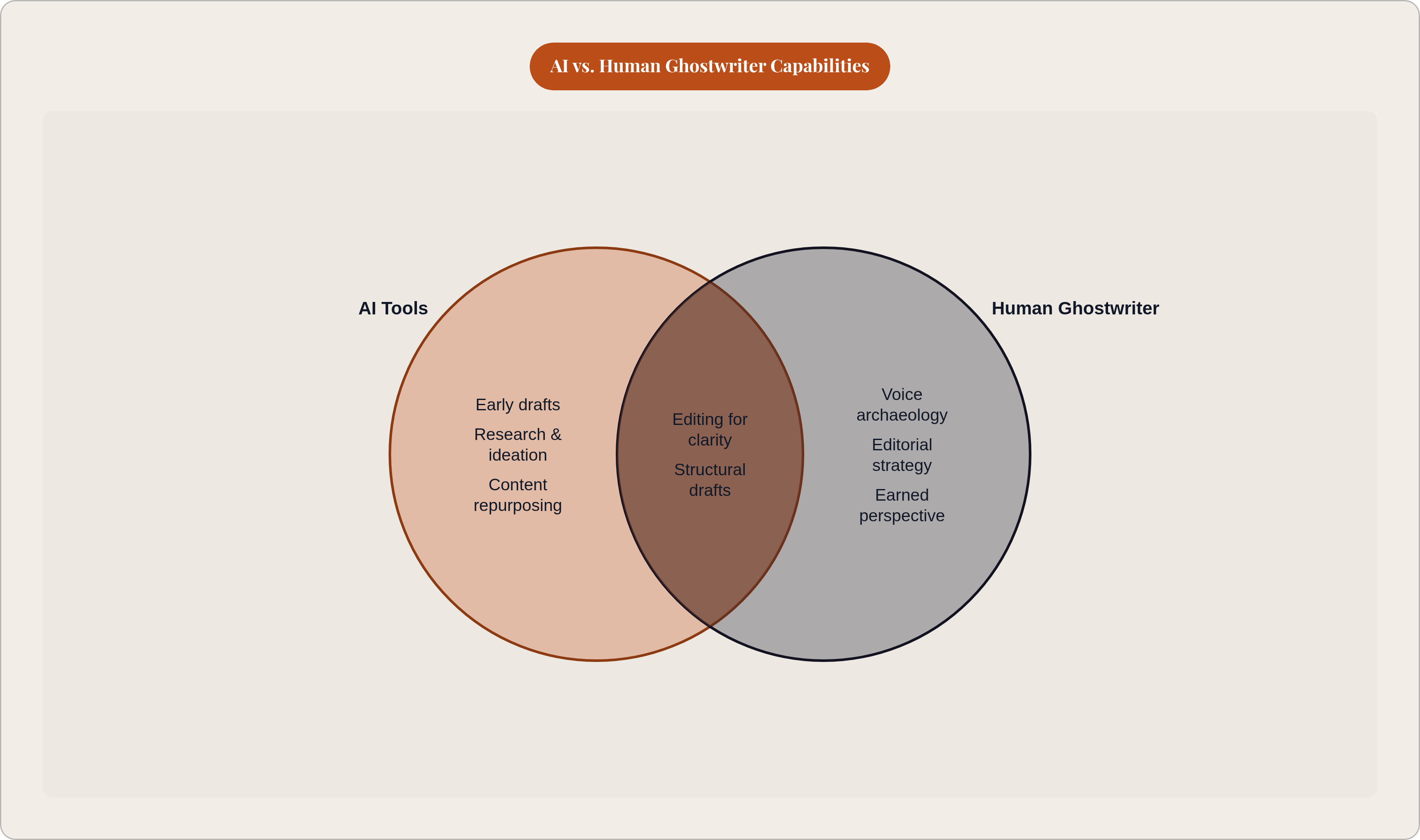
The fastest-growing service model right now is AI-assisted ghostwriting. Tools trained on a client's writing history handle early drafting. The ghostwriter owns strategy, voice refinement, and editorial direction.
AI genuinely accelerates certain things: research and ideation, structural first drafts, editing for clarity, repurposing existing content into new formats. Those are real gains and it's worth being honest about them.
What AI can't do is figure out what's actually worth saying. It can't bring earned perspective to a topic. It can't maintain voice fidelity when the subject matter gets genuinely nuanced, and it can't make the strategic call about which topic serves a specific business goal this specific week.
The generic AI failure mode is already documented. ChatGPT flooded LinkedIn with competent, forgettable content in 2023 and 2024. Posts that read exactly like everyone else's competent, forgettable content. The algorithm ignores them. Readers skip them. There's a useful irony in this: the flood of generic AI content has made genuinely voice-matched, perspective-driven writing more visible and more valuable. The differentiation is now the advantage, not the volume.
A skilled ghostwriter uses AI the way a senior analyst uses a spreadsheet. It's infrastructure that accelerates execution. The judgment, the strategy, and the voice are still human.
If you're evaluating services, the right question isn't whether they use AI. It's how. AI-first drafting with no strategic layer is a commodity. AI-augmented drafting under expert editorial direction is a different product.
What Founder Storytelling Looks Like When It Actually Works on LinkedIn
The most effective founder content on LinkedIn is not thought leadership in the corporate sense. It's specific. Personal. Grounded in something the author actually lived through.
Story-structured posts consistently outperform purely informational ones, and the reason is worth understanding. The mechanism isn't information transfer. It's identification. The reader sees something of themselves in the story, and that's what keeps them reading rather than scrolling.
The hook carries a disproportionate amount of weight. The first two or three lines determine whether anyone reads past them. They need to signal who this is for and create enough tension or curiosity to earn the next scroll.
A few narrative structures that reliably work:
- The epiphany bridge. Start in the moment something shifted. Then explain what led there and what it means now.
- Building in public. Share what you're testing, what failed, what the numbers showed. Transparency about process builds more trust than polished outcomes.
- The contrarian take. State plainly what you believe the industry gets wrong, then earn the claim with something specific from your own experience. Not a hot take for its own sake. An actual position backed by something real.
Voice is what separates your version of an insight from anyone else's version of the same insight. The ghostwriter's job is to protect that distinctiveness, not sand it into something publishable but generic. The goal isn't a viral post. It's consistent recognition from the specific people you're trying to attract: candidates, investors, customers, peers. That's the actual scoreboard.
How to Evaluate a Ghostwriting Service Before Signing — and What the Engagement Should Produce
The options span a real range. Freelancers with lower monthly investment and lighter strategy. Boutique agencies with deeper systems and more editorial involvement. In-house hires that maximize context but add fixed overhead. All of these are legitimate depending on your situation and what you actually need.
Price alone is a poor filter. The meaningful difference is whether strategy and voice ownership are included or whether you're buying production hours with no editorial thinking attached.
Questions worth asking any prospective ghostwriter:
- What does your voice intake process look like, and what does it actually produce?
- Who owns editorial strategy, you or me?
- How do you use AI in your process, and where does human judgment replace it?
- What results have you produced for executives in a similar position, and how do you measure them?
- Have you built an audience yourself on this platform?
That last question matters more than it sounds. A ghostwriter or agency where the operators have actually grown their own LinkedIn audiences brings a different calibration than one staffed entirely by writers who haven't been in the feed themselves. There's a feel for what works that doesn't come from reading about it.
What a healthy engagement looks like at sixty to ninety days: consistent publishing cadence established, voice guide locked in, early engagement signals on specific post types, and at least one inbound conversation you can trace back to content. Those are reasonable early markers.
Impressions, follower growth, and inbound pipeline are the valid scoreboards. A ghostwriting engagement that doesn't move those numbers within a reasonable window is either the wrong service or the wrong strategy, and it's worth being honest about which one it is.