Using LinkedIn to Attract Angel Investors Before a Fundraise
Angels decide in 60 seconds on your LinkedIn before they even reply.

Here's how it actually plays out. An angel meets you at a conference, or a mutual friend drops your name in a text thread. The angel nods, says "interesting," even means it. Then they pull up your LinkedIn. Quietly. On their phone. In the car, or at the airport, or honestly probably at dinner while half-listening to someone else talk. And in about 60 seconds, they decide whether to respond to your follow-up email.
You never see this happen. That's the part most founders miss.
What they're scanning for isn't your resume. They want to know if you're embedded in real networks or operating in a bubble. They're looking for mutual connections, which function as silent references. They want evidence that you've actually lived inside the problem you're claiming to solve, not just read a market report about it. And they're reading your About section to see if you can communicate clearly, because if it's a wall of jargon, that's a preview of how you'll talk to a board.
Think of the profile less like a biography and more like a landing page that runs 24 hours a day without you touching it.
Most About sections read like a reformatted resume. The structure that actually maps to investor concerns is simpler: why this problem and why you (make it specific, because a vague origin story signals a manufactured narrative), what's actually broken in the market, what has changed since you started, and where this is going. You don't need to pitch in the About section. You just need to open the door. Keep it between 180 and 260 words. Long enough to show depth, short enough to survive a mobile scroll.
There's also a credibility killer that trips up even serious founders, and it has nothing to do with their own profile. Your profile says the market is $4B. Your COO's says $1.2B. Your VP of Sales still has your old logo up. One of your executives has traction numbers from 18 months ago. To an investor doing diligence, that inconsistency doesn't read as an oversight. It reads as disorganization, or worse, as leadership misalignment. Your pitch deck, company page, and every executive's profile need to be telling the same story. If they aren't, that's the first thing to fix. Before anything else.
Why a Strong Personal Brand Changes What Investors Say When They Finally Do Sit Down
There's a version of a fundraising meeting where the investor spends the first 40 minutes deciding whether you're credible. Then there's a version where they walk in already convinced, and the conversation starts somewhere closer to "how do I get involved?"
The difference is almost entirely determined by what happened before the meeting.
A founder who has built visible, consistent credibility online arrives at the table having already done half the work. The Edelman 2024 Trust Barometer found that 81% of stakeholders now expect executives to be visible public voices. Investor expectations have moved in the same direction. Content shared by founders generates something like 8 times more engagement than the same content posted by a company page. I'll be honest: I've seen that figure cited in multiple places and the specific number varies, but the direction is consistent enough that it's not far off. The founder's personal brand is, practically speaking, the highest-reach distribution channel the company has.
The compounding timeline is what most founders underestimate. Meaningful brand impact takes 12 to 24 months to build. Starting the quarter before your raise isn't starting early. It's starting late, and scrambling feels exactly like scrambling to anyone watching.
The Narrative a Founder Needs to Build in Public — and the Trap That Trips Most of Them
A credential list is not a story. This is the most common mistake, and it kills otherwise strong profiles.
A real founder narrative answers three questions in a way that feels inevitable: Why you? Why now? Why this approach? If someone finishes reading your About section and feels like they just read a resume, the narrative isn't there yet. A simple structural test: does your story have a problem, a turning point, and a logical response? If not, it's still a resume dressed up in paragraph form.
Investors read generality as a warning sign. Naming the exact customer, the exact friction, the exact moment you realized the problem was real. That specificity is the sound of someone who has lived inside the problem. Generic language is the sound of someone who read a summary of it.
Here's the trap that even operationally strong founders fall into. Every piece of content they publish is about something they personally built or shipped. It reads like operator content, and operators are valuable. But seed-stage angels aren't just betting on someone who can execute. They're betting on someone who can recruit, set direction, and make judgment calls when the information is incomplete and the stakes are high. Your content record needs to show both dimensions.
The blend that actually builds authority covers three categories. Teach from experience: fundraising lessons, hiring calls, product strategy decisions. Show the build in progress: experiments, honest progress updates, things that didn't work. And state a market point of view: unpopular opinions, pattern observations nobody else is saying out loud. Only teaching looks abstract. Only journaling looks self-absorbed. Only stating opinions looks noisy. The mix is what creates authority.
How Consistent Thought Leadership Content Changes What Investors Already Believe Before the First Call
A majority of B2B decision-makers say they trust thought leadership over traditional marketing when assessing someone's capability. More than half say strong thought leadership content prompted them to research a company they hadn't been considering before. That's from the Edelman-LinkedIn B2B Thought Leadership Impact Report, 2025. The same dynamic applies when angels are sizing up a founder.
The frame that changes everything: at any given time, a small slice of potential investors are actively looking to deploy capital in your category. The rest aren't in-market yet. Traditional outreach chases the ones who are ready now. Consistent content builds the trust layer that makes you the obvious call when everyone else eventually comes around.
This is why the return on thought leadership diverges so sharply from generic outreach over time. The founder who has been publishing consistently for a year arrives at every investor conversation with a track record. The investor has already seen how you think, what you believe, and how clearly you can communicate. Before the intro is even made.
Adam Robinson built $4M in ARR in year one largely through LinkedIn storytelling, including 1,600 leads from a single post. The mechanism that moves buyers from aware to interested is the same one that moves angels from aware to interested. No pitch required.
What to Actually Post, How Often, and What the Algorithm Rewards in 2026
Posting three to five times per week is the sustainable range. Daily posting risks quality decay. Once a week is too slow to build real momentum.
Every post gets tested on a small slice of your network first. Reach expands or collapses based on early signals. A few things that matter more than most people realize: dwell time and substantive comments drive distribution far more than likes. Comments carry far more weight as algorithmic signals than a quick double-tap. The first 90 minutes after you post are critical, so reply to every comment in that window. And links in the post body suppress reach, so put them in the comments if you need to share them.
On format: PDF document uploads (8 to 12 slides) are generating noticeably stronger reach than single-image posts right now. Treat them like a mini-deck. Bold cover, one idea per page, a clear close on the last slide. Multi-image posts generate nearly double the engagement of standard posts. Short-form video under 90 seconds works. LinkedIn Live sees higher interaction than pre-recorded video, which makes it useful for Q&As, product demos, and team moments.
LinkedIn has deployed detection models for unedited AI content, and generic templated posts are being deprioritized. Your actual voice and specific detail are the differentiator. An investor who reads your content and then meets you should feel like they're talking to the same person. If the content doesn't sound like you, it's working against you, not for you.
What consistency signals to an investor doing diligence: a founder who has posted thoughtfully every week for a year is demonstrating discipline, conviction, and the ability to communicate clearly under pressure. Those are exactly the things angels are betting on.
Using LinkedIn to Engineer Warm Introductions Rather Than Wait for Them
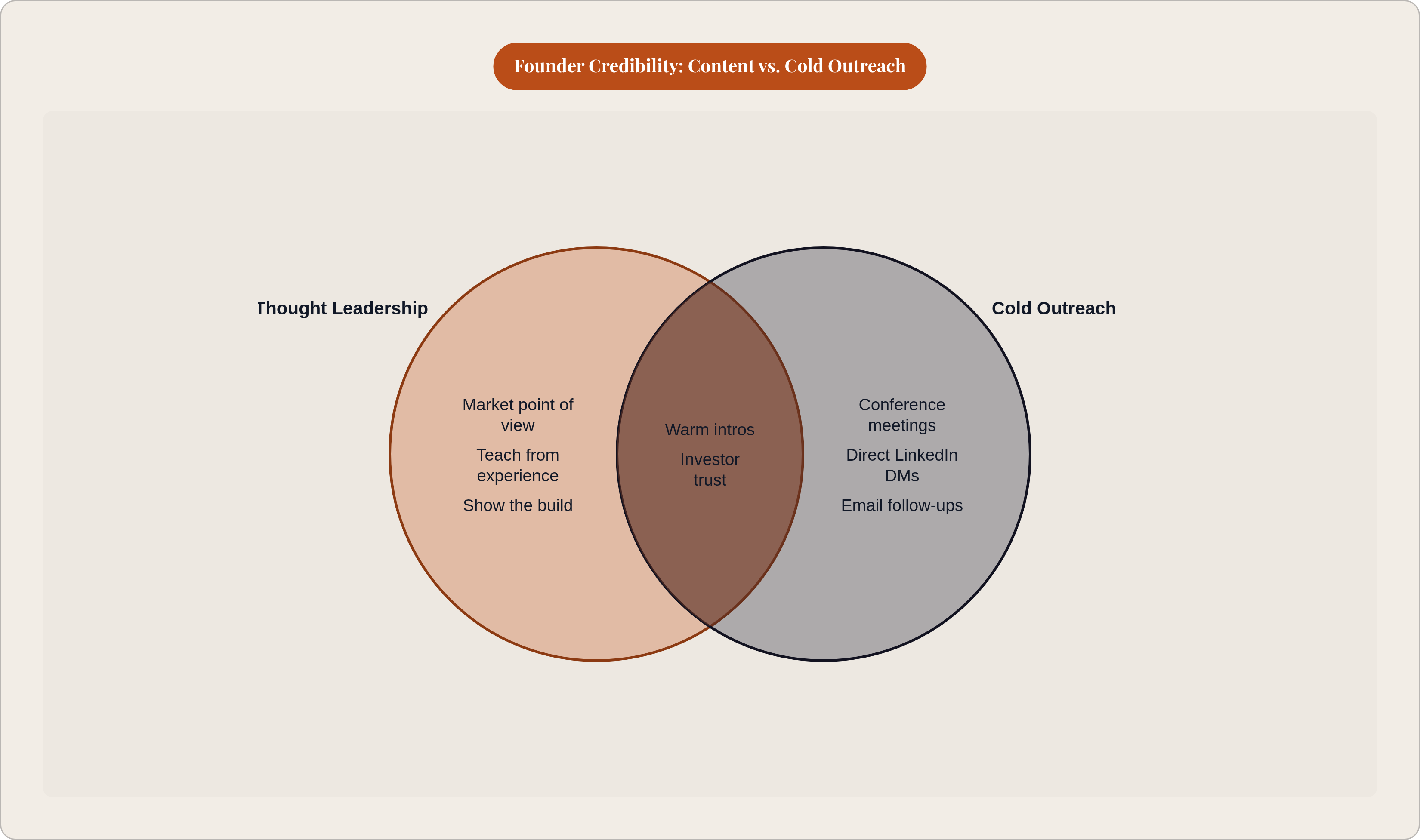
Warm introductions lead to significantly better funding outcomes compared to cold outreach. Cold LinkedIn messages to investors average below 1% response rates. The math on cold outreach is brutal. The goal is to never need it.
The practical pathway isn't complicated. Identify 10 to 15 angels who back companies in your sector. Find two or three portfolio founders from each, people who are slightly ahead of you in stage. Connect with those founders genuinely. Ask for market insight. Offer something of value first and don't make the first interaction transactional. After building real rapport, ask for a founder-to-founder introduction. When a portfolio founder vouches for you to an investor they already have a relationship with, you arrive pre-validated.
This is why content matters for the intro pathway too. A founder who has been publishing consistently already has a track record the portfolio founder can reference when they make the introduction. "I've been following her posts for six months. Her market read is sharp." That's a very different intro than "I met her at a conference last fall."
Engaging substantively on other people's posts, especially investors and adjacent founders, also builds visibility in the right circles before any direct outreach happens. Comment something worth reading. Not "great post." Actually engage with the idea. You're building a visible presence in a community before you need anything from it.
Why Founders Who Plan to Raise in the Next 12 to 24 Months Should Start This Week
If you start building when the raise opens, you've already missed the window.
Starting this week doesn't mean "getting ready to start." It means auditing your profile against the narrative structure: does it communicate vision, traction, and invitation, or just credentials? It means checking your leadership team's profiles for consistency on market size, traction data, and current branding. It means identifying your content pillars and drafting your first post in the "what you believe" category. The market point of view that only you hold is the right place to start. And it means mapping 10 to 15 target angels and their portfolio founders, then beginning genuine engagement now, not after the profile is "ready."
The honest execution problem is that building a consistent, high-quality content record while running a company is genuinely hard. Most founders who start with good intentions let it slide by week six. A fundraise opens. A key hire falls through. The post doesn't go out on Tuesday. This is where ghostwriting fits as a legitimate tool. Not outsourcing your thinking, outsourcing the execution. Your ideas, your voice, your market convictions, produced consistently by someone whose entire job is making sure the post goes out on Tuesday. One SaaS CEO has been publishing every week for over a year through a ghostwriting arrangement. His writer maintains the program. Twenty-three percent of his closed deals in Q1 cited that content as a factor in their decision. The voice and ideas belong to the founder. The execution is delegated.
LinkedIn isn't where founders go to raise money. It's where angels go to decide whether to take the meeting. The founders who understand that difference aren't waiting for the raise to start building. They're building now, while the stakes are low and there's still time for the work to compound.
Your profile and content record are running whether you manage them or not. The question is just whether what they're saying is what you'd want an investor to hear.