How Founders Use LinkedIn to Build Investor Pipelines
Optimize your profile photo, headline, and posts months before pitching investors.

A warm intro happens. A conference conversation goes well. The investor pulls up your LinkedIn the moment they get back to their desk. What they find in the next thirty seconds either confirms the meeting or quietly kills it.
Most founders treat their profile like a résumé. Investors read it like a pitch deck cover page. Almost nobody optimizes for the right one.
The elements investors notice first, roughly in order:
- Banner image. Brand identity before a single word gets read. A blank banner is a missed opportunity. A generic template is almost as bad.
- Headline. State what the company actually does, and why you are the person building it. If your headline says "CEO at [Company]," you have already lost the first five seconds.
- Photo. Match the tone and ambition of the business. A blurry headshot from someone's wedding in 2019 sends a signal, and not the one you want.
The About section is where most founders quietly lose people. Long blocks of career history get skipped. Investors are busy and a little impatient. Lead with the venture, not your background. One clear sentence on the market insight that motivated the company, then build from there.
A few things create doubt fast and need to go:
- Multiple concurrent roles that suggest split attention
- "Side project" language anywhere near the startup description
- Experience that has no visible connection to the problem you are solving
Network size matters too, even if it feels arbitrary. A thin network raises quiet questions about reach before a single post is even considered. Mutual connections matter even more. Investors notice when they share contacts with you, and that overlap is often what turns a profile scan into an actual reply.
Why Six Months Before a Raise Is the Minimum, Not the Target
The most common mistake founders make is starting to post when they decide to raise. That is already too late.
Investors who get serious about a company typically want to have encountered a founder's thinking for months before committing to a first meeting. Several more months before committing capital. The timeline is longer than founders expect, and LinkedIn is where the clock starts, whether you realize it or not.
What consistent presence builds over time that a pitch deck simply cannot:
- Ambient familiarity. By the time your outreach lands, the investor has already seen your thinking. You are not a stranger anymore.
- A longitudinal record. Posts spread across months show that your conviction is stable, not reactive. Anyone can sound confident in a deck. Fewer people sound confident over a year of public posts when things are going sideways half the time.
- Warm paths through the network. Comment threads and connection requests create context that makes eventual outreach feel much less cold.
Six months is the floor. Founders who have been building in public for a year or more show up to fundraising conversations with a real advantage. If you are already behind, start now. Treat the next six months as pre-fundraise runway and audit what your profile currently communicates to someone who has genuinely never heard of you or your company.
Why Posting a Pitch on LinkedIn Doesn't Work, and What to Do Instead
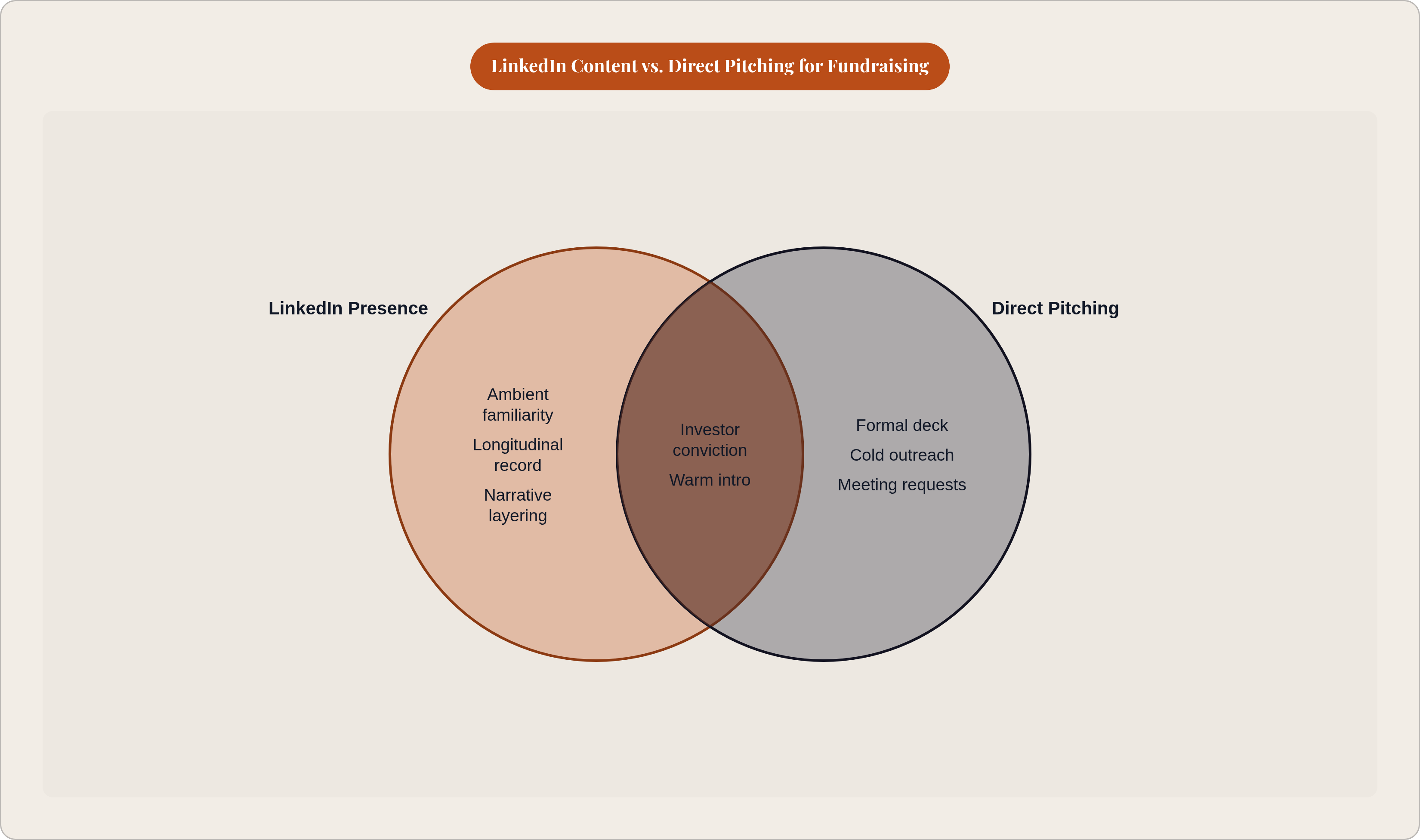
Cold pitching on LinkedIn signals the opposite of what you intend. It tells investors you do not understand how fundraising works. An unsolicited message with a deck attached arrives without the context investors need to evaluate it, and with a credibility gap that no amount of polished writing closes.
LinkedIn content is a foundation that makes a pitch land when you eventually send one.
There is one exception worth knowing. Announcing a raise publicly can work, but only when the framing is right. Frame it around a competitive process with a clear timeline, not an open invitation. Social proof and scarcity signal momentum. An open door does not. And this kind of post only lands well when there is an existing body of content behind it, something investors can actually scroll back through.
The posts that move investors are usually aimed at customers and the market. Content that reads as authentic because it was never written for investors in the first place. Nobody sits down to write "content that will build investor conviction." They write about a customer conversation that changed how they thought about pricing, or a hire that went sideways and what they learned. Investors read that stuff and feel like they are getting the real version of the founder. Which they are.
The Content Mix That Builds Investor Conviction Over Time
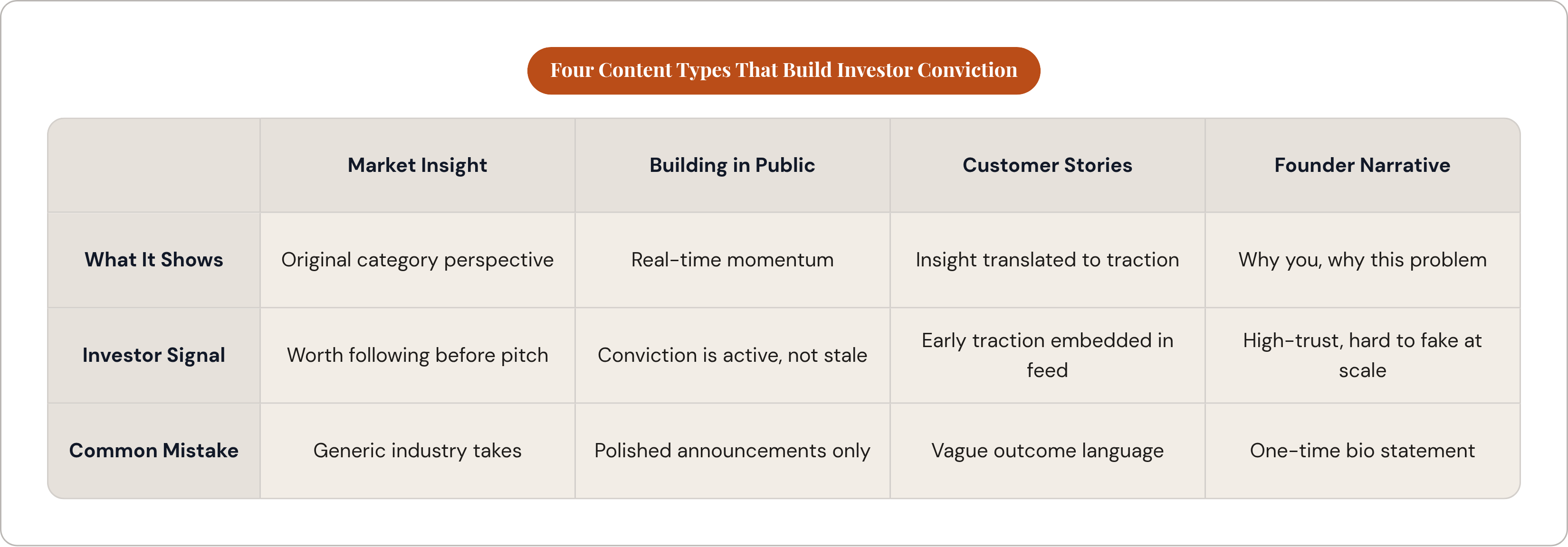
Investors want a founder's perspective, not polished marketing copy. Experience plus insight is what builds credibility over months. Four content types do most of the heavy lifting.
Market insight and hot takes. Your original point of view on the category you are operating in. These posts position you as someone worth following before anyone knows what your company does.
Behind-the-scenes and building-in-public. Product decisions, hiring, customer conversations, what changed and why. This demonstrates momentum in real time. Progress posts do more for investor discovery than any viral moment.
Customer and results stories. Proof that your insight has translated into something that works. Investors read these as early traction signals embedded in the feed, not in a formal document you sent them.
Founder story and personal narrative. Why you, why this problem, why now. The origin story is one of the highest-trust content formats because it cannot be convincingly faked at scale.
What kills it fast: AI-generated content that sounds like marketing copy. Investors have developed a nose for this, and it undoes the credibility everything else was building.
A few format notes:
- Text-only posts with deliberate line breaks travel furthest on the platform.
- Video has grown substantially. A founder who is comfortable on camera compounds reach faster than one who is not.
- Comments you leave on other people's posts carry real algorithmic weight and extend your visibility well beyond your existing audience.
Consistency beats volume. Showing up with a clear point of view at a sustainable cadence outperforms the burst-and-disappear pattern, which also makes investors wonder whether you have the bandwidth to actually build something.
How to Build a Narrative That Investors Find Themselves Repeating
Investing is emotional before it is analytical. Investors write checks because they believe in a vision they want to be part of. A founder whose market thesis is wrapped in a story gets repeated in investor conversations across town. A founder who leads with data gets summarized once and mostly forgotten.
Four narrative frameworks show up repeatedly in successful fundraising. The NFX framework is a useful reference point here:
- Industry Story. Positions your company against broader market shifts. Works well for category-creation plays.
- Customer Story. Puts the human problem at the center. Builds empathy before the business case lands.
- Hero Founder Story. The unconventional background or insight that makes you the right person. Works when the origin is genuinely distinctive, falls flat when it is not.
- Company Journey to Insights. The honest account of what you tried, what failed, and what you now know as a result. The most credible of the four because it requires intellectual honesty, which investors find surprisingly rare.
The mistake most founders make is picking a narrative, stating it once cleanly in a bio, and moving on as if the work is done. Narrative actually works through repetition and layering. You demonstrate it repeatedly through posts that each add a layer. Your LinkedIn feed should function as a running argument for why the market is real, why the timing is right, and why your team will win. Each post does not need to make the full case. But the body of work should make it unmistakably.
A simple test: after three months of posts, can a well-networked investor summarize your thesis in a single sentence? If not, the narrative needs tightening.
How to Build Investor Relationships on LinkedIn Without Ever Sending a Pitch
Start by mapping before you connect. Identify investors by portfolio fit, thesis alignment, and stage focus, not just "VC" or "angel." Investors whose existing portfolio overlaps with your market are highest priority because the context already exists. Boolean search logic on LinkedIn filters out noise and surfaces the specific profiles actually worth your time.
The engagement-first approach requires patience, which is the part most founders skip:
- Follow before connecting. A period of genuine engagement creates a history before a connection request even arrives.
- Leave substantive comments on investor posts. These carry real algorithmic weight and put your name in front of the investor's broader network, often people you would never have reached otherwise.
- Respond thoughtfully when investors comment on your posts. Each exchange deepens the relationship without a single direct ask.
After a few genuine exchanges, a connection request is a natural next step.
When to move to DMs: only after there is a real basis for the conversation. A shared thread, a comment they made, something they engaged with. The first message references something specific. It never leads with a deck. The ask, if there is one, is for perspective, not a meeting, and definitely not capital.
Mutual connections accelerate everything. A warm introduction through a shared contact, combined with a LinkedIn presence the investor has already encountered, collapses the trust-building timeline considerably.
The goal is that by the time formal fundraising begins, a meaningful portion of your target investor list already knows who you are. The first outreach feels like a reminder, not a cold introduction.
Why Most Founders Burn Time on LinkedIn Without Building a Pipeline
The real reason founders do not post consistently is not lack of material. It is the time cost of translating lived experience into publishable content week after week, while also running a company.
Writing, editing, scheduling, and engaging can eat several hours per week. Most founders deprioritize it when other demands spike, which is exactly when they should be building the pipeline. The result is the burst-and-disappear pattern, and it does not build anything durable.
The leverage model that actually works is partnering with a ghostwriting or content team. The founder's time collapses to reviewing and approving drafts rather than producing them from scratch. Those are very different tasks.
Here is how a good voice extraction process actually works:
- A short conversation each month surfaces what surprised you, what you changed your mind about, what you wish you had known earlier.
- That raw material is what makes posts feel like they came from a real person.
- The first batch of posts is a calibration period. You flag anything that does not sound right, the partner adjusts, and within a few weeks the voice locks in well enough that most readers cannot tell the difference.
Ghostwriting is a legitimate tool with a long history. Senior executives and political leaders have worked with communications partners for decades. What makes it work is that the ideas, experiences, and perspective have to be yours. The ghostwriter's job is extraction and packaging, not invention.
One real risk: content teams that have never built audiences themselves tend to produce output that reads like marketing copy, which is exactly the signal investors have learned to ignore. The instincts behind the content are what matter. Forj Media works the way it does because the people producing the content have done it themselves. That distinction is easy to overlook and hard to recover from if you pick the wrong partner.
What a Functioning Investor Pipeline on LinkedIn Actually Looks Like After Six to Twelve Months
The compounding effect of consistent presence is nonlinear. Early months build slowly enough that it is easy to wonder whether any of it matters. Later months accelerate as the algorithm distributes to a larger base, mutual connections deepen, and your name keeps appearing in the right feeds at the right moments.
What actually changes for founders who have built this well:
- Inbound signals start arriving. Investors following, commenting, or connecting without you initiating anything.
- Warm intros get easier. The intermediary can point an investor to a public body of work rather than vouching cold for someone the investor has never encountered.
- The first meeting arrives with prior context. The investor already has a rough mental model of your thesis before you walk in the room. That changes the entire tone of what follows.
- The fundraise feels less like a pitch tour and more like a continuation. Because for the investors who have been following you, it genuinely is.
LinkedIn is not a fundraising machine you turn on and walk away from. But founders who treat it as a long-game trust-building channel, and who put the operational infrastructure in place to sustain it, find themselves having warmer conversations with better-informed investors at the moment it actually counts.
That is just what happens when you show up before anyone asks you to.