LinkedIn Visibility During a Live Fundraising Round
Investors check your LinkedIn before reading your deck—make sure it's worth their time.

When an investor gets your deck, the first thing they do isn't read it. They search your name on LinkedIn. That profile is running its own quiet due diligence on you around the clock, whether you're posting or not, and it's forming an opinion before your first call even gets scheduled.
First Round Capital found that over 80% of VCs check a founder's LinkedIn before taking the meeting. Before, always before. So if your profile is thin, stale, or reads like three different people wrote it at three different points in your career, you've lost ground before anyone says hello. Investors are reading for conviction, checking whether you actually understand your market or just memorized the slide about it.
This signal runs both directions, and founders underestimate that part constantly. A profile with real thinking on it creates momentum, a sense that something's happening here. A blank or dormant one creates a vacuum, and investors fill that vacuum with their own guesses. Most of those guesses aren't flattering. Once your round goes live, this effect multiplies fast: every warm intro, every LP conversation, every cold email triggers a fresh LinkedIn lookup, all compressed into a few weeks. Right now, while you're reading this sentence, those lookups are happening.
What LinkedIn's actual composition means for fundraising founders
People still talk about LinkedIn like it's a place for career updates and awkward conference selfies. The platform has assembled something tens of millions of decision-makers and millions of C-level executives in one place, sitting alongside hundreds of millions of senior-level professionals. You don't build an audience like that. You show up to it.
Four out of five LinkedIn members influence business decisions at their companies, and they carry roughly twice the buying power of a typical web user. A 2024 survey found 68% of financial advisors call LinkedIn their primary marketing channel. Read that as a signal: the professional investor class is actively working the platform.
CEO posting activity climbed 52% year over year across the past two years too. That's competitive pressure, plain and simple. Posting consistently used to set a founder apart, but now it's closer to table stakes, and skipping it is what actually gets noticed, for all the wrong reasons.
Worth saying plainly, since founders get this backwards constantly: investors go to LinkedIn to size you up, not to browse an audience you've built for its own sake. Treat it like a stage, not a diary.
How the 2025–2026 algorithm decides which founders get seen
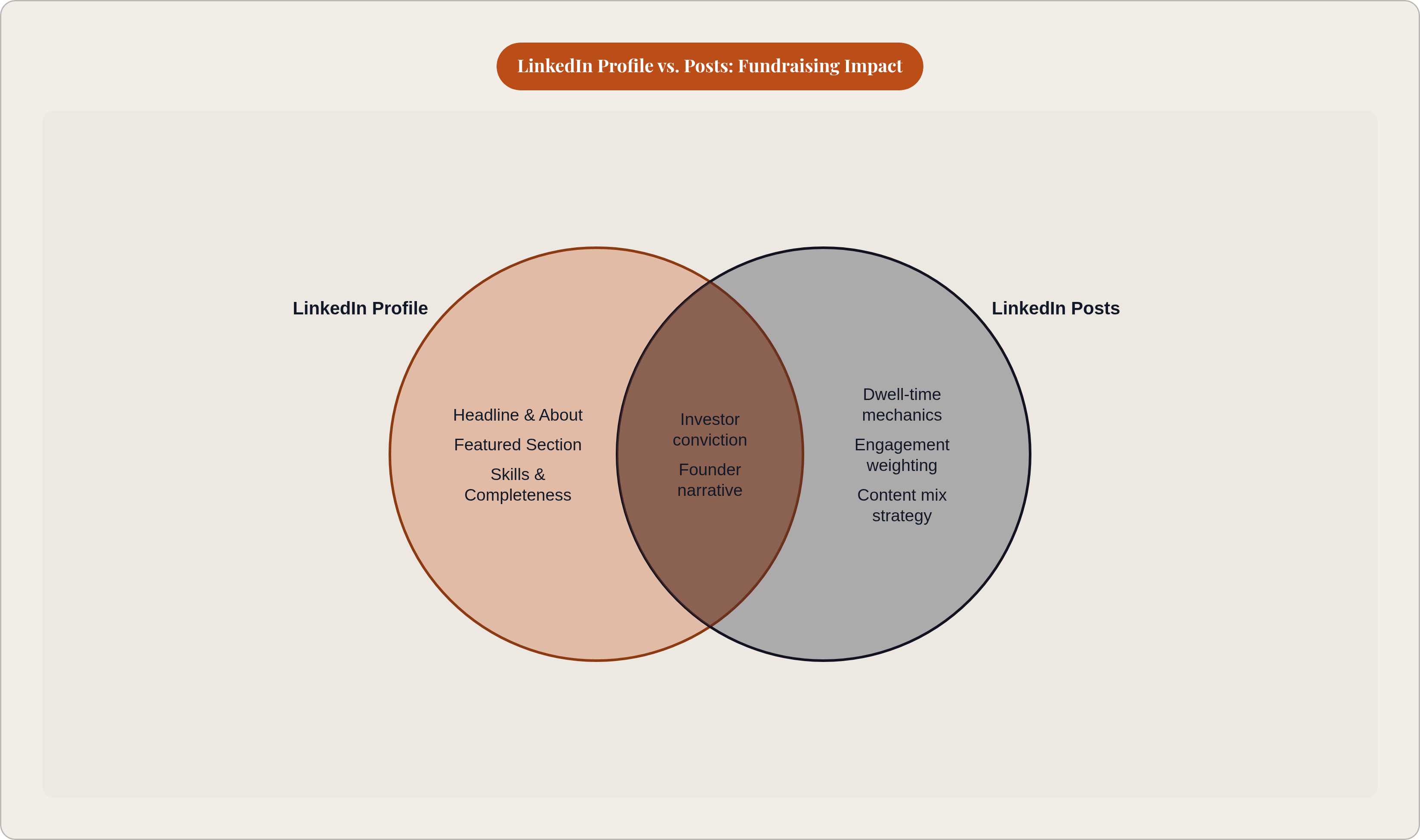
LinkedIn rolled out an AI system called 360Brew in 2025 that checks your profile's credibility before it decides how far a given post travels. Your profile and your posts aren't separate anymore, in other words. A great post sitting on top of a thin profile doesn't move the way it used to.
There's a dwell-time mechanic worth knowing about too. Get a reader to pause for roughly 4-5 seconds and you unlock basic distribution. Cross about 7 seconds and the post gets pushed to a second, wider wave. So your opening line isn't a stylistic flourish, it's a distribution lever, and a flat first sentence means most people never see the rest of the post.
Engagement type matters more than raw count. A comment carries something like three times the weight of a like, a share carries close to five times the weight, and a post with ten real comments will out-travel a post with a hundred likes. Here's the detail that trips up a lot of founders: personal profiles get roughly eight times more engagement than company pages. Post your fundraising narrative from the startup's company page and you're fighting the algorithm with one hand tied behind your back.
Only about 1% of LinkedIn users post weekly, and that small group still generates something like 9 billion impressions between them, every week. The bar for standing out sits lower than people assume, mostly because almost nobody clears it with any consistency.
One more wrinkle heading into 2026: a large share of long-form posts on the platform are likely AI-generated now, AI-written comments have spiked hard, and LinkedIn is actively pushing that content down in the feed. So specific, founder-voice writing (actual details, actual opinions, actual stakes) is worth more now than it's ever been. Generic is easy to spot and easy to bury.
The profile as a live document investors read in parallel with your deck
During an open round, investors aren't discovering you on LinkedIn for the first time. They've got your deck open in another tab already, cross-referencing as they go. The profile's job is to add what the deck can't: texture, conviction, the sense that a real person with real judgment sits behind the numbers.
Your headline and About section carry most of the weight, since that's what gets read first, often before anything else on the page. If those two sections read like a résumé, job title, dates, a list of past employers, you've wasted the most valuable real estate you have. They should communicate vision. What are you building, and why does it matter right now, this year, not eventually?
Here's a quiet red flag investors catch more often than founders think: when the story on your deck doesn't match the story on your website, which doesn't match the story on your LinkedIn. That reads as unresolved strategy, like you haven't actually settled on what you believe yet.
The Featured section sits underused on most profiles, and it shouldn't. Pin a strong media mention, a product milestone post, a sharp market-insight thread that backs your investment thesis. It's free real estate most founders leave completely blank.
This isn't only about you, either. If your leadership team has scattered, inconsistent, or dormant profiles, that tells investors something about the depth of the bench. Coordinate messaging across the executive team, shared market data points, consistent framing, even matching cover photos, so the whole leadership group looks like it's rowing the same direction.
Small mechanical things compound here. Listing a current position gets you up to 5x more connection requests, and listing at least five relevant skills makes you dramatically more likely to get messaged cold. During a round, when more people are actively looking you up than at any other point in your company's life, basic profile completeness pays off in a very literal way.
What to post during an open round — and the logic behind the content mix
Every post you publish during an open round gets read by investors, potential hires, customers, and competitors, all at once, all with different agendas. That's the actual constraint you're writing inside. Your content has to work for all of them without tipping your hand to any one of them.
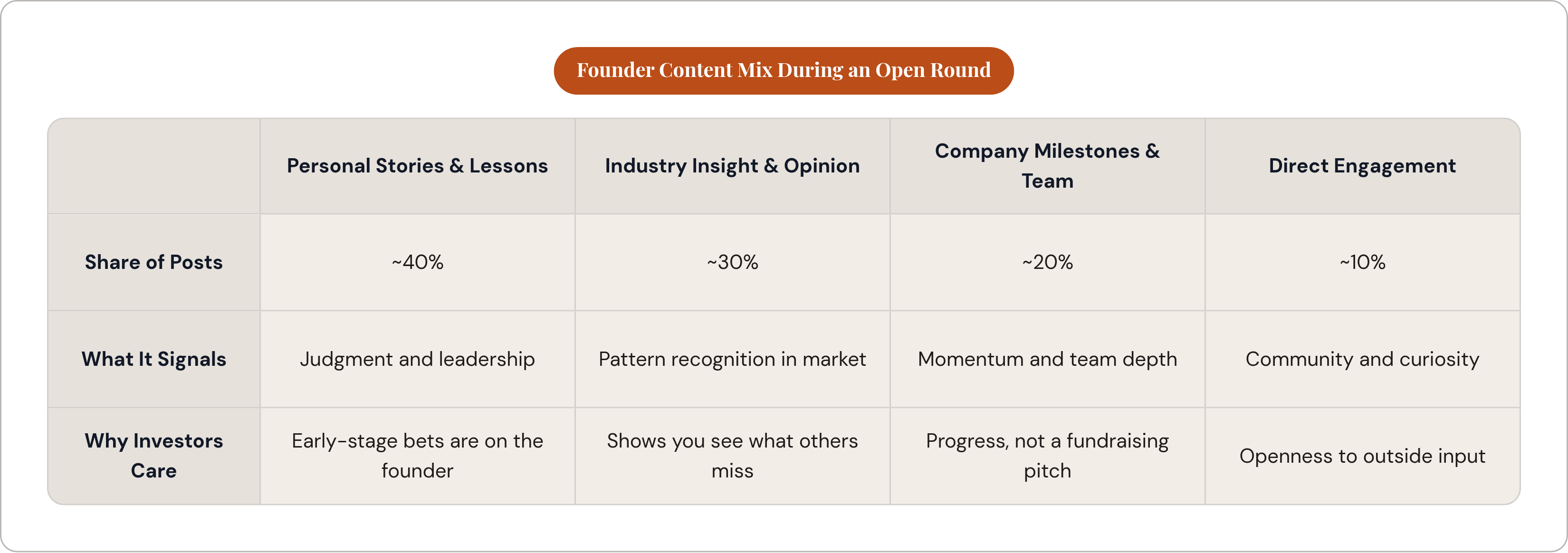
Look at high-performing founder accounts and a pattern shows up in the content mix. Personal stories and lessons make up the biggest share, roughly 40%: your perspective, decisions you made, what you learned from being wrong about something. Industry insight and opinion take another 30%, market framing that shows you've connected a dot others haven't. Company milestones and team highlights round out about 20%, framed as progress rather than a fundraising update dressed up in a costume. The remainder is direct engagement, polls and questions, things that invite someone to raise their hand.
That first bucket, personal stories, matters most during a raise. It's the category that signals judgment and leadership, which is exactly what early-stage investors are betting on when they write the check. Nobody funds you because your CAC dropped 4%; they fund you because they believe you'll make good calls when the plan falls apart. And at some point, it will fall apart a little.
Watch for what I'd call the founder trap: posting only about what you personally shipped or built. That reads as "operator" rather than "leader." Investors at seed and Series A want vision and judgment on display, not a highlight reel of your Jira tickets.
The best posts connect a market shift, a behavior change, or a technology trend directly to why your company is the obvious next move. Reasoned inevitability travels further than hype. Done well, that builds real investor FOMO without ever typing the word "raise" once.
On frequency, two or three sharp, well-aimed posts a week beat daily posting with no throughline, since every post during a live round needs to earn its spot on the feed. On format, text-only posts under about 1,300 characters tend to beat carousels and video for founder accounts, though short video under 90 seconds pulls noticeably more engagement when the content actually calls for it. Pick the format the idea needs, not whatever's trending on the platform that week.
How to use LinkedIn to warm investor relationships before and after each meeting
There's a sequence that works, and it starts well before you send a connection request. Leave two or three genuinely substantive comments on a target investor's posts over the course of a week. By the time your connection request lands, your name already looks familiar.
Keep the request short. Personalized notes under 100 characters get accepted close to half the time, versus roughly 28% for a blank request. Be specific enough that they remember who sent it, rather than treating the note as a pitch.
Before a first meeting, if the investor recently posted something relevant, engage with it thoughtfully first. Now you've got a shared reference point walking into the call, and you've quietly shown you did the homework. After the meeting, publish something on a topic that came up in conversation, without mentioning the meeting itself. It lands in their feed like an organic follow-up, reinforcing your thesis minus the awkwardness of a "just following up!" email.
Warm intros get easier here too. LinkedIn surfaces shared connections, so you can find the right path to an investor and engage with the mutual contact's content first, which makes the eventual ask feel like a natural next step instead of a cold favor you're calling in.
There's a compounding effect worth knowing about: when a well-connected investor comments on your post, the algorithm pushes your reach into that investor's own network. One good comment from the right person can put you in front of five other investors you hadn't even targeted.
What not to post — confidentiality, signaling desperation, and the mistakes that hurt rounds
Most founders worry about accidentally leaking the round, or worse, looking like the round is struggling. Fair worry, and worth being precise about. Round size, valuation, a named lead investor, a close date: none of that belongs on LinkedIn while things are still open. Full stop, no exceptions.
Market trends, product thinking, culture, customer problems, and personal lessons learned the hard way carry a different kind of risk calculus. None of that touches material non-public information, and founders who avoid posting anything substantive out of over-caution are leaving the whole channel on the table for nothing.
Desperation has its own tells, and investors have seen every single one. A post transparently fishing for attention ("looking to connect with VCs who love…") reads as exactly what it is. A sudden burst of posting after months of silence gets correctly pattern-matched to a live ask, every time. Posts that inflate minor metrics into vanity wins smell like manufactured momentum from a mile away.
There's a subtler risk too: posting something that contradicts your deck's market sizing or competitive positioning. Investors already sitting with your deck open will spot the gap immediately, and it doesn't read as flexible thinking. It reads as confusion, and confusion doesn't close rounds.
Here's a test worth running before you hit publish on anything during a live round: would this post make sense if you weren't raising at all? If yes, post it. If the post only makes sense because you're raising, it goes back in drafts.
Building narrative capital that outlasts the round
A strong narrative doesn't just close this round; it compounds well past it. Better narrative produces investor belief, which produces better terms, which funds the milestones you'll eventually get to publicize, which strengthens the narrative again heading into the next round. Founders who get this loop right find each subsequent raise a little easier than the last one.
Rally Ventures has made the point that the same company can be worth roughly half again as much purely on the strength of its storytelling, since even the most technical investor still needs to understand the vision before they can price it. Framing does real selling work that numbers alone can't do.
There's a long tail to all of this. A sharp market-insight post from your seed round might resurface in an investor's search over a year later, right as your Series A conversation kicks off. The system you build now pays out later, often when you least expect it, which is exactly why the worst possible time to start posting is once you're deep in diligence with zero bandwidth left to spare.
Trust follows the same logic with investors as it does with customers. Most people say they trust a company more when its senior leadership shows up visibly on social media, and that trust builds through repetition, not one lucky viral post. The content should shift with your stage too. At seed, you're selling vision and conviction; by Series A, the same presence needs to start carrying commercial proof and a real team standing behind it. A static content strategy stops working the moment your company stops being static.
How founders who can't write consistently still maintain a strategic LinkedIn presence during a round
The honest bottleneck here is rarely a lack of ideas. It's bandwidth, plain and simple. A founder mid-raise is running the company, sitting through investor meetings, prepping for diligence calls, and somehow also supposed to write three sharp posts a week on top of it. Something gives, and usually it's the LinkedIn post.
Ghostwriting isn't some hack invented for the internet age, either. Executives have leaned on speechwriters, PR teams, and comms leads for decades; LinkedIn ghostwriting is the same function, just pointed at a different channel. Good ghostwriting pulls your actual thinking out of meeting notes, investor calls, offhand comments in Slack, and shapes it into something that sounds unmistakably like you, rather than inventing opinions for you. The conviction stays yours. The execution gets shared.
When you're evaluating a content partner mid-round, a few things actually matter. Has the person built a real audience themselves, or do they just manage content calendars for other people? Do they understand investor psychology, or only LinkedIn's posting mechanics? Can they keep your posts and your deck telling the same story, without drifting into two different narratives? And speed matters, because a live round won't wait around for a four-week onboarding process.
The real question for any partner is simple: have they built audiences, or have they just scheduled posts? Those are different skills, and only one of them helps you during a round. A weak LinkedIn presence while you're raising costs you in investor skepticism, cold intros that go nowhere, and a narrative that doesn't hold together under a second look. A good content partner costs something fixed and known, which is a lot easier to plan around.