LinkedIn Content That Demonstrates Traction to Investors
Investors fund founders they feel they already know through months of specific, quantified proof.

Traction is not one post. It's a pattern that builds across weeks and months. An investor pulling up your profile isn't reading individual posts one by one. They're scanning the whole thing at once. Think of each post as a tile in a mosaic — step back far enough and either a clear picture forms or it doesn't.
Four signal categories carry the most weight:
- Customer momentum. Named wins. Specific outcomes. Retention and expansion stories tied to a real industry.
- Hiring velocity. Who joined, what role, and what that says about where the company is headed.
- Product milestones. What shipped, why it was built, and the thinking behind the call.
- Market insight from your own data. Observations you can only make because you have real customers doing real things.
Investors skip vague signals fast. The posts that actually move them have specific numbers in them: revenue growth rates, user counts, adoption curves. Quantified proof is one of the fastest ways to establish credibility in a feed, and most founders chronically underuse it.
Your full LinkedIn presence needs to tell one consistent story. Headline, About section, posts, team profiles, company page. If investors see a polished deck and then land on a sparse, scattered profile, that gap reads as a warning sign. Not a small one.
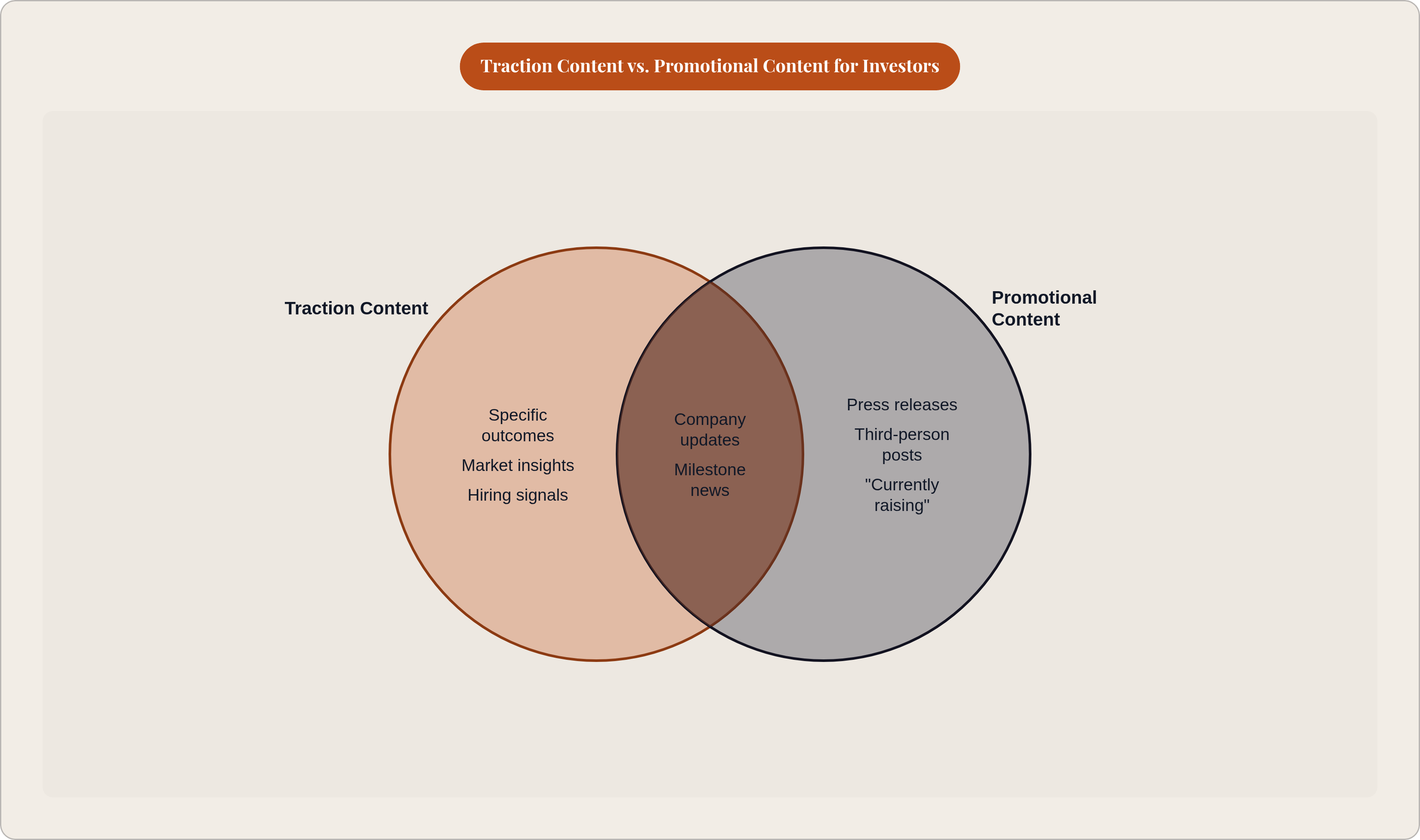
What traction content is NOT: press releases, product announcements written in third person, or "currently raising" in your headline. None of that signals momentum. It signals that you need something from the reader.
The timing problem most founders get backwards
Most founders either go quiet during a raise or start posting the moment the round opens. Both are wrong, and for the same reason. The credibility that gets you into a first meeting takes months to build. You can't manufacture it in real time.
The practical threshold is six to twelve months of consistent, evidence-led posting before a planned raise. Start earlier than feels necessary. The founders who close rounds fastest are not always the ones with the best product. They're the ones investors feel like they already know — and familiarity lowers perceived risk before a single slide gets shared.
The content types that translate each traction signal into investor-readable proof
Customer momentum posts
Short narrative. The customer's problem, the moment they chose you, a specific outcome with a number on it.
What makes it investor-readable is naming an industry or use case and, if you've posted more than one, showing that the pattern repeats. That's what investors are actually looking for. Not a single happy customer. Evidence that it keeps happening.
Drop the "thrilled to announce" language. Investors skip it because it tells them nothing about your business. It tells them you have a comms template.
Hiring and team posts
Introduce the hire. Give their background. Make the "why they joined" specific to where the company is going, not a compliment to the person.
Someone leaving a stable job or a known company to join yours is a signal. Role titles also telegraph direction. A head of enterprise sales at 18 employees tells investors something specific about the next twelve months. And if your leadership team is also posting on LinkedIn and reinforcing the same story, that compounds the signal considerably.
Product milestone posts
What shipped. Why it was built. What user behavior or customer request drove the decision.
The reasoning matters more than the announcement. Any company can say they shipped a feature. Explaining why, in plain terms, shows product judgment and responsiveness to real market signals. Those are the things investors are actually weighing when they read your feed.
Market insight from your own data
A specific observation you can only make because you have customers. A usage pattern. A trend that surfaced from actual customer conversations that you haven't seen anyone else name yet.
This is the content type that proves founder-market fit and market depth at the same time. It's also the hardest to fake, which is exactly why investors trust it more than anything else you post.
Founder journey posts
A specific hard decision, what you learned, and what changed. Not a motivational reflection. More like a case study in judgment.
Here's one that actually worked. A founder had to kill a feature her whole team loved. Three months of engineering work, cut. The data showed it was pulling users away from the core workflow instead of deepening it. She wrote about the decision in plain terms: what the numbers showed, what the argument against cutting it was, and why she did it anyway. That post generated more investor outreach than anything else she published during her raise. You could say she turned a hard cut into the sharpest tool in her deck.
Investors fund decision-makers. Seeing how someone reasons through a hard call, with no deck to hide behind, is about as close to a live audition as they get before the first meeting.
The content mix that actually performs
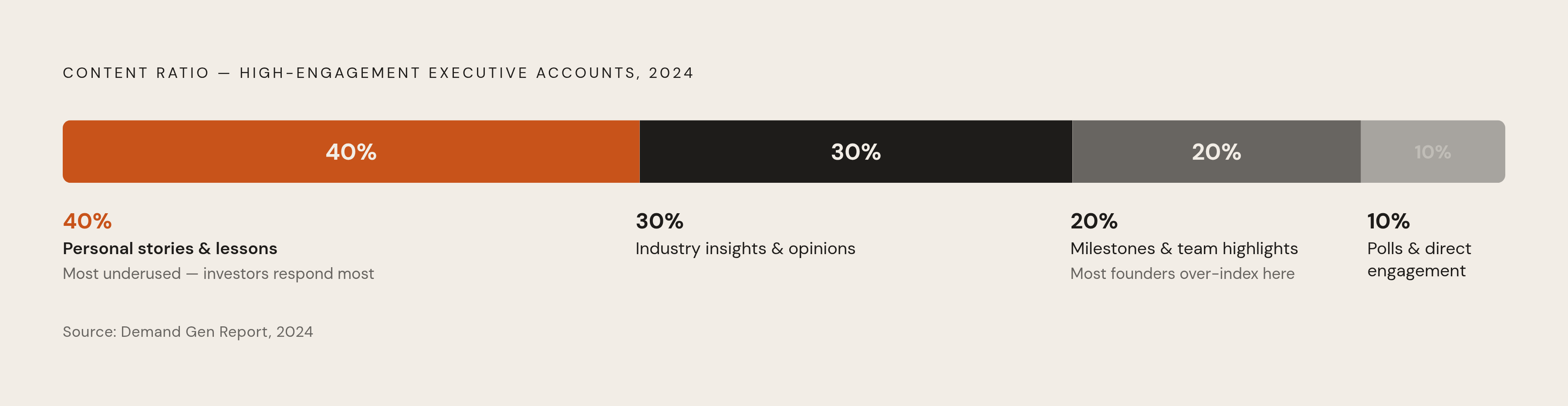
A 2024 Demand Gen Report analysis of high-engagement executive accounts found a mix that holds up across industries: 40% personal stories and lessons, 30% industry insights and opinions, 20% company milestones and team highlights, 10% direct engagement formats like polls. Check your own feed against that ratio. Most founders are heavy on milestones and light on everything else.
How format choices affect whether investors actually see and trust the content
Post from your personal profile, not the company page
Your personal profile generates more reach and more engagement than an equivalent post from a company page. For fundraising purposes, the founder's voice is the asset. Post from your profile.
Carousels and short video outperform text alone
LinkedIn document posts (carousels) and short native video are the two formats with the highest engagement rates on the platform. Carousels work well for milestone summaries and traction recaps. Video works for presence and credibility in a way text can't replicate.
On video: native uploads under roughly 60 seconds retain most viewers and earn more engagement than longer content. Native uploads also significantly outperform external links in both reach and engagement. For investors, 45 seconds of a founder on camera is a credibility signal a text post simply cannot match.
The authenticity requirement is now baked into the algorithm
In July 2026, LinkedIn introduced a user-reporting function for content that looks AI-generated. Posts that follow predictable structures, use generic vocabulary, or lack a specific human point of view get suppressed.
For founders posting traction content, the implication is direct. Your post needs details only you could know. A specific customer name where you have permission. A real number. An actual decision and its outcome. AI can help with structure and drafting. Your specific facts and your contrarian takes are what make it land.
One algorithm change worth knowing: strong posts can now stay in feeds for weeks rather than hours. A milestone post doesn't disappear overnight anymore. It compounds.
Why thought leadership content earns investor trust at a level promotional content cannot
The 2025 Edelman-LinkedIn B2B Thought Leadership Impact Report, drawing on nearly 2,000 global professionals, puts numbers to what most experienced founders already sense:
- 95% of "hidden buyers" say strong thought leadership makes them more open to outreach before any direct engagement
- 71% say it is more effective than traditional marketing at showing potential value
- 64% trust thought leadership more than product sheets when sizing up capabilities
- 79% say they are more likely to advocate internally for a proposal when the vendor produces consistently strong thought leadership
These findings describe buyer behavior. But the investor dynamic works the same way. Investors are sizing up a founder's credibility and judgment before any formal process starts. Content is the primary input available to them outside a warm introduction.
DSMN8, citing Entrepreneur research, found that 82% of people say they are more likely to trust a company when its senior executives are active on social media. For early-stage founders without a big institutional name behind them, the founder's voice is the brand's credibility. There is no other version of it.
Brunswick research, also cited by DSMN8, found that financial readers trust leaders with a personal brand over those without one by a 6:1 ratio. In a fundraising context, that shows up in whether your cold email gets a reply.
Thought leadership doesn't just raise awareness. It changes the default posture of the person reading. From skeptical evaluator to someone who is already halfway there.
How to sequence traction content deliberately during a raise
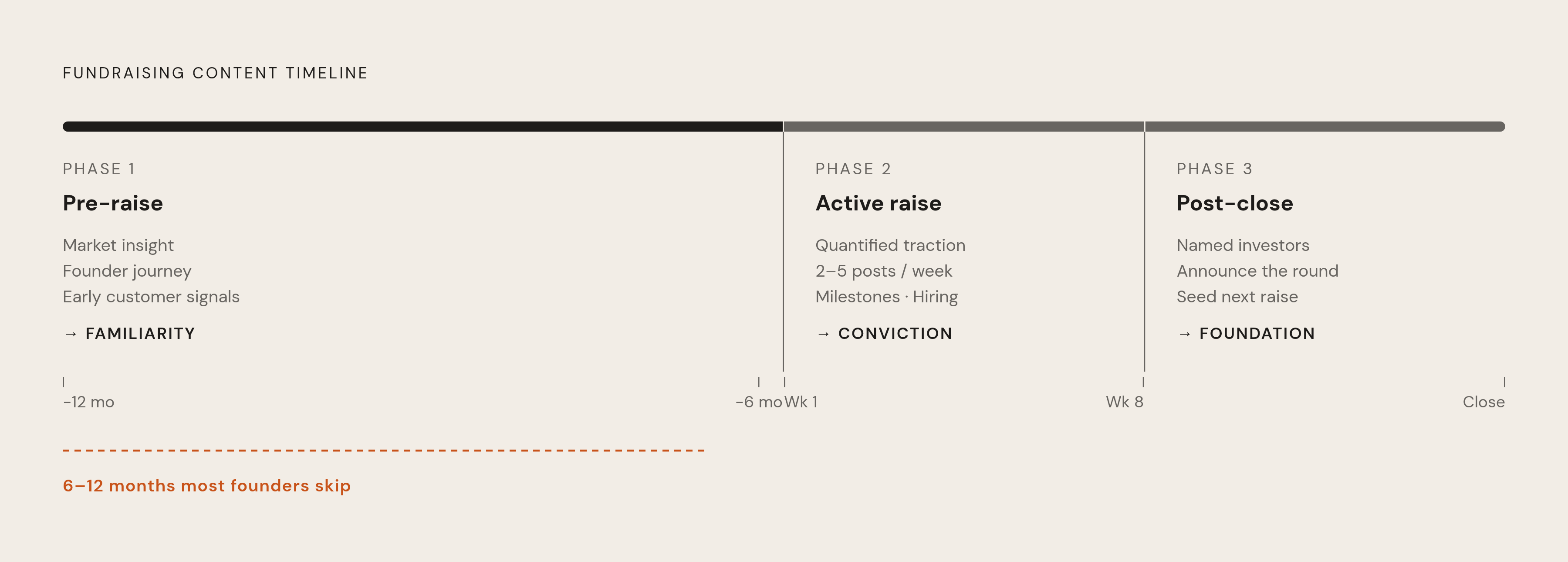
A raise has three phases, and each one calls for different content.
Pre-raise (6 to 12 months out): build authority
- Market insight posts that establish domain credibility
- Founder journey posts that build familiarity and show judgment over time
- Early customer signal posts, even anecdotal and qualitative ones
By the time you're pitching, investors who will take your call should already know your name and your thinking. You are not cold to them. You are familiar. That's the whole goal of this phase.
Active raise (weeks 1 through 8): accelerate the signal
- Shift toward concrete, quantified traction: milestone posts, hiring announcements, customer outcome stories
- Post two to five times per week, weighted toward the four signal categories investors read most closely
- Don't broadcast that the round is open in the post itself. Social proof is better signaled through round-fill language and competitive-window framing used selectively in direct outreach
One practical note: the investor update you sent last Friday is a post waiting to be written. The facts are already there.
Post-close: keep building
Announce the close with named investors and the story of why they invested. That post does double duty as customer credibility and talent magnet. Then keep going. The audience you built during the raise is the foundation for the next one.
The weekly rhythm that supports all three phases
- Monday: A structured insight that shows market depth
- Wednesday: A sharp, specific point of view. A belief about the market or the product that only you hold.
- Friday: Story-backed proof. A customer moment, a team win, or a milestone with the reasoning behind it.
Get the profile investor-ready before any content goes out
The first 45 characters of your headline appear in search. Structure it as: "Founder of [X] | Solving [Y] for [Z market] | [Traction signal]." Your About section should follow four parts: origin, problem, traction, invitation. Update both at the start of the pre-raise phase. Do this before the active raise begins, when you have no time to think clearly.
The execution problem most fundraising founders hit and how ghostwriting addresses it
The problem is almost never knowledge. It's bandwidth and consistency under pressure.
Founders in active fundraising mode are simultaneously pitching, managing their team, and keeping the business from wobbling. Content is what gets cut. And cutting it during a raise is exactly backwards, because that's when it's doing its most important work.
Ghostwriting has a long history in executive communications. Speechwriters, communications directors, editorial partners. These roles have always been part of how senior leaders communicate at scale. LinkedIn is the modern version of the same thing. Nothing dishonest about it.
What makes ghostwriting work for traction content specifically:
- The founder owns the raw material. The customer story. The product decision. The market observation.
- The ghostwriter's job is to pull those things out and shape them. A 10-minute founder conversation becomes a post that reads like the founder wrote it on their best day.
- Authenticity holds because the facts, the voice, and the specific details all come from the founder. The ghostwriter provides structure and consistency.
The real risk with generic content agencies is simpler than it sounds: they don't know how to tell an investor-signal post from a brand-awareness post. The framing, the specificity, and the sequencing are what make traction content work. Those require someone who knows what a fundraising process actually feels like from the inside.
Forj Media works this way. Their team has built audiences and run content programs using the same methods they bring to clients, which means they can pull the right signals from a founder's real experience and shape them into content that reads as credible to investors. Story-driven proof, written in the founder's voice rather than polished corporate messaging.
The measurable outcome is not likes and impressions. It's inbound investor interest, faster first-meeting conversions, and a raise that starts with warmer relationships than cold outreach alone would ever produce.