Warm Introductions to VCs Through LinkedIn Network Paths
LinkedIn's graph reveals VC intro paths founders overlook.

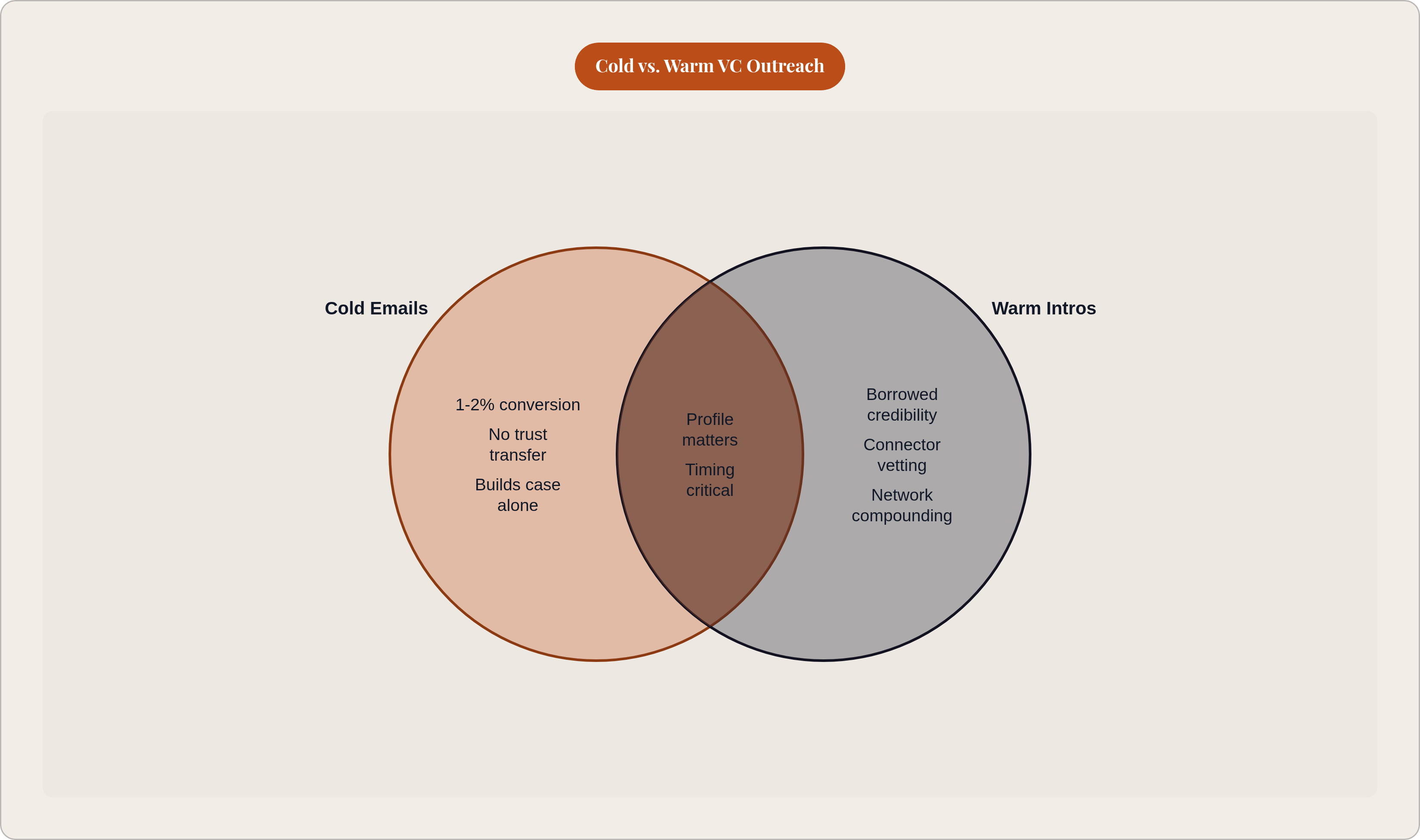
Cold emails to VCs convert at somewhere around 1 to 2 percent. Jeff Bussgang, who teaches at Harvard and runs Flybridge Capital Partners, has said out of roughly 60 deals he's done, exactly one came from a cold intro. Sixty deals, one cold email. I've watched enough raises up close to tell you that ratio is the baseline, and everything else here just unpacks why.
Early-stage investing runs on soft signals. There's no revenue to point to yet, no retention curve, nothing hard. So VCs lean on something else: trust they've already extended to someone they know. A warm intro drags that trust along with it into the inbox. A cold email has to build its own case from a standing start, and most of them never get there.
That trust costs the introducer something too, which people forget. Make a bad connection and you look bad by association, so your connector is quietly vetting you before they ever type a word. A warm intro is a background check with better manners. The actual question is where these relationships are already sitting, because you've got more of them than you think. You just haven't gone looking.
How LinkedIn's graph structure reveals the intro paths founders don't know they have
Mutual connections and second-degree visibility are the whole design of the graph, and most founders touch maybe 10 percent of it before giving up.
Search a VC's name. Their profile shows you exactly who bridges the two of you, real names, sometimes three or four of them, sitting there the entire time you were about to send a cold email instead.
Then there's the layer people skip past entirely: "People Also Viewed," "People You May Know." I've seen these surface a portfolio founder who went to the same state school, a former coworker now sitting at a fund one stage up, an advisor two people never realized they shared. None of that shows up if you're only staring at the target's profile, waiting for something to click. It shows up when you click one layer down, which almost nobody does.
Alumni groups. Accelerator cohorts. Industry associations. These sit there, full of people, mostly untouched. LinkedIn claims something like 65 million decision-makers and 180 million senior-level members, so the distance between you and nearly any VC on your list is shorter than you'd guess sitting at your desk convinced you don't know anyone. Founders stare at the destination and skip the road. That's the miss.
Choosing the right node in the path — who actually moves the needle as an introducer
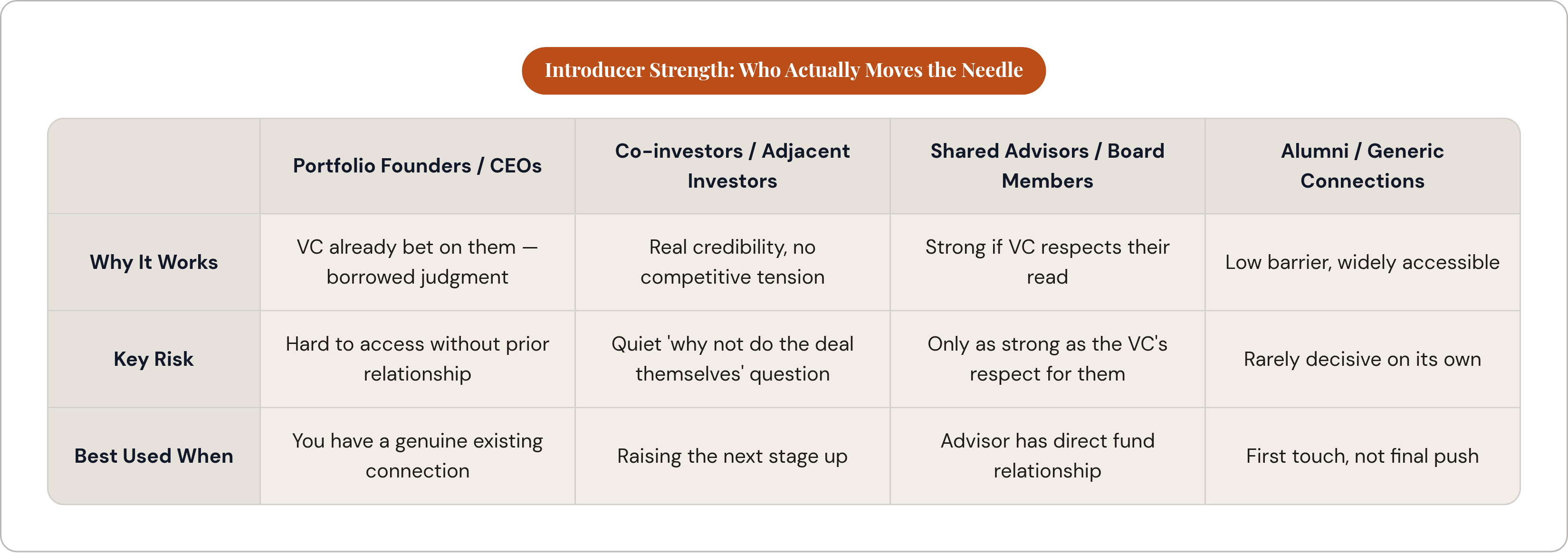
Found five mutual connections? Good. Now the actual work starts, because those five aren't interchangeable, and treating them like they are burns a favor on the wrong ask.
Rough pecking order, from what I've seen actually land:
- Portfolio founders and CEOs. A referral from someone the VC already bet money on is close to gold. You're borrowing their judgment wholesale.
- Co-investors, or investors one stage adjacent (a seed investor vouching for you to a Series A fund). Real credibility, no competitive weirdness underneath it.
- Same-stage investors at other funds. Helpful, but there's a quiet "why didn't they just do the deal themselves" question hovering nearby.
- Shared advisors or board members. Strong, assuming the VC actually respects that person's read on things.
- Alumni groups or generic shared connections. Weakest of the bunch. Fine for a first touch. Rarely the golden ticket.
Ask yourself one thing: would this person's name in a subject line make the VC open the email faster? If you're shrugging, you haven't found the right node yet. Dig another layer down.
Timing is the part nobody wants to hear. Founders who've quietly built relationships for months walk in with warm nodes ready to go. Founders mapping this out three weeks before a raise are doing triage under a deadline, and triage under a deadline makes for worse calls than people ever admit to afterward.
Making the ask without wasting the relationship or the opportunity
This is the part that separates founders who look sharp from founders who look like they're using someone. The whole gap lives in the wording.
Something close to this works: "I saw you're connected with [Investor Name] on LinkedIn. Do you know them well enough to make an intro? Happy to send a drafted note if so." Nothing pushy in there, on purpose.
It gives your connector a clean exit. "Not well enough" is a fine answer, and nobody has to invent an excuse to give it. It treats the relationship like something worth protecting. And handing them a pre-written note does two things at once: removes friction, and lets you control how you're described instead of hoping they remember you accurately from a conference two years back.
Keep the forwardable note tight. One sentence on what the company does, clear enough that the VC gets it in ten seconds. A traction line, offered as proof. One line on why this VC specifically, not a form letter dressed up as thoughtful. A next step with almost no friction, a deck or a 15-minute call, something easy to say yes to between two other meetings on a Tuesday.
LinkedIn's group messaging feature does more work here than people give it credit for. A three-way thread puts everyone's profile and shared context in view at once, so the VC isn't squinting at a name that shows up cold in their inbox five minutes later.
Personalize the connection request too. You get 300 characters. Use them on a specific portfolio company, a recent post, a thesis they've said out loud somewhere public. Small move, real lift in acceptance rate. And skip the instinct to mass-connect with 150 VCs and see what sticks. A tight list of 15 to 20, worked properly, beats spray-and-pray every time, and VCs have gotten good at spotting spray-and-pray from a mile off.
Why a founder's LinkedIn profile and content record determine whether the intro converts
Nobody thinks about this until it bites them. The intro gets the VC to look. Your profile does the actual convincing, or the actual damage, and it happens fast.
The second a warm intro lands, the VC searches your name. Basically guaranteed. What comes back either backs up the trust that just got handed to you, or quietly drains it before you've said a single word.
Treat the profile like a landing page, because that's functionally what it's become. The headline has to say something real, since "Founder | Building the Future of X" says nothing at all to anyone reading it. The featured section should carry proof, screenshots, numbers, press mentions, rather than a link to a homepage nobody was going to click anyway.
In the roughly sixty seconds a VC spends on your profile, they're really asking three things. Does this person know what they claim to know? Do they have an actual point of view, or just professional-sounding sentences that resolve into nothing? And is there any visible sign of momentum, comments, traction, people vouching for them where anyone can see it happen?
Only about 3 percent of LinkedIn users post more than once a week, so a founder posting consistently already stands out before anyone reads a single line closely. There's a compounding effect layered on top. If the VC has already seen your name in their feed, or a mutual mentioned you in passing months back, you're walking in ahead, and that's not something you can fake retroactively.
A 2025 Edelman-LinkedIn report on B2B thought leadership found that a little over half of decision-makers said content like this led them to look into a company they hadn't been considering. Swap "company" for "founder" and the mechanism holds. LinkedIn's own algorithm also weighs what you post against your professional background, so posting in your actual lane earns you a credibility bump from the platform itself, on top of whatever the humans reading it decide.
Building the network before the fundraise — why LinkedIn presence compounds over time
Founders who run this well didn't start when the term sheet clock started ticking. They started months out, often without ever calling it "fundraise prep," because it was just a thing they did on a Tuesday.
LinkedIn content has a strange habit of not dying after 48 hours the way most social content does. A post from four months back can still be quietly working today, pulling in a comment, a DM, a mutual nodding along somewhere you'll never see it happen. Whatever you publish before you need it is already earning by the time you actually need it.
Commenting matters as much as posting, arguably more, and it costs less. Founders who post regularly and leave ten-plus comments a day see roughly double the inbound DMs of founders who post and vanish. A sharp comment on a VC's thread, or a portfolio founder's thread, works as a low-pressure first touch long before any connection request gets sent.
Rough shape of how it tends to unfold. In the first couple months, consistent posting builds topic credibility and the algorithm starts pushing your stuff toward the right crowd. By months three and four, mutuals start actually seeing and engaging, and soft name recognition builds inside your target network without extra effort on your part. By month five or six, when you finally ask for the intro, your connector already has context, so the ask feels natural instead of transactional. Because by then, it is.
I know a fintech founder who built exactly this kind of visible track record over time. By Series A, conversations had flipped from "convince me this works" to "tell me how I get in." What could've dragged into a six-month slog closed in about eight weeks, on the back of months of quiet, unglamorous compounding that nobody outside the company ever saw happening.
Start the quarter before you plan to raise. Earlier, if you can manage it.
Where founders lose the thread — the execution gap between knowing the playbook and running it
Everything above is learnable in an afternoon. Doing it for six straight months while actually running a company is where founders fall off, and nearly all of them do, at least a little.
Makes sense. You're closing customers, managing a team that's too small for everything you're asking of it, putting out fires that didn't exist yesterday morning. LinkedIn content is always the first thing that gets bumped when something urgent shows up. Something urgent always shows up.
The cost isn't just an algorithm penalty, though that part's real. The relationship-building effect doesn't survive a long silence. A VC who saw three sharp posts from you in January, then nothing since, doesn't read that as "busy building a company." They read it as momentum that stalled out, whether or not that's true.
Posting just to post doesn't fix any of it either. Generic content gets you neither algorithm reach nor VC trust, it just fills space nobody asked to have filled. It has to reflect something you actually know, a position you'd defend if someone pushed back on it in the comments section.
Executives have used speechwriters and communications people for decades, and nobody thinks less of a CEO for having help shaping words around ideas that are genuinely theirs. LinkedIn runs the same arrangement, just at a much higher frequency, week after week, which is exactly the part founders run out of bandwidth for the moment the company starts actually moving.
A founder who maps every VC path perfectly but skips the profile and the content underneath it is betting everything on someone else's credibility, with nothing of their own compounding underneath. No inbound. No warm DMs showing up unprompted. Just one favor, spent once, and then quiet.