Narrative Arcs for Founders Building in Public on LinkedIn
String together posts that promise something's unfolding to earn readers who return.

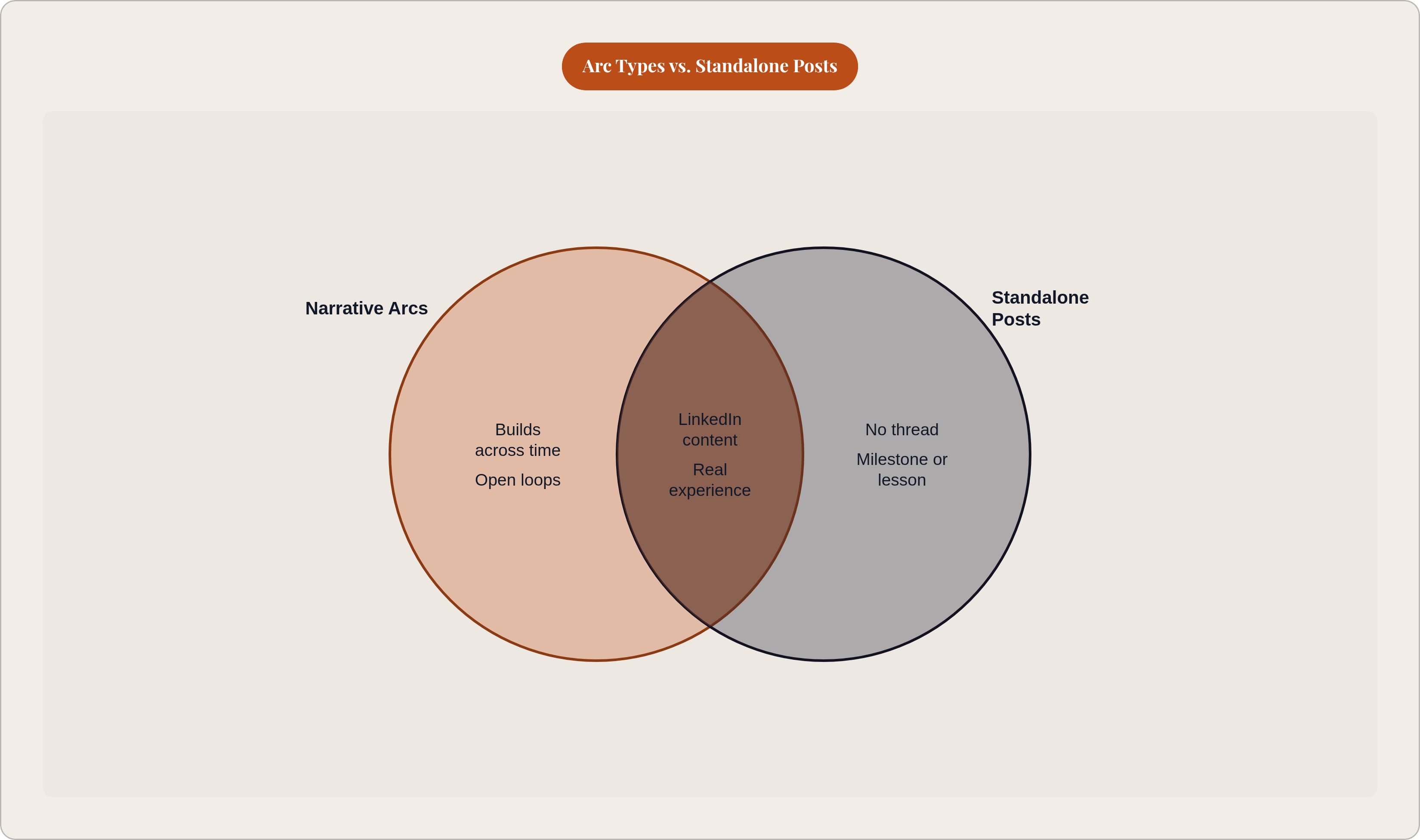
Building in public on LinkedIn only works when the posts add up to an arc. Post a milestone here, a lesson there, and each update lives and dies alone. The reader has no reason to come back tomorrow. String those same updates into something with a beginning, a middle, and a direction, though, and the whole relationship flips: people start following instead of just double-tapping and scrolling on.
Most founders default to three moves. Announce a milestone. Share a reflection. Post a lesson. Each one is fine in isolation. None of them pull the reader forward, because there's no thread, no open loop, nothing to check back for. You can like a post like that and still have zero reason to hit follow.
Now compare that to a sequence where every post quietly promises there's more coming. Suddenly the reader is watching something unfold in real time. It's also a good moment to be doing this, since the feed is drowning in AI-flavored, templated posts. Plenty of that "thought leadership about resilience" content making the rounds was probably typed by a model with a three-sentence prompt. Bad for the feed. Good for you, actually, because the bar for standing out just fell through the floor for anyone willing to bring a real, unfinished, human story instead of another glossy paragraph.
Founders who do this earn something templated content will never buy: people who come back. Here's the part nobody says out loud at founder meetups. The gap between a LinkedIn presence that turns into pipeline and one that just racks up likes comes down to one thing. Do the posts add up to anything? Arc, not volume. That's the whole argument.
What a narrative arc actually means in a LinkedIn context
An arc is a beginning state, a development, and an outcome that's still moving, visible to a reader across time. It doesn't need a title. It doesn't need "Part 1" stamped in the headline. It can stretch six weeks or six months and nobody but the founder has to know it's a series at all.
What the arc hands the reader is a reason to stick around, the same pull you feel checking in on a neighbor's kitchen renovation even though you own zero percent of that kitchen.
What it hands the algorithm is less poetic but just as real. LinkedIn's feed rewards depth signals: comments, repeat visits, engagement that looks like a relationship instead of a drive-by. A post that references something from three weeks back and pulls a comment from someone who actually remembers that post is compounding its own reach, for free.
Episodic and serial content aren't the same animal. Episodic posts are self-contained and interchangeable, shuffle the order and nothing breaks. Serial posts still have to stand alone, since you can never assume anyone saw the last one, but they carry extra weight from what came before. Each post works double duty: a complete thought on its own, and another link in a chain nobody's forced to notice.
The founder's actual experience supplies the material. The arc gives it a shape a total stranger can follow, and, more importantly, care about.
The Progress Arc: making the messy middle visible
The structure is almost embarrassingly simple. Say what you're testing right now. Show the real numbers, unfiltered. Admit what failed and why. Explain the decision that came out of the failure. End with what's next.
Why does this work? The reader is watching someone think in real time, which is about as close as a LinkedIn post gets to an actual trusted-advisor relationship. Nobody trusts the highlight reel. Everyone secretly wants the blooper footage instead.
"Messy middle" isn't a metaphor. It's the actual content: a hiring process that dragged three times longer than planned, a pricing tier that flopped hard before the one that finally clicked, a roadmap that got torn up after a bad run of customer calls.
Each new progress post quietly rewrites the ones before it. That's the compounding part nobody mentions. A reader who shows up late scrolls backward, because the earlier post about the failed pricing test reads completely differently once they know how it ended.
Don't sand the story down into a tidy lesson too soon. If the post lands already resolved, the tension's gone, and tension is the entire engine here. Founders who post specific, unflattering numbers get more real engagement than the ones posting a clean announcement, because nobody's showing up for the headline. They want the decision behind it.
The Recovery Arc: why the low point is the most trusted post a founder can write
Structure: name the low point with real specifics, describe exactly what it cost (time, money, morale, maybe a relationship or two), show what changed, then land on what it means now without turning it into a TED Talk closer.
The logic's simple. A reader who only ever sees wins can't tell if a founder is good or just lucky. A recovery arc proves judgment under pressure, because it shows the exact moment things went sideways and what the founder did next.
Two things separate a recovery post that lands from one that reads like a performance.
Specificity that stings a little: "we lost our three biggest customers in six weeks" beats "we faced some headwinds," every single time. And patience. Resolve the difficulty too fast and the reader never actually feels it; sit in the discomfort a beat longer than feels natural.
The lesson should surface out of the story itself, not get announced ahead of time, the same way a punchline dies the second you explain the joke first.
This arc pulls extra weight for founders fundraising or hiring, since investors and candidates are quietly evaluating whether someone holds up when things break, not just whether they've had wins. A recovery arc is evidence; a highlight reel is a claim.
One catch: post nothing but struggle and you erode confidence instead of building it. Mix recovery arcs in with progress and conviction posts. Don't make it the whole diet.
The Conviction Arc: staking a contrarian position and defending it over time
Structure: state a belief most of the industry gets wrong, explain what your own experience showed you instead, put that belief to a real test, then come back later and report what actually happened.
Written out, the formula sounds almost too clean: "most people in this industry think X, I think Y, here's the experience that got me there." It's a credibility flex, sure, but an honest one, since it signals you've actually sat with the problem longer than the consensus has.
What makes this arc pull readers across multiple posts is plain old suspense. They're waiting to find out if you're right. Suddenly they've got skin in an argument they never signed up to care about.
A founder betting publicly against a dominant hiring norm, tracking it for a quarter, then reporting the actual result. A founder calling a market shift early and coming back later to say honestly whether the call landed or whiffed. Both work.
This is also the arc that pulls investors and buyers specifically, since decision-makers spend real hours reading this stuff, and a lot of them say it's changed who they even consider working with. A conviction arc is the clearest window anyone gets into how a founder actually reasons.
What kills it: stating a belief three months ago and never returning to complicate or confirm it. Skip the follow-up and that wasn't an arc. That was an opinion you happened to type out loud once.
The Character Arc: letting the audience watch you change
Structure: establish who you were, or what you believed, at the start of some defined stretch of time. Document the pressure, the encounters, the decisions that leaned on that identity. Show the updated version, with real specifics on what shifted and why.
This is the hardest arc to pull off. Full stop. It means publishing before you know the ending, admitting your earlier thinking was incomplete, and staying accountable in public to a change you announced in public. Most people would rather reorganize their garage than do this.
It's also the most powerful, for a simple reason: stories stick in people's heads far better than facts do on their own, and a character arc is exactly the shape human memory already runs on. Nobody remembers a spreadsheet. Everyone remembers the person who changed their mind and explained why.
In practice: a founder tracking their own relationship with fundraising, from chasing every intro, to dreading the whole circus, to eventually building something investors came looking for on their own. Or a founder's shifting take on remote work as the company grows through stages and the old answer quietly stops fitting.
Timeline matters a lot here. A real character arc plays out over months, not days; this is a quarterly or annual thread, never a weekly format. It usually isn't even a distinct category of post on its own. Progress posts, recovery posts, conviction posts, those are the individual episodes that, read back later, trace the shape of the character arc after the fact.
The Teaching Arc: turning your hard-won pattern into the reader's shortcut
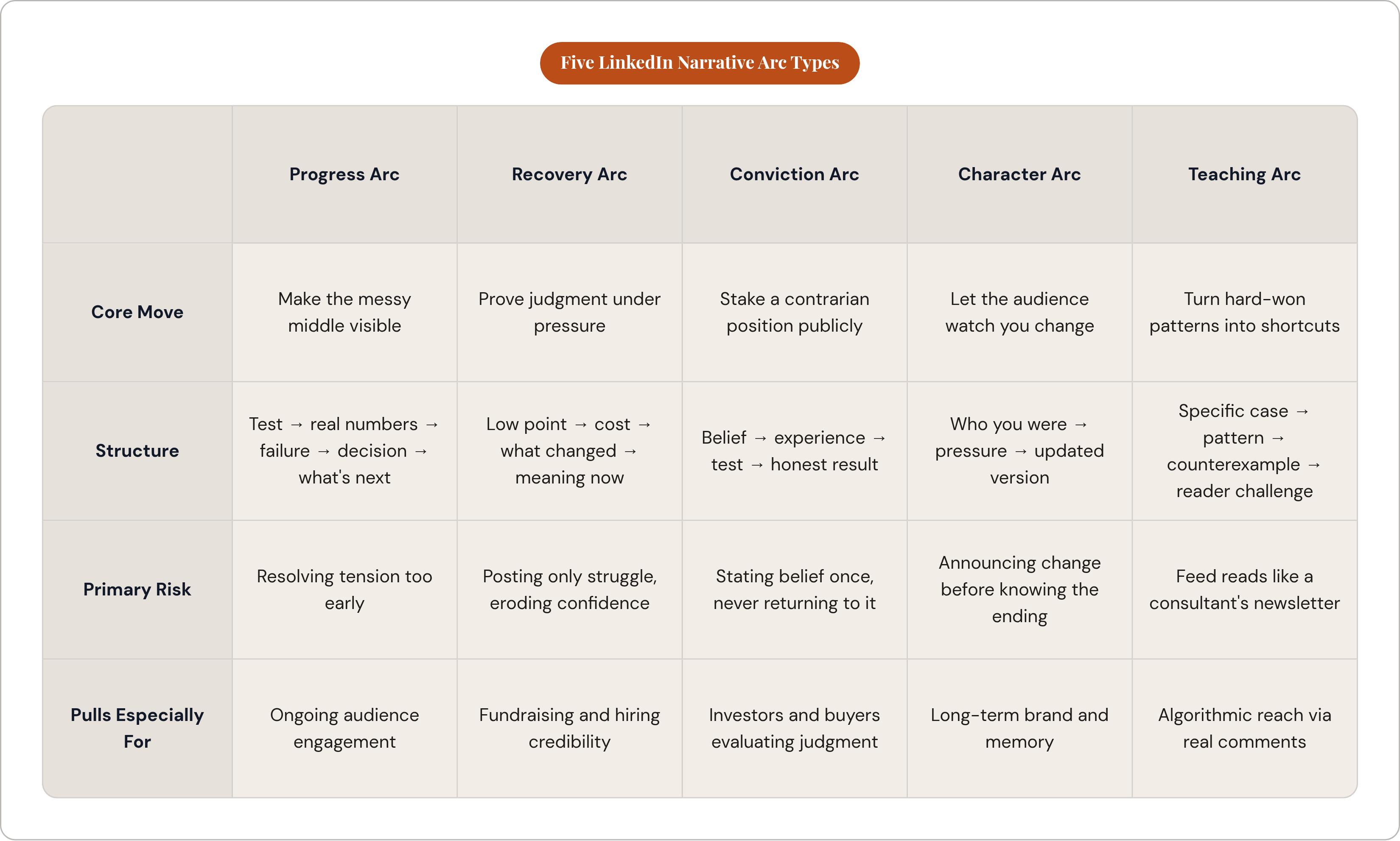
Structure: anchor the lesson in one specific personal experience, pull the pattern out only after you've shown the case, test the pattern against a counterexample, then invite the reader to push back or try it themselves.
What separates this from a listicle is the reasoning left in. A teaching arc shows the thinking that produced the conclusion, so the reader can actually argue with it instead of skimming past on the way to lunch.
Comments matter more here than people give them credit for. A teaching post that genuinely invites disagreement pulls real comments, and a thoughtful comment carries more algorithmic weight than a like, stretching the post's reach without you writing another word.
The serial version is a founder who keeps circling the same territory, hiring, pricing, product calls, and explicitly builds on what they said last time. That's the point a feed stops being a feed and starts being a body of work. Readers anticipate the next installment the way they'd wait on the next episode of a show. The profile turns into something people bookmark, not something they scroll past.
One risk: go all-in on teaching and the feed starts reading like a consultant's email newsletter. Useful, fine, but nobody follows a newsletter. They follow a person, and the human story underneath is what keeps this from turning into a resource people bookmark once and never open again.
How to sequence arc types so the overall profile tells a coherent story
No single arc should carry the whole feed. All recovery reads as gloom. All conviction reads as preachy. All teaching reads like a consultant's newsletter. All progress reads like a logbook nobody asked to read.
A workable mix looks something like this:
- Most of the feed: personal stories and lessons pulled straight from lived experience. This is the anchor, the thing everything else hangs off of.
- A solid chunk: industry takes and contrarian positions, building the conviction arc and general credibility.
- A smaller slice: company milestones and team wins, enough to keep the business visible without letting it dominate.
- A small, deliberate slice: direct engagement, questions, reactions to something happening in the industry, an occasional poll. These reset the relationship and pull in comments that lift everything else's reach.
Threading the arcs together without it feeling engineered comes down to two habits. Reference earlier posts by outcome, not by date. "The pricing experiment I mentioned finally resolved" beats "as I posted on January 14th" every time. Then use a new post's hook to close a loop from an old one; it rewards readers who've been paying attention and gives new readers a reason to go dig up the earlier thread.
On cadence: one or two well-considered posts a week sustains an arc just fine. Post daily and the story fragments into noise. Consistency beats frequency, every time.
Here's the part people underestimate. A post published today, as part of a developing arc, can keep generating inbound messages months from now, once some new reader stumbles onto the thread and binges backward through the whole profile like it's a show they just found.
What the voice underneath all these arcs has to sound like
An arc is only as trustworthy as the voice telling it. Write a recovery arc in flat corporate passive voice, "challenges were encountered, decisions were made," and the story stops landing even if every fact in it checks out.
Authentic voice on LinkedIn means sounding like someone talking to a peer in their network, not someone drafting a press release. Shorter sentences. Specific detail. An opinion stated plainly instead of hedged into mush. The mechanics back this up too: LinkedIn's feed weighs content against a creator's demonstrated expertise and history, so a post that doesn't match the founder's real experience tends to get quietly buried, no matter how well-structured the arc is.
Three things have to hold true, regardless of who actually typed the words. The ideas need to come from the founder's real experience and judgment, not a template. The voice needs to sound like the founder on a good day, not a copywriter doing an impression of the founder. The founder needs to be able to sit in a live conversation and defend every sentence on the spot, no notes, no prep.
None of that rules out a writing partner. Leaders have leaned on communications help for about as long as leaders have needed to say things out loud; what actually matters is whether the substance is real. Authenticity lives in the ideas, not in whose fingers hit the keyboard.
A good collaborator gets there through extraction: interviews, digging through what the founder's already said or written somewhere, pinning down the actual opinions they hold about their market, then shaping all of it into the arc the founder simply doesn't have five free hours a week to build alone. That flips the ethics question most people get backwards. A founder typing a fabricated story with their own two hands is less honest than a founder working with a partner to publish something true and accurate. Nobody should care who typed it. What matters is whether the post reflects something genuinely lived and genuinely believed.
What a founder's LinkedIn narrative arc is actually building toward
A profile built on real, deliberate arcs turns into something closer to a due-diligence file than a content feed. Investors, buyers, candidates, they read back through it the way they'd read a case study, or flip through a portfolio before a meeting.
That changes the shape of every conversation downstream. A buyer who's followed months of a progress arc walks into a sales call already trusting the founder's judgment, before a single slide gets shared. An investor who watched a recovery arc play out in real time has already formed a view on resilience before the meeting even starts. A senior hire who's read a conviction arc for a quarter joins believing in the direction already, a very different onboarding conversation than talking someone into it cold.
Companies whose leaders post with any consistency see real, measurable trust from the people watching, and plenty of decision-makers admit thought leadership shaped which vendors made their shortlist at all. None of that shows up in a follower count. The actual measurement is what walks in the door, and whether the conversation starts from trust instead of a stranger's cold pitch.
The timing argument matters most, honestly. Founders who build this system before they need the pipeline, before the fundraise, before the hiring crunch, before the category fills up with five competitors doing the same thing, are the ones for whom the arc pays out precisely when the stakes are highest.
Building in public becomes a trust strategy the moment the audience realizes they're watching a story, not scrolling past a stream of updates. And a story, by definition, is something people stick around to see resolved.