Conflict-Driven Post Structures That Build LinkedIn Engagement
LinkedIn's 2026 algorithm rewards posts that create narrative tension.

This piece breaks down the specific structural patterns that introduce, sustain, and resolve conflict in a LinkedIn post to maximize meaningful engagement.
Why LinkedIn's 2026 algorithm makes conflict-driven posts structurally advantageous
LinkedIn stopped counting likes as a sign of anything real. The platform's 2026 algorithm runs on something called a Depth Score, built on 360Brew, a 150-billion-parameter model that came out of LinkedIn's Foundation AI Technologies team in a January 2025 research paper How to Increase Engagement on LinkedIn: 2026 B2B Algorithm Guide | Whitehat. Depth Score tracks dwell time, comment depth (threads with real back-and-forth beat a stack of thumbs-up emojis), saves, and private shares. None of that responds to the old tricks.
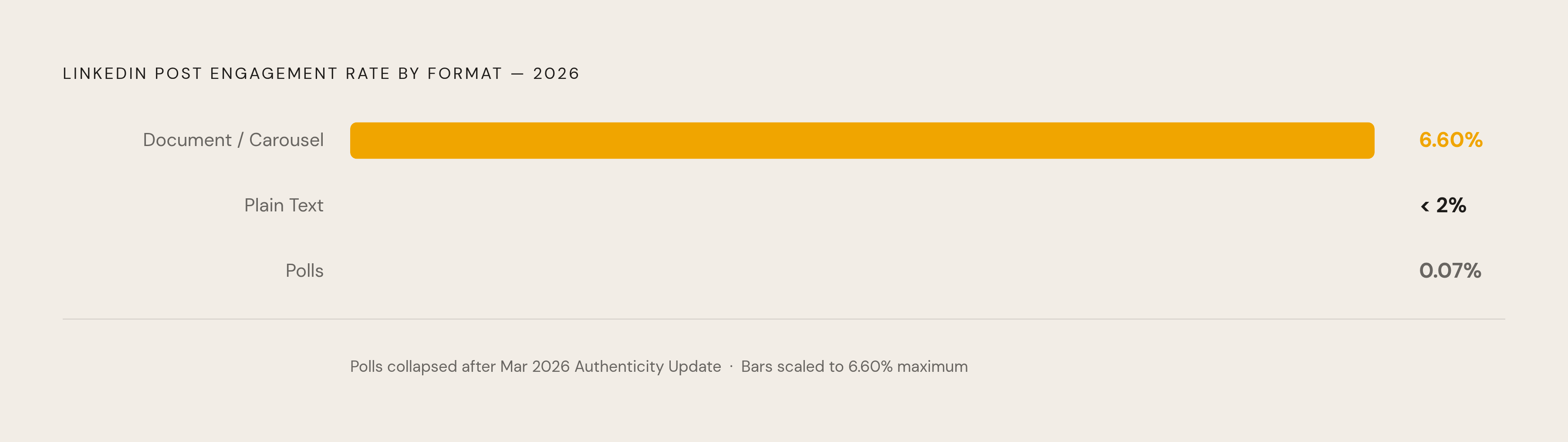
Which explains a weird gap in the format data: document posts, the PDF carousel kind, are pulling 6.60% engagement, while plain text posts can't crack 2% LinkedIn Algorithm 2026: What Works Now (Documents, Newsletters, Video) LinkedIn Algorithm 2026: Engagement Strategy Guide. Format alone doesn't explain that gap. The best posts inside any format, carousel or text or video, share one thing: tension that earns time from the reader LinkedIn Algorithm 2026: What Works Now (Documents, Newsletters, Video) LinkedIn Algorithm 2026: Engagement Strategy Guide. That's the whole argument of this piece, spelled out early rather than built up to.
Meanwhile, LinkedIn actively suppresses the bait tactics that used to work, "Comment YES if you agree," reaction polls, engagement pods How to Increase Engagement on LinkedIn: 2026 B2B Algorithm Guide | Whitehat LinkedIn Algorithm 2026: What Works Now (Documents, Newsletters, Video). The March 2026 Authenticity Update made that suppression aggressive, and polls fell to a 0.07% engagement rate as a result How to Increase Engagement on LinkedIn: 2026 B2B Algorithm Guide | Whitehat LinkedIn Algorithm 2026: What Works Now (Documents, Newsletters, Video). Overall, the platform's numbers look rough: views down 50%, engagement down 25%, according to Richard van der Blom's Algorithm Insights 2025 Report LinkedIn Algorithm 2026: Engagement Strategy Guide How to Increase Engagement on LinkedIn: 2026 B2B Algorithm Guide | Whitehat LinkedIn Algorithm 2026: What Works Now (Documents, Newsletters, Video). Specific post structures are still outperforming inside that decline, and this piece is about what those structures have in common LinkedIn Algorithm 2026: Engagement Strategy Guide How to Increase Engagement on LinkedIn: 2026 B2B Algorithm Guide | Whitehat LinkedIn Algorithm 2026: What Works Now (Documents, Newsletters, Video).
What conflict means in a LinkedIn post and why it compels readers to slow down
Conflict, here, is the gap between what a reader expects and what the post actually says, or between a stated goal and the thing that got in its way. It's the gap between what a reader expects and what the post actually says, or between a stated goal and the thing that got in its way. That gap is what makes a brain stop scrolling.
There's a reason for that, and it's not mysterious. People track stories through setup, obstacle, resolution, because that's how the brain assigns cause and meaning to anything. A post that opens a gap creates what amounts to an open loop, and the reader sticks around to see it close. Close the loop too fast and dwell time dies. Never open one, and the reader never slows down enough to register the post at all.
Conflict and controversy get confused constantly, and they're not the same animal. Conflict is structural: someone wants something and can't get it. Controversy is just a hot-button topic. Structural conflict reliably earns dwell time. Controversy often just earns a pile of reactions with nothing underneath them.
The data backs this up in a specific way: posts built on storytelling frameworks generate 27% more engagement than posts that are purely informational lagrowthmachine.com. The mechanism doing the work there is conflict lagrowthmachine.com. Depth Score's weighting toward comment threads is really just a mechanical version of the same idea How to Increase Engagement on LinkedIn: 2026 B2B Algorithm Guide | Whitehat. A post that makes someone think "that's dead wrong" or "that happened to me too" earns a real reply, not an emoji, and real replies are what the algorithm actually measures. The engagement strategy that works in 2026 is saying something specific enough that people react to it, not asking a question and hoping someone answers. It's saying something specific enough that smart people push back on it How to Increase Engagement on LinkedIn: 2026 B2B Algorithm Guide | Whitehat.
The hook: how the opening line manufactures the tension that the rest of the post has to sustain
The opening line carries more weight than anything else in the post, because it has to stop the scroll before any of the conflict structure gets a chance to do its job. Four hook types reliably do this: a surprising statistic that breaks the reader's mental model, a flatly stated contrarian opinion, a personal admission of vulnerability dropped in line one, or a direct question that puts the reader on the spot.
Keep it under 15 words How to Increase Engagement on LinkedIn: 2026 B2B Algorithm Guide | Whitehat. That's not a style preference, it's a mechanical constraint: the hook has to land before a thumb moves to the next post How to Increase Engagement on LinkedIn: 2026 B2B Algorithm Guide | Whitehat. Skip the warmups. Opening with context, a company announcement, or "I'm thrilled to share" defers the tension instead of creating it, and dwell time starts the second the post loads, not whenever the reader feels like paying attention.
The hook's only job is opening a loop. It isn't there to deliver value, that comes later, in the resolution. The hook decides which bucket a post is in before the second sentence even gets read LinkedIn Algorithm 2026: Engagement Strategy Guide.
Four named conflict structures and how each generates dwell time and comment depth differently
MRS (Mistake, Realization, Shift) runs on internal conflict: the author held a wrong belief and acted on it. Both replies count as substantive. The Realization has to be specific, or the whole thing collapses into a vague memoir post, and the Shift has to be something operational, "here's exactly what changed and why it worked," because that's what actually earns a save.
Struggle, Realization, Lesson leans on an external obstacle blocking a goal. It's the closest thing to a classic story arc, and it works in a professional feed because the lesson turns the tension into something the reader can actually use. If the struggle is specific enough, readers recognize their own version of it and stick around to see the resolution. Dropping in a generic lesson like "resilience matters" costs the post the specificity that got people reading in the first place.
Hook-Story-CTA buries its conflict inside the story section: the hook opens tension, the story sustains it, and the CTA channels whatever engagement that tension built. It's the most versatile structure for founders who need to balance authority-building with pipeline, since the CTA can be a question, a resource, or an invitation without breaking the narrative logic. The CTA has to grow out of the resolution, not interrupt it, a hard turn to "DM me" right after a vulnerable story kills trust instantly. Done right, the alignment with the algorithm is almost too neat: strong hook drives dwell time, specific story drives comment depth, real CTA drives saves and private shares.
The tension is the distance between a worse state and a better one. It works best when the reader currently lives in the Before, so if they see themselves in it, they'll read through to the Bridge. Where it goes wrong: an aspirational After reads as sales copy, while a quantified or story-backed After earns actual trust.
All four share the same skeleton, the shared mechanic that produces the different mechanics. Each opens a gap the reader wants closed, each waits long enough before resolving it to earn real dwell time, and each ends with something the reader can actually take and use, not just a personal anecdote with no application. I was wrong about X" admissions are rare on LinkedIn, where success stories dominate: readers who had the same wrong belief comment to confirm, readers who still hold it comment to defend it, and both are substantive. BAB (Before, After, Bridge).
The contrarian/unpopular opinion format as a standalone conflict engine
Stating a position that runs against received wisdom in a specific professional lane creates instant friction. The reader either agrees and wants to say so, or disagrees and wants to argue, and both reactions generate the multi-reply threads Depth Score weights hardest. Most LinkedIn content still skews toward success stories and safe, polished advice. A post announcing "the conventional wisdom on X is wrong, here's why" stands out by sheer contrast.
Specificity is what separates a contrarian opinion from a stale one. "Hustle culture is bad" isn't contrarian anymore, everyone's said it. But "the best hire made came from someone who bombed the first interview" is precise enough that reasonable people will actually argue with it How to Increase Engagement on LinkedIn: 2026 B2B Algorithm Guide | Whitehat. Those posts pull comments from people who lived through something similar, and pushback from people still holding the old belief, and both keep the thread growing. Contrarian isn't the same as inflammatory. The goal is a position specific enough to argue with, not a post designed purely to provoke. Bait gets reactions. It doesn't get depth.
The operational takeaway requirement: why conflict without resolution kills saves and repels serious readers
A struggle with no principle attached is just memoir, and memoir doesn't get saved. What turns dwell time into a save is telling the reader what this actually means for how they run their own work. Saves are the algorithm's clearest quality signal: when someone saves a post, they're telling LinkedIn this is worth coming back to. A conflict arc that never resolves gives them nothing worth keeping.
Numbers help here in a very specific way. A resolution that says "cut onboarding time by a third" earns more trust than one that just gestures at improvement, because a number proves the lesson actually got tested against something real. That's also the line between real storytelling and a bait-and-switch: authentic posts leave a reader thinking "this person actually knows something," while bait leaves them thinking "this person wants my attention." One builds inbound interest that converts. The other just inflates a follower count that never does anything.
The resolution has to survive a sales call, and that's the harder test underneath all this. An exaggerated founder origin story falls apart the moment a prospect asks one follow-up question, so the conflict arc has to be true enough that the lesson holds up under someone actually poking at it. Structurally, that means the operational takeaway belongs at the end of the post, after the tension has earned its keep, not up front where it reads as advice with nothing behind it.
How post length, format, and early engagement patterns interact with conflict structure to determine algorithmic distribution
Length has a sweet spot. Clarity isn't a nice-to-have here either. Posts written above a 10th-grade reading level see 35% less reach, so a conflict arc buried in dense jargon loses its audience before the tension even resolves LinkedIn Marketing Strategy 2026: Complete B2B Guide LinkedIn Algorithm 2026: Engagement Strategy Guide How to Increase Engagement on LinkedIn: 2026 B2B Algorithm Guide | Whitehat.
Comment quality gets measured too, not just comment count. Conflict structures that pull genuine disagreement out of readers produce that pattern.
Timing matters just as much as structure. LinkedIn tests a new post on roughly 5% of the author's network first, and how that small group engages in the first 60 to 90 minutes decides whether the post ever reaches second and third-degree connections LinkedIn Algorithm 2026: Engagement Strategy Guide. A strong conflict-driven hook is what drives that early velocity. Carousels get a distribution advantage too, earning 2 to 3 times more dwell time than plain text or image posts, because readers physically advance through the slides How to Increase Engagement on LinkedIn: 2026 B2B Algorithm Guide | Whitehat. A carousel that puts the problem on slide one, complications through the middle, and resolution on the last slide maps the conflict arc directly onto how the format already works. Whitehat SEO found that posting the same format back-to-back suppresses reach by around 20%, so conflict structures need to rotate across carousels, video, and text rather than living in one format alone How to Increase Engagement on LinkedIn: 2026 B2B Algorithm Guide | Whitehat. Check replies at the two-hour mark, since engagement velocity in that window is the clearest early signal of how far a post is going to travel. Optimal text post length is 300–400 words and 20+ sentences, which maximizes dwell time per Whitehat SEO's analysis (long enough to sustain a conflict arc, short enough to hold attention to resolution) How to Increase Engagement on LinkedIn: 2026 B2B Algorithm Guide | Whitehat. Carousel format earns higher dwell time, 2–3× more than text or image posts per digitalapplied.com, because readers advance slides: a conflict-structured carousel, with problem on slide 1, complications through the middle, resolution on the final slide, maps the narrative arc onto the format's natural interaction pattern.
The personal profile advantage and why conflict structures are more powerful for founder voices than company accounts
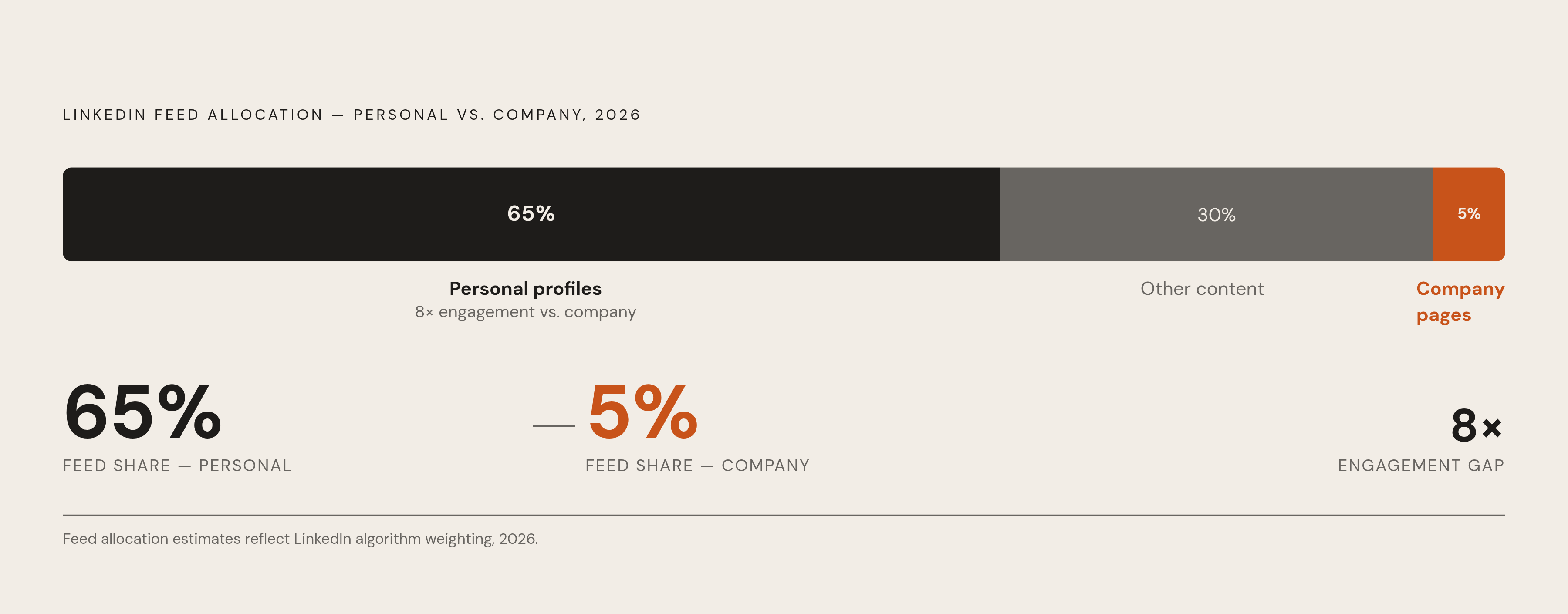
Personal profiles generate 8x more engagement than company pages (a finding the 2026 data settled definitively) LinkedIn Marketing Strategy 2026: Complete B2B Guide LinkedIn Algorithm 2026: Engagement Strategy Guide How to Increase Engagement on LinkedIn: 2026 B2B Algorithm Guide | Whitehat. Company pages now receive approximately 5% of user feed allocation while personal profiles account for roughly 65% LinkedIn Marketing Strategy 2026: Complete B2B Guide LinkedIn Algorithm 2026: Engagement Strategy Guide How to Increase Engagement on LinkedIn: 2026 B2B Algorithm Guide | Whitehat. That gap isn't cosmetic, it's structural, and it matters specifically for conflict-driven posts.
A company page has no main character. It can't be wrong about anything, can't have struggled through a bad quarter, can't hold an unpopular opinion and have anyone believe it meant it. A logo can't do that.
This connects directly to how buyers evaluate vendors now. In the Edelman-LinkedIn B2B Thought Leadership Impact Report (n=1,934), 73% of decision-makers said they trust thought leadership more than product sheets or marketing material when judging whether someone actually knows what they're doing 2025 Edelman and LinkedIn B2B Thought Leadership Impact Report How to Increase Engagement on LinkedIn: 2026 B2B Algorithm Guide | Whitehat. A conflict-driven post built on real professional experience is, functionally, what that report means by thought leadership 2025 Edelman and LinkedIn B2B Thought Leadership Impact Report How to Increase Engagement on LinkedIn: 2026 B2B Algorithm Guide | Whitehat. The same report found 53% of B2B decision-makers rate thought leadership as more important than brand recognition when picking a vendor 2025 Edelman-LinkedIn B2B Thought Leadership Report How to Increase Engagement on LinkedIn: 2026 B2B Algorithm Guide | Whitehat. The credibility a good conflict post builds isn't just an audience play, it feeds pipeline directly 2025 Edelman-LinkedIn B2B Thought Leadership Report How to Increase Engagement on LinkedIn: 2026 B2B Algorithm Guide | Whitehat.
The fundraising angle makes the stakes concrete. One fintech founder case study, cited by obapr.com without naming the founder, illustrates how strong founder visibility shortened Series A conversations from a 6-month cycle to 8 weeks. Conflict-structured posts that show someone actually thinking under pressure build that kind of pre-meeting credibility. And the reverse holds too: in 2025, a founder's LinkedIn and Google presence functions as a first impression for investors, and if there's nothing compelling there, they move on How to Increase Engagement on LinkedIn: 2026 B2B Algorithm Guide | Whitehat. A profile stacked with generic, corporate-sounding posts performs about as well as no profile at all How to Increase Engagement on LinkedIn: 2026 B2B Algorithm Guide | Whitehat. CEO content generates about 4x more engagement than average company page posts, and lagrowthmachine.com reports that the platform is structurally saying that the personal voice is the most powerful distribution channel a company has.