Hiring Narrative Posts That Attract Top Candidates on LinkedIn
Top talent watches founders on LinkedIn before they'll take the call.

Job applications hit at an overwhelming rate per minute in early 2026. A growing share of those come from AI-assisted auto-apply tools that blast a resume at every open req without reading a word of it. Post a plain job description in that mess and you're fishing in a lake that's mostly runoff. Founders landing good hires right now are writing posts that make the right person stop scrolling.
That's the whole trick: write something that reads like a story instead of a listing.
LinkedIn as the specific arena where passive top talent already spends time
LinkedIn passed over a billion members in 2025, and Satya Nadella mentioned it on Microsoft's Q4 earnings call like it was a footnote. It's a small country's worth of professionals, and the good ones check the app before they check email.
Here's what founders keep missing. Executives say LinkedIn is their first choice for professionally relevant content, by a wide margin, and decision-makers spend roughly double the time there compared to other platforms. The senior people you want to hire aren't hard to find, and they're already reading, already forming opinions about founders they've never met.
Recruiters caught on to this years ago, and the vast majority source through LinkedIn now. The platform is packed with people watching, yet barely anyone posts consistently, maybe a tiny fraction of users, which means almost everybody's reading and almost nobody's writing. Empty stage, packed house. Most founders won't even walk up the steps.
Candidates pre-vet you the same way you'd pre-vet a contractor. They scan your posts before they'll take your call, the same way you'd check reviews before sitting down at a restaurant you've never tried.
What separates a hiring narrative post from a reworded job description
"5+ years experience required 🚀" isn't a story. It's a job description wearing a costume, and nobody's fooled by the costume.
The real version tells you who the company is, how the founders actually think, what a normal Tuesday looks like there. The hiring signal shows up in the back half, not the headline. Readers decide whether to keep going within seconds, and a bullet list of requirements loses that race almost every time, while a decent story at least has a shot.
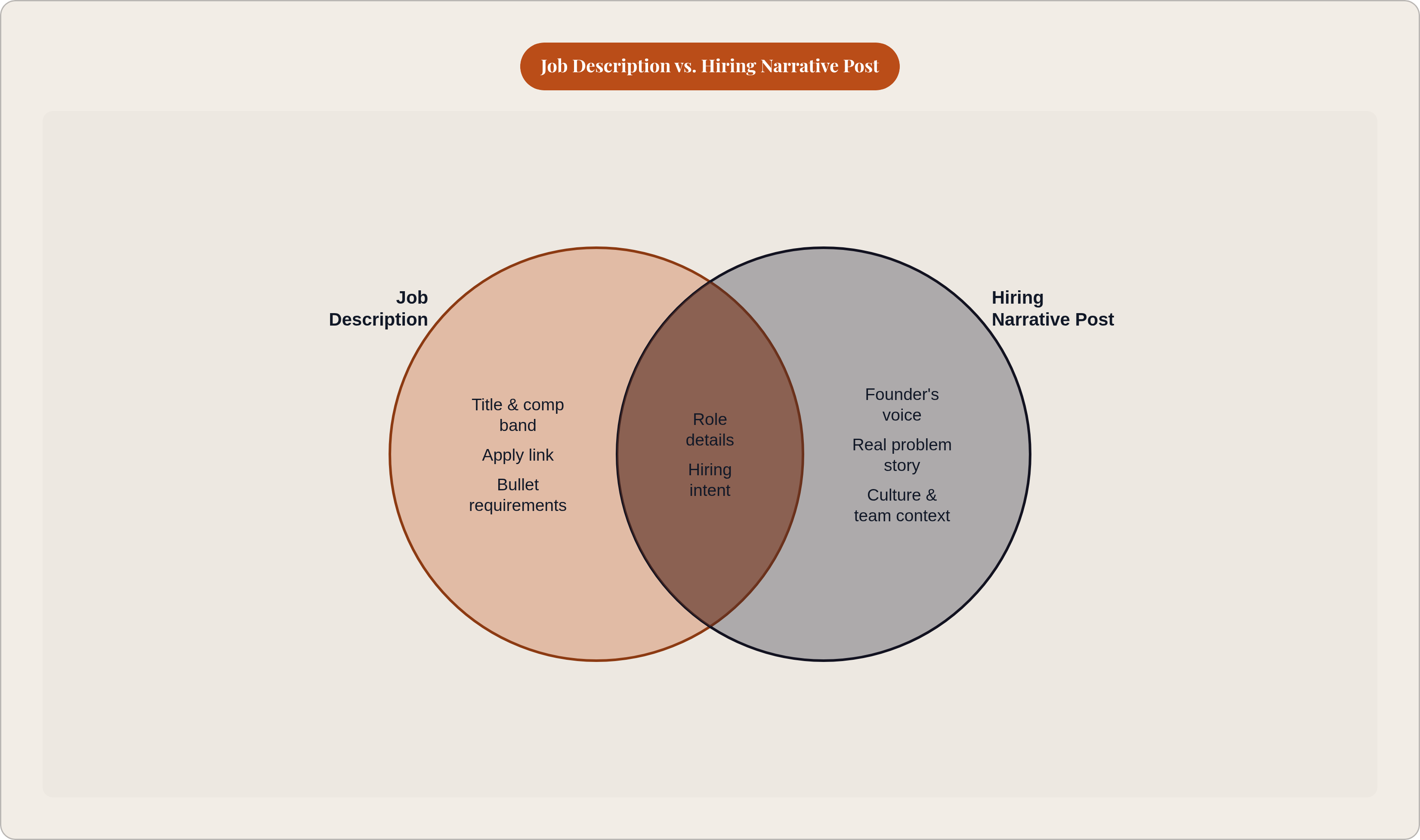
Put them side by side. A job description gives you a title, a comp band, an apply link, nothing else. A narrative post gives you an actual problem the team hit last quarter, what the standup sounds like when things are tense, the kind of person who'd thrive in that mess, and only then, almost like an afterthought, the news that they're hiring for it.
The brands that pull this off lead with identity and let the role show up as an extension of it. Content that teaches something earns attention; content that only sells, spends it. Hiring posts run on that same math, and posts built with real narrative structure pull noticeably more engagement than plain informational ones.
The structural building blocks of a hiring narrative post that holds attention
Three frameworks do most of the work, and none of them require a writing degree.
STAR (Situation, Task, Action, Result) started as an interview trick, but it flips nicely here. Instead of a candidate answering "tell me about a time," the founder tells the story first. "We're hiring an engineer" becomes a specific account of a problem the team hit and the hole it left behind. The 3-Act Structure (setup, conflict, resolution) gives even a three-paragraph post some forward motion, because people follow arcs better than they follow spec sheets. Present-Past-Future works well in a founder's own voice too: here's where we are, here's how we got here, here's where this hire takes us next.
Structure carries real weight here. LinkedIn profiles with a clear narrative arc pull noticeably more recruiter messages than the ones without.
Open with something specific: a hard call the team had to make, a moment things nearly fell apart, a lesson that cost real money or real sleep. Skip the mission statement, save that for the About section nobody reads anyway. The middle shows what's actually getting built, who's already in the room, what the work feels like on a Wednesday afternoon. Close with the role, described the way you'd describe it to a friend over coffee, not the way HR would describe it in a template. Then give people a next step with almost no friction: comment, DM, one link, done.
Across a founder's whole feed, a rough mix tends to work. Mostly founder insight and company updates, some stories about customers or the team, and a smaller slice of behind-the-scenes stuff that never made it into a case study. Hiring posts live mostly in the first bucket and the last one. Done right, they read like a natural part of the feed, not like a job board post that wandered onto the wrong app by mistake.
Worth saying plainly: specificity is the entire engine here. Staying vague feels safer in the moment, but it also produces a post indistinguishable from the other five thousand vague posts published that same day, which defeats the point of writing one at all.
Why thought leadership posts function as a continuous talent pipeline
Half of buyers say thought leadership matters when they're deciding who to trust, according to LinkedIn research. Swap "buyers" for "the senior person quietly deciding where they want to work next," and it's the same audience wearing a different hat.
They're not skimming this on the way to something else. Over half of decision-makers, and an even higher share of C-level executives, spend more than an hour a week reading this kind of content. Real attention, deliberately spent, from the exact people a founder is trying to reach.
Trust builds a specific way here too. Most decision-makers say thought leadership gives them a clearer read on someone's actual ability than a product sheet or a slick deck ever could. Swap "assessing a vendor" for "deciding whether to work for this person," and the logic doesn't bend.
That's the pipeline. A founder who posts consistently about how they think and what they're building ends up with a warm audience that already trusts them before a role even opens. The hiring post works because it converts people who already believe in the founder, rather than pitching cold strangers. This cuts both ways, too: plenty of employers say they've hired someone based on content that person put out publicly, and roughly half have passed on a candidate over a thin or missing online presence. Candidates run the identical check on companies and their leaders. Companies with an active executive voice also see dramatically higher employee engagement scores, which happens to be the exact proof point a founder needs when telling candidates the culture is actually good and not just described that way in a slide deck.
Adam Robinson and what building in public actually produced
Adam Robinson is the cleanest documented case of this working as a real business lever and not a vanity project. 21 million LinkedIn views, and a company that grew to $4 million ARR right alongside it.
Here's the number that keeps the story honest: he spent something like 65% of his working time on content. Treated as core business, the same way you'd treat sales calls or roadmap meetings, not an afternoon here and there when he felt inspired.
Building in public, in practice, means telling the real version. Actual decisions, actual setbacks, hiring moments that went sideways, product pivots that only happened because something broke first. Told plainly, not dressed up like a press release, it produces an audience that already understands the mission, has watched the founder handle pressure badly and then well, and self-selects into the role before it's even posted.
Most founders who skip this aren't clueless about the upside. They're worried about sounding repetitive, or self-promotional, or a little naive, and that's a personal hangup wearing a strategic disguise, nothing more. The actual fix is reps. A mediocre post published every week beats a brilliant post published twice a year, because the pipeline gets built by rhythm, not the occasional flash of genius nobody sees coming.
And for founders convinced they have nothing to write about: the material's usually sitting there already, unused. A five-minute voice memo at the end of the week covering three decisions that got made. Highlights from a customer call, buried in a CRM note nobody's looked at twice. That Slack thread where you explained something to a confused new hire and it actually landed. All three are posts waiting to be reshaped, not blank pages waiting to be filled.
What ghostwriting actually is and why it does not undermine authenticity
Executive ghostwriting means someone else writes and publishes the content on the leader's behalf, to build that leader's voice and reputation. The ideas belong to the executive, and the writer gives them shape and keeps them showing up on schedule, whether inspiration strikes that week or not.
The ethics here aren't actually murky, whatever the gut instinct says. Ghostwriting is standard practice, and it's ethical, as long as the ideas are genuine, the voice sounds like the person, and nothing gets invented out of thin air. Politicians and executives have worked this way for decades, and nobody clutches their pearls when a senator didn't personally draft every line of a floor speech.
A real engagement usually starts with a substantive interview where the writer pulls apart how the executive actually thinks: opinions on the industry, pet peeves, the phrases they reach for when nobody's editing them in real time. That conversation becomes a style guide built for exactly one person. A handful of posts later, most clients say it reads like they wrote it themselves, and in every sense that matters, they did, since the words just came out of someone else's fingers first.
What ghostwriting closes is the gap between what a founder knows privately and what the market can actually see. The authority already exists; the ghostwriter just makes it visible. For a growth-stage founder juggling hiring, fundraising, and running the company itself, the missing ingredient was never ideas or credibility. It was time, and the translation from head to page. A decent writing partner solves that translation problem, working from the founder's own material instead of inventing a persona from a questionnaire.
The real risk is hiring a ghostwriter or agency with no track record of its own, one that's never built an audience with these exact methods. That kind of partner is guessing at what resonates, and the writing usually reads like a guess: safe, generic, forgotten five minutes after you scroll past it.
How founders can start building a hiring narrative presence this week
Don't start by writing a post. Start by naming the two or three things the founder actually believes about the industry, the team, or how work should get done. Those beliefs are the pillars everything else hangs off, and skip this step and the content drifts into filler within about three weeks, ask anyone who's tried it.
From there, rotate through a small set of post types. A decision the team made this month, and the reasoning behind it, shows how leadership actually thinks. A mistake the company made and what changed afterward signals psychological safety louder than any values page ever could. What the team actually looks for in a hire, the stuff that never makes it onto the job description, and a behind-the-scenes moment from a sprint or a rough customer call round it out. Every so often, a direct hiring narrative post, written as a story, with the role tucked into the back half instead of leading the charge.
The mix matters more than any single post does. Something close to 80% pure education, insight, and genuine opinion, no company mention required, against no more than 20% touching the company or a role directly. Trust gets built in that 80%, and the hire follows from it, on the strength of that groundwork rather than the pitch itself.
Measure the right thing. Application count isn't the tell, it never was. Inbound messages from people who say they've been reading the founder's posts for months, that's the real signal, because that person opted in long before you ever had to ask.
This kind of presence takes a year or two to really compound, which means waiting until a role opens to start is already too late. Starting now is, functionally, the earliest it'll ever be again. Founders without that runway, who still want to move fast without faking anything, are better off working with a writing partner that's actually built its own audience on this exact platform, not one that's only ever managed somebody else's content calendar.