Measuring Talent Pipeline Impact of a Founder's LinkedIn Presence
Founders who track LinkedIn hiring signals outperform those who only watch vanity metrics.

A founder's personal LinkedIn profile builds a measurable hiring pipeline that a company page cannot replicate, and most founders never track the numbers that prove it. This article maps the specific signals that connect a founder's posts to actual hires, from the leading indicators that appear within weeks to the cost-per-hire math that becomes visible months later.
A founder's LinkedIn presence as a recruiting channel
A company page posts announcements. A founder posts opinions, decisions, and mistakes. That difference changes everything about who shows up to read it.
People follow company pages the way they follow a cable bill: out of obligation, rarely with interest. Candidates research the CEO or the founding team long before they hit apply. A founder's profile answers that question before a recruiter ever sends a message. The trust-building work is already done by the time outreach starts.
A company page saying "we value innovation" reads like wallpaper. A founder saying "we killed a feature last month because our best customer told us it was a waste of their time" reads like a window into how the place actually runs.
That window is the asset. An engaged founder audience becomes a standing distribution channel that reaches the exact kind of candidate the company wants to hire, builds trust with that candidate before any conversation starts, and pulls in investors and customers at the same time, since none of those audiences are mutually exclusive on LinkedIn. None of this requires a job to be open. It runs in the background, all the time, which is the whole premise the rest of this piece builds on: an always-on channel only pays off if someone is actually measuring what it produces.
What makes a LinkedIn-sourced candidate pipeline different
A candidate who clicked a job ad and a candidate who has followed a founder for six months, saved three of their posts, and then applied are fundamentally different candidates, even if they end up in the same applicant tracking system folder. The second one arrives with an opinion already formed about the company's culture and the person running it. That is a fundamentally different intent signal, and treating both candidates the same in a pipeline report hides which one converts faster, and why.
Job postings and recruiter outreach work like a tap. Founder LinkedIn presence works more like a reservoir that fills continuously, whether or not anyone is hiring this quarter. That distinction matters most for passive candidates, the ones who are not scanning job boards and would never see a posting in the first place, but who might still read a founder's post about a hard decision and think, quietly, that they'd like to work somewhere run by someone who thinks like that.
A fair question follows: if LinkedIn's own AI hiring tools are getting faster at surfacing candidates, does any of this founder-level effort still matter? It does, for a simple reason. The tools are good at narrowing a large pool down to a smaller, more relevant one. They are not good at making a stranger feel like they already know and trust the company before the first call. That part still runs on the founder's visible credibility. The AI shrinks the haystack; the founder's presence is what makes the candidate want to stay in it once they're found. These are two layers of the same hiring stack, one algorithmic and one human, and they work better stacked together than either does alone.
The five signals that translate founder LinkedIn activity into talent pipeline data
Most founders who track their LinkedIn numbers stop at impressions and likes, which is a bit like judging a restaurant by how many people walked past the window. Those numbers describe attention, not appetite. Five signals sit one level deeper and actually predict pipeline quality.
The first is follower quality, not follower count. Growth only counts as a leading indicator when the new followers match the ideal candidate profile. That requires segmenting new followers by job title and company type every month and watching whether the mix shifts toward the roles that matter.
The second is inbound candidate DMs and profile views from people in target roles. A spike in profile views from exactly the kind of person a company wants to hire, right after a specific post goes up, is about as close to a smoking gun as organic content analysis gets. DMs that reference a specific post by name are even better, since they are self-reported proof that content turned into interest.
The third is the applicant-to-connection ratio by role. For every open role, it's worth checking what share of applicants are already connected to the founder or already follow their content. A ratio that climbs over time means the organic channel is pulling real weight next to paid sourcing or recruiter-driven outreach, and this is measurable through LinkedIn Recruiter filters and ATS tagging without building anything custom.
The fourth is CV self-attribution. Candidates who name a specific post represent the highest-intent slice of the inbound pool, and they deserve their own tracking bucket so their conversion rate can be measured separately from everyone else.
The fifth is time-to-fill and cost-per-hire, split by source. This is the signal that closes the loop. If roles filled through founder-driven inbound close faster and cheaper than roles filled through recruiter-sourced outbound, that is the number that justifies every hour spent writing posts. Tracking time-to-fill and cost-per-hire with founder LinkedIn as its own channel, separate from job boards and recruiter outreach, turns the whole exercise from a vibe into a return-on-investment calculation.
How content type affects talent signals
Not every post earns its keep the same way, and treating all posts as equally useful for pipeline measurement is how founders end up with numbers that lie to them.
Bold opinions and hot takes rack up impressions. A post that a huge audience scrolls past does less hiring work than a post that a small fraction of the right people save.
Saves are one of LinkedIn's strongest signals for algorithmic amplification, and they correlate with that same person coming back to the founder's profile later, which is exactly the kind of returning attention that precedes an application.
Culture posts, the behind-the-build updates about what the team is working on, why a product decision went one way instead of another, what the founder actually believes about hiring, are the posts most directly tied to inbound DMs and CV self-attribution. They answer the question a candidate is already asking in their head before they apply: what is it actually like here? That is not a question a job description can answer honestly, and it's not a question a company page post can answer convincingly either.
The practical move is to favor market insight and behind-the-scenes posts over company news, not as a style preference but as a pipeline optimization choice. Tagging every post by type in a simple log, then checking which types came right before a spike in target-role profile views or inbound DMs, produces a content-type map a founder can actually act on.
Instrumenting attribution without enterprise tooling
LinkedIn's native analytics will not tell a founder that a specific post led to a specific application. That connection has to be built by hand, and any founder posting without some version of this instrumentation is running on guesswork about which content actually works.
Three instruments cover most of the gap, and none require a data team. The first is an application form field asking "Where did you first encounter us?" with founder LinkedIn listed as its own option. It takes minutes to add and starts producing self-reported data on day one. There is no built-in filter, though, for followers or connections of one specific individual such as the founder, which is the real ceiling on this method.
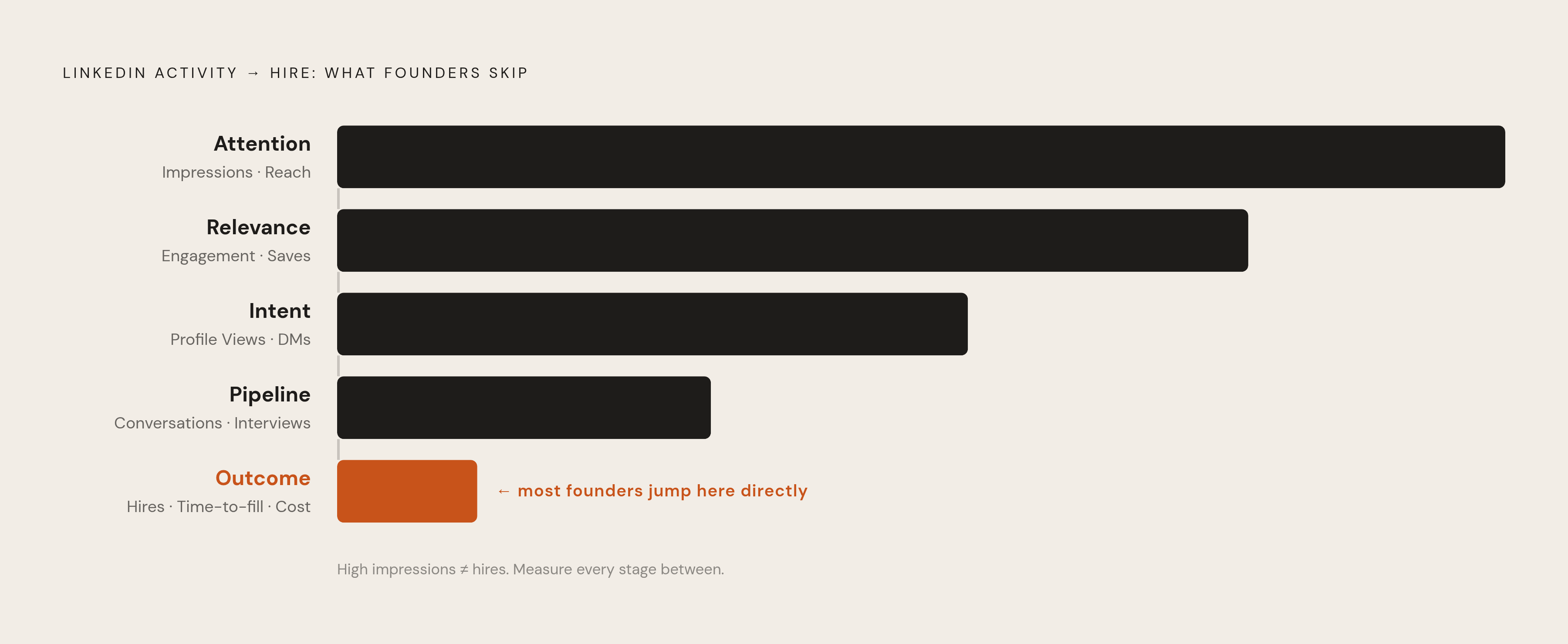
A five-level sequence makes the whole system easier to reason about: Attention (impressions, reach), Relevance (engagement and saves from the right audience), Intent (profile views and DMs from target roles), Pipeline (qualified conversations, applications, interviews), Outcome (hires, time-to-fill, cost-per-hire). Applied to recruiting specifically, each level has its own metric and its own job to do, and skipping straight from Attention to Outcome is how founders end up unable to explain why their impressions are high but their hires are flat.
A simple proxy metric helps bridge the gap in the meantime: for every 100 net-new followers gained in the target role category, track how many inbound candidate conversations open within a set window afterward. What should stop getting measured, or at least stop getting celebrated, are impressions and likes counted on their own. Those numbers make a founder feel productive while the actual pipeline sits still.
Posting consistency and voice integrity as drivers of pipeline compounding
A pipeline that only grows while the founder is actively posting is a series of spikes that flatten the moment attention moves elsewhere, built on consistency and voice.
Consistency builds a returning audience, and a returning audience is what produces the profile views that come before applications. A founder who posts on a recognizable rhythm gives people a reason to check back. A founder who posts in bursts and then disappears for a month breaks that loop every time, forcing the audience to be rebuilt. Three to five posts a week tends to be the sustainable range for compounding reach. Accounts posting once or twice a week grow followers 10 to 20 percent annually, a pace that counts as real growth but a slow one next to what higher-frequency, high-quality posting can produce.
Voice matters just as much as rhythm. A candidate who has followed a founder for months will notice if the tone suddenly shifts, if the judgment in the posts starts sounding like it belongs to someone else, or if the writing starts reading like it was generated. LinkedIn's own stance as of May 2026 backs this up directly: AI can support the writing process, but posts still need to reflect the member's actual voice and perspective, and generic AI-sounding content tends to get less distribution outside the poster's immediate network. The platform itself is pushing against template-filling, which lines up with what candidates already sense instinctively.
The way to use outside help without losing the voice is to treat it as extraction, not fabrication. The founder stays the source of the actual expertise and judgment. A writing partner's job is to handle the drafting and the calendar, not to invent opinions the founder doesn't hold. A founder who thinks in public makes recruiting easier, and employees already in the building tend to feel more connected to a leader who shows their reasoning. That same visibility tends to pull employees into sharing and commenting themselves, since people are far more likely to post when their own founder is already doing it.
Labor market conditions in early 2026 and founder-led passive pipeline strategy
The labor market in early 2026 is tight in a specific way: hiring is down 20 to 35 percent in advanced economies compared to pre-pandemic levels, and job transitions are at a 10-year low, according to LinkedIn's Economic Graph Research Institute. Fewer people are actively job-hunting, and the ones who are now find job seekers outpacing open roles.
That squeeze does something specific to job boards and recruiter outreach: the signal-to-noise ratio gets worse, because a smaller pool of active candidates is being contacted by every recruiter at once. A founder's organic content sidesteps that traffic jam entirely, because it reaches passive candidates who are not fielding five recruiter messages a day, simply by showing up in their feed as something worth reading.
LinkedIn's own infrastructure is leaning further into AI-assisted hiring. Its Hiring Assistant tool, after a year of general availability, has reached tens of thousands of customers and is finding interview-quality applicants faster while requiring far fewer profiles to be reviewed by hand. That platform-level shift makes the case for founder content stronger, not weaker. A founder's visible presence is what they find.
The practical conclusion is straightforward: founders who build their LinkedIn audience now, before a critical hire becomes urgent, are the ones whose pipeline is already warm when the market tightens further. Building an audience during a hiring freeze is the correct timing, since the reservoir needs months to fill before anyone needs to draw from it.
Building the measurement system: a repeatable monthly review for founder pipeline metrics
A monthly review turns everything above from scattered observation into a system. Each month, the same four things get pulled and compared side by side: new follower composition by role and company type, profile views and DMs from target-role candidates, the applicant-to-connection ratio for any roles open that month, and time-to-fill or cost-per-hire for anything closed, split out by source channel with founder LinkedIn as its own line.
Layered against that, a content log tagged by post type (story, culture, opinion, announcement) makes it possible to see which kind of post preceded which kind of signal spike, so next month's content can lean into what actually worked. None of this needs a dashboard team or enterprise software. It needs a spreadsheet, one new application form field, one question asked consistently on first calls, and the discipline to check all of it on the same day every month instead of only when a candidate pipeline runs dry and someone starts asking why.