Authentic Vulnerability in Founder Content Without Oversharing
Vulnerable founder posts perform best when they serve readers, not your need to confess.

Vulnerability in founder content works when it serves the reader more than the founder's need to get something off their chest. That's the whole idea. The rest of this piece is about telling those two things apart before you hit publish, which is the moment that actually matters, well before your investor's DMs go quiet.
What the engagement data actually reveals about personal story content on LinkedIn
Across 1,141,932 LinkedIn posts, a challenge-overcome story pulls a 1.03% median engagement rate. A genuinely hard, unresolved moment pulls 0.80%, while the platform median sits at 0.39%. So both formats are running two to two-and-a-half times ahead of everything else on the feed.
Now the part that stings a little. The polished "5 lessons I learned" post, the one every LinkedIn guru swears by, sits at 0.44%, barely above the floor, below content that's actually messy and unresolved.
The hard-moment post also does something odd with the numbers: 16 median comments against only 47 likes. That ratio matters more than it looks like it should. Likes are applause, while comments are conversation, and conversation is what the algorithm rewards, and also what actually builds a relationship with someone you've never met.
Pain gets a response. Polish gets a scroll, a polite nod, and a trip to the next post about somebody's grindset.
FTI Consulting found something similar from another angle: when business leaders post as themselves instead of through the company page, they generate three times more comments and double the engagement. Personal authority tends to beat brand voice, and fairly consistently at that.
None of this guarantees every hard-moment post performs, of course. It just raises the ceiling when you get it right, and the rest of this piece is about hitting that ceiling on purpose instead of by accident.
The personal-versus-private distinction that most vulnerability advice skips
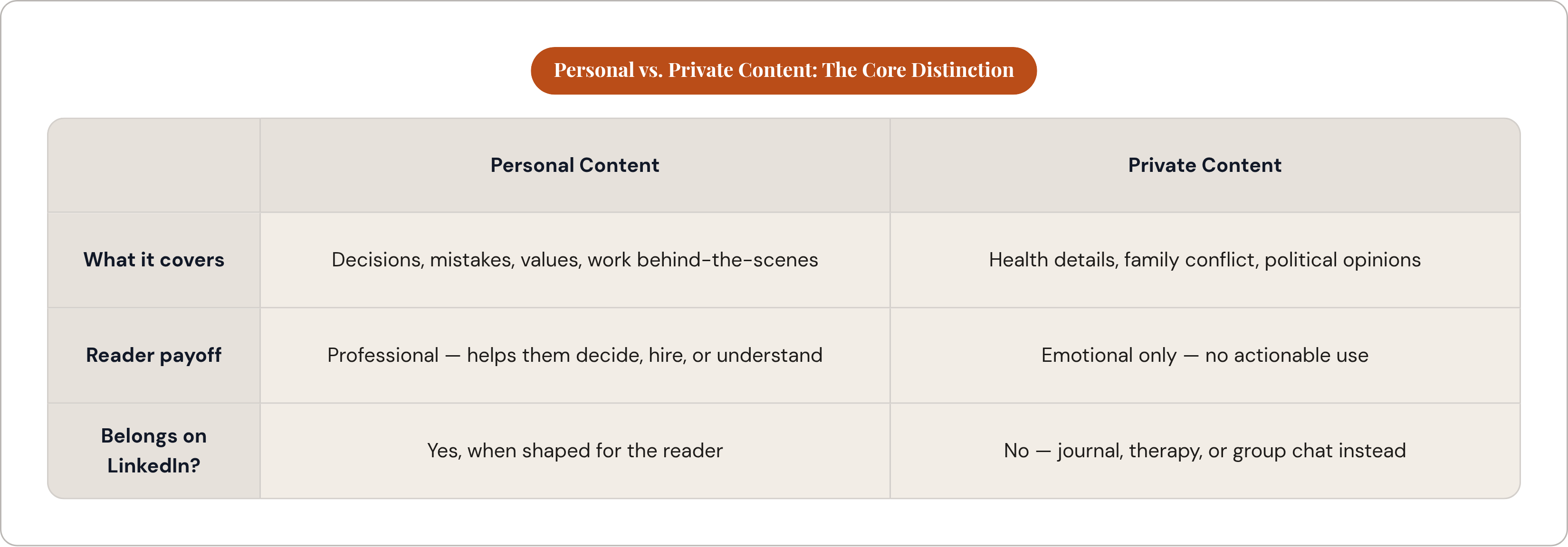
Almost nobody draws this line clearly enough: personal is not the same thing as private.
Personal content covers your decisions, your mistakes, your values, the behind-the-scenes stuff attached to actual work. A reader can take it and use it, either to do their job better or to size you up as someone they might hire, fund, or buy from.
Private content is health details, family conflict, political opinions, anything whose only payoff is emotional instead of professional. It's off-limits, less because it's shameful and more because it can't do the one job this whole framework cares about: helping the reader understand something they didn't before.
Founders mix these up constantly. "This happened to me" starts to feel like "this is useful to you," and it isn't, not automatically. Intensity isn't relevance. The worst week of your life might make a great story at your best friend's dinner table and a terrible LinkedIn post, because the audience is different and the job the story needs to do is different too.
So ask the question that actually sorts it out: what does this let the reader do, decide, or understand that they couldn't before? If the honest answer is nothing, the story belongs in a journal, a therapy session, or a group chat, somewhere far from the feed.
How humble-bragging masquerades as vulnerability and why readers see through it immediately
There's a specific genre of fake-vulnerable post, and you've read a hundred of them. "I was terrified before my keynote to 5,000 people." "I almost said no to the seven-figure offer." The wound is technically real, but the stakes favor the founder from the first word to the last, no exceptions.
Here's the test: if the "vulnerable" post makes you look better than you looked before you wrote it, something's off. That's a flex wearing a confession's clothes.
Real vulnerability means the founder might come out of the post looking bad. The outcome isn't quietly guaranteed, the failure doesn't resolve into a win by paragraph four, and the lesson isn't wrapped in a bow before the reader even asked for one.
Readers catch the fake version fast, almost instantly, because the emotional signature is off. Humility and triumph can't share a sentence without some tension leaking through the seams, and readers feel that tension even scrolling half-distracted on their phones, even when they couldn't tell you why.
It's also why AI-written founder content tends to flop. Across founder posts studied, AI-generated content underperforms human-written posts by 40 to 50%, and the gap has nothing to do with grammar. It's the missing specificity, the kind that can't be faked. Guillaume Moubeche's lemlist posts show what that specificity looks like in practice: he names the failures, the pivots, the exact moment things nearly fell apart, and it's that detail that keeps the story from reading like marketing copy in a trench coat.
The posts that pull 16 comments instead of 47 polite likes are usually the ones where the founder genuinely might look bad, where the resolution is still unfolding, or where the lesson contradicts something they said publicly a year ago. Writing those is uncomfortable. That discomfort is a decent proxy for whether it's working.
The retrospective frame: why timing within a story determines whether vulnerability serves the reader or burdens them
Timing decides almost everything here, and it's the part most vulnerability advice skips.
Post about a wound while you're still standing in it, and you put the reader in a strange spot. They have to respond emotionally to something unresolved, which reads more like a burden than a lesson. Burdens don't build trust, and they build awkward silence in the comments instead.
The retrospective frame flips that. You've already done the processing, so the reader gets the insight without having to manage your feelings for you. You carried the weight; they get what's left over once the weight's been carried.
A pattern that tends to work:
- Open with the moment you were wrong, a scene, a decision, a belief you held with total confidence.
- Walk through what you thought was true at the time, and why it seemed reasonable then.
- Name the specific event that broke the assumption. Not a vague turning point. A real one.
- State the new operating principle, not a platitude like "trust your gut," but a concrete change in how you actually decide things now.
That's roughly the architecture of a good business school case study, and there's a reason those stick with people for years. It's familiar, it builds trust, and it ends in a takeaway instead of a vibe.
Shaped storytelling gives the reader a scene, a turn, a moment to exhale. Raw storytelling tends to hand them pain with little structure, which can land as a burden dropped on strangers who never asked to carry it. Shaping the story doesn't mean softening the failure either; the failure has to stay a failure. This is entirely about when you tell it, separate from whether you tell it at all.
A pre-publish framework for distinguishing resonance from oversharing
This isn't a checklist to run mechanically. It's a set of questions meant to build judgment, so that eventually you don't need the questions anymore.
Who benefits first, you or the reader? If the honest answer is "I just need to get this out," hold the post. If it's "this changes how the reader thinks about X," go ahead and publish.
Is the wound still open? If you're still processing it, you're not ready to shape it for someone else. The retrospective frame needs distance, emotional or just time, and there's no way around that.
Does the post only work if the reader feels sorry for you? If yes, it's too raw. A post that needs sympathy to land reads more like a cry for help with a nicer font than like thought leadership.
Would your most skeptical investor, your next hire, or your top customer trust you more after reading this? Call it the skeptical-reader test. Disclosing a flaw should make you look self-aware. If it raises a question the post can't answer on its own, it isn't ready yet.
Does the reader walk away with a specific, nameable insight, or just a mood? "Founders have it hard" is ambient validation, not a takeaway, and ambient validation doesn't move anyone to hire you, fund you, or buy from you. The takeaway needs to be a principle, a decision rule, or an assumption you've changed your mind about.
Run the personal/private filter one more time at the end. Does anything in the post cross from professional experience into information nobody can actually use to do their job better? Cut it if so.
Run all of this before you write, not after. As an edit on a finished draft, it catches maybe half the problem, while as a filter before you start typing, it stops you from writing the wrong post in the first place.
What well-executed vulnerability actually produces in business terms
Here's the number that should change how founders think about all of this: the 2025 Edelman-LinkedIn B2B Thought Leadership Impact Study found that 63% of hidden buyers (finance, legal, compliance, procurement people who never like or comment on anything) spend more than an hour a week reading thought leadership content.
They're largely invisible in your engagement metrics. They read in silence and decide in silence, and strong thought leadership consistently makes them more open to sales outreach down the line. A well-shaped vulnerable post is quietly doing sales work in a room the founder never sees inside of.
Adam Robinson turned a legal threat into a viral growth story and built $4M in ARR in year one, largely off LinkedIn storytelling. That story works because it has real stakes, a real antagonist, and an outcome nobody could guarantee the moment he hit publish. People rooted for him less because the post told them to and more because they genuinely didn't know how it would end.
There's a fintech fundraising case that makes a similar point from the investor's side. A founder who'd built consistent credibility through personal content watched Series A conversations shift from "convince me this works" to "tell me how I can get in," cutting the fundraising cycle from six months down to eight weeks. The mechanism is straightforward enough: vulnerability that shows real judgment and self-awareness tells an investor you can be trusted with their money, which is the only thing they're actually trying to figure out.
None of this argues for restraint as some kind of virtue. It argues for making every post earn its place, doing work for the business on top of whatever it does for the founder's mood that day. For anyone hiring, fundraising, or building in public, a well-shaped vulnerable post reaches a room full of silent decision-makers that almost no other content format gets into as efficiently.
If you work with a ghostwriter or a communications partner, this is where they earn the fee. Less in writing the post for you, more in being the skeptical reader who asks who does this actually serve before you hit publish, and holding you to the answer even on the days you'd rather they didn't.