Using Customer Proof Stories in Founder LinkedIn Content
Proof stories beat testimonials because they show your thinking, not just your wins.

Most founders post a client quote, call it a testimonial, and move on with their day. That's leaving most of the value sitting on the table, untouched. A proof story does something a testimonial can't, and the founders who figure out the difference end up with a credibility engine instead of a folder of nice things people once said about them.
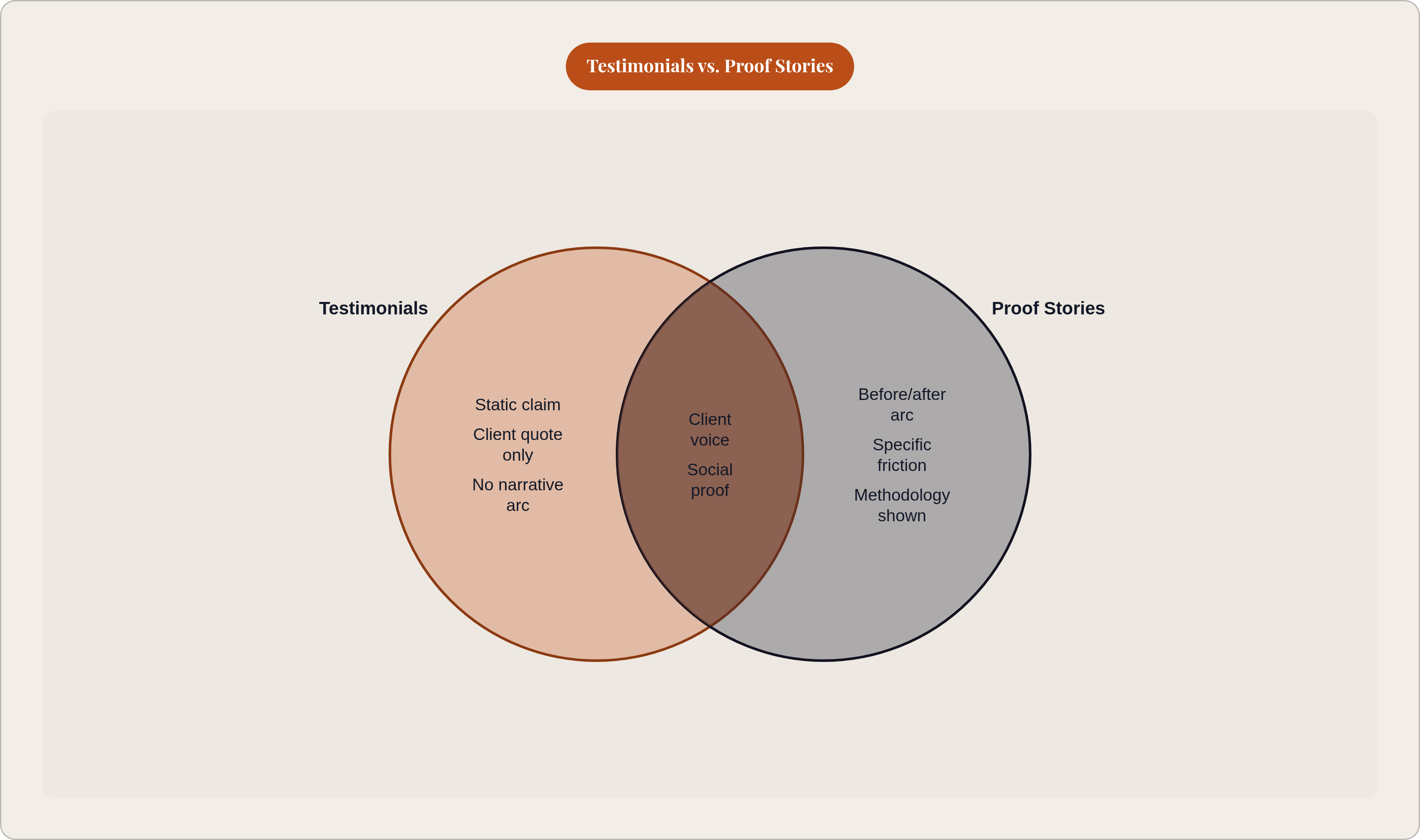
A testimonial is a static claim. "They're great to work with" tells you nothing except that someone agreed to say that on the record, probably after a little nudging. A proof story has a shape to it: a before-state, a specific friction point, a resolution, and a number you can actually hold in your head afterward. Case studies present facts. Proof stories give you an experience, one where the emotional arc, the stakes, the turnaround, does the heavy lifting, and the facts show up later just to confirm what you already felt in your gut.
For a founder, this matters more than it would for some 40-year-old company with a logo wall. You don't have the Fortune 500 client list yet. No analyst has written you up. There's no decade of track record to point to when someone asks "so, are you legit?" At that stage, the stories you choose to tell in public are basically the whole brand. A proof story shows your judgment and your method alongside your results. A pitch tells someone you solved a problem once; a proof story shows how you think about that entire category of problem, which is a very different flex.
Why LinkedIn is the right venue for this, and why your personal profile beats the company page every time
Around 80% of B2B social leads come from LinkedIn, and more than 70% of its users hold some kind of decision-making authority. So the person reading your proof story is, structurally, already the buyer. You're fishing in a stocked pond with a net, rather than casting a line into open water.
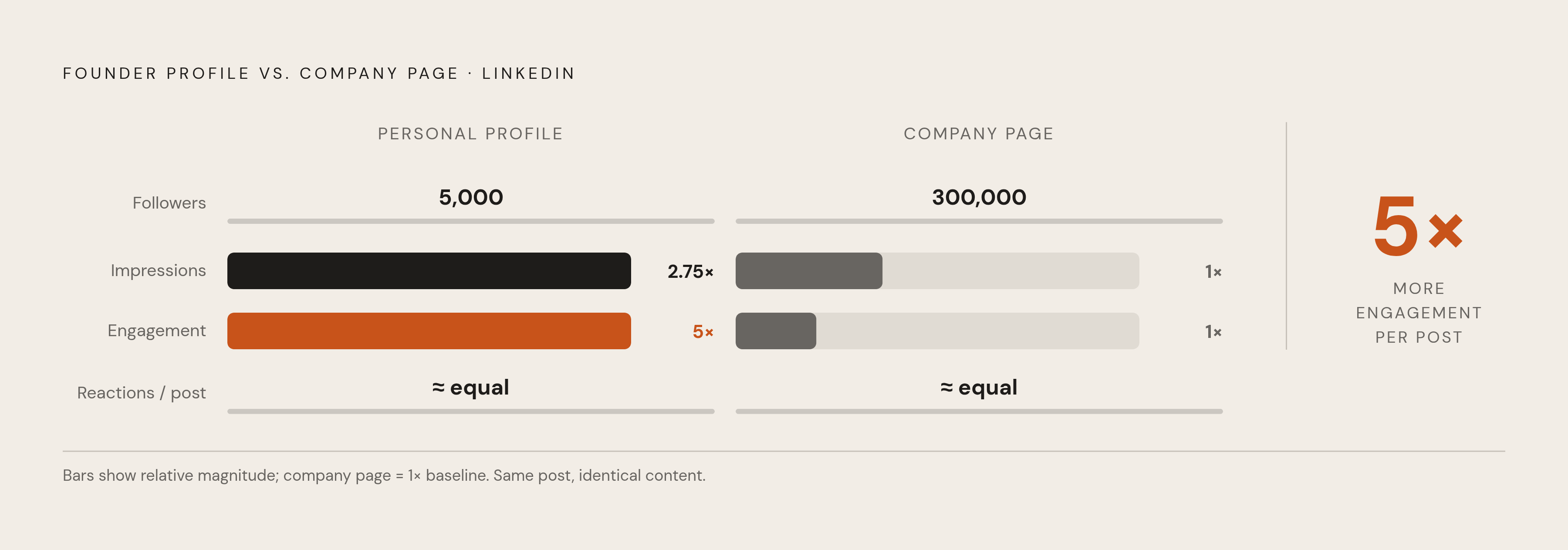
Here's the part most founders miss, and it's not a small gap. DSMN8 looked at over 11,000 LinkedIn posts and found a CEO with roughly 5,000 followers gets about the same reactions per post as a company page sitting on 300,000 followers. People are three times more likely to engage with a post from a named founder than the identical post from a brand account. Same words, same day, same idea, and personal profiles still pull 2.75 times the impressions and five times the engagement.
Which is wild, because almost nobody's doing it. Only about 1% of LinkedIn users post weekly, and that thin sliver still generates 9 billion impressions a week across the platform. The packed arena founders picture in their head, full of slick content teams and matching brand colors, turns out to be mostly empty. A founder sharing a real client win in their own voice reaches decision-makers in a way a brand page struggles to match, because a brand page talks in a style guide, not a voice.
The trust problem that makes proof stories the highest-leverage thing a founder can publish
Trust is the scarce resource right now, full stop. In a feed drowning in generated content, 94% of B2B marketers say building trust is the single most important factor for brand success, per LinkedIn and Ipsos's 2025 B2B Marketing Benchmark. Authenticity cuts through, and a proof story, with its specific friction and its earned ending, is about as exportable as authenticity gets.
Think about what happens before anyone books a call with you. They've already looked you up on LinkedIn. Scrolled your last ten posts. Quietly decided whether you seem like someone who knows what they're doing or someone selling fog. That judgment forms before you've said a single word on Zoom.
The numbers line up with that instinct: 73% of B2B decision-makers say thought leadership tells them more about a company's real capability than its marketing materials do. A proof story is doing sales work before the sales call exists, whether the founder thinks of it that way or just calls it "content" and moves on.
There's also the 95:5 rule, from Edelman and the Ehrenberg-Bass Institute, which says roughly 95% of potential buyers aren't shopping right now. A proof story you post today isn't for the 5% searching this week. It's for the 95% who'll be searching eventually, and who'll remember the person who showed up consistently long before they needed anything. And 82% of people say they trust a company more when its leaders show up on social media. The founder's presence is carrying the whole brand's trust score on its back, whether the founder signed up for that job or not.
How proof stories move someone through the buying journey without it feeling like a sales pitch
Here's the part that surprises people: proof stories close deals already in motion, and they also start ones that didn't exist before. 54% of decision-makers say thought leadership pushed them to research a product they hadn't considered before, and 47% say it led them to actually buy from a company that wasn't even on their radar. That's demand generation wearing a disguise.
Further down the funnel, the job changes. When a prospect is comparing three vendors and needs to justify a pick to their boss, a specific metric from your proof story becomes their own talking point. It's borrowed ammunition, and they didn't even have to ask you for it.
That internal case matters more than founders tend to give it credit for. More than 40% of B2B deals stall not because the buyer said no, but because the buyer's own team couldn't agree on yes. And 79% of "hidden buyers," the internal stakeholders you never actually talk to, say they're more likely to back a vendor during an RFP if that vendor has been consistently putting out solid thought leadership. Your proof story is doing work in rooms you'll never set foot in.
None of this works if the post reads like a pitch, though. Posts where the customer is the hero, and the founder's method shows up as one tool among several, convert to inbound DMs at roughly four times the rate of hard-sell posts. The job of the post is to get someone thinking, quietly, "huh, that's my problem too."
The narrative shape that makes a proof story feel earned instead of promotional
Start with the client's situation. Open on the mess, well before the logo, your own resume, or a list of credentials.
Make the friction specific. What was the client actually doing day to day? What had they tried already that flopped? What assumption were they working under that turned out to be flat wrong? Generic case studies skip this part entirely, and that's exactly why specificity signals real expertise. You can't fake it. You either watched the problem up close or you didn't.
Two structures do the job well. Before-After-Bridge is the simpler one: paint the struggle, show the new state, then use the bridge (the actual path between them) to show how you think and what method got the client there. STAR, meaning Situation, Task, Action, Result, works better for technical work, and it hands you a natural spot to drop a client quote right at the Result, closing the loop in someone else's voice instead of yours.
Pick one number. Just one. A single metric the reader can repeat back at a dinner party does more work than five stats crammed into a paragraph. "Trial-to-paid conversion jumped from 4% to 11% in six weeks" beats a dashboard, because a reader can actually hold onto it. Can they repeat it back without looking at the post again? That's the whole test.
The customer stays the hero. You're the guide, or the method, rarely the main character. That's the line between thought leadership and a brochure with better formatting. A direct client quote, whether it's in the text, on a graphic, or dropped into a carousel, adds a human voice no amount of founder narration replaces. Third-party proof, living inside first-person storytelling.
One formatting note that trips people up constantly: posts without outside links outperform the ones with them. Got a full case study to share? Put the link in the first comment, not the post. The algorithm reads outbound links as an exit sign, and exit signs don't exactly help engagement.
What separates a proof story that builds authority from one that reads like a press release
Details are the whole game. "They were manually reconciling two CRMs every Monday morning" beats "they had an inefficient workflow" every time, because one of those sentences was obviously written by someone who was actually in the room.
Name the wrong assumption out loud. If the client thought the problem was X and it turned out to be Y, say that. That's the moment you prove you diagnosed the issue instead of just filling an order form. A failed attempt, something that didn't work before you showed up, makes the eventual win feel earned instead of assumed.
There's a deeper signal buried in here too: when a proof story reveals how you think about an entire category of problem, not just one client's flavor of it, you start reading like a practitioner instead of a vendor. That's the shift that actually builds a reputation, rather than just padding a portfolio page.
What you leave out matters just as much. A metric dump makes a proof story read like an earnings call, when the emotional arc was always doing more work than the spreadsheet. Jargon that impresses an engineer but loses the CFO defeats the whole point, since the best proof stories get written for the person who has to approve the budget, not the person implementing the tool. And bragging in first person without the client's actual voice collapses the whole thing into a claim instead of a story. You narrate, the client validates, and pulling either half out breaks it.
Worth knowing: LinkedIn's ranking currently favors dwell time and real comments over quick reactions. A proof story specific enough that someone stops scrolling to type out their own similar mess is generating exactly the signal that extends reach. Turns out specificity is good algorithm strategy and good writing at the same time, whether or not that was the plan going in.
Building a proof story cadence you can actually sustain, without burning through every client win you have
Founders with active LinkedIn profiles generate three to five times more inbound leads than company pages, but that only holds up if you're consistent. One proof story a month is a nice gesture; a program needs more than a gesture.
Here's the trick: one client engagement can fuel four separate posts, not one, if you just change the angle each time.
- The outcome story: what changed, and by how much.
- The diagnosis story: what the real problem turned out to be, which usually isn't what the client thought walking in.
- The assumption story: what you believed going in that turned out to be wrong. Takes a little humility to write, but humility paired with real expertise reads as confidence, not weakness.
- The methodology story: how you approach this entire category of problem, told through this one client as the example.
That's four posts, not one, from a single engagement. For most founders, two to four solid posts a week, with proof stories anchoring the calendar, keeps you visible without needing a fresh client win every seven days, which frankly nobody has. LinkedIn's algorithm also tends to reward a handful of recurring themes, usually three to five, so proof stories work best when they keep circling back to a point of view you already hold, instead of functioning as disconnected wins with no thread between them.
Don't skip the first hour after posting. Founders who reply to comments right away see meaningfully higher total impressions, because the post opens a conversation and the comment thread is what actually stretches its reach.
On client permission: anonymized versions still work fine, as long as the friction and the outcome stay specific. The detail earns trust more than the logo ever did anyway. Some clients go further and share the post themselves, which pushes the story into a whole new audience for free.
Why proof stories pay off as a long-term asset, not a one-off post
Executives estimate that 44% of a company's market value ties directly to the CEO's reputation, according to Weber Shandwick. A proof story archive is part of that reputation, laid brick by brick, post by post.
The downstream effects go further than most founders expect. 87% of executives say CEO reputation shapes investment decisions, and 77% say it affects a company's ability to attract talent. So one proof story is quietly working pipeline, fundraising, and hiring all at once, from the same piece of content you spent twenty minutes writing on a Sunday.
The compounding logic loops back to that 95:5 rule. A proof story published today reaches the 95% who aren't shopping yet. Months later, when they finally enter a buying cycle, the founder who's been quietly, consistently credible the whole time has an edge no ad campaign can buy on short notice. Advertising rents attention; proof stories build a reputation that just sits there, waiting for someone to need it.
Different audiences read the same archive differently, which is the whole point, not a coincidence. Prospects see validated outcomes and a pattern across clients. Investors see traction and founder-market fit. Talent sees someone who builds in public, which reads as someone worth betting a career on.
That's the discipline behind what Forj Media does with founder content: pulling the real, specific texture out of client engagements and turning it into a LinkedIn program that actually holds up over months. Handled that way, a proof story becomes durable brand equity, still paying out long after the original client win has faded from everyone's memory except the founder's.