Founder Voice Consistency Across Ghostwritten LinkedIn Content
Ghostwritten posts tank when agencies prioritize schedule over the founder's actual voice.

Ghostwritten LinkedIn content fails for a boring reason: most agencies solve for time, at the expense of voice. A founder hands over a brief, gets posts back on schedule, and six weeks later the content reads like it was written for a slightly different person who happens to share the same job title.
The time problem is real. Founders are busy, writing takes hours they don't have, and outsourcing that task makes sense on its face. But time is the easy half of the equation. The hard half is making sure the posts that come out the other side still sound like the human who supposedly wrote them.
Here's the tell: employees notice first. Then close contacts. Then, worst of all, the exact people the content was supposed to reach start to feel something is off, even if they can't say what. That's usually because the ghostwriter is running a platform playbook (hook, tension, payoff, call to action) that works fine in the abstract and erases the founder in the process. Voice consistency is whether a post carries a recognizable point of view: real opinions, specific word choices, a way of arguing that belongs to one person and nobody else. B2B buyers research people on LinkedIn before they engage with them, checking for coherence rather than polish, weighing whether this is a real person with a real spine, or a content calendar with a headshot attached.
Voice consistency is a craft problem. Craft problems have repeatable solutions, and the rest of this piece is about what that repeatable solution actually looks like.
What founder voice actually consists of
Tone gets all the attention and deserves less of it. Casual versus formal, short sentences versus long, that's surface-level stuff. Voice runs deeper than that, and it's made of parts most style guides never touch.
Start with characteristic opinions: positions a founder holds again and again about their industry, the ones they'd defend at a dinner party without needing notes. Add to that argumentative structure. Does this person open with a statistic, a story, or a flat provocation? Then there's vocabulary, which is more revealing than most founders realize. Someone who says "our people" instead of "team members," or "build" instead of "scale," is telling you something about how they see their company before they've made a single argument.
Just as important is what a founder refuses to say. Every strong voice has edges, topics they won't touch, framings they reject on principle, claims they think are dishonest even when they're common. And emotional register matters, too: where does this person let vulnerability show, and where do they stay buttoned up?
The founders with the strongest presence on LinkedIn usually aren't the best writers in the technical sense. They're the most legible. You know where they stand before you finish the second sentence. A ghostwriter's job is to make a founder's natural reasoning visible and repeatable on the page, post after post, without smoothing off the parts that make them recognizable.
Here's a quick test. Take a finished post and imagine pasting it onto a different founder's profile. Would it still read as plausibly theirs? If the answer is yes, the voice work isn't done yet, no matter how many likes it gets.
Why a one-time brief doesn't hold over months of content
Most onboarding looks the same across the industry: a style guide, a questionnaire, a handful of sample posts to calibrate tone. All useful. None of it sufficient on its own, because a brief is a snapshot, and founders don't stay still long enough for a snapshot to hold.
Opinions shift. A founder who was bullish on a trend six months ago may have quietly revised that view after watching it play out with customers. Business context shifts too: a pivot, an aggressive hiring push, a fundraise in progress, all change what the content is actually for. And language shifts in ways founders don't even notice, absorbed from customers, investors, competitors, until the way they talk in a meeting sounds nothing like the voice guide from four months ago.
A ghostwriter working only off the original brief doesn't notice the drift either, because it happens slowly. Each post is only slightly more generic than the last one, and slight differences don't set off alarms. They accumulate.
Worth saying plainly: some consistency is the goal. A founder shouldn't sound like a different person every week. But the emphasis, the examples, the urgency behind the content should track the business as it actually moves, not the brief as it existed on day one. Executive use of writing support has become common practice at large companies (a Content Marketing Institute survey put the figure at 61% of C-suite executives using some form of it), and the common failure across those engagements is treating onboarding as something you finish instead of something you maintain.
The extraction process that captures voice before a word is written
The stronger operators in this space have converged on roughly the same structure: an onboarding phase that runs one to two weeks before a single post gets published.
It usually starts with a voice interview, structured, around 45 minutes. The questions aren't about content topics. They're about how the founder thinks. What would they argue about at dinner? What's a decision they've reversed on? What annoys them about the way their own industry talks about itself? A good interviewer isn't collecting quotes here. They're listening for the phrases a founder returns to without being asked, the rhetorical habits that show up whether the topic is pricing or hiring or a product launch.
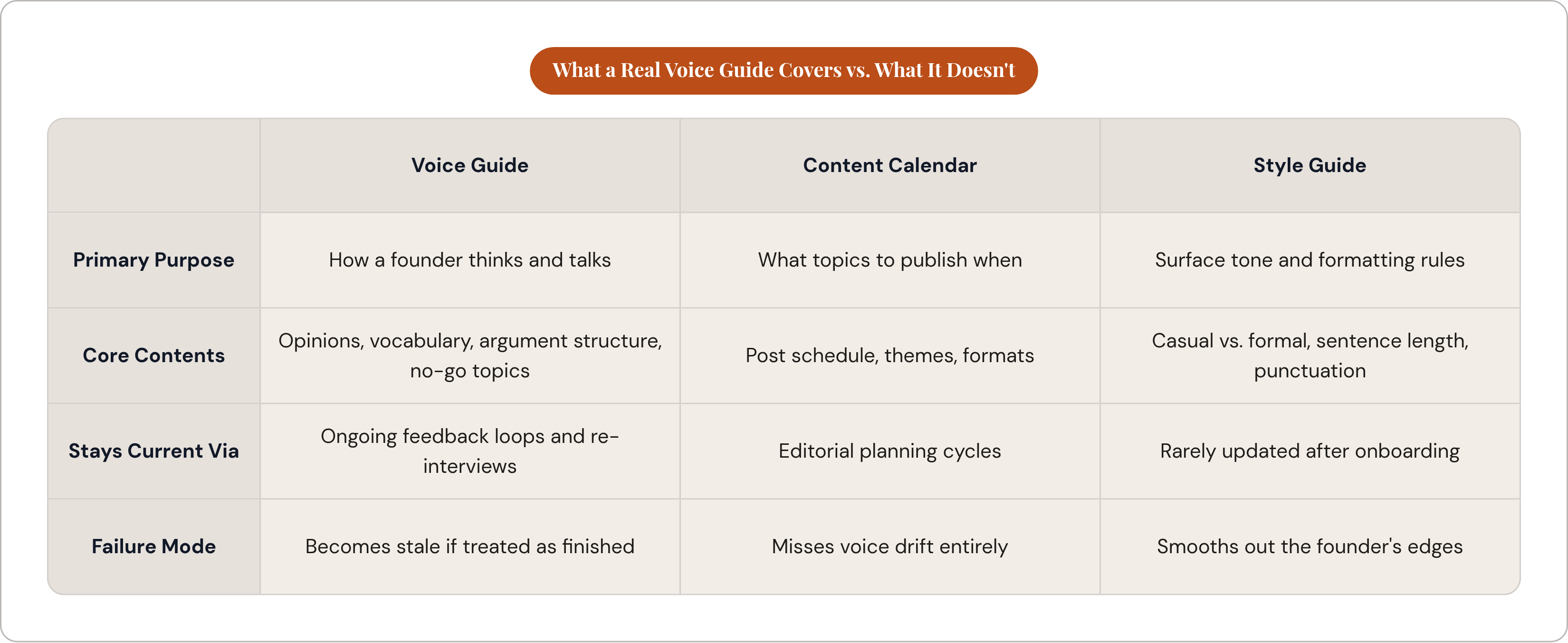
That interview turns into a voice guide, and a real one covers more than tone. Vocabulary preferences, structural tendencies, the positions the founder wants to be known for, the no-go topics they won't engage with regardless of relevance. Alongside that, the ghostwriter should be digging through old material: emails, past posts, talk transcripts, investor updates, anything that shows the founder's voice in its natural habitat before anyone starts shaping it.
The underlying principle is worth stating directly: ghostwriting leans almost entirely on extraction, not invention. The ideas have to come from the founder. The ghostwriter's job is to surface them and give them a shape that holds up on the page. A decent test of whether the onboarding worked: within two or three posts, the founder should read a draft and say it feels like something they wrote.
One clarification, because it trips people up. A voice guide is not a content calendar, and it's not a list of topics to cover. Those are editorial tools. A voice guide is about how someone thinks and talks, full stop.
How working feedback loops keep the voice calibrated over time
Month three is usually where ghostwriting engagements either hold together or start to wobble, and the feedback loop is the reason why.
The strongest setups pull from more than a weekly call. Voice recordings and meeting transcripts are a good source: a five-minute voice note recorded right after a customer call often has more real material in it than an hour of formal prompting, because the founder isn't performing for the interview, they're just reacting to something that happened. Email threads and Slack messages help too. Founders write more candidly in internal channels than they ever will in a scheduled interview, and those raw reactions tend to sit closer to the real voice than any polished draft. On top of that, quarterly re-interviews, even short ones, catch the opinion shifts and vocabulary changes before they show up as inconsistency in the actual feed.
The founder's time commitment, done well, is smaller than most expect. A well-run engagement asks for 10 to 15 minutes a week for review and approval.
What separates useful feedback from feedback that kills the loop entirely? "I wouldn't use that word" or "that's not really how I feel about this anymore" gives the ghostwriter something to work with, something transferable to the next post. Straight line-editing for prose style, with no explanation attached, teaches the ghostwriter nothing beyond that single sentence. It gets fixed once and drifts right back.
The real obligation on the ghostwriter's side is to treat every note as voice data, updating the guide rather than just the draft. A feedback loop that works keeps the style guide alive and changing, not sitting in a folder from week one, gathering dust like a gym membership nobody uses in February.
Where AI fits in the process without flattening the voice
AI is in every serious ghostwriting operation at this point, whether anyone admits it publicly or not. The real question is where it earns its place and where it quietly does damage.
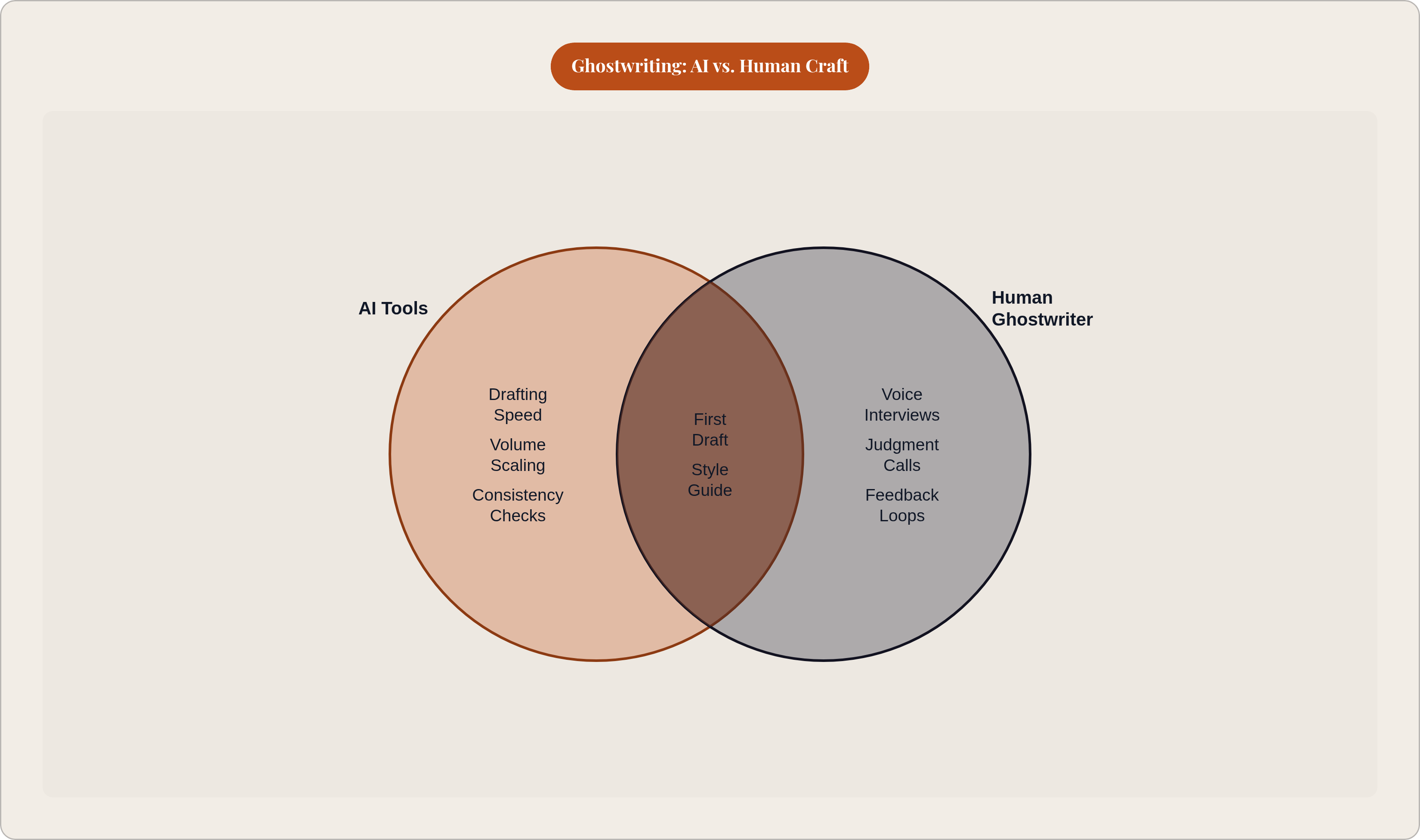
It earns its place in a few specific spots. Drafting speed is one: turning a voice recording or a transcript into a first structure so the ghostwriter is editing instead of staring at a blank page. Consistency checking is another, flagging when a draft has wandered from the documented vocabulary or the founder's usual argument structure. And it helps with volume, letting a ghostwriter take on more clients without cutting corners on depth, because the mechanical steps are handled elsewhere.
Here's the catch. AI trained on generic prompts produces generic voice, every time, without exception. It only becomes useful once it's working against a specific client's voice guide instead of an average of what performs well on LinkedIn. Feed it a template built for engagement metrics, and you'll get engagement-shaped writing that belongs to nobody in particular.
There are places it simply can't go. It can't run the interview that surfaces what a founder actually believes. It can't make the judgment call on whether to publish something politically sensitive. And it can't catch the phrase that's technically correct but sounds like nobody this founder has ever been. Founders who skip the extraction work and go straight to an off-the-shelf AI tool usually end up with content that's better than nothing, sure, but not better than generic. It still doesn't sound like them, which was the entire point of doing this in the first place.
AI lowers the cost of producing a post. The work that makes the post worth producing carries its own, separate cost.
What readers actually experience when voice consistency works
Strip away the process and get down to what a reader actually feels scrolling past one of these posts. When the voice holds together, it creates the sense of a real person with real opinions, someone worth following and, more importantly, worth reaching out to.
The break is obvious once you notice it. A post that could have been written by anyone in the industry does nothing. A post that contradicts the personality of the ten posts before it does worse than nothing, because now the reader is actively confused about who they're dealing with.
Different audiences are checking for different things, even if they'd describe it the same way. Prospects are looking for a genuine point of view, not a credentials list dressed up as a post. Investors research founders on social media before meetings (an estimated 84% do, per available figures), and what they're really evaluating is whether the public voice lines up with the person they'd be backing behind closed doors. Potential hires read a founder's feed before they accept an offer, treating it as a culture signal long before day one.
Trust compounds here, post by post. Each consistent piece of content adds another small piece of evidence about who this person actually is. One inconsistent post doesn't just fail on its own; it erodes the credibility of everything that came before it. Founders who manage to build a coherent public voice, ghostwritten or not, tend to see it show up downstream: available estimates on executive brand ROI put it at roughly 3x more qualified job candidates and deals closing around 60% faster. Numbers aside, the mechanism is simple. The reader doesn't need to know who typed the words. They just need to recognize the person those words were written for.
How to evaluate whether a ghostwriting partner will protect rather than dilute your voice
Forget the portfolio for a second. The strongest signal of whether a ghostwriter will protect your voice is whether they can explain, in plain terms, exactly how they capture and maintain it. If the answer is vague, that's the answer.
Ask directly. What does onboarding look like, and what do you actually produce at the end of it, a document or a vibe? How do you keep gathering raw material between posts, once the initial interview is behind you? When my opinions shift, or the business changes direction, how fast does the content adjust to match? And a harder one: can you show me two different clients' work and let me tell them apart without checking the names?
There's a real difference between agencies running a content formula and operators who've built their own audience using the exact methods they're selling. The second group understands what makes a post feel like an actual person because they've done it themselves and watched what happens when it's done wrong.
Price is a signal too, whether people like admitting it or not. Serious voice-capture engagements aren't a commodity service. Monthly retainers covering a full content program typically run $3,000 to $12,000. A partner quoting well below that range is very likely skipping the extraction work, and that's the work that makes everything after it defensible.
One honest tradeoff worth naming before signing anything: even the best partnership needs the founder to show up. Ten to fifteen minutes a week for review, plus periodic re-interviews to catch drift. A founder expecting zero involvement won't get authentic content, full stop; that expectation and that outcome don't coexist.
What good looks like at six months isn't complicated. The style guide has already been revised at least once. The ghostwriter can guess what the founder would say about a brand-new topic before anyone asks them. And the audience has grown steadily, with nobody in it ever sensing a gap between the person and the prose.