Executive Brand Audit Checklist for LinkedIn Profiles
Decide what makes your founder profile credible before investors or buyers see it.
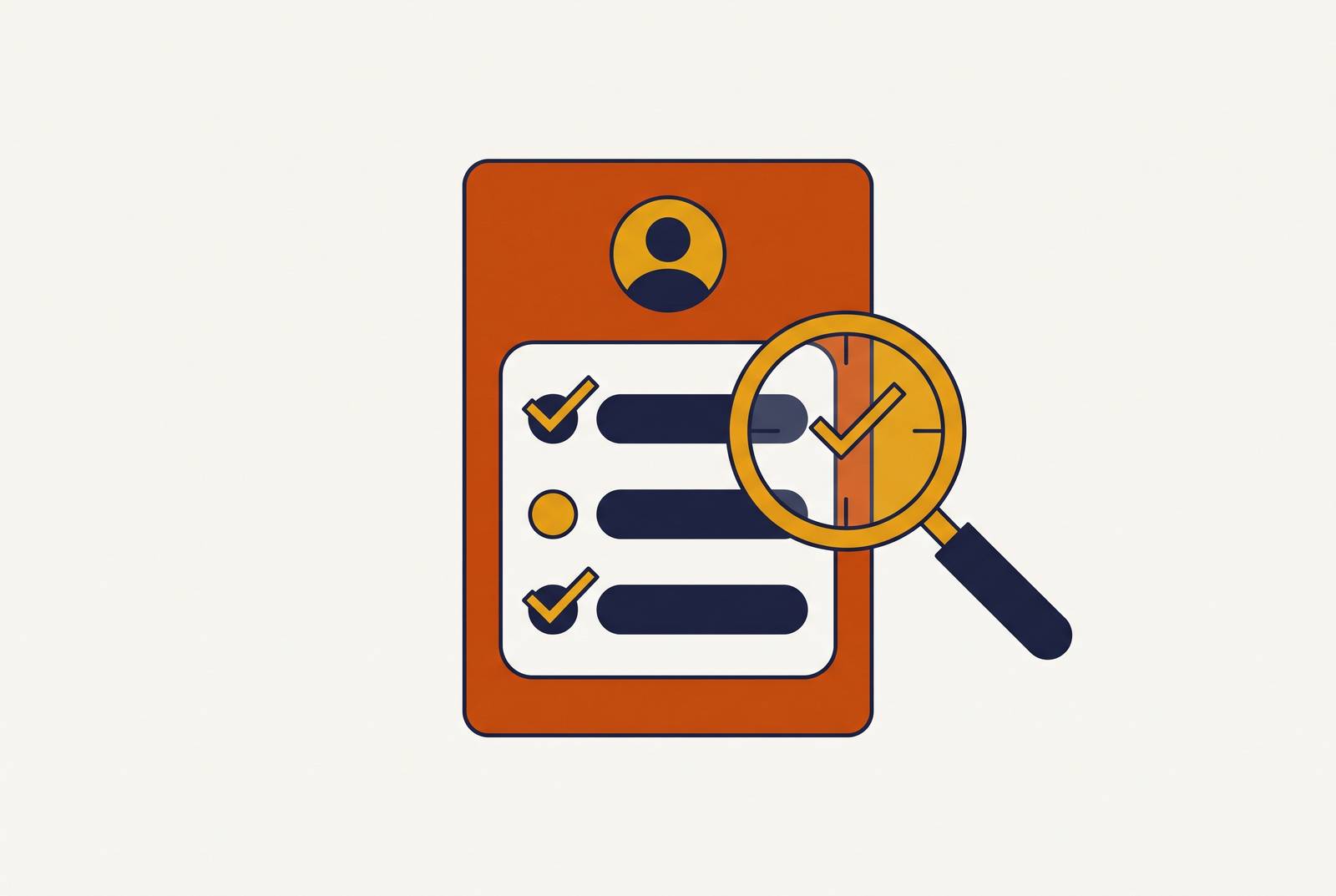
Someone checks a founder's LinkedIn before the first call, before the term sheet, before the offer letter goes out. That's the entire premise behind a profile audit: it's a systematic look at whether the profile matches the business outcome the founder actually needs. B2B decision-makers widely use LinkedIn during vendor research. Executives who show up and engage online earn more trust from consumers, and more of those consumers say they'd buy from a company whose CEO actually posts. With 61 million senior-level influencers and 40 million decision-makers sitting on the platform, the audit is essential. It's where the deal, the hire, or the check gets decided before anyone says a word out loud.
What a profile audit is
Swapping in a better headshot or adding a job title isn't an audit, it's tidying up. A real audit interrogates every element on the page and asks one question over and over: does this build trust, authority, and relevance for the specific person reading it, whether that's an investor, a buyer, or a candidate?
Order matters here. Content strategy without a working profile is like running ads to a broken checkout page: the traffic arrives and leaves. A weak profile creates friction no matter how strong the posts underneath it are. And LinkedIn's own mechanics punish that friction directly. Heading into 2026, the algorithm tracks how long a visitor sticks around on a profile. Click in, bounce out in two seconds, and the algorithm reads that as a signal the profile isn't worth surfacing again. Dwell time is the tell. Fix the page before worrying about what's driving people to it.
The headline: the first signal most founders are wasting
"CEO at [Company Name]" tells a reader what the org chart says. "CEO at [Company Name]" tells a reader what the org chart says, not why they should stop scrolling. That's the single most common failure point on founder profiles, and it's an easy one to fix once it's named.
The fix pushes search appearances up by 40%, a lift beyond vanity metrics, when a custom headline replaces a bare job title. That's not a vanity metric. Search appearances are how cold prospects, recruiters, and reporters find a profile they weren't already looking for by name.
Ask this during the audit: does the headline name the audience the founder needs, the outcome they produce, or a credibility marker, or does it just restate the title already sitting in the About section? Two structures can be tested against each other. The first leads with proof: "Founder of [Company] ($10M ARR) | Speaker | Investor." The second leads with specificity: "The [Adjective] Guy/Gal for [Industry]." Both work. Neither is "CEO at."
The About section: where authority is built or silently lost
LinkedIn cuts the About section off after three lines, and everything past that point only shows if the reader clicks "See more." That means the opening three lines are doing essentially all of the persuasive work. If they read like a resume summary, nobody clicks further and the rest of the section, no matter how good, might as well not exist.
Skipping the section entirely costs more than most founders assume. Profiles with a filled-out About section get 30% more weekly views than the ones that leave it blank. For a founder, that section needs to carry four things: why the company exists in the first place (funders and buyers back missions, not job titles), a specific description of the problem and who has it, evidence of expertise shown through how the founder thinks rather than a list of degrees, and a clear next step for anyone who's interested.
Read the section back as a total stranger would. Does it tell a story, or does it just list achievements in order? Does it reflect what the founder actually wants to be known for, or what happened to be true five jobs ago?
The banner, photo, and Featured section as a trust stack
Before a single word gets read, three visual elements decide whether the profile looks credible: the photo, the banner, and the Featured section. Together they're a trust stack, each layer holding up the one above it.
The photo is the face people are checking for. Buyers, investors, and candidates want to see who they'd actually be working with, and a missing or grainy photo reads as either neglect or, worse, evasiveness. The banner is prime billboard space that most founders leave at LinkedIn's factory-default blue, which is the equivalent of buying a highway billboard and leaving it blank. Use it to state the value proposition, the company name, or the outcome the founder delivers.
The Featured section is where the audit gets tactical. Pin the best-performing post or the founding story, the piece of content that shows how the founder thinks. Add a link straight to the product's landing page, or to open roles if hiring is active. Pin a client story, a media mention, or a case study, something that proves outcomes instead of just proving activity. Turning on Creator Mode makes this section more prominent, but the formats themselves (posts, articles, links, media) are open to every LinkedIn member, Creator Mode or not.
Experience entries, skills, and keywords as the profile's search infrastructure
By 2026, LinkedIn's matching runs on industry language and functional keywords beyond job titles typed into a form. That changes what "keyword audit" even means. Pull job descriptions for the roles or partnerships the founder wants to attract, note which terms recur, and work those same terms into the Headline, About, and Experience sections. This isn't keyword stuffing, it's speaking the exact dialect the target audience already uses when they search.
Experience entries get judged on a different question than most founders assume. The entry gets judged on whether it shows an outcome instead of a responsibility. "Led product team" says nothing. A number attached to growth, scale, or revenue says everything. Each entry should work as a small proof point backing up whatever the headline claims.
Skills matter too, and LinkedIn allows up to 100 of them. The audit isn't checking whether 100 are listed, it's checking whether the ones listed match the language buyers, investors, and recruiters actually search for, rather than the founder's private description of their own job.
Recommendations: the third-party validation that closes credibility gaps
Self-written copy can only go so far. Recommendations carry weight precisely because someone else is vouching for leadership, trustworthiness, and what it's actually like to work with this person, and that third-party voice is a direct input into investor confidence.
Not all recommenders carry the same weight for the same audience. Customers, advisors, partners, executives, and team members each speak to something different. An investor-facing profile needs advisors and executives who can vouch for judgment and leadership under pressure. A buyer-facing profile needs customers who can speak to delivery and results. A talent-facing profile needs team members describing what it's actually like to be led by this person day to day.
There's a keyword angle too: recommendations written in the same language the target audience uses can reinforce the overall coherence of the profile's positioning. Aim for several high-authority recommendations, enough to read as a pattern rather than a lone friendly endorsement.
How profile quality compounds with content output
The average LinkedIn post in Q1 2026 reached 5,083 people, a 14% jump from the year before. That reach isn't spread evenly across everyone posting.
Executives posting 15 or more times a month made up just 13% of the dataset studied, yet that small slice captured 47% of all impressions across a 33-million-impression sample. That's a steep concentration curve: a small group posting consistently pulls in nearly half the attention. The same data shows a four-year pattern holding steady: reach keeps climbing, consistency compounds instead of flattening out, personal storytelling beats straight promotion, and original posts dramatically outperform reshares.
The audit and the content strategy meet at this point. A well-optimized profile causes that posting activity to convert; without it, the activity produces no results. Skipping the audit means increased posting just sends more traffic to a page that can't convert it. Do the audit first, and that same compounding reach turns into inbound leads, investor interest, and a stronger talent pipeline.
The profile audit's differences across fundraising, hiring, and closing deals
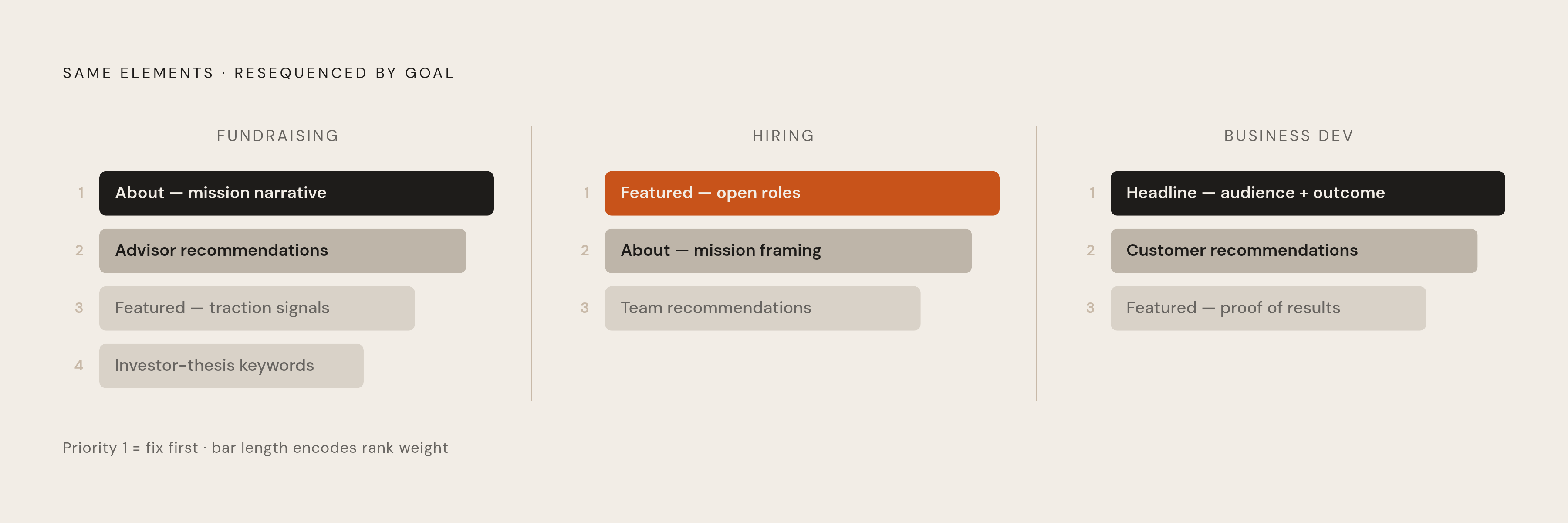
The elements on the page stay the same across every goal. What changes is the order they get fixed in, and which section carries the most weight for which reader.
For fundraising, the stakes are direct: 77% of VCs research a founder's LinkedIn before or during diligence, and founders with an active, authentic presence raise roughly 23% more per round. One fintech founder's case shows what that shift looks like in practice: consistent visibility moved Series A conversations from "convince me this works" to "tell me how I can invest," and cut the fundraising timeline from six months down to eight weeks. For this audience, prioritize the About section's mission narrative, advisor recommendations, a Featured section stacked with traction signals, and keywords that mirror the investor's own thesis language. Building a brand that actually moves the needle takes 12 to 24 months. A founder mid-raise doesn't have that runway, so the profile needs fixing now, not after the round closes.
For hiring, candidates read the founder's profile to judge culture and leadership style before they'll even take a call. The Featured section's open-roles link and the About section's mission framing carry the most weight here, and team member recommendations, describing what it's like to actually work for this person, tend to matter more to candidates than almost anything else on the page.
For business development, the numbers make the case on their own: 73% of B2B decision-makers say thought leadership is a more trustworthy read on a company's capability than its marketing materials or product sheets, and 47% say thought leadership led them to do business with a company they hadn't considered before. Here the priority stack is a headline that states clearly who the founder serves and what outcome they deliver, customer recommendations, and a Featured section built around proof of results.
The audit as a recurring practice, not a one-time fix
LinkedIn's AI Hiring Assistant, rolled out starting in 2024 and expanding through 2025, changed how profiles get surfaced and evaluated. A profile that was fully optimized back in 2024 can now be missing signals the platform weighs differently today. Profiles don't stay finished, they go stale.
Most founders run the audit once, see a bump, and then let the profile sit while content production eats all the attention. That's the exact failure mode this whole piece is warning against: the profile and the content strategy are one system, not two separate projects, and letting one drift while feeding the other just recreates the friction the audit was supposed to remove. Treat the audit the way a car gets treated for an oil change, done on a regular schedule. Revisit the headline, the About section, the Featured pins, and the recommendation mix on a set schedule, and check them against whatever LinkedIn's algorithm happens to be rewarding that year, because that target moves regardless of anyone watching it.