LinkedIn Outreach to LPs for Emerging Fund Managers
Emerging fund managers must build visible credibility on LinkedIn before pitching.
Fundraising in 2026 doesn't reward the manager with the best deck. It rewards the manager who already looks familiar by the time the deck gets opened. Outreach used to mean cold emails and a warm intro from a mutual friend. Now it means showing up on LinkedIn with enough visible proof of your thesis that the LP has half-decided before the call even gets booked.
The numbers explain why the old playbook is dying. PitchBook's 2025 US PE Breakdown put the average first-time fund at $28.7 million, down from $42.1 million in 2021. Fewer LPs now control more capital, so each relationship carries more weight and forgives less. Family offices got more professional too, and they show up with actual mandate documents and pacing models now, not gut instinct. But the factor that changes behavior most is simpler than either of those: LPs know things about a manager before they ever say hello. Platforms like Altss track over 150,000 private-markets entities with data refreshed inside 30 days, so an LP can pull a manager's track record, co-investment history, even team turnover before anyone schedules an intro call.
When those three factors combine, cold outreach converts at very low rates. The game is arriving already vetted, not getting vetted on the call.
Due diligence has widened to match. Ocorian's 2026 survey found institutional investors weighing governance, operational maturity, and reporting discipline right alongside returns, with valuation methodology ranking as the single biggest worry, ahead of even liquidity risk. LPs aren't just checking whether a manager can pick winners anymore. They're checking whether that manager thinks clearly, consistently, and in public, long before the meeting starts.
The screening happens somewhere specific. A manager can shape it, or ignore it and hope the deck does the talking.
Where LP attention lives and why LinkedIn is the pre-vetting surface
LPs are on LinkedIn for the same reason everyone else is: it's where professionals spend their scrolling time now. What matters is whether a manager shows up looking like someone worth a meeting, or like background noise scrolling past at speed.
LinkedIn passed 1.3 billion registered members in 2026, with roughly 310 million checking in monthly. About four out of five members make business decisions at their organization, which rules out the "just interns on lunch break" theory pretty quickly.
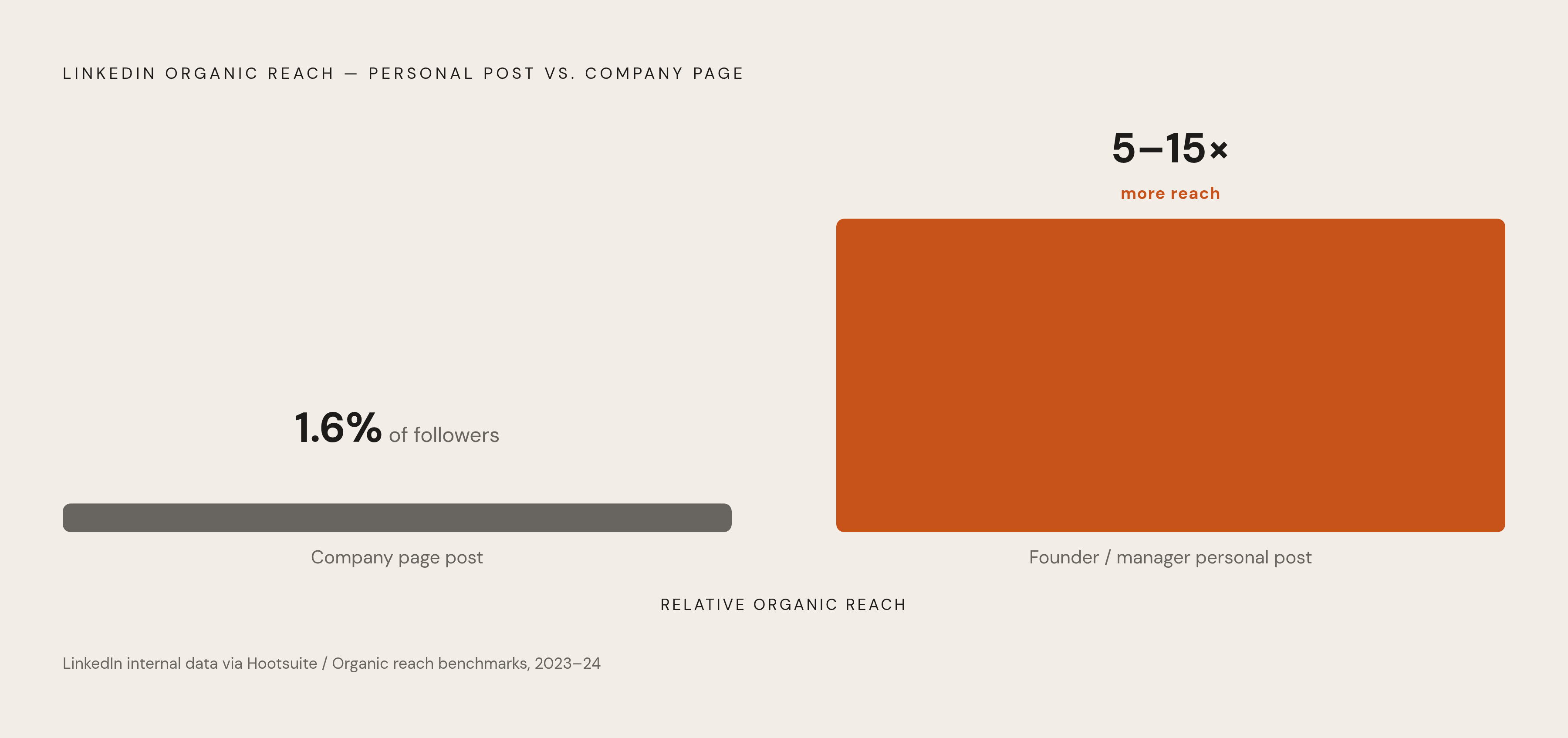
Social Media Examiner reports LinkedIn drives 80% of all B2B social leads, more than Twitter, Facebook, and Instagram combined. Research from windmillgrowth.com finds a personal post from a founder or manager gets 5 to 15 times the reach of the same content posted from a company page, while company pages are stuck reaching about 1.6% of their own followers organically. That gap alone should settle the argument for any manager still pouring energy into a firm page instead of a personal one. It shouldn't be a debate at this point, and yet plenty of managers still run it as one.
For a fund manager, the personal profile is the first artifact an LP finds, and often the only one read before deciding to take the meeting. Research from foundera.co found 77% of VCs research founder profiles before agreeing to a meeting, and LPs being pitched behave no differently. Separately, foundera.co's research found founders with an active, genuine LinkedIn presence raised about 23% more.
There's a timing edge too, easy to underrate. Cold email and conference badges catch someone whenever they happen to check an inbox or wander past a booth. LinkedIn lets a manager show up at the exact moment an LP is chewing on a sector question or a thesis debate. That's ambient presence, and it compounds. Show up consistently enough, and eventually the manager is just there when the LP needs them to be, no cold email required.
Knowing LinkedIn is the surface solves half the puzzle. Figuring out what LPs are actually looking for once they land on it matters just as much.
Reading LP signals on LinkedIn before sending a single message
Timing a message right means knowing when an LP is actively putting capital to work in a given sector, stage, and geography. LinkedIn hands over that information in real time, for anyone who knows where to look.
A handful of things are worth watching. Posts or reposts about a specific sector theme usually mean active thesis development. Comments left on founder or portfolio announcements in that space are a tell. New job postings, a new MD with a diagnostics background say, often reveal a fresh mandate sleeve opening up. And noticing which of a GP's posts an LP keeps liking or resharing shows what that LP is paying attention to right now.
Specificity separates a real signal from noise, and the line between the two is sharp. "Your 2025 healthcare IT allocation increased 40% and your team hired a new MD with a diagnostics background" is a signal worth acting on. "We saw you invest in Series B enterprise SaaS" is filler that could apply to fifty other LPs and tells them nothing about why anyone is reaching out now. Most managers write the second version, then wonder why nobody responds. That's the design working exactly as built to do nothing. That's the message doing what it was built to do, which is nothing.
Layering that LinkedIn activity on top of public filings, LP letters, co-investment trails, and conference rosters produces a warm path map instead of a hunch, something a manager could point to and defend if anyone asked why they reached out when they did.
The calendar matters here too. Altss flags Q1 as the mandate reset window, when most institutional LPs lock in annual pacing and start deploying new sleeves of capital. Q4 offers a second window, as LPs work through whatever capital is left before year-end. LP activity on LinkedIn tends to follow those rhythms, so watch for spikes around those windows instead of assuming activity is random.
Before any outreach starts, rank targets on fit and timing together. Mandate overlap matters, but so does whether an LP has shown visible interest in the theme in the last 90 days. Skipping that filter results in cold, undifferentiated outreach wearing a fancier spreadsheet.
What survives that process is a short, ranked list where reaching out gets triggered by evidence. Once that list exists, the next job is making sure the profile gives those LPs a reason to keep reading after they click through.
Building the LinkedIn profile that converts LP curiosity into credibility
A LinkedIn profile isn't a resume. Treat it like a landing page, built to turn a curious click into a formed opinion on whether the thesis holds up and the operation runs tight.
The headline carries more weight than any other line on the page. It follows a name into search results, into comment sections, into every connection request sent. Waste it on a job title and the five most valuable words on the platform go to nothing. Use it to say what gets invested, for whom, and why the sourcing edge is credible, all in a line an LP can read while scrolling past at speed.
The About section works like a compressed pitch, and only the first two lines show before someone clicks "see more." Those two lines have to hook someone who arrived cold off a comment thread or a post. Track record language does the heavy lifting here, and LPs have gone allergic to vague credit-claiming. "I was part of the team that did X" reads as filler now. Say what actually happened: sourced it, led it, managed the exit. Specific verbs, not team spirit.
GP commitment deserves a direct mention. GP commitment is a number LPs notice, and alignment questions tend to surface when a manager's contribution reads as minimal. Better to address it on personal terms in the profile than get asked about it defensively in a first meeting.
The Featured section is where proof lives: documents, media coverage, and content that demonstrates the thesis in concrete terms. These are formats LPs actually click, not scroll past.
Lock all of this down before starting any content push or outreach cadence. Sending traffic to a half-finished profile is like buying billboard space for a store that hasn't unlocked its doors yet. Once the profile can carry the weight, the next question is what to actually publish so LPs build proof of thesis fit before they hear anyone say it out loud.
What to publish on LinkedIn to become pre-vetted before the first meeting
Content for a fund manager means building a visible record, post by post, so that by the time an LP finds the profile, the edge is already understood without needing it explained out loud on a call.
Scarcity works in a manager's favor here. Only about 3% of LinkedIn users post more than once a week, so showing up consistently already puts someone ahead of nearly everyone else on the platform, no clever tactics required. There's a noise problem working in the same direction: Recent data estimates 53.7% of long-form LinkedIn posts are likely AI-generated at this point, with AI-written comments up 340%. That flood of generic content makes anything genuinely lived-in stand out by contrast, structurally, without extra effort.
LinkedIn's algorithm in 2026 rewards what Magicpost calls semantic density: posts with real data, first-person detail, and an original angle get amplified, while generic templates get quietly buried. Good news for anyone with real experience to draw from. Bad news for anyone copying a content calendar off the internet.
A few formats do real work for a fund manager specifically. Writing about a deal passed on, and why, gives LPs a window into how decisions actually get made. A post built around a pattern spotted across a dozen recent founder conversations proves the sourcing engine is actually running, not theoretical. Writing openly about how markdowns, governance, or LP reporting get handled speaks directly to the due diligence questions Ocorian's survey flagged as top of mind. Writing honestly about a portfolio bet, why it made sense at the time, instead of dressing it up as a press release, signals the intellectual honesty LPs are quietly screening for.
Format matters as much as topic. Native video, 30 to 120 seconds, no production budget required, is widely cited as a high-performing format in the current post mix. Magicpost reports carousel and document posts pull an average engagement rate of 24.42%, compared to 4.10% for plain text, which makes them a natural fit for thesis frameworks or sector maps. Text posts still earn their keep, as long as they carry specific data and a first-person voice instead of generic advice nobody asked for.
On cadence, Research from growleads.io suggests three to four posts a week, Monday through Thursday, between 8 and 10 AM in the target audience's timezone. Consistency beats any single post going viral, every time.
The payoff compounds. Agency BAM's client data found founders who kept up a consistent narrative raised 41% more than the general market. The content built between raises becomes the asset spent during them.
Engagement pods, popular back in 2022 and 2023, are dead weight now. LinkedIn's algorithm has learned to spot and suppress pod-driven engagement, and Research from foundera.co notes pods actively undermine the authentic signal the platform now rewards. Skip them. They cost more effort than they return, and they're a tell to anyone who's been on the platform long enough to notice the pattern.
The comment-first outreach sequence that converts cold LPs into warm conversations
Outreach sent after real engagement converts at dramatically higher rates than a cold connection request ever manages. Being a recognized name by the time the request even hits the inbox is the goal. It's being a recognized name by the time the request even hits the inbox.
Start with comments, not connection requests. Before sending anything, leave two or three substantive comments on the LP's posts over roughly a week. "Great insight" doesn't count. A specific reaction, a related data point, a question that shows real understanding of the sector, that counts. By the time the connection request shows up, the LP already recognizes the name, and acceptance rates nearly double as a result, based on patterns Growleads observed across six executive accounts since late 2025. Compelite's 2026 guide goes further: ten thoughtful comments a day in the niche, before posting any original content at all, is the fastest LinkedIn growth lever available right now.
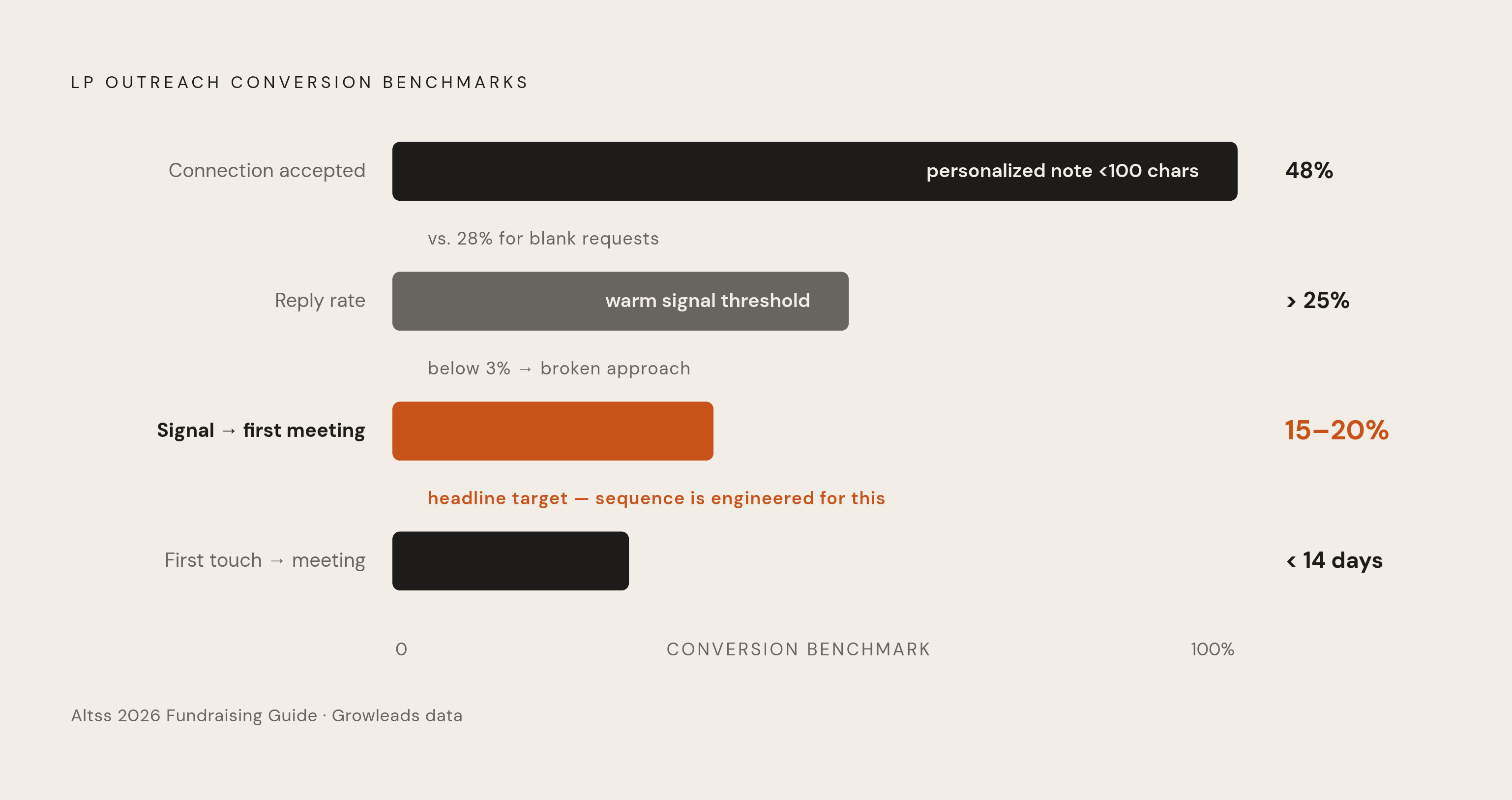
The connection request itself needs a personal note. LinkedIn's own data, cited by Growleads, shows personalized notes under 100 characters get accepted 48% of the time, versus 28% for a blank request. Reference something specific, such as a post they wrote, a panel they sat on, or an observation tied directly to the thesis. Skip "I'd love to connect." It says nothing, and gets treated exactly that way.
Once the connection lands, the first message needs structure. Open with two evidence points tied to something the LP actually did or said publicly in the last 90 days, keeping the focus off their AUM and off the firm's general mandate lifted straight from a website. Follow with one sentence on why the fund fits that specific signal. Close with one clear next step, a proposed conversation with defined scope that keeps the work on the sender rather than dumping it back on the LP. The whole message should read in about 90 seconds. No deck attached.
Altss's 2026 fundraising guide sets the bar clearly. A qualified signal should convert to a first meeting at 15 to 20%; anything under 10% means the targeting is too loose. Reply rates on that first message should sit above 25% for genuinely warm signals; below 3% means the approach needs rethinking, not more volume. Time from first touch to first meeting should land under 14 days; longer than that usually means the signal wasn't as strong as it looked.
Volume kills this faster than anything else. Altss documented one emerging manager who blasted a large batch of identical emails in January 2026 and converted at a fraction of a percent, torching the entire pipeline inside a week. Another sent 14 follow-ups from the same firm within 30 days and got blacklisted by the LP. Less outreach, aimed better, wins here every time: 20 to 30 LPs where genuine fit exists, worked over six to twelve months, beats a spray-and-pray list the market has already learned to ignore.
Getting the first meeting is the opening move. What happens in the stretch between that meeting and the next one, and between one fundraise and the next, is where the relationship actually gets built, or quietly lost.