LinkedIn Direct Message Scripts That Convert for Founders
Triggered outreach beats cold pitches because the recipient already engaged with you first.

A cold DM asks for something. A triggered DM replies to something the other person already did, a comment, a like, a connection accept. That difference in sequencing is the entire game. Founders who tie their outreach to a specific signal instead of a cold list get replies at multiples of the founders sending "Hi {firstName}" into the void.
LinkedIn's own scale makes the noise problem worse every year. Satya Nadella told investors the platform crossed 1.3 billion members in 2025, with 65 million of those counted as decision-makers, so the targeting precision is there in theory. But LinkedIn's own blog reported creator posting volume up around 41% year over year in 2024, which means more comments, more likes, more shares, more raw signal to work with, and also more competing messages fighting for the same inbox. Only 3% of users post more than once a week, so a founder who shows up consistently is already standing out before a single DM goes out.
The old cold-pitch opener ("Hi, I noticed your profile") reads as spam now, both to the human reading it and, increasingly, to the platform itself. LinkedIn tightened InMail throttling and cracked down harder on automated-pattern messaging in 2024. Unsolicited outreach isn't just annoying anymore, it's structurally penalized. None of this is a copywriting problem. Founders don't fail because they picked the wrong words. They fail because they're asking for attention before they've earned any, treating a template like an opening line when it should read like the second sentence of a conversation the other person already started.
How triggered DMs outperform cold outreach, in numbers
HubSpot's marketing data puts inbound lead conversion at 14.6%, against 1.7% for cold outreach leads. That's an 8.6x gap, and it's really a gap between two different kinds of trust: one where the lead found value on their own, and one where they got chased.
LinkedIn narrows that gap somewhat but doesn't close it. Outbound benchmark data from leadhaste.com (2026) shows LinkedIn DMs pulling a 10.3% average response rate against 5.1% for cold email, better than double, but still a floor, not a ceiling. A 2025 study of over 13,000 LinkedIn accounts (leadsmonky.com) found personalized connection requests hitting 9.36% response rates versus 5.44% for generic ones. The entire gap comes down to one thing: does the message signal "I know who you are," or does it not.
Timing compounds this. Salescaptain.io's analysis found that reaching out within a few days of a trigger event lifts response rates by roughly 32%. Comment-to-DM sequences, where someone comments on a post and gets a follow-up message, run 40 to 60% reply rates. That sounds almost too good, and the catch is real: someone commenting for a free PDF isn't automatically a buyer. A high reply rate only means something if the message after it actually sorts out who's serious.
Thibaut Souyris, CEO and founder of SalesLabs, is a useful data point here because his numbers are public and specific. He runs personalized, conversation-opening messages, not copy-paste pitches, and gets a 38% reply rate with an 11% meeting-booked rate (per kaspr.io). That gap between 38 and 11 is worth sitting with. It's the gap between someone being polite enough to reply and someone actually willing to get on a call, and it's exactly where most founders lose the thread, mistaking a reply for a win when the real work is still ahead.
The four-part structure every converting DM shares
Saylink.io's review of what actually gets replies on LinkedIn breaks the winning structure into four pieces, and it holds up across recruiting, fundraising, and sales DMs alike.
First, name the trigger in one sentence. "Saw your comment on my post about onboarding flows" works. "I came across your profile" does not, because it could have been written by a bot scanning ten thousand profiles overnight (and often was).
Second, deliver value before you ask for anything. Send the resource, answer the question, do the thing you said you'd do, ideally within the first minute of the exchange. Third, close with a soft ask: a question, a link, a "want me to send the breakdown?" Not a calendar link. Not in the opening message. Fourth, and this one surprises people: give them permission to ignore you. A single line acknowledging they might not want to continue actually raises reply rates, because it removes the pressure that makes people go quiet instead of saying no.
Keep the whole thing under 100 words. Connection requests need to stay under 300 characters (leadsmonky.com). Saylink.io's review found that templates skipping the trigger reference get roughly half the response rate of ones that include it, and the fix is almost never a full rewrite, it's one missing sentence. Swap a calendar link for "want me to send the breakdown?" and reply rates climb, because the conversation needs a low-stakes second message before anyone asks for thirty minutes of someone's calendar. None of this is a personalization-token trick, dropping in a first name and a company name isn't context. Context is proving you read the thing they posted.
Trigger type 1 (the comment-to-DM workflow for business development)
A comment is an open door. The prospect raised their hand first, so the DM isn't an interruption, it's a reply to a conversation they started.
The operational wrinkle shows up at scale. Once a post crosses 50 comments, replying to each one by hand inside a 24-hour window turns into a part-time job nobody signed up for. Saylink.io's fix is keyword-triggered automation: a comment containing a specific word fires the matching DM template automatically, inside the window that still feels natural rather than three days late.
Three variants do most of the work here. The standard lead-magnet drop just says thanks, here's the resource, no gate, and invites a quick reaction to keep the thread open. The context-question variant delivers the resource, then asks one qualifying question, pointing the person to the section that matters for them, turning a delivery into an actual back-and-forth. The social-proof variant notes how many people have already used the resource and flags the most popular section, which cuts overwhelm and shows the founder actually knows their own audience.
For business development specifically, a comment-triggered DM to a prospective customer or partner sits in a different category than a cold pitch to that same person, because the founder's content already did the qualifying work. The catch: reply rates of 40 to 60% look great on a dashboard, but the conversion-to-meeting rate runs lower, and that's fine. The qualification doesn't happen in message one, it happens in the follow-up. None of this works, though, if the founder isn't posting content that attracts the right commenters in the first place. The DM playbook and the content calendar aren't two separate strategies. They're the same strategy wearing two hats.
Trigger type 2 (the new connection window for recruiting)
The 24 hours after someone accepts a connection request is the single highest-reply-rate window on the entire platform, according to saylink.io's review of what gets replies on LinkedIn. Most founders burn it by pitching immediately, which is a little like getting someone's phone number and proposing marriage in the same text.
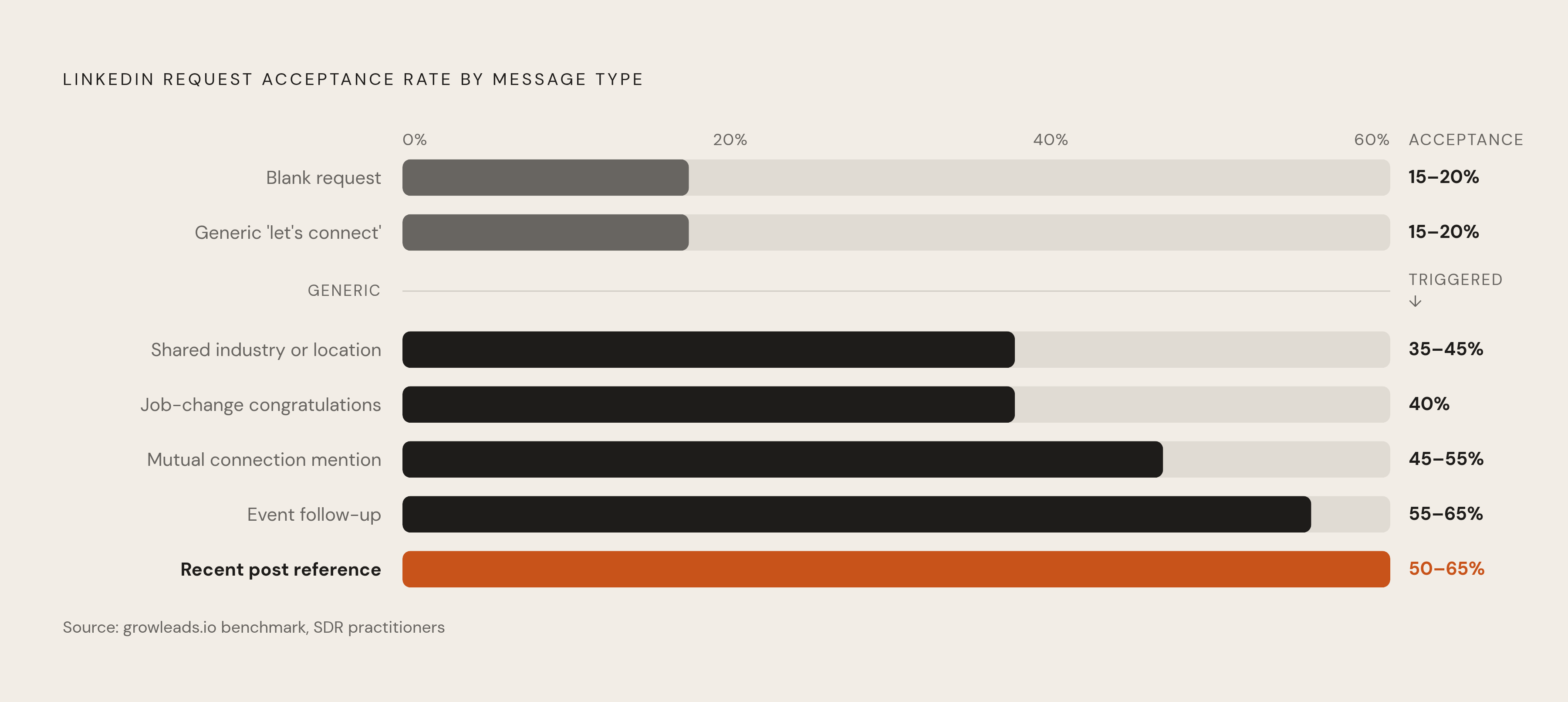
Connection acceptance rates vary sharply by message type, per community benchmarks compiled by growleads.io from SDR practitioners. A blank request with no note lands 15 to 20%. A generic "let's connect" performs about the same. Reference a shared industry or location and it jumps to 35 to 45%. Mention a mutual connection and it climbs to 45 to 55%. Connection requests referencing a recent post hit 50 to 65%. Job-change congratulations messages clear 40%, and event follow-ups run 55 to 65%.
For recruiting, the welcome DM after acceptance isn't the place to describe the role. It's the place to prove the founder actually knows this specific person and has a real reason to be in their feed. Three approaches do most of the work here: naming a specific post or idea of theirs to show you're not working off a spreadsheet, referencing mutual context (shared connections, a comment thread) and inviting their take on something you're building, or offering a small, unpublished resource tied to whatever prompted the connection in the first place, giving value before any ask ever shows up.
The best hires are usually people who weren't looking for a job. A trigger-based welcome message to someone who engaged with a founder's content, rather than a cold InMail to a stranger who's never heard of the company, starts from an entirely different footing. The connection request is the first filter. The welcome DM is the second. Neither one should be asking for a call yet.
Trigger type 3 (signal-based investor outreach)
LinkedIn hands over a layer of context before an investor reads a single word of the message: face, title, mutual connections, recent posts. Cold email can't replicate that, and for investor outreach specifically, that context layer is doing meaningful credibility work before the DM even starts.
Watch for a handful of signals. An investor comments on a post about your market or thesis. An investor likes or shares something touching on the exact problem the company solves. An investor accepts a connection request that followed a content-first approach rather than a cold ask. A fund announces new capital or a portfolio company hits news, giving a specific, real reason to reach out now.
Alore.io lays out a structure that holds up: name yourself and the company, reference something specific about their fund or a portfolio company (not "I love your work," something they'd recognize as accurate), state the one-line company description plus a real traction number, then make one narrow ask, a short intro call, not a pitch deck review disguised as a coffee chat. Timing still matters here the same way it does everywhere else: reaching out within a few days of the trigger event lifts response by roughly 32%.
A fintech founder case documented by obapr.com makes the larger point well. By building a visible personal brand through consistent posting, the founder shifted investor conversations from "convince me this works" to "tell me how I get in." The DM itself didn't change much, the brand behind it did all the groundwork, and the fundraise reportedly went from a roughly six-month slog down to about eight weeks. The lesson generalizes: the DM is the last mile of fundraising, not the whole trip. A founder with zero content history sending the exact same investor script as a founder with a real posting track record is going to see very different reply rates on identical words.
Trigger type 4 (re-engaging a warm signal that went quiet)
A like without a comment is a weaker signal than a comment, sure, but it's still stronger than cold silence. It opens a door quietly, without requiring the founder to invent a reason to reach out.
Worth mining for this: someone who commented three to six months ago and never got a follow-up. A connection who just changed jobs or got promoted (job-change congratulations messages hit 50 to 60% acceptance per growleads.io). Someone who registered for a webinar or grabbed a resource but never turned into an actual conversation. A prospect who replied warmly to a DM once, then the thread just died of natural causes.
The re-engagement message shouldn't pretend no time passed. Something as simple as "it's been a while since we connected over X" reads as more honest than acting like the conversation is fresh, and honesty here performs better than the pretend-continuity approach. Morgan J Ingram, Creative Advisor at Cognism and founder of AMP, describes a specific tactic for webinar no-shows (via kaspr.io): send a short video walking through the event page's key points, name one concrete benefit, and make a soft offer to talk further. It treats the registration itself as a real signal of intent, even without anyone showing up to the actual event.
Most founders are sitting on a backlog of these warm signals they never followed up on. Re-engaging them costs nothing and converts meaningfully better than chasing a brand-new cold list, if for no other reason than these people already know the founder exists.
What a multi-touch sequence looks like when DMs are the spine
Overloop.com's data shows combined LinkedIn-plus-email sequences producing 3 to 4x the reply rate of either channel alone, with 40% more booked meetings. Neither channel does this alone. Together, they compound.
Overloop.com's research points to a multi-touch sequence that alternates LinkedIn and email touchpoints across a few weeks — a personalized connection request, a follow-up email that references the LinkedIn touch so it doesn't read cold at all, a DM once the connection is accepted, and a final email closing the loop.
The DM's job in this sequence isn't to close anything. It's to build up enough context that by the time the email lands, it doesn't feel like it came out of nowhere. The channel-switching is the actual mechanism at work, not a gimmick. Salescaptain.io found that profile engagement before a DM, likes, comments, a profile visit, measurably lifts reply rates, with combined profile-visit-plus-message sequences hitting 11.87% reply rates against a lower cold baseline.
Every touchpoint in the sequence should reference the one before it. Not as a nagging follow-up ("just bumping this!"), but as one continuous thread that reads like genuine interest instead of a list getting worked through top to bottom. The whole thing collapses the moment it gets templated and automated without any actual personalization, at which point it's just cold outreach wearing a nicer outfit, at higher volume, annoying more people faster.
Why the content a founder posts determines how well their DMs convert
None of the four trigger types work without raw material, and the raw material is content. Martal's data puts 75 to 85% of all B2B leads generated from social media as coming from LinkedIn specifically. Personal profiles, per Refine Labs, generate 2.75x more impressions and 5x more engagement than company pages do. LinkedIn's own 2024 B2B marketing data found content shared by executives pulling 8x more engagement than the same kind of content shared from a company page.
The practical math is simple. A founder posting consistently is generating comment triggers, connection request spikes, and profile visit surges around the clock, and those are exactly the inputs the whole DM framework runs on. A founder who isn't posting has no triggers to work with, which means falling back to cold outreach by default, and cold outreach converts at a fraction of the rate, every single time, regardless of how well the message itself is written. The DM script was never really the bottleneck. The content feeding it was.
Sources
- LinkedIn DM Templates: 14 Scripts That Convert in 2026 | Saylink
- Best LinkedIn Messaging Examples & Strategies That Work in 2025 | Alore
- 9 LinkedIn Message Examples: Templates For SDRs
- 7 LinkedIn Connection Scripts That Get Accepted
- LinkedIn vs Email for B2B Outreach
- Outbound Sales Benchmarks 2026
- obapr.com
- salescaptain.io