LinkedIn Growth Strategy for Founders in 2026
LinkedIn's algorithm now rewards profile alignment and saves over hooks and posting cadence.

Most founders using LinkedIn right now are optimising for the wrong thing. They're chasing hooks and posting cadence while the platform quietly rebuilt its entire distribution engine underneath them. Tactics that worked in 2023 now actively suppress your reach. The gap between founders who understand the new mechanics and those still running old playbooks is widening every month.
LinkedIn replaced its old keyword-matching infrastructure with a system called 360Brew. It no longer scans for keywords. It reads meaning, intent, and topical relevance. More importantly, it cross-references your post against your profile. If your profile says growth marketer but you keep posting about enterprise SaaS architecture, the system reads that as inconsistency and throttles your distribution. Profile alignment with posting topic is now a content strategy decision, not a once-a-year housekeeping task. Fix the profile first. Then build the content strategy.
The second shift is how feeds get populated. Only about 31% of the average LinkedIn feed comes from first-degree connections. Another quarter comes from second and third-degree connections. The rest is algorithmically surfaced content from people the reader has never followed. LinkedIn is drifting from a relationship graph toward an interest graph. For founders, that's actually good news: you don't need a massive existing network to reach buyers. But your content has to earn its distribution. Nothing gets handed out by default anymore.
The reach reality
Here's a number that looks alarming until you understand the context. Analysis of nearly 400,000 posts in Q1 2026 showed median impressions were down significantly from the peak in Q3 2023. That sounds like a platform in decline. It isn't. Between Q4 2025 and Q1 2026, impressions dropped only about 2%. The floor has stabilised.
What's actually happening is concentration. The top posts achieve dramatically higher reach than the median. The bottom 80% of posts from average creators generate only a tiny fraction of total impressions. Average reach has permanently reset lower, but average engagement is up. LinkedIn isn't dying. It's sorting. And what it's sorting for is now knowable.
The five signals that actually move the needle
Stop guessing. These are the mechanics worth internalising.
Dwell time. Posts read for at least 15 seconds get a meaningful reach bonus. Your first three visible lines have one job: make someone stop scrolling. The functional sweet spot for length is 800 to 1,500 characters with genuine takeaway value. Not padding. Actual substance.
Saves. This is the strongest quality signal on the platform. When someone bookmarks your post, LinkedIn interprets it as reference-worthy content and pushes it wider. The practical implication: create frameworks and step-by-step methods rather than opinion pieces that age out in 48 hours.
The Golden Hour. When you publish, LinkedIn shows your content to a small slice of your active followers for the first 60 to 90 minutes. That sample's response determines whether the algorithm pushes it further. This window is not optional. Think of it like a job interview where you only get one shot to make the panel lean forward — miss it, and the opportunity walks out the door.
Who engages, not how many. Ten SaaS founders engaging with your post signals topical relevance to that sector. Fifty unqualified engagements confuse the algorithm and actively throttle reach. Quality of audience matters more than volume of reactions.
External links in the post body. Putting a link directly in your post costs you a significant chunk of your reach. Put the link in the first comment. Every time. No exceptions.
One more thing on hashtags: posts without hashtags now outperform posts with hashtags. The algorithm reads your full post copy and your engagement history to determine relevance. Topic Authority has replaced hashtag classification. Let it do its job.
Which Content Formats Are Winning in 2026 and the Posting Cadence That Sustains Reach Without Burning Out
Most founders are badly misallocating their time here, and it's entirely understandable. The received wisdom floating around LinkedIn advice circles is about two years out of date.
The format hierarchy
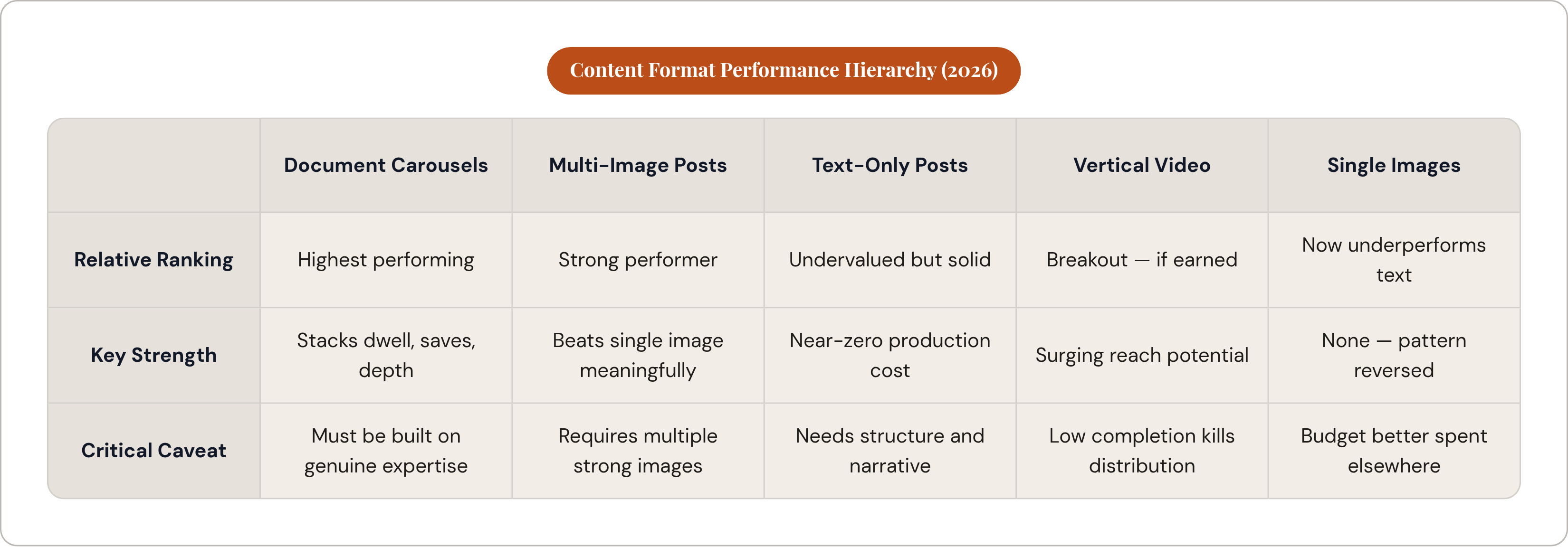
Document posts (PDF carousels) are the highest-performing format on the platform right now. They stack dwell time, save behaviour, and visual depth all in one post. A well-built carousel on a topic you actually know cold is the single most efficient piece of content a founder can produce.
Multi-image posts also outperform single images by a meaningful margin.
Single-image posts now underperform text-only content. This is a direct reversal of 2024 and 2025 patterns. If you've been paying a designer to produce polished static images for LinkedIn posts, you've been spending real money to get worse results. That budget belongs somewhere else.
Text-only posts are massively undervalued relative to their production cost, which is basically zero.
Standard text without structure or narrative is the format floor. It struggles to break through regardless of topic.
The vertical video exception
Vertical video reach has grown substantially. That's a genuine breakout signal. But here's the catch: video usage surged while overall video reach declined at the same time, because completion rates are low and the algorithm penalises content people don't finish. A poorly structured video destroys its own distribution.
A 30 to 90 second native vertical video with captions (80% of users watch without sound) can outperform everything else on the platform. But only if it earns the watch-through. The execution bar is higher than it looks. And never embed a YouTube link. Always upload natively.
The LinkedIn Stories window
LinkedIn quietly relaunched Stories in 2026. Most founders missed it entirely. The ones who didn't are accessing reach levels the rest of the platform can't touch yet. Three content types that work: behind-the-scenes process, in-the-moment decisions, and talking through a real customer objection. This is an early-mover window. It won't stay open forever, but right now it's wide open.
Cadence and timing
The sweet spot is two to five posts per week. Daily posting causes posts to cannibalize each other's visibility. That's a mechanical LinkedIn constraint, not a soft preference. More importantly, forcing daily output produces filler. Platitudes. Generic advice. And filler actively undermines Topic Authority by diluting what the algorithm associates your account with.
The goal of consistent posting is simple: your name appearing reliably in the feeds of prospects, board members, and candidates, whether they engage on any given day or not. Presence without noise.
Timing matters. Publish during decision-maker planning windows: 8 AM EST, Tuesday through Thursday.
The other half of publishing is the engagement block. Actively responding to early comments and engaging with relevant posts in the first 60 to 90 minutes after you publish. Agencies that auto-publish and walk away sacrifice a significant portion of potential reach every single time. That should make you wince.
The AI Content Flood and Why Authentic Founder Voice Is Now a Genuine Competitive Moat
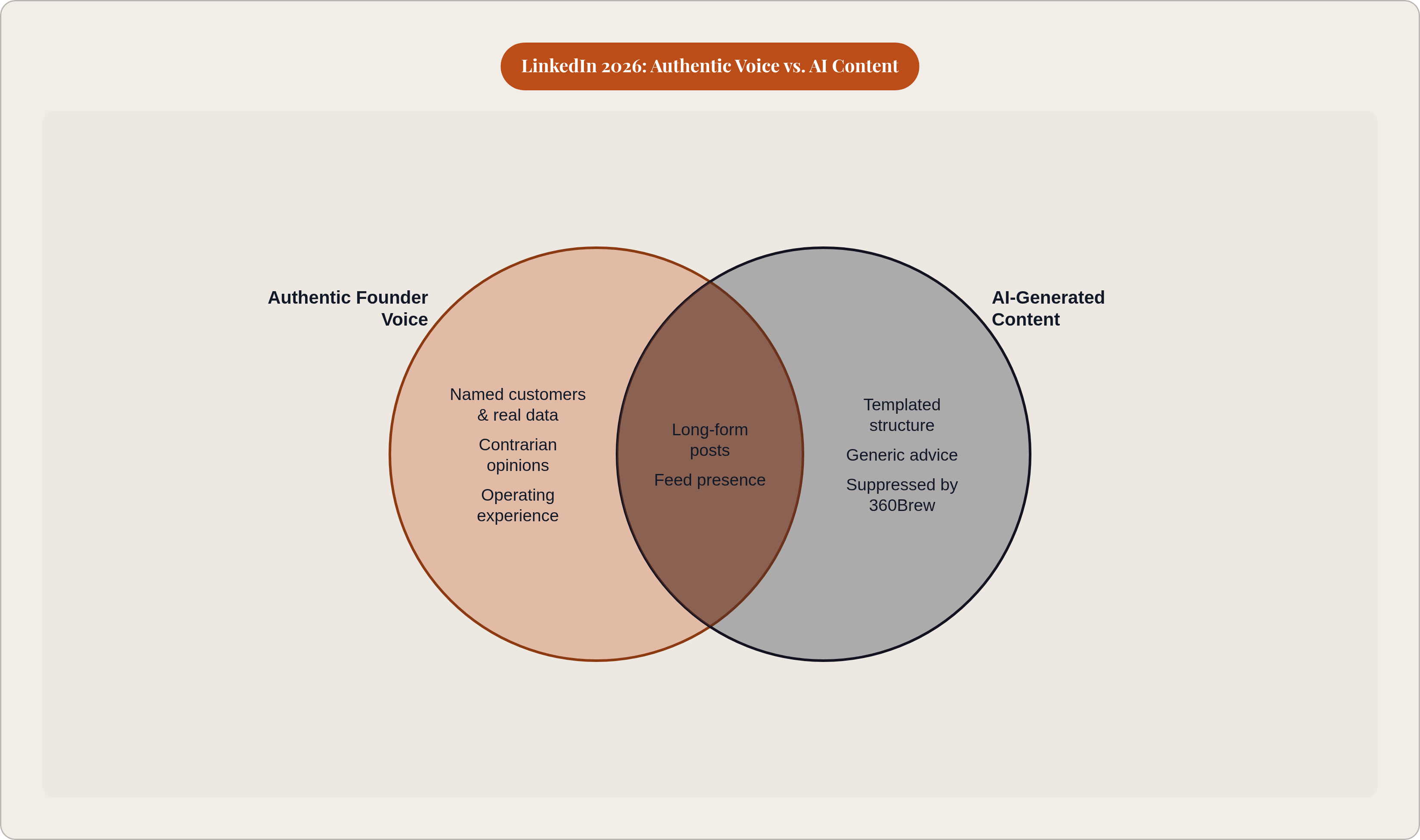
A majority of long-form LinkedIn posts in 2026 are AI-generated. AI comments have surged. The feed has become a wall of generic, templated content that sounds like it was written by the same ghostly committee regardless of industry or topic. The bar for standing out has paradoxically dropped because most content is mediocre. This is genuinely good news for founders willing to say something real.
What "authentic voice" actually means
Not warmth. Not personality quirks. Specificity.
- Named customers, with real numbers from your own company
- Decisions that didn't go as planned, and what you actually learned from them
- A contrarian opinion with a reasoned argument behind it, not a motivational statement dressed up as insight
- Industry analysis grounded in operating experience, not five aggregated takes from posts you read that morning
The 360Brew system reinforces this. It reads meaning and intent. AI-generated content that mimics structure without substance doesn't fool the relevance signals. The algorithm has gotten better at detecting thin content faster than most people realise. You can feel clever outsourcing your thinking to a tool and still end up suppressed.
The company page comparison sharpens the point. Personal profiles generate dramatically more engagement than company pages. Company pages represent a tiny fraction of user feeds. A corporate voice, whether AI-generated or human-written in brand tone, is exactly the wrong register for LinkedIn's 2026 feed.
The three-pillar content mix
Industry content (roughly 60% of output). Market breakdowns, trend analysis, contrarian takes grounded in what you actually see operating in the space. This establishes you as a domain authority, not just a product promoter.
Actionable content (roughly 30%). How-to frameworks, step-by-step methods, PDF carousels built from tools your team is already using internally. These drive saves and shares, which are the strongest algorithmic signals.
Product and company content (maximum 10%). Nobody follows a billboard. Enterprise buyers follow founders who teach them something. When you do post about your product, it lands because you've earned the attention first.
The trust dimension here is real. Research consistently shows that the overwhelming majority of business decision-makers trust companies more when leadership is visible and specific about their thinking. Founder visibility is not a vanity metric. It is a prerequisite for trust at scale.
How a Founder's LinkedIn Presence Shortens Sales Cycles, Accelerates Fundraising, and Attracts Better Talent
Lead generation
The inbound shift is real and structural. A large majority of B2B decision-makers ignore cold direct messages in 2026. Outbound as a primary channel is broken at the architecture level, not just the execution level.
Here's what actually replaces it. A SaaS founder we've tracked attributed millions in enterprise deals to LinkedIn content. Prospects mentioned his specific posts during discovery calls, after following him for three to six months before booking a demo. His sales cycle shortened significantly versus cold outbound. The mechanism is straightforward once you see it: prospects who have been consuming your content for months enter the sales conversation already trusting your methodology. Discovery calls become confirmations, not introductions. You're establishing credibility before the meeting even begins. They already believe it. The meeting is almost a formality, like a job interview where both parties already know how it ends.
Fundraising
Building a brand through LinkedIn requires 12 to 24 months to create meaningful fundraising impact. Founders who wait until they need a round to start have already lost the window. This is the most common and most expensive LinkedIn mistake founders make, and it's completely avoidable.
A fintech founder who built her personal brand through consistent industry content shifted her Series A conversations from "convince me this works" to "tell me how I can invest." Her fundraising timeline compressed dramatically.
The deeper mechanism: investors who have watched a founder operate publicly, making decisions transparently and communicating clearly under pressure, have been evaluating that person's leadership judgment for months before the first pitch. The pitch is not a first impression. It's a confirmation of something they already believe. There's also a valuation dimension. The same company is worth more with better storytelling, because investors need to understand the vision before they can price it accurately.
Talent
The candidate who applies because they've been following you for six months already understands your company's thinking, your operating philosophy, and what it actually looks like to work there. You don't have to sell them on the vision. They bought in before the interview started.
Founders who post openly about building in public create a continuous signal to top-tier talent. Without a recruitment ad. Without a recruitment budget. The LinkedIn and Ipsos Influence report adds a useful layer: expert endorsements are significantly more likely to give a brand the edge over a competitor compared to written content from the company itself. That's founder visibility doing work that no job posting can replicate.
What Systematic LinkedIn Execution Looks Like for a Founder Who Has No Time to Spare
You don't have unlimited hours. Neither does anyone worth benchmarking against. Here's what this looks like at the operational level.
The profile as landing page
Before any content strategy matters, your profile has to do its job. In 2026, a founder's LinkedIn profile is the first place investors look to gauge leadership and a primary destination for top-tier talent deciding whether to apply. It is not a résumé.
The 360Brew profile-content alignment requirement makes this mechanical. A profile that doesn't match what you post about actively suppresses your distribution.
The practical elements:
- Headline positioned for your intended audience (buyer, investor, recruit), not a job title
- Featured section used as a conversion path, not a trophy case
- About section written as a strategic narrative, not a biographical summary
The batch-and-publish operating model
One structured monthly session to extract themes from your actual operating experience. Decisions made. Metrics hit or missed. Real conversations with customers and candidates. This is where the content lives. Your job is to surface it, not invent it.
One weekly session of 30 to 60 minutes to shape those themes into posts. Carousels drafted from frameworks you're already using internally. Text posts built from real conversations you had this week. The content that performs best (specific data, real experience, original perspectives) is only available from you. The bottleneck is extraction, not production.
The engagement block
Fifteen to 20 minutes after publishing. Respond to early comments. Engage meaningfully with relevant posts in the same topic area. This is how you activate the Golden Hour. Skip this and you are leaving the majority of your potential reach on the table every single time you post.
Where ghostwriting fits
The LinkedIn ghostwriting market has grown substantially since 2024, driven by founders realising that organic LinkedIn content outperforms paid ads for B2B pipeline. A meaningful share of funded startup founders now use some form of ghostwriting service.
The ghostwriter's actual function in 2026 is extracting your voice and structuring it into formats that earn algorithmic distribution. The raw material still comes from you. Your calls. Your decisions. Your data. Your opinions formed from operating experience. The ghostwriter turns that raw material into posts. The voice has to be genuine or the 360Brew system will treat it as thin content and suppress it.
The founder who wins on LinkedIn in 2026 is not the one with the most followers or the cleverest hooks. It's the one who shows up consistently, talks about things they actually know, and doesn't mistake motion for strategy. In other words: on LinkedIn, consistency isn't just a virtue — it's the whole game, and most founders are still reading the wrong rulebook.