LinkedIn Organic Growth Strategy Without Paid Ads

LinkedIn has over a billion users. About 1% of them post anything in a given week. That tiny group generates around 9 billion impressions per week. Sit with that ratio for a second.
The platform should be a gold rush for anyone willing to actually show up. But it feels noisy. How can something feel so crowded and still be so underserved?
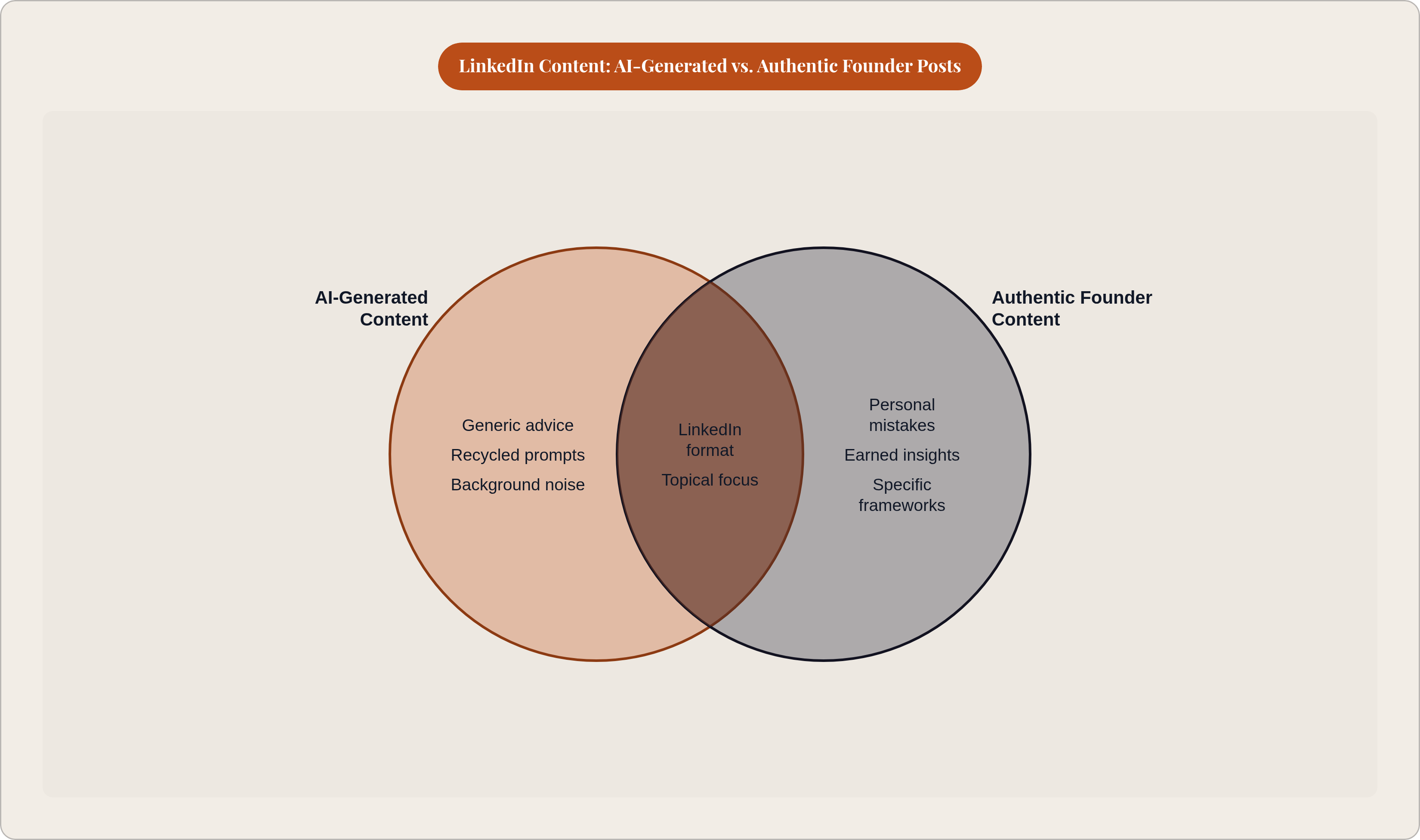
Here is the honest answer: most of what looks like content is not really content. A large and growing chunk of what fills the LinkedIn feed in 2026 is AI-generated text shaped by the same dozen prompts, recycled through thousands of accounts. It is furniture. Background noise the eye learns to skip before the brain even registers it.
What actually got scarce is a specific human perspective. The post that could only have come from one person, because it describes something that actually happened to them. A mistake they made. A belief they changed. A pattern they kept seeing until it finally meant something. When that shows up, people stop. The algorithm stops. It stands out not because it is better-produced but because it is recognizably real.
So when a founder posts with that kind of specificity, they are not competing against a billion accounts. They are competing against a much smaller group of people who are actually writing from experience. That gap is the opportunity — wide open, and most founders have not walked through it yet. Think of it like an uncrowded highway at rush hour: the road exists, the on-ramp is right there, and most people are still stuck in traffic one exit back.
How LinkedIn's Algorithm Actually Decides Who Sees Your Posts in 2026
LinkedIn's 360Brew AI model changed things quietly enough that most people posting today are still playing by the old rules.
The first thing the algorithm does, before it even measures engagement, is check whether your post topic matches your professional background and your previous content. Post consistently about enterprise sales, and the system builds a clear picture of what you are about. Post about something unrelated, and it treats the content as noise from an unverified source. Topical consistency is not just personal branding advice. It is literally the entry condition for distribution.
After you post, here is what happens:
- A small slice of your connections sees it first, somewhere around 6 to 8 percent
- Engagement in the first hour determines whether it gets pushed wider
- The algorithm watches how long people actually pause on the post before scrolling past, not whether they liked it
- Substantive comments carry far more algorithmic weight than likes
That last point matters more than most people realize. One thoughtful comment from a relevant person does more for a post's distribution than a pile of reactions. The system is reading for genuine engagement, not volume.
The hook, meaning the first line or two, is not a stylistic nice-to-have. It is the entire game. Someone scrolls past quickly, the post is effectively done. Someone stops, the post gets a second chance at a wider audience. No meaningful middle ground exists, which is why the opening line deserves more attention than anything else in the post.
The window right after posting is also when founders need to actually be present. Responding to early comments, keeping the conversation alive. Not extra credit. That is how the system decides whether to push content to the next distribution tier.
Building the Profile as a Conversion Surface Before Writing a Single Post
Here is something that happens constantly. A founder writes something good. It gets traction. Someone clicks the name on the post and lands on a profile that says "CEO at Company," headshot from five years ago, blank about section. The traffic arrived. There was nowhere to go. A profile like that is like a storefront with a lit sign but a locked door — people showed up, looked around, and left.
The profile is not a resume. It is a landing page. And it needs to actually work before you start sending people to it.
The headline is the highest-leverage piece of real estate on the whole profile because it shows up everywhere: search results, comments, connection requests, anywhere your name appears on the platform. "CEO at Company" communicates a title. "Helping B2B founders build pipeline through content that compounds" communicates what you do for people. That is a different thing entirely.
The featured section is where most profiles quietly waste their best shot at converting visitors. Founders drop in a press hit or a conference photo. What should be there is a direct path to something. A lead magnet, a newsletter, a booking link. Whatever makes sense as a next step for someone who just read your content and wants more.
The about section should read like a person wrote it, because the whole point is that a person with a specific view of the world wrote it. A list of past roles accomplishes nothing. A perspective does. Why this market, why now, what you see that others are missing.
There is also a less obvious reason to get the profile right before you ever post. The algorithm uses profile depth as a credibility signal when deciding how far to distribute your content. A thin profile can suppress reach regardless of how good the post is. The profile is doing two jobs at once: converting the humans who land on it and signaling legitimacy to the system that decides whether they get there at all.
What to Post: The Content Types and Topics That Build Topical Authority
The algorithm does not reward variety. It rewards coherence. Posting across scattered topics dilutes the authority signal the system is building for your account. Two or three clear content pillars, posted consistently, compound into something. Ten loosely related topics compound into nothing anyone can recognize.
The formats that have been working well heading into 2026:
- Native document carousels. Each swipe registers as engagement, and the format lets you actually develop an idea across slides instead of cramming everything into a text block.
- Text posts. Still the most natural format for founder voice. No production overhead. Just the thinking, written out.
- Video. Particularly effective when personality and domain knowledge need to come through at the same time.
External links are notably absent from that list. LinkedIn pushes native content because native content keeps people on the platform. Posting a link to a blog and expecting reach is working against the distribution mechanics.
What actually performs well, regardless of format:
- Insights drawn directly from experience. Not general observations. Specific things you saw happen.
- Frameworks you developed from actually operating in the space.
- Honest accounts of being wrong and what changed because of it.
- Anything that clearly could not have been written by anyone else.
What underperforms, reliably:
- Generic advice that applies to everyone and therefore speaks to no one
- Shared news without a genuine take
- Posts that read like they came from a template
One thing worth saying plainly: narrow content consistently outperforms broad content on LinkedIn. The more precisely a post speaks to a defined audience, the higher the engagement rate within that group, and the algorithm uses that signal to push the post to more of the same people. Being specific is not narrowing your reach. It is exactly how you build it.
Posting Rhythm and the Mechanics of Building Compounding Momentum
Three to five posts per week is the target. Enough to build algorithmic momentum, not so much that the founder burns out or the audience starts tuning out.
Tuesday through Thursday, morning and late afternoon in whatever time zone most of your audience lives in, produces the best results. No magic to those windows. They simply reflect when professionals are on the platform and actually engaging.
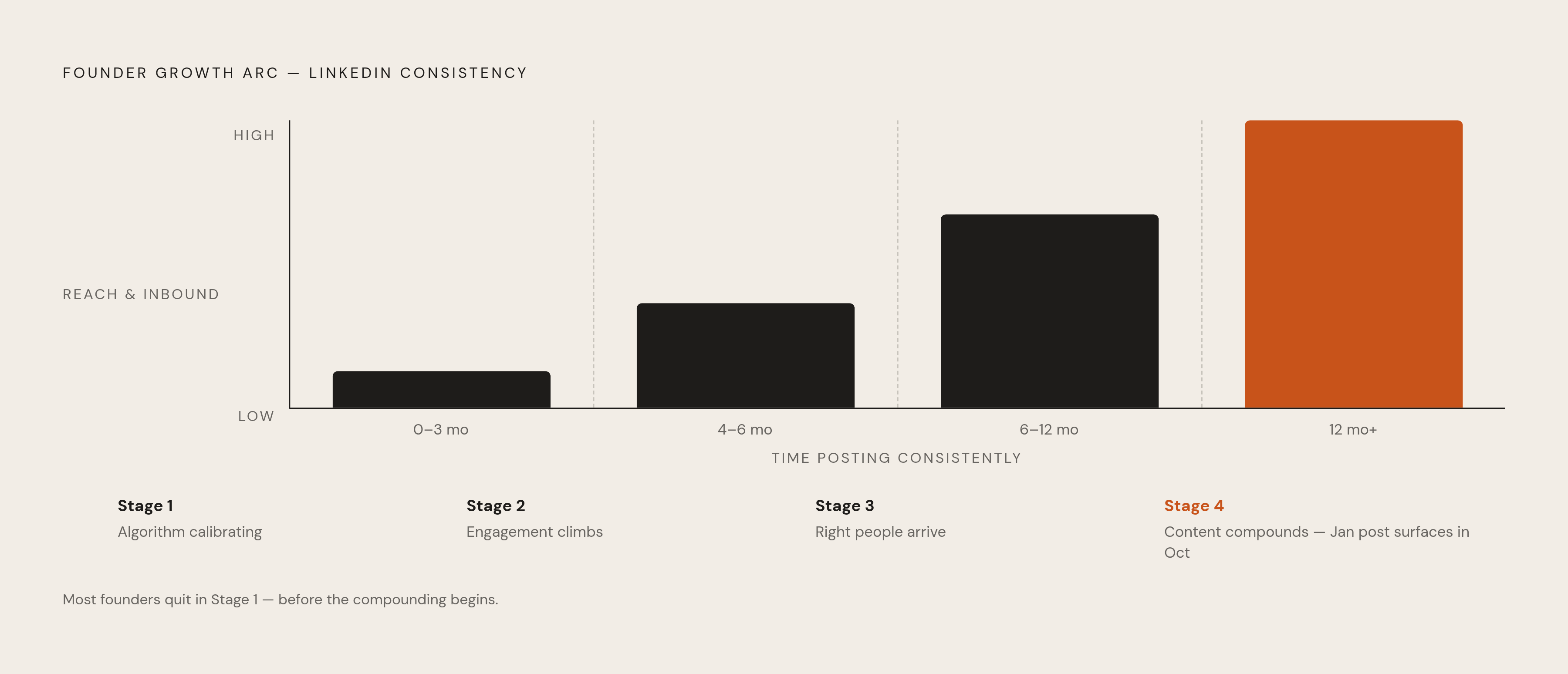
Here is the part founders need to hear before they start: the first 90 days are slow. Not discouraging, just genuinely slow. The algorithm is still learning what you are about. The audience is small. Most posts will land quietly. That is not failure. That is the cost of entry, and everybody pays it.
The arc over time looks like this:
- First 90 days. Modest reach, small audience, algorithm still calibrating. The job is to keep going.
- Months four through six. Engagement rates climb. Inbound connections from relevant people start appearing. The authority signal is taking shape.
- Six to twelve months. Consistent posting at that frequency starts producing visible results: inbound from the right people, follower growth that actually means something, conversations that come from the content rather than cold outreach.
- Beyond that. A post published today can surface in search results and generate inbound 18 months from now. The content library does not stop working just because you moved on to writing the next thing.
That last point is the one that takes the longest to internalize. A post you wrote in January can bring someone into your orbit in October, and you will have completely forgotten you wrote it. The founders who benefit most from LinkedIn organic are the ones who built the system before they urgently needed it. By the time a fundraise opened, the compounding had already been running.
Engagement is also part of the system, not a bonus activity. Responding during that first hour after posting, leaving real comments on other people's content, sending targeted connection requests. These behaviors feed the distribution mechanics directly. Optional is the wrong word for them.
The Founder Story as the Content That Compounds Fastest
The single biggest shift a founder can make in their content approach is this: stop posting about the company, and start posting about what building the company has taught you.
"We launched X today" is company news. Almost no one outside your immediate team cares about company news, and honestly even some people inside your team are going to scroll past it. But "Here is what launching X taught me about Y that I had completely wrong" is a story. The company becomes the context. The founder's thinking becomes the actual content. Those are two very different things in terms of who stops to read them.
Two narrative structures that work well for founders:
Hero's Journey. External challenge, transformation, earned insight. Works well for origin stories and pivot posts. Takes the reader through an arc with a lesson they can actually apply.
Epiphany Bridge. The moment a belief changed. Works well for market thesis posts and contrarian takes. "I used to think X. Then I saw Y. Now I believe Z." Simple, credible, readable in under two minutes.
There is also a longer-game concept worth naming. A body of consistent, specific storytelling accumulates credibility over time that no single post can create. Investors and candidates and customers often do not just read the latest post. They scroll back. They are looking for a coherent worldview, not a highlights reel. The archive either confirms that this person has a clear and consistent perspective on their market, or it raises questions.
Rally Ventures has noted that storytelling quality can affect how investors perceive a company's value. The substance of what a founder thinks, told specifically and consistently over time, is not soft content work. It is company-building work wearing a different outfit.
What wins or loses the distribution game is almost always the opening line. Not a statistic, not a rhetorical question that nobody actually asked. A specific moment or an unexpected claim. Something that makes a person genuinely want to know what comes next. That is what stops the scroll.
Why LinkedIn Organic Reach Specifically Matters for Fundraising and Hiring
A large majority of investors research founders on social media before meetings. LinkedIn is almost always the first place they look. What they are actually scanning for is not a polished profile. It is intellectual presence. Does this person understand their market? Do they attract relevant attention? Does their public thinking hold up?
Follower count is not really the signal. The signal is whether there is a coherent point of view on why the market is moving and why this person sees it clearly. A founder with 800 followers and a consistent, substantive content track record reads differently than a founder with 8,000 followers and a feed full of reposts and generic takes. That gap matters more than most founders expect.
The fundraising timing problem is real and there is no clever workaround for it. Founders who start building their LinkedIn presence when they open a round are already behind. The compounding timeline requires months of consistent posting before it produces the kind of audience and credibility that actually affects how a fundraise goes. There is no shortcut through that timeline. You just have to have started earlier.
When the time does come to post about a raise, framing matters. A post that signals a competitive process with a clear timeline reads differently than an open-door announcement. Social proof and urgency signal momentum. An open invitation can accidentally signal the opposite.
Hiring follows the same logic from a different angle. Candidates research founder profiles during their decision process. A founder with a visible, substantive LinkedIn presence signals someone who has a clear perspective on where the company is going. A blank or generic profile leaves a different impression, and people make that inference fast whether they mean to or not.
LinkedIn also consistently outperforms other social platforms for B2B lead generation, and the audience composition is a big reason why. Four out of five members on the platform influence business decisions. That makes it the one channel where a founder's organic presence can do useful work across sales, hiring, and investor relations simultaneously. No other single platform does all three of those jobs at once.
When Ghostwriting Fits the Organic Growth Strategy and What to Look for in the Process
Posting three to five times a week, at the level of voice-specificity and strategic consistency that actually produces results, is a real content operation. Most founders are also running actual companies. The bandwidth problem is not a personal failing. It is just math.
Ghostwriting for founders has grown significantly since 2024, driven largely by the recognition that this gap exists. A meaningful share of funded startup founders now use some form of writing help. This is not a secret, and it is not particularly scandalous.
The ethics question comes up every time. The answer is not complicated. Op-eds from busy executives, keynote speeches at major conferences, books from well-known founders: most have had professional help somewhere in the process. Richard Branson has said as much about his own books. What makes ghostwriting legitimate is that the thinking, the experience, and the perspective belong to the founder. The ghostwriter extracts and structures the voice. They do not invent the substance. That is the line that matters.
What a strong ghostwriting engagement actually looks like:
- Real interviews to surface original thinking and specific stories, not a questionnaire you fill out once and forget about
- Voice-matching that holds up across every post, not just the first few
- Thought leadership strategy, not just post production
- Revision cycles that keep the founder genuinely in the loop
- Narrative consistency built over time, not batch-produced content that sounds like it came from three different people
What to watch out for: agencies running AI-first processes produce content that reads like it came from an AI-first process. The most common complaint founders raise in 2026 is exactly that. If the output reads like a chatbot wrote it, the ghostwriter has not solved the problem. They have just moved it slightly downstream.
When evaluating a ghostwriter or agency, ask three direct questions. Do they post content themselves, and does it perform? Can they show engagement data from existing clients rather than just follower counts? Do they have a documented process for extracting founder voice, or are they filling in a template?
On pricing: retainers for ongoing LinkedIn ghostwriting run around two thousand to eight thousand dollars per month depending on scope. The relevant comparison is not the line item in the budget. It is the cost of losing several months of compounding growth by doing it inconsistently on your own. The platform rewards consistency more than almost anything else. Starting and stopping is worse than never starting. If ghostwriting is what makes the system sustainable over twelve months, the math works out.