Best Times to Post on LinkedIn for Executive Accounts
Executives check LinkedIn on a different schedule than average users do.

Generic LinkedIn timing advice comes from mass-account averages, and executive accounts just don't behave like the average account. The pattern holds up consistently enough to trust over the chart. Sprout Social's benchmark data covers nearly 2 billion engagements across 307,000 profiles, which sounds like gospel until you ask who's actually sitting in that sample.
The sample spans a wide mix of account types, while founders, investors squeezing in a scroll between board meetings, and enterprise buyers deciding who to call back are likely thin on the ground. Those averages tell you when LinkedIn as a whole is loudest, a different question from when the ten people you actually need to reach are paying attention. Mix up those two questions and your timing strategy optimizes for a crowd you never wanted to talk to in the first place.
The platform context that makes executive timing decisions higher-stakes
LinkedIn has hundreds of millions of registered members, but only a fraction show up in a given month, meaning roughly one in four ever logs in. That's the real stage: a much smaller room than the billion-plus headline number that gets thrown around.
Here's what makes executive accounts worth the extra thought. Of that active slice, LinkedIn is widely cited as driving the large majority of B2B social media leads, which points to an unusually concentrated audience of people with budgets and hiring authority.
And personal profiles crush company pages. As of 2026 data, personal accounts generate eight times the engagement of company pages, and C-suite posts specifically pull five times the views and engagement of posts from other member types. So before timing even enters the conversation, a founder's personal account is already the strongest asset the business has on the platform.
Which raises the stakes on getting the post out at the right moment. A single well-placed executive post reaching the right decision-maker outperforms dozens of company page impressions landing in a void somewhere. Miss the window and the loss is real, not theoretical: one of the few genuinely high-leverage moves available just goes to waste.
That matters more now than it did a couple years back, since organic conditions have tightened across the board. Tryordinal's 2025 data, pulled from nearly 400,000 profiles, showed average visibility down 47%, engagement down 39%, follower growth down 42%. When the platform hands you less for free, the variables still in your control carry more weight than they used to, and timing's one of the few levers left.
What the major timing datasets actually agree on — and what they leave out
Three major studies, three different methods, one shared conclusion: Tuesday through Thursday wins. Sprout Social, Hootsuite's analysis of over a million posts, and Buffer's review of 4.8 million posts all land in the same neighborhood on which days matter.
Then they fall apart on the hour, and this is where it gets a little annoying. Hootsuite says peak engagement hits 8 to 9 AM on Tuesdays and Wednesdays. Sprout Social's April 2026 update points to Tuesday 11 AM to 5 PM and Wednesday 11 AM to 4 PM. Buffer's post-level breakdown finds Wednesday at 4 PM and Friday afternoons pulling the strongest numbers. They're measuring different things: reach isn't engagement rate, a daily view isn't an hourly one, and different math produces different winners.
What none of them do is split results by account type. There's no segmentation for follower size, industry, or whether the audience skews toward job seekers versus people running a P&L, and that's the actual gap. The honest read is that Tuesday through Thursday, somewhere in the 8 AM to 5 PM band in your audience's time zone, is a safe range. Inside that range, an executive account is solving a narrower problem the aggregate numbers were never built to answer.
One thing every source agrees on without a fight: weekends are dead, and overnight hours, roughly 10 PM to 5 AM, are deader still, so it's worth skipping both rather than overthinking it.
How executive schedules shape when their audience actually looks at LinkedIn
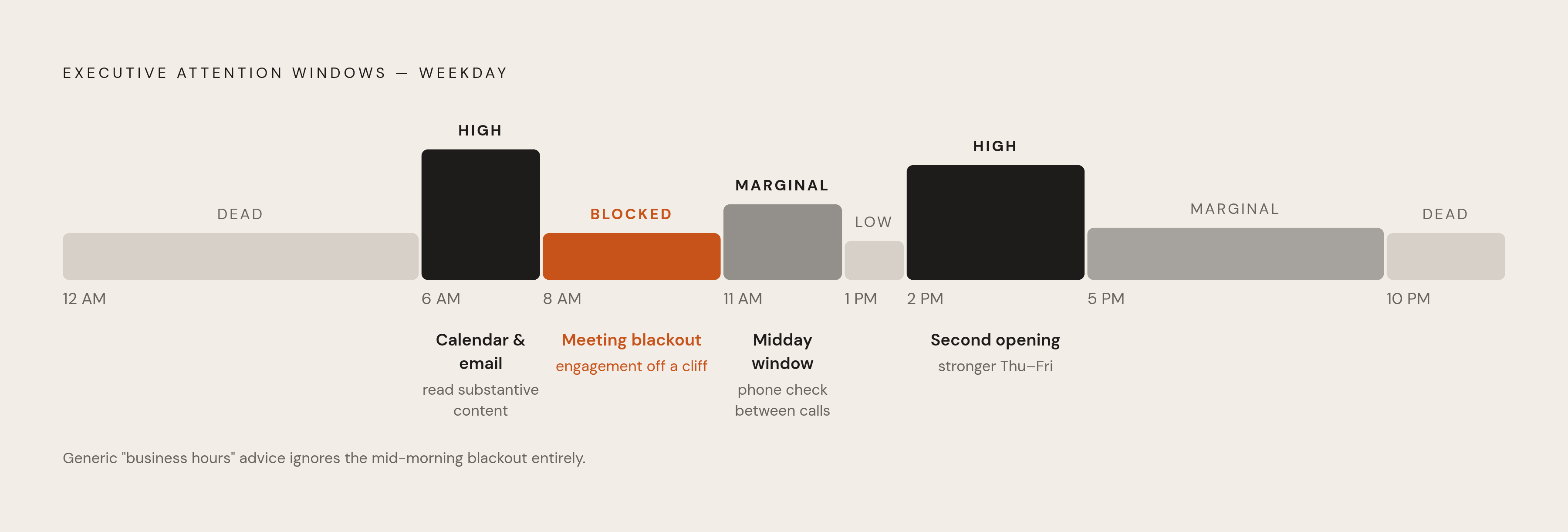
An executive's day runs on a different clock than the average user's, and it's worth mapping out, because the chart doesn't know this exists.
Early morning, 6 to 8 AM, is calendar review and email triage. Attention's still intact, the day hasn't fragmented, and this is when substantive content actually gets read instead of skimmed. Mid-morning is usually a write-off; that's deep meeting territory and engagement drops off a cliff. Midday, roughly 11 to 1, opens a short window, often just a phone check between calls. Afternoon, 2 to 5, is the second real opening, and it gets stronger Thursday and Friday as the week tips toward planning mode.
Early Tuesday morning is particularly valuable for reaching decision-makers who are mapping out the week before their calendars fill in. Decision-makers are mapping out the week then, still with bandwidth before the calendar fills in behind them.
Sunday evening deserves a myth-busting moment, because I still hear people plan around it. The idea that executives are "getting ready for the week" by scrolling LinkedIn on Sunday night doesn't hold up well against the data. Inbox prep happens; feed browsing largely doesn't. Monday has its own drag too, since early-week urgency shoves activity later in the day or off the radar completely, and attention doesn't really stabilize until Tuesday shows up.
Who you're trying to reach changes all of this. Investors move differently than enterprise procurement leads, and senior operators tend to check LinkedIn around commute windows and right before meetings, so those small pockets matter more for that audience than any generic 9-to-5 chart would suggest.
The algorithm's first-hour dynamic and why it amplifies the timing question
LinkedIn gives every post a trial run, and the first hour or so after publishing is widely understood to play a significant role in how far it travels. Strong engagement in that window earns wider distribution; weak engagement gets the post buried before most of your audience ever lays eyes on it.
That changes what "posting when your audience is online" actually means. People need to be scrolling, sure, but more specifically, the slice likely to comment fast, not just glance and keep moving, needs to be active right then. For executive accounts, that early-engaging group tends to be peers, former colleagues, people who follow closely and react quick because they're genuinely plugged into what you're doing.
This is why a genuinely strong post at 10 PM on a Thursday can flop while the identical post at 8 AM Tuesday takes off. At 10 PM, the people most likely to comment in that critical first hour simply aren't there, since they're asleep, or at least they should be.
One more wrinkle: Posting multiple times in a single day is generally understood to hurt rather than help, with later posts cutting into the first one's distribution, so spacing posts well apart is worth the discipline. Stack them and the first one smothers the second before it gets a fair look.
A practical posting cadence built around how founders actually work
A consistent cadence of posts across Tuesday through Friday fits the strongest engagement days and how the algorithm rewards regularity. It covers the strongest engagement days and skips Monday's attention deficit entirely.
Tight on bandwidth? Cut to three: Tuesday, Wednesday, Thursday. That stretch shows up as the strongest window across every major dataset, so it's the safest place to concentrate effort if four a week isn't realistic.
Friday is worth including, especially for posts that invite a bit of reflection as people start mentally checking out for the weekend. If Monday posting can't be avoided, push it to early afternoon instead of morning, since engagement shows up later in the day once the week actually gets moving.
Format plays into timing too. Format is worth factoring in alongside timing, since different content types tend to land differently depending on when and how people are browsing.
Treat this cadence as a ceiling, not a floor. Steady, sustainable posting over months beats a hot week followed by three weeks of silence, because the algorithm rewards accounts it can predict. For founders working with a ghostwriter or content team, scheduling in advance to hit the exact window matters more than it does for someone posting on a whim, since a mistimed post stings more when real production time went into it.
How to find your own best window instead of trusting an industry chart
LinkedIn's own analytics, free, built into every account, are the most relevant dataset you have. They show impression curves and follower activity broken down by day and hour, specific to your actual audience instead of the platform average. Nobody ever seems to check this tab, which is a shame because it's just sitting there.
Two things worth actually looking at: the follower activity heatmap, meaning when your specific followers are online, and the timing of your posts' early comments historically. These two don't always agree, and when they don't, comment timing is the better signal, because views tell you who saw it while comments tell you who cared enough to stop scrolling.
Run a simple test over four to six weeks. Keep content quality steady, rotate posting time across three windows (early morning, mid-morning, early afternoon), and track first-hour comments per post. Whichever window pulls the fastest comments is your real peak, no matter what the industry benchmark says it should be.
Geography and industry warp the picture in ways the big studies flatten right out. A founder with a London-heavy audience runs on a different clock than one targeting West Coast operators, and a fintech founder's audience might peak earlier in the day than a creative industry executive's would. None of that shows up in an aggregate chart built from hundreds of thousands of mixed profiles.
And the picture shifts over time, since as an account grows and the follower mix changes, the ideal posting window drifts with it. Checking analytics every quarter keeps the schedule from going stale. One signal worth tracking on its own: whoever shows up first and comments on your posts, consistently, week after week. Their activity pattern maps your real community better than any industry-wide average ever could.
Why timing is a multiplier, not a foundation, and what actually drives reach
Every dataset here lands on the same caveat eventually: timing multiplies a strong post and does nothing for a weak one. Post a mediocre update at the perfect hour and it still underperforms a genuinely good post published at a mediocre one.
The current algorithm favors original insight and firsthand experience. Posts sharing something you actually lived through or figured out beat posts summarizing somebody else's take, and no amount of scheduling precision closes that gap. The first two or three lines before the "see more" cutoff carry outsized weight too; a weak opening kills a post before the algorithm even gets a chance to distribute it. Length matters in a specific way as well. Posts long enough to actually develop an idea tend to pull deeper engagement than short, thin posts, regardless of what time they go out.
Here's the trade that actually compounds: a founder posting consistently at good-but-not-perfect times with strong content beats a founder chasing the perfect hour with average content, every time, no exceptions I've seen. Consistency is the longer lever, and it's the one within reach starting today, not after some analytics team finishes crunching your numbers.
Timing's worth solving, just solve it last, after the content and the cadence are already sound. Chasing the perfect posting hour before you know what you're actually saying is like arranging furniture in a house you haven't bought yet.