LinkedIn Audio Events for Founder Community Building
LinkedIn Live now handles the community-building job Audio Events once did.
LinkedIn's December 2024 killing of native Audio Events proved less important than what happened next. That's the headline fact. What matters more for founders trying to build community on the platform is what actually happened next: the format didn't die, it moved house, and the move changed the math on production effort versus payoff in ways you should understand before you plan your next session.
How and why LinkedIn shut the format down in December 2024
The dates are specific, and LinkedIn was clear about them. December 2, 2024 was the cutoff for creating any new native Audio Event. December 31, 2024 was the last day an already-scheduled Audio Event could run as planned. And December 15 was the deadline to migrate anything happening after the final day of the year over to LinkedIn Live, or the event got pulled. Three weeks, four dates, one format retired.
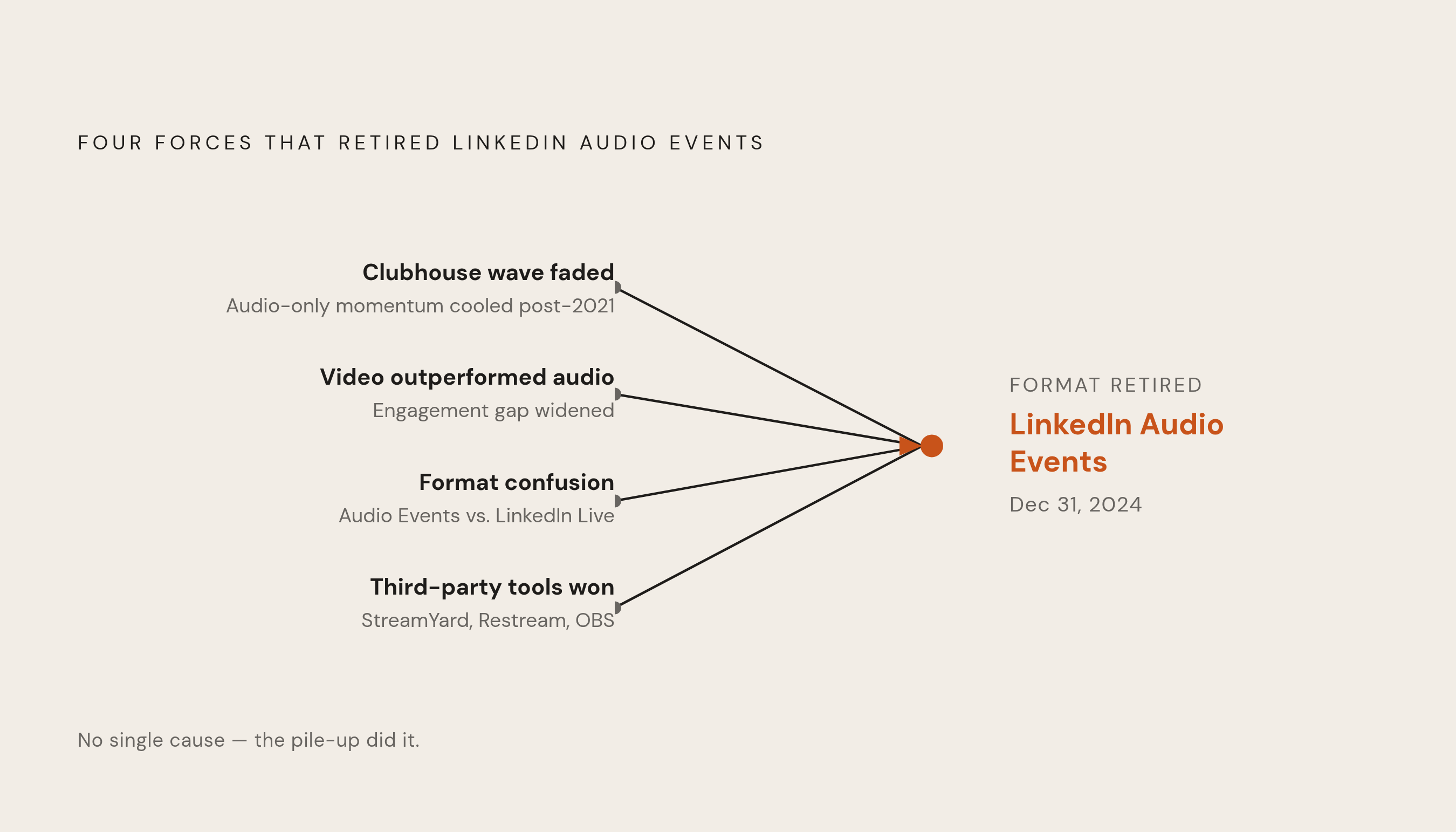
LinkedIn's official line was consolidation: fold Audio Events and LinkedIn Live into one entry point so people stop guessing which format to pick when they schedule something. That's the polite version. The blunter version involves four things happening at once.
Adoption never caught fire the way it needed to. The audio-only wave that Clubhouse rode in 2021 had already cooled by the time LinkedIn's version matured, and momentum doesn't reverse itself just because a feature launches on a bigger network. Video also just plain outperformed audio on engagement, consistently, which on a platform that tracks engagement obsessively is close to a death sentence. Add to that the fact that having two separate live formats confused users who didn't know whether to click "Audio Event" or "LinkedIn Live," and you've got a genuine user experience problem, not just a strategic one. And the final nail: tools like StreamYard, Restream, and OBS Studio already did audio-first production better than LinkedIn's native tool ever managed.
This wasn't LinkedIn acting alone, either. Meta pulled back its audio social features around the same period. X Spaces is still around but has drifted into video territory since 2024. Clubhouse, the platform that started the whole audio-room trend, pivoted in 2023 away from live rooms toward asynchronous voice messages, a much smaller footprint than its 2021 peak. LinkedIn's exit fits a pattern across the industry, the result of a broader trend rather than a rash decision made in isolation.
None of that means the community-building job Audio Events did for founders disappeared. The job stayed. The tool changed.
What transferred to LinkedIn Live (and what genuinely didn't)
Some of what moved over is a straight upgrade. LinkedIn Live auto-records everything, so replays exist natively now, solving the single biggest complaint about the old format (Audio Events left zero trace once the session ended). Engagement options expanded too: comments, reactions, the ability to throw a slide or a chart on screen mid-conversation. Discoverability through LinkedIn's event infrastructure, plus built-in analytics on who registered and how long they stuck around, all carried over intact. Branding got better as well, logos and banners are now fair game.
But some things just didn't make the trip. The old format's biggest asset was how little it asked of you: no camera, no streaming software, no static image workaround, just open the app and talk. That ease is gone. So is the psychological comfort some guests felt about not being on camera, which made them more willing to jump in spontaneously rather than agonize over lighting and backgrounds first.
Access got harder too. Audio Events asked for 150+ followers and a clean compliance record, full stop. LinkedIn Live asks for that same follower threshold, plus account approval and a third-party streaming tool sitting between you and your audience. Creator Mode used to be one optional path to trigger that eligibility check, not a hard requirement, but the overall bar sits higher now regardless of which door you walk through.
Founders who want that stripped-down, audio-only feel can still get close to it. It just means opening StreamYard, Restream, or OBS Studio and putting a static branded image in the video field instead of your face, which is a workaround, not a restoration. More setup, more moving parts, same conversational core. LinkedIn's own numbers explain the direction of travel here: live video events grew 15.3% throughout 2024. The platform picked its lane, and it's video.
How founders run audio-first LinkedIn Live sessions today
Getting set up starts with clearing the access bar: 150+ followers, account approval, and a compliant content history. Check LinkedIn's current Creator Mode requirements directly, as access conditions have continued to evolve.
From there, pick a streaming tool that matches your patience for technical setup. StreamYard runs in a browser and asks almost nothing of you technically, a solid starting point for a founder who wants to hit "go live" without reading a manual first. Restream is a popular option if you want to broadcast to multiple destinations from a single session. OBS Studio is free and about as flexible as software gets, but it comes with a learning curve that will eat an afternoon the first time you touch it.
To keep the audio-first feel alive inside a video-first tool, swap your camera feed for a static branded banner or a simple slide in the video field. The conversation still runs the way an audio event used to, LinkedIn's technical requirement just gets satisfied on the side.
Promotion matters more than most founders assume going in. Build a LinkedIn Event ahead of time, invite your connections to RSVP, and drop teasers into your regular posts and newsletter in the days before. LinkedIn's algorithm tends to extend the visibility of content that sparks real conversation, which means both the pre-event hype posts and the post-event recap can get a longer runway than most content sees.
And because LinkedIn Live sessions can be recorded for replay, repurposing becomes part of the plan, not an afterthought. Turn the replay into a podcast episode. Write it up as a newsletter recap or a LinkedIn article. Pull the best lines into a carousel post, since carousel and document posts average 24.42% engagement against 4.10% for plain text posts, a gap too large to ignore. Aim for sessions long enough to build real engagement, with 15 minutes generally cited as the practical floor before audiences can connect meaningfully.
Format ideas that fit the LinkedIn Live container and serve founder community goals
The production upgrade opens doors Audio Events couldn't. A fireside chat between a founder and a peer, an investor, or a customer still works with the camera off, but now it carries a branded frame around it instead of floating in empty audio space.
Recurring formats build their own momentum. Quarterly community meetups, open Q&A, or members sharing their own experiences work because repetition creates expectation, and people show up because they know the thing exists on a schedule. Cory Connors ran a version of this weekly, alongside co-hosts Adam Peek and Evelio Mattos, and the cadence itself became the value: a standing appointment for an industry to check in with itself. Executive roundtables with two or three peers work on the same logic, and co-hosting adds a distribution bonus, each host's audience gets the event notification, so three hosts means three networks lit up at once instead of one. A weekly CEO Insights digest, 15 to 30 minutes on a recurring theme, asks for less prep than a full production and sends a strong signal of consistency over time.
The format should track the founder's actual situation. A founder deep in a fundraising round needs a different kind of session than one focused on recruiting or building publicly, so match the content to the goal instead of running the same template regardless of what's happening in the business. And the value doesn't stop when the stream ends: attendees who feel some personal connection during a live session tend to keep engaging with the founder's regular posts afterward, which makes each event less a one-off and more fuel for the broader content engine.
Why LinkedIn remains the right platform for these sessions despite the format change
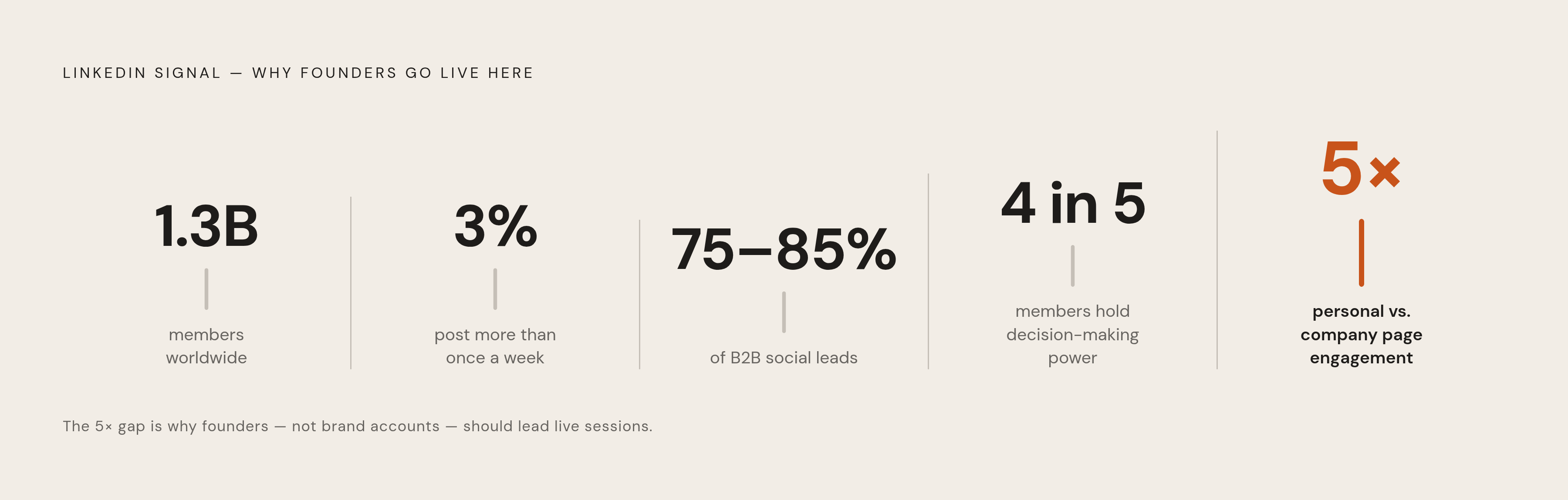
LinkedIn crossed 1.3 billion members worldwide in 2026, a professional-audience density no other platform comes close to matching. Only 3% of LinkedIn users post more than once a week, so a founder who shows up consistently for live sessions is already outpacing nearly everyone else on the platform before any strategy gets applied at all.
The business case for staying on LinkedIn specifically, rather than chasing audio elsewhere, isn't subtle. Somewhere between 75% and 85% of all B2B leads generated from social media come from LinkedIn. Personal profiles generate 2.75 times more impressions and five times more engagement than company pages, which tells founders that showing up as a person beats showing up as a logo. Four out of five LinkedIn members hold some kind of business decision-making power, so a founder's live audience isn't a general crowd, it's a room full of people who actually buy things.
LinkedIn's algorithm adds another layer of advantage for founders specifically. Posts with real semantic density and first-person specificity tend to perform better than generic content, a structural tailwind for exactly the kind of live, expert-led session this whole piece is about. And 89% of active LinkedIn event participants report career growth within twelve months, a number that suggests the platform's own users treat these events as worth their time, not background noise to scroll past.
How consistent live presence compounds into a measurable business asset
Trust is the first domino, and it falls in a measurable way. 82% of employees say they're more likely to trust their company when senior executives show up actively on social media. The Edelman-LinkedIn B2B Thought Leadership Impact Report found that 95% of decision-makers say thought leadership directly influences their purchasing decisions. LinkedIn's own B2B Buyer Report puts a number on the purchase side too: 75% of B2B buyers say a founder's thought leadership content directly shapes their buying decision.
That trust translates into deals closing faster. Founders who build public credibility through consistent content often report that fundraising conversations shift in character, with investors arriving more informed and more ready to engage. On the hiring and donor side, a stronger LinkedIn presence can open doors on the hiring and donor side that cold outreach alone rarely does.
Weber Shandwick's research puts a number on the reputation side of all this too: CEO reputation accounts for 44% of a company's market value. Live presence is one of the more direct, visible ways a founder builds that reputation in public, session by session, rather than hoping it accumulates by accident.
A newer wrinkle is emerging. Consistent publishing and live presence builds a body of indexed, attributed content that can extend a founder's reach well beyond the platform itself, a compounding return on the same steady effort.
None of this pays off on day one, though. Brand authority builds slowly, and it tends to matter most exactly when a founder needs it most, mid-raise, mid-hiring-crunch, mid-sales-cycle, which is precisely the wrong moment to start from zero. Most founders already know they should show up consistently. Knowing isn't the bottleneck. Content competes with every other fire a founder has to put out that week, and that gap between knowing and doing is where most good intentions quietly go to die.