LinkedIn Poll Strategy for Founder Audience Research
Polls reveal named audience segments and real opinions, not just vanity metrics.
LinkedIn polls get seen more than almost anything else a founder posts, and they get talked about less. A poll will show up in more feeds than a carousel or a text post, but almost nobody will do anything with it beyond tapping an option and moving on. Most founders treat that reach number as the win and stop there. They end up optimizing for a number that doesn't pay rent: impressions from people who voted once and never came back.
What LinkedIn polls can do
The poll format has one trick no other LinkedIn post can do: it hands a founder named, segmented audience data for free, with zero editing, zero design work, and zero wait time. Every other post on LinkedIn gives a founder anonymous aggregate numbers, likes, views, maybe a few comments from people willing to type in public. A poll gives a founder the actual list: who voted, and which option they picked. That's primary market research, the kind companies normally pay for through user interviews or paid surveys, except here the audience raises its hand and volunteers the data on its own.
Three uses fall straight out of that. A founder testing a new offer can ask "which of these would you actually use" and get a list of warm names to follow up with directly. A founder whose reach has gone flat can post a low-effort poll and watch LinkedIn's algorithm wake back up, because polls are built to re-trigger circulation. And a founder trying to figure out what their audience actually believes, rather than guesses they believe, gets a real distribution instead of a hunch.
None of that makes a poll a replacement for the harder work. A poll can't explain why someone voted the way they did, it can't close a deal, and it can't carry the story-driven, long-form content that actually moves a pipeline forward. A poll is the first draft of an interview guide, not the interview.
Poll design and the difference between signal and noise
Every choice built into a poll, how sharp the question is, how many options sit below it, how long it runs, whether there's a space for an open answer, decides whether the votes that come back mean anything. Get those choices wrong and a founder ends up with a pile of clicks that look like data but can't actually be used for anything.
Start with the question itself. A sharp, narrow question beats a broad one every time, because a broad question invites everyone to vote and nobody to care. A question only your specific audience has a real opinion on, something a marketer would ask other marketers, will always beat a generic question lobbed at the whole feed.
Then there's the number of options. Lea's analysis, citing a 2025 study by van der Blom of millions of posts, found that polls with three answer options perform best. Three options create just enough tension to force a real choice while keeping the list short enough for people to actually finish voting.
The most underused design choice is the "Other, comment below" option. Adding it tells voters the founder actually wants to understand their situation instead of just confirming what the founder already believed going in. It also routes the most interesting, most different answers straight into the comments, where the real "why" behind the data lives. The mistakes to avoid are just as concrete: options that overlap so voters can't tell them apart, options stacked so one obviously looks "correct," and options so vague that a vote doesn't tell the founder what to do next.
The five poll question types that produce usable founder intelligence
Different poll structures pull out different kinds of information, so the real skill is matching the question type to the decision a founder is actually trying to make.
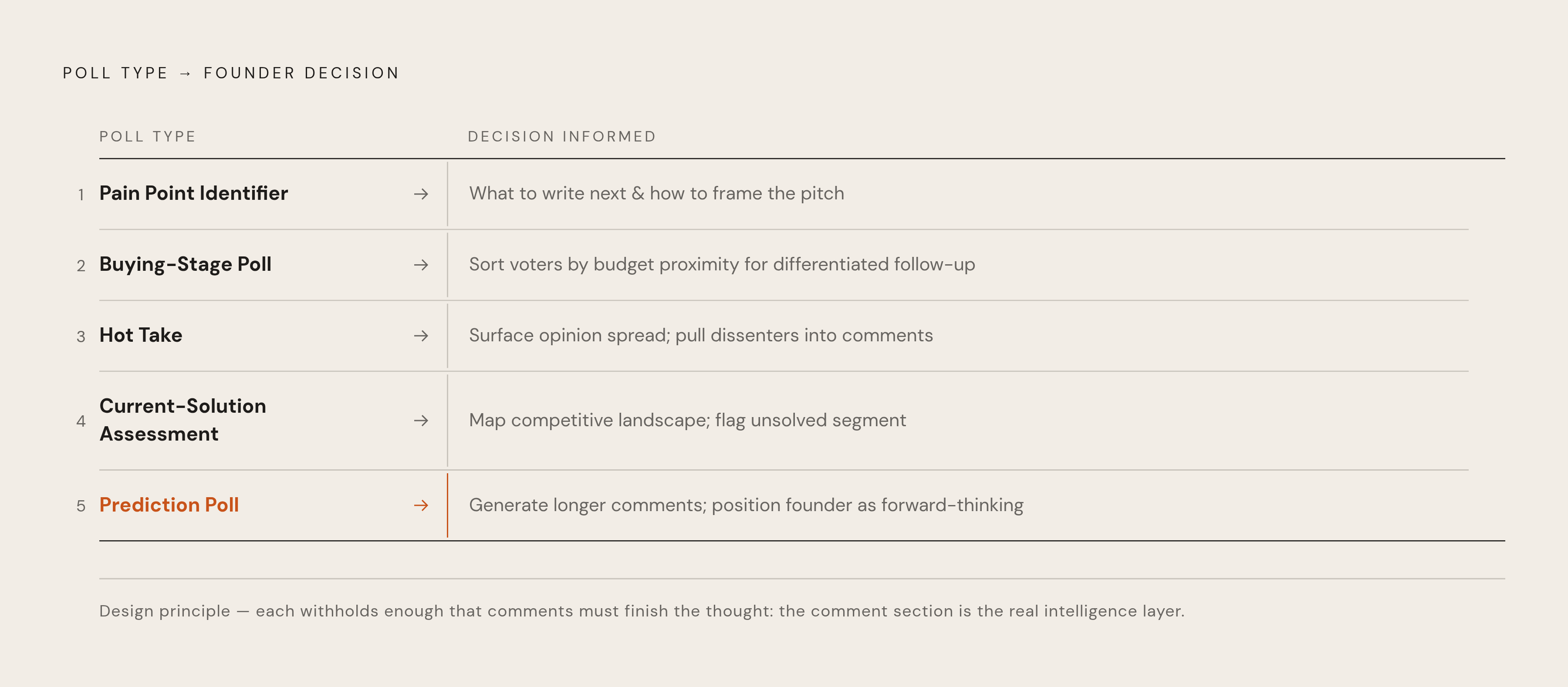
The first type is the pain point identifier: a question like "what is your biggest obstacle to [outcome] right now," with four options pulled from complaints the founder has actually heard in real conversations. The pain point identifier produces a ranked list of which problem appears most often in the votes, which tells the founder what to write next and how to frame the pitch in sales calls.
The second is the buying-stage or priority poll, something like "where are you increasing investment this year," with options that are specific and don't overlap. This sorts voters by strategic priority, and by extension, by how close they are to actually having budget, so a founder can follow up with a different message for each group.
The third is the hot take: a question like "is [specific claim] still true in 2026," built around a real debate in the founder's own niche. This shows the actual spread of opinion across the audience and, just as important, pulls the people who disagree down into the comments to argue their case. Those comments become the real data set, richer than the vote count itself.
The fourth is the current-solution assessment: "what is your primary tool or approach for [specific task]," with named competitors as options plus a "no solution yet" choice. This maps out the competitive landscape sitting inside the founder's own audience, flags the unsolved segment, and shows which adjacent products the founder is quietly being measured against.
The fifth is the prediction poll: "will [trend or behavior] still matter in a year." This invites people to defend their bet in the comments, producing longer, more thought-out replies than a simple opinion poll, and it positions the founder as someone thinking a step ahead of the news cycle.
What ties all five together is what they leave out. Each one holds something back on purpose so the comment section has to finish the thought. The vote is the door. The comment is the room where the actual intelligence sits.
Converting poll votes into a segmented prospect list
A poll's votes are raw material, not a finished product. The real intelligence comes from sorting voters by what their choice revealed about their situation and following up with something specific, instead of blasting the same message at everyone who clicked.
Because LinkedIn polls aren't anonymous, a founder can see every single voter by name alongside the option they picked, and that list is the starting point for sorting people into groups, not just a privacy footnote. A simple three-tier framework handles most of the work. Voters who picked the option that signals they're dealing with the problem right now are worth a short, personalized DM or connection request within a day or two of the vote, one that references the actual thing they voted for, while voters who picked an option that signals they're still researching or weighing the problem belong in a steady nurture sequence, kept warm through regular content rather than pushed toward a sales conversation too early. Voters who picked the option showing they're aware of the issue but not yet acting on it are worth keeping around for the long game, through ongoing content.
The comments add a layer of signal votes alone can't give. A voter who also leaves a comment has shown more engagement than one who just clicked, and is more likely to actually respond when a founder follows up. Replying to every substantive comment before the poll closes keeps the post circulating and gives the founder a natural opening to move the conversation into DMs. The poll result itself can also become its own piece of content: a founder who posts their own read of the data in the comments ("here's what surprised me about how you voted, and here's what it means for...") adds something the raw vote count doesn't have, and that often pulls in a second wave of people who missed the original post. What kills all of this is mass-messaging every single voter with a pitch the moment the poll closes.
How poll findings shape the content strategy that follows
A poll is worth the most not as a one-off post but as the opening move in a longer sequence. The votes and comments tell a founder exactly which angle, which pain point, which frame deserves the longer piece of content that actually moves people toward a decision.
The pattern runs in a straight line. A poll surfaces the biggest pain point in the audience, and the founder turns around and writes a story-driven post or carousel aimed straight at that pain, citing the poll result as proof the problem is real and shared by a lot of people, not just one unhappy customer. A poll turns up a surprising minority position, often buried in the "Other" comments, and the founder turns that friction into the hook for a hot-take post or a piece that pushes back on the consensus. A poll shows which tool or approach the audience is actually using right now, and the founder tailors advice, case studies, and offers to that real landscape.
Format rotation matters here too. Meet Lea's 2026 analysis found that cycling through carousels, text posts, video, and polls drives more follower growth and keeps an audience more engaged than leaning hard on one format. Polls earn their spot in that rotation as the research step, not the step that closes the deal.
The real payoff appears over time, as a pattern across repeated polls. A founder who runs six targeted polls across a quarter ends up with a mapped picture of their audience, pain distribution, where people sit in their buying journey, which tools they already use, and what they expect a year out. That's the kind of input that would otherwise cost real money as a research project, or take months of pattern-matching across sales calls. It's the same intelligence a founder needs before a fundraise or before opening a new role, except gathered in public, for free, a few questions at a time.
Where polls fit in a founder's content program
Polls do real work inside a content program that also includes story-driven posts, case studies, and thought leadership. Run on their own, they produce reach without any relationship attached, which is the exact problem this piece opened with.
Used well, polls do a specific set of jobs. They break a reach plateau when organic distribution has gone quiet. They generate named prospect data no other organic LinkedIn format produces. They test an angle cheaply before a founder commits time to a longer piece of content. And they show an audience that the founder is genuinely curious about their reality, which builds more trust than simply handing out advice ever does.
The founders getting the most out of LinkedIn pair polls with story-driven posts that pull from real personal experience, build-in-public updates that document actual decisions and actual results, and content that shows practitioner-level knowledge. Those are the formats that turn an audience into inbound leads, investor conversations, and strong hires.
Designing a poll strategy this way takes more upfront thought than tossing out a generic yes-or-no question. The payoff is a content program built on real audience data instead of a founder's best guess about what their market cares about. A founder's personal profile already sits in a different distribution environment than a company page, so a well-designed poll starts with an advantage before a single vote comes in. Wasting that advantage on a throwaway engagement-bait question is an expensive habit. Treated as a research habit instead of a content trick, the poll becomes something that shapes a founder's positioning, hiring messaging, and fundraising story, not just their next week of posts.