LinkedIn Posting Schedule for Founders in Multiple Time Zones
Skip the "best time" myth—post when your audience overlaps.
Founders with investors in one region, engineers in another, and customers in a third have all read the "best time to post on LinkedIn" articles. They've read three of them, in fact, and walked away with three different answers. Best time to post" assumes one clock, one time zone, one audience, which is a design flaw in the question itself. The moment a founder's network spans a single ocean, that assumption stops holding. A number built for a single region doesn't degrade gracefully when applied globally; it stops meaning anything, since the studies producing these numbers report everything in the poster's local time, which only works if the poster and the audience live in the same hour. A founder in San Francisco who follows Buffer's recommended slot of 4 p.m. PT is publishing to a London feed at midnight and a Singapore feed at 7 a.m. the next day, well outside any window where those audiences are awake and scrolling. The research isn't wrong. It was never built to answer a multi-region question, and founders have been asking it one anyway.
2026 LinkedIn Engagement Data
Strip away the differences in methodology across the major 2026 studies and three things hold up no matter which dataset gets pulled: Tuesday through Thursday beat every other day, weekends are close to dead for professional content, and Wednesday is the strongest single day across the board. Buffer found the best window runs 3 to 8 p.m. on weekdays, with Wednesday at 4 p.m. as the single strongest slot. That's a shift from 2025, when peak engagement sat entirely inside standard working hours. RecurPost found the best days are Tuesday through Thursday, with Wednesday again on top, but its best window is 10 a.m. to 2 p.m., peaking at 10 to 11 in the morning. Saturday and Sunday come in lowest by a wide margin in that same dataset. Kanbox found that late afternoon and evening posts between 5 and 10 p.m. are now performing significantly better than in past years, a shift tied to mobile usage and the blurring of work hours into personal time. PostFast found a strong morning window between 8 and 11 a.m., driven by decision-makers checking LinkedIn before their calendars fill up, and found Wednesday's lunch hour specifically outperforms lunch on every other day of the week.
None of these numbers need to be forced into agreement. The morning-versus-evening split between RecurPost and Kanbox reflects a genuine divide in the data, and trying to collapse it into one "correct" hour would throw away information. What all four datasets agree on is the band: late morning through afternoon, Tuesday to Thursday, is where engagement concentrates no matter which study is doing the measuring. Scheduling inside that band covers the outcome either study predicts, without betting the whole week on a single hour. One firm exception holds across all four sources: weekends draw dramatically lower professional activity, with one narrow carve-out for Saturday morning, where career-development and personal-branding content still finds an audience.
How LinkedIn's algorithm treats timing
LinkedIn's feed isn't a chronological ticker, and it doesn't hand out reach based on how recently something was posted. It rewards early engagement velocity, meaning how much interaction a post picks up within the first few hours of going live, and it uses that signal to decide how far to push the post beyond the original audience. That mechanic matters enormously for a founder juggling time zones, because it means a post doesn't have to launch at a region's exact peak hour to eventually reach that region. It just has to generate enough engagement, fast enough, somewhere, that the algorithm decides to keep distributing it. A post published at 7 a.m. ET lands at noon GMT, catching the American morning and the European lunch break in the same stretch. If it picks up comments and shares from the US crowd in that first window, it can still be actively circulating by the time London's afternoon scroll begins. Timing before a region's peak, in other words, can outperform timing at a region's peak, because the algorithm's evaluation window buys the post time to travel.
There's a quality dimension here too. Buffer's data suggests late-day LinkedIn activity reflects professionals winding down and reading more intentionally, engaging with peers and thought leadership. That points to higher-quality interactions per impression in the afternoon and evening window, even if raw volume is lower than during the workday. None of this works as a substitute for consistency, either. A founder who posts sporadically, even at textbook-perfect times, will lose out to a founder who posts reliably at merely decent ones, because the algorithm also weighs topic consistency and accumulated profile credibility alongside the timing of any single post.
Mapping the overlap windows: which UTC posting times reach which regions
Once timing is understood as a window rather than a single clock reading, the real question becomes which UTC slot creates usable overlap between the regions that actually matter to a given founder. For a founder with a US-only audience spanning both coasts, 9 to 11 a.m. ET does the job: it is 6 to 8 a.m. PT for early scrollers on the West Coast and hits peak hours for the East Coast at the same time.
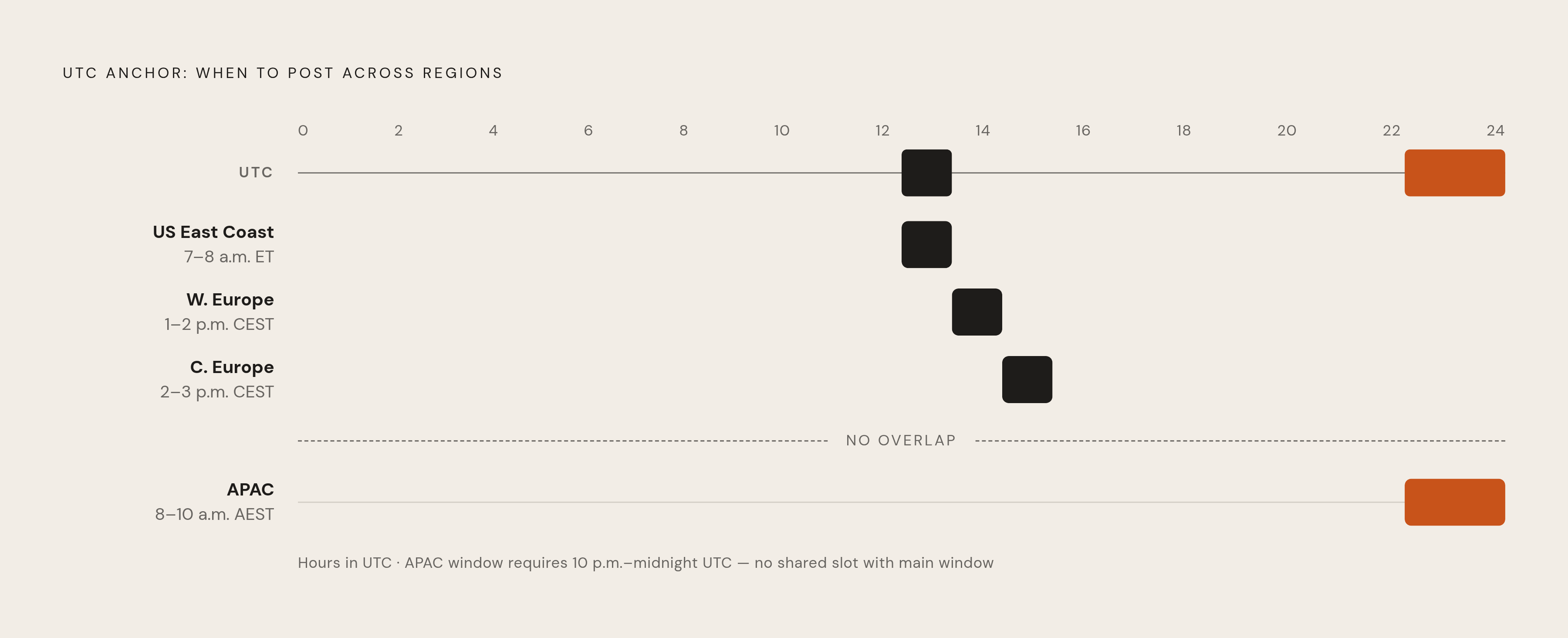
For a founder with a US and Europe audience, the standout slot is 12 to 1 p.m. UTC. That hour hits the US East Coast at 8 a.m., right in the pre-meeting scroll window, hits Western Europe at 1 to 2 p.m., just after lunch, and hits Central Europe around 2 to 3 p.m. CEST during summer time (shifting to 1 to 2 p.m. CET in winter). ET, catching the European lunch break and the American morning in the same breath.
| Audience | Best UTC window | Local translation | |---|---|---| | US only (both coasts) | 2–4 p.m. UTC | 9–11 a.m. ET / 6–8 a.m. PT | | US + Europe | 12–1 p.m. UTC | 7–8 a.m. ET / 1–2 p.m. CEST | | US + Europe + APAC | add 10 p.m.–midnight UTC | 8–10 a.m. AEST (separate post) |
Australia's eastern time zone is the outlier. An 8 to 10 a.m. AEST slot maps back to 10 p.m. to midnight UTC the day before, a stretch that doesn't overlap with either the US or European peak windows in any useful way. Reaching APAC audiences well requires treating that region as its own posting cadence rather than trying to stretch one anchor post across three continents. The practical rule is simple: a US audience gets targeted in Eastern Time, a European audience gets targeted in CET or GMT, and no single clock reading serves both at full strength.
Matching the anchor post's region to the founder's current priority
No founder can optimize every region at once without turning LinkedIn into a second full-time job, so the anchor post of the week (the one piece of content built to work hardest) should go out in the window where the highest-value outcome is most likely to happen. That outcome looks different depending on what the founder is actually chasing that quarter.
A founder deep in a fundraise should anchor on the 7 to 8 a.m. ET window, since it catches both the US morning and the European midday at once, and investors cluster heavily on the US coasts and in London and Berlin. Milestone updates, build-in-public progress, or a market thesis should land here on a Tuesday or Wednesday, inside the band every 2026 study agrees is strongest.
A founder in active hiring mode should treat the early-morning executive scroll, roughly 5:30 to 7 a.m. in the candidate's own time zone, as a strong secondary target, since candidates often check profiles outside standard business hours. Hiring across multiple markets at once calls for multiple region-specific posts, since one anchor can't do all the work.
A founder focused on customer development should lean on the Tuesday through Thursday, late-morning-to-afternoon band that shows up across every dataset, since that's when buyers and prospects are most reliably active. The anchor post here should be tactical or thought-leadership content, timed to whichever region holds the biggest pipeline opportunity that quarter.
The obvious pushback is that most founders are juggling all three priorities simultaneously, and that's a fair complaint. Instead, the anchor post should serve the top priority of the moment while a second weekly post, inside a two-to-three-post cadence, serves the next priority in a different region or window, without requiring daily posting to cover every base.
A repeatable weekly posting cadence for multi-region founders, built around two to three posts
For most founders, two to three well-placed posts a week do more for multi-region reach than a daily post fired off at a single "optimized" hour. The logic above (data, algorithm mechanics, overlap windows, and priority) all feeds into one concrete weekly structure, built here for a founder with a US and Europe audience.
The anchor post goes out Tuesday, timed for 7 to 8 a.m. ET, which is 12 to 1 p.m. GMT. This is the highest-priority content of the week, whatever that currently means for the business: a fundraising update, a build-in-public milestone, a piece of real thought leadership. It's placed here specifically because this window catches US morning and European midday in the same post, giving it the broadest possible reach for a single piece of content.
The second post goes out Wednesday or Thursday, between 10 a.m. and noon ET, riding the single strongest engagement day across every 2026 study while keeping a US-primary audience in mind. This slot carries secondary content: a tactical insight, a customer story, or a hiring signal, depending on what didn't make the anchor slot. Founders comfortable posting later in the day can push this toward Buffer's top overall slot of Wednesday at 4 p.m., since that hour has the strongest single-slot performance in the Buffer dataset even if it sits outside the core overlap window.
The third post goes out Friday morning, local time, somewhere between 9 and 11 a.m. This one should run lighter and more personal than the first two. PostFast's data shows Friday posts with a personal tone outperform strictly professional content, likely because the "Friday wind-down" mindset makes people more receptive to a story than a pitch. Keep it short.
For founders who've added APAC to the mix, a fourth post timed for Sunday evening UTC, which lands as Monday morning in Australia, extends the cadence without disturbing the core three-post structure. Treat it as an addition when the APAC pipeline justifies the extra effort, not as a replacement for the anchor post that's already doing the heaviest lifting for the business's main priority.
None of this holds up if the founder is staring at a blank draft every Monday night trying to write three posts from scratch. The cadence only becomes repeatable once there's a reliable process behind it, whether that's a recurring call to capture the founder's voice and ideas, with drafts coming back for a quick approval, or some other system that keeps the content pipeline running without demanding fresh creative energy every single week.
Calibrating the schedule over time using LinkedIn Analytics
Aggregate data from Buffer, RecurPost, Kanbox, and PostFast gives a founder a solid starting schedule, but it can't say whether that schedule is actually reaching the right regions at the right hours for one specific account. Only a founder's own LinkedIn Analytics, filtered by follower demographics and broken down post by post, can answer that.
RecurPost itself makes this point: recommended posting times are a useful starting point, not a guarantee, and the best posting times for any given account get identified through that account's own analytics over time. A workable calibration cadence runs the framework as built for four to six weeks, then pulls post-level data and sorts it by engagement rate. If the Tuesday anchor post keeps losing to the Friday personal post, the real audience behavior may skew later in the week than the aggregate studies suggest, and the schedule should shift to match what the data is actually saying.
One signal worth tracking is the gap between when a post goes live and when it picks up its first real engagement, measured by comments. A long gap followed by a late surge suggests the algorithm's distribution is doing more work than the original timing. The post is strong enough to survive a shifted window, and the founder has room to experiment with reaching a different region next.
The most common mistake at this stage is changing the content type and the posting time in the same week, which makes it impossible to tell which change caused which result. Adjust one variable at a time, run it for a full four-week cycle, and let the data isolate the answer. For founders working with a content partner, this kind of analytics review belongs as a standing item in the regular check-in rather than something revisited only when engagement dips. The schedule built here is a starting hypothesis, not a finished product. The founder's own data is what turns it into something sharper than any study, from Buffer's 4.8 million posts to RecurPost's updated numbers, could have handed over on its own.