LinkedIn Job Post vs Recruiter InMail for Early-Stage Startups
Early-stage startups lack the brand signals these tools require to convert.

LinkedIn job posts and recruiter InMail are built for companies with established employer brands. Early-stage startups have neither the brand nor the recruiting infrastructure, which changes the math on both tools. Understanding that structural mismatch is what determines which approach actually converts to hires.
A LinkedIn job post surfaces candidates through AI-powered matching fed by company page signals, follower counts, and brand recognition. A pre-seed or seed-stage startup with no following cannot supply those inputs. Recruiter InMail requires either a costly contract or a self-serve seat with constrained outreach volume. Its response rates also depend heavily on sender credibility and name recognition. Again, an unknown startup lacks those inputs.
The result is that founders who import large-company hiring playbooks into an early-stage context are not just using suboptimal tactics. They are fighting a structural disadvantage the tools were never designed to compensate for. The tools work. They just work for someone else.
What LinkedIn job posts actually do, and where they stall without a brand behind them
A LinkedIn job post is a passive-inbound tool that rewards brand equity. Post a role without an established company presence, and you get a thin applicant pool at best. The matching logic draws on member profile data, not the hiring company's page signals or follower count.
LinkedIn's own product page positions job posts as a way to reach active and passive candidates through AI-powered matching. That matching is fueled by unique insights from a member base spanning over a billion profiles. But the engine matches candidates to open roles, not to the story of why anyone should join your company in particular.
LinkedIn offers three distinct job-posting tiers. Hiring Pro is the AI-assisted product for small businesses that hire occasionally and have no dedicated recruiter. It generates a tailored job post, shortlists applicants, handles first-round screening, and surfaces 25 candidate recommendations per day. Job Slots is a subscription-style product for growing teams that hire year-round, with ATS and CRM integrations, pipeline visibility, and team collaboration tools. Pay-per-post or a free post is available for one-off listings, with lower visibility and no AI shortlisting support.
For an early-stage founder with no recruiter and low hiring volume, Hiring Pro is the closest structural fit. But even Hiring Pro's candidate matching still surfaces applicants who find the job post. It does not surface candidates the founder has attracted through reputation or storytelling. That is the upstream limitation.
The deeper problem is what candidates evaluating early-stage roles are actually asking. Is this founder credible? Is the mission real? Is the team worth joining? A founder's profile and the content they publish can, which is why many early-stage leaders treat personal brand-building as a prerequisite to scaling their recruiting efforts.
What recruiter InMail actually costs, and why the volume math punishes early-stage budgets
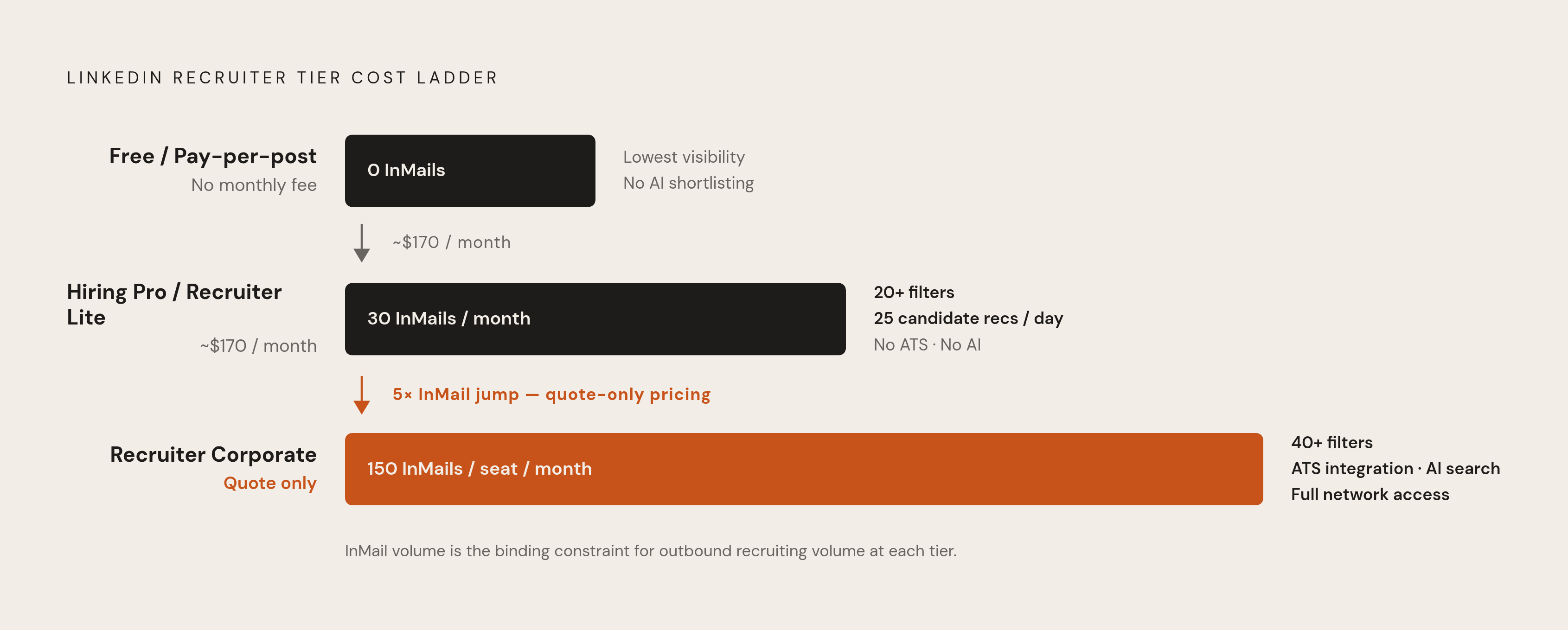
Recruiter InMail is a high-cost, low-volume channel whose economics only make sense when response rates are strong. For an unknown early-stage startup sending cold outreach, those rates are not. A July 2026 comparison of LinkedIn's recruiter tiers establishes the pricing structure.
Recruiter Lite is the self-serve option, last listed at $170 per month or $1,680 per year on annual billing. It includes 30 InMails per month per seat, search capped at 3rd-degree connections, and over 20 search filters. There is no ATS integration, no bulk messaging, and no AI features. Recruiter Corporate is quote-only, with third-party estimates placing it meaningfully higher than Recruiter Lite. It includes 150 InMails per seat, over 40 search filters, full network access, ATS integrations, and AI-assisted search and messaging. Hiring Assistant is an AI agent add-on available on Recruiter Corporate and RPS+ contracts, distinct from Hiring Pro.
Recruiter Lite's 30 InMails per month is a hard ceiling on outreach volume. A founder trying to fill two or three roles simultaneously reaches that ceiling almost immediately. Then the math gets ugly. Cold InMail response rates for unknown senders are low. Even a month's full allotment may yield only a handful of conversations. That is not enough to build a candidate pipeline for a critical early hire.
InMail has one real structural advantage. The sender can see the candidate's full professional context before reaching out, enabling genuinely specific personalization. But it does not compensate for inbox saturation when the company name carries no weight. Founders who have invested in their own visibility, however, can turn even limited InMail volume into something more effective, because the recipient checks the sender's profile before deciding to reply.
Why the founder's personal profile is the recruiting asset that job posts and InMail both assume you already have
Before either tool can work for an early-stage startup, the founder's LinkedIn profile needs to function as a recruiting landing page. It has to answer the questions a serious candidate has before they ever see a job post or respond to an InMail. A 2026 founder hiring playbook frames the personal profile as the recruiting infrastructure that comes before any outreach. Candidates arriving at a blank or generic founder profile see no reason to respond, regardless of how the message was delivered.
The profile elements that function as recruiting signals are specific. A headline rewritten as a mission statement signals momentum and active hiring rather than a static title. An About section answers three candidate questions: what problem is being solved, why this founder, and what joining looks like right now. A pinned Featured post tells the company's origin story. It is not a job description. It is a narrative that gives a candidate a reason to care.
The logic underneath all this is that candidates evaluating early-stage roles are making a risk decision, not just a career decision. The founder's profile is the primary due-diligence document available to them. When a candidate clicks through from an InMail or a job post, that profile either builds or destroys confidence before a conversation starts. For early-stage founders without an established employer brand, the disadvantage runs deeper than tool selection. It reflects a gap in founder visibility itself. LinkedIn ghostwriting agencies like Forj Media work directly on this problem, building the personal brand foundation that makes any recruiting channel actually convert by establishing the founder's credibility in the first place.
This is the upstream fix that changes the output of every other tactic. A strong profile raises InMail response rates because the sender is credible. It raises job post conversion because applicants who land on the company page can verify the founder's story. It enables warm outreach because the profile supports the ask.
How founder-led content on LinkedIn creates inbound recruiting interest that no tool can buy
Founder-led content on LinkedIn generates inbound candidate interest that bypasses the response-rate problem entirely. Candidates who reach out after reading a founder's posts are already pre-sold on the mission. The 2026 founder hiring playbook identifies this as where the real leverage lives. Content answers candidate questions at scale, around the clock, and the founder does not have to start each conversation.
Certain content types drive hiring interest specifically. Posts about why the company was started and what problem the founder is personally obsessed with establish mission credibility. Posts about the early team and what it's like to work at the company right now reduce the fear of the unknown that holds back candidates considering early-stage risk. Posts that demonstrate founder thinking, industry judgment, and learning in public signal the intellectual environment a candidate would be joining.
The compounding logic is straightforward. Each post builds the founder's network. A larger network expands the organic reach of the next post. That surfaces the company to more potential candidates without additional spend. Personal LinkedIn accounts reach audiences more broadly than company pages organically. That is the mechanism by which a founder posting from their own account outperforms a company posting a job from its page. It explains why brand-less startups struggle with job posts alone.
The strongest objection is time. The answer is that even a modest cadence, a few posts per week, begins building the asset. The cost of not building it is a permanently cold InMail channel and a job post that competes against branded employers on no footing. That is a worse trade.
Why the same visibility that attracts candidates also works on investors and customers
The founder visibility that makes InMail and job posts work better is the same asset that investors vet before meetings and customers evaluate before buying. Building it is not a recruiting tactic. It is a core business investment.
The hiring problem and the fundraising problem share the same upstream cause. An unknown founder has no credibility surface, which raises the friction of every conversation, whether with a candidate, a limited partner, or a prospect. A founder who can attract strong early hires through personal visibility is also demonstrating, visibly, the ability to recruit and lead. VCs treat that as evidence of founder quality during diligence.
The B2B sales dimension connects directly. A founder who is not growing a team cannot build a sales function. The content that builds recruiting credibility also builds commercial credibility with prospects who research the founder before agreeing to a meeting. A post about a hiring challenge signals transparency to candidates. It shows investors the founder is building openly. One asset, three audiences, no additional spend.
How to combine Boolean search, warm outreach, and founder content into one hiring approach that works without a recruiting budget
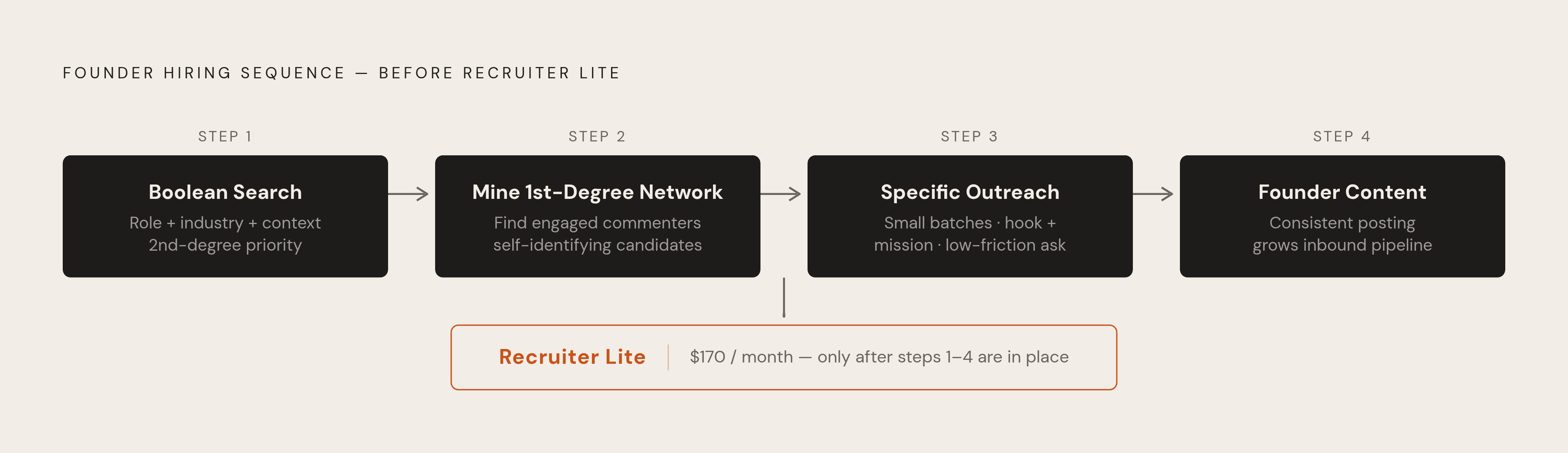
The most effective early-stage hiring approach on LinkedIn combines free search tools, warm-network prioritization, and founder content, in that order. It is not a choice between job posts and InMail as if they were the only options. Step one is using LinkedIn's free Boolean search before spending anything. Boolean operators in the standard LinkedIn search bar can narrow results significantly without a paid seat. The structure looks like this: role keyword AND industry AND context NOT irrelevant signal, filtered by location and connection degree. Second-degree connections convert at meaningfully higher rates than cold third-degree outreach, so prioritize them first, always. Candidates who are actively posting on LinkedIn are already on the platform and already responsive. Search by recent activity, not just profile keywords.
Step two is mining existing first-degree connections before searching cold. The founder's own network is the warmest possible candidate pool. Look for people commenting on relevant content in the target space. They are self-identifying as engaged with the domain.
Step three is writing outreach messages built on specificity, not volume. The framework is a specific hook referencing something the candidate actually did or wrote, followed by a mission-first pitch about what you're building and why it matters. Add an honest acknowledgment of early stage, then a low-friction ask. Not a call request. An offer to share more. Batch outreach in small groups so response patterns can be tracked and the message refined before scaling.
Step four is letting founder content run in parallel to reduce dependence on cold outreach. Posting consistently from the founder's personal account means the network grows, the profile becomes more findable, and some candidates arrive inbound. A job post placed after the founder has built even a modest content presence performs better, because candidates who land on the post can verify the founder's story before deciding whether to apply.
Recruiter Lite fits into this sequence, but not at the start. A $170-per-month Recruiter Lite seat adds expanded InMail capacity and expanded search filters. It becomes useful once the free Boolean approach has been exhausted and the founder's profile is strong enough to support a credible sender profile. Buying it before building the profile wastes the credits.
When to bring in a LinkedIn ghostwriting partner to build the founder content engine at scale
To change your LinkedIn hiring outcomes with founder content, you need consistent, high-quality output. Most founders cannot sustain that alone. A ghostwriting or content partner is the difference between the strategy that exists in theory and the one that actually compounds.
The execution gap is real. A founder posting inconsistently, two posts one month and none the next, does not build the compounding visibility the hiring argument depends on. The algorithm and the audience both require regularity. That is where the gap opens.
The objection to ghostwriting is that it is inauthentic. That misunderstands how the best ghostwriting works. The partner extracts and shapes them. Its stated priority goes to founders who are actively hiring, fundraising, or building in public, which is exactly the situation this article addresses.
What should you look for in a LinkedIn content partner for a founder in hiring mode? First, practitioner credibility. The partner should have built a real audience using the same methods they propose for the client, not just managed accounts for others. Second, a process that extracts personal experience. Frameworks and generic takes do not build the kind of trust that converts passive candidates into applicants. Specific, verifiable founder stories do. Third, measurable output goals: impressions, follower growth, inbound candidate or investor conversations started. Not just content delivery. Other LinkedIn content agencies and freelance ghostwriters are available and may be appropriate depending on budget and scope. Evaluate any provider on whether they can show their own audience-building track record, their process for capturing authentic founder voice, and their ability to connect content output to business outcomes rather than vanity metrics.
The hiring case for acting now rather than waiting is the strongest one. A founder who begins building LinkedIn visibility today compounds that asset over the months it takes to close a critical hire. Waiting until the hire is urgent means starting from zero when the cost of a bad or slow hire is highest. The second-best time is being cleaned up right now.