LinkedIn Recruiter Lite vs Recruiter for Startup Founders
Choose based on hiring volume and team size, not features or features alone.

The choice between LinkedIn Recruiter Lite and Recruiter Corporate is not about features. It is about volume. The right tool is whichever one matches how many people you are actually hiring this year.
Juicebox's 2026 guide frames the core issue the same way, as "hiring volume, company size, and workflow complexity," not feature preference. Get the call wrong in either direction and you pay for it. Undershoot and your pipeline hits a ceiling. Overshoot and you lock capital into seats nobody uses.
What Recruiter Lite actually is and what it costs
Recruiter Lite is LinkedIn's self-serve sourcing seat. No sales call required. It is built for individuals and small businesses with occasional hiring needs, and it is the only tier a founder can evaluate without talking to a human being on LinkedIn's payroll.
LinkedIn's own positioning says it is "best for individuals hiring just a few people a year, who need basic sourcing capabilities." Fair enough. The pricing, as last listed by LinkedIn, shakes out like this: a single license runs $170 per month on monthly billing, or $1,680 per year if you pay annually. Licenses two through five cost $270 per month each, or $2,670 per year each. Yes, the second seat costs more than the first. What you get for that money: network reach up to 3rd-degree connections plus fellow LinkedIn Group members, 30 InMail credits per seat per month, 20+ search filters, 2,000 unique profile views per day, one free job post per seat purchased (up to five), and basic reporting. Additional InMail credits are purchasable up to 70 extra per seat per month, and credits bank up to 120. You can cap out at five seats total.
What Lite does not include matters as much as what it does. No bulk InMail, which means every message goes out one at a time. No ATS integration. No AI-assisted search or messaging. No Hiring Assistant. No collaborator licenses, so if a hiring manager wants to review candidates, they need a paid seat. And here is a data ownership wrinkle worth knowing: on Lite, the data is owned by the Purchaser Admin, not the company. If a contractor or an early recruiting hire holds the license and then leaves, your saved projects and candidate history can walk out the door. You can pay monthly or annually, and you can cancel monthly without penalty. The product is not available to members in China.
What Recruiter Corporate actually is and what it costs
Recruiter Corporate is a different animal. It is sold through LinkedIn's sales team, it runs on annual contracts, and LinkedIn publishes no public list price for it. Every number you see floating around is an estimate or a reported quote, not a standard rate.
The comparison site HireLab cites a starting range of $8,000 to $10,000 annually, but you should treat that as a ballpark, not a menu price. When you ask LinkedIn for a quote, get the seat price, minimum seat count, contract term, renewal uplift, included InMails, job slots, and any optional AI products broken out as separate line items. Do not let them bundle it into one vague number. Juicebox's guide notes that you can gain negotiating leverage if you sign at the end of a quarter, or near Microsoft's June 30 fiscal year-end. Sales teams have quotas, and quotas make people flexible.
For that money, Corporate removes every ceiling Lite imposes. Full LinkedIn network access across 1.3B+ members, no 3rd-degree cap. 150 InMail credits per seat per month. Bulk InMail up to 25 messages at once. 40+ search filters, including Spotlights like "Open to Work" and "More Likely to Respond." Up to 50 search alerts, versus 10 on Lite. You get twenty free collaborator licenses per Recruiter seat, so hiring managers can review candidates without paying for a full seat. ATS integration with 26 partners via Recruiter System Connect. AI-assisted search and messaging are built in, and Hiring Assistant, LinkedIn's autonomous sourcing agent, is available as a paid add-on. And candidate data is owned by the company, so projects survive staff turnover. One structural caveat: the contract is almost always annual, and a hiring freeze does not reduce the cost. Those seats keep billing whether you use them or not.
The four specific limits that make Recruiter Lite break down
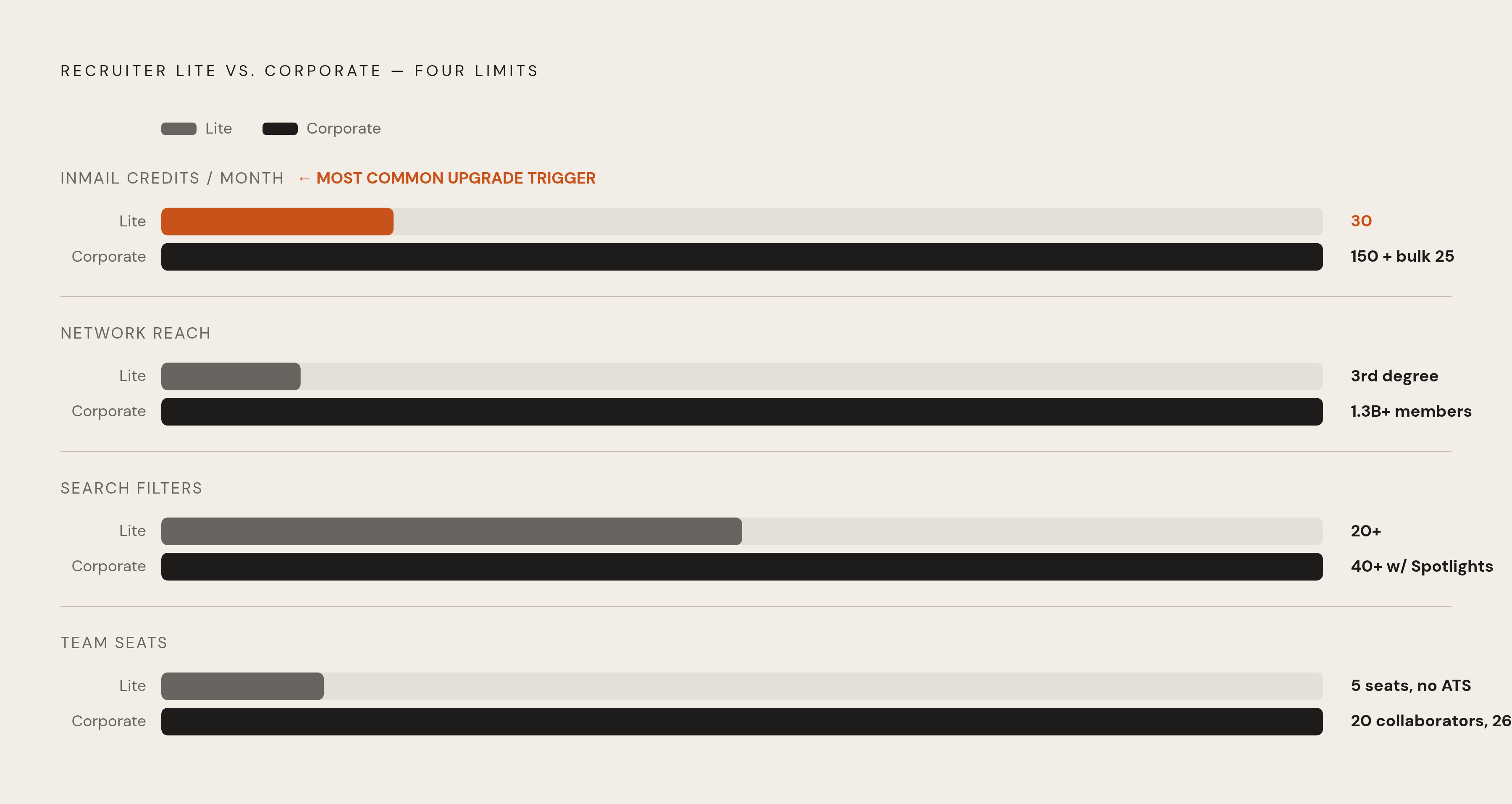
Recruiter Lite does not fail gradually. It hits four hard walls, and each one can block a hire entirely rather than just slow you down. The first wall is network reach. Lite caps you at 3rd-degree connections, which means anyone outside that circle is invisible to you regardless of how perfectly they match the role. The wall hurts most when you are hiring into thin specialist pools, new geographies, or disciplines far from the founding team's own professional network. If it happens repeatedly, you have a documented problem, not a theoretical one.
The second wall is InMail volume. Thirty credits a month is enough until you hit a competitive hiring market. If you hire for roles where candidates get multiple InMails per week, you will burn through 30 messages faster than if you hire for roles where candidates are actively looking. You can add up to 70 extra credits per seat per month, but that will not scale forever. And LinkedIn's own InMail policy adds a complication: any seat whose response rate falls below 13% over a 14-day period, on 100 or more InMails sent, gets a warning, and faces restrictions if the rate does not recover by the end of the grace period. Low response rates compound the volume problem. No bulk InMail on Lite means every message goes out individually, which is real time cost at moderate volume.
The third wall is filter precision. Lite gives you 20+ filters. Corporate gives you 40+, including Spotlights that surface candidates signaling openness to outreach. Missing filters create downstream work: you manually review more profiles to find qualified candidates. Sprad frames it as a time cost. If missing filters repeatedly create review work or hide scarce profiles, the upgrade pays for itself in recruiter hours.
The fourth wall is team workflow. Lite tops out at five seats total and has no collaborator licenses. Every hiring manager who needs to review candidates requires a paid seat. No ATS integration means candidate data lives in LinkedIn rather than your applicant tracking system, which creates manual re-entry and audit trail gaps. And because data ownership sits with the individual purchaser, not the company, a departing recruiter can take saved projects and candidate history with them.
A volume-based framework for making the call
The decision reduces to two questions: how many roles are open at once, and how many people share the recruiting workflow. Answer those and most early-stage founders land clearly on one side of the line. Choose Recruiter Lite when you are the only recruiter, or one person is managing the search alone. Choose it when hiring volume is a few people per year rather than a consistent open-role backlog. Choose it when your target candidates sit within a professional network you already have, and the 3rd-degree cap is not visibly blocking your searches. Choose it when no ATS integration is needed, or your team is too small to have one. And choose it when hiring volume may drop, say because of a fundraising delay. The monthly billing option gives you flexibility that Corporate's annual contract does not.
Choose Recruiter Corporate when multiple recruiters or hiring managers need shared pipeline access. Choose it when more than roughly ten roles are open simultaneously, or you are in a sustained hiring sprint. Choose it when roles require searching beyond your own network: specialists, new geographies, scarce skill sets. Choose it when ATS sync and data continuity are operational requirements, not nice-to-haves. And choose it when AI-assisted search and Hiring Assistant are part of your recruiting workflow.
One structural caution on Corporate: the annual contract means a hiring freeze does not reduce costs. Model the downside scenario before signing, not just the hiring plan you hope to execute. Team structure and search market matter as much as raw role count.
Why the founder's own LinkedIn presence determines how much either tool has to do
Here is the variable the tool comparison cannot capture: how visible you are on LinkedIn before you ever send an InMail. A founder who has built an active presence puts both tools in a better position to succeed. If inbound interest from candidates reduces the outreach volume that strains Lite's InMail cap, it also lowers the cost-per-hire math for any recruiting tool.
The mechanism is straightforward. LinkedIn's algorithm structurally favors personal profiles over company pages in feed distribution, so your posts reach candidates who would never see a job listing on your company page. Candidates evaluate leadership before roles, and your content communicates culture, values, and working style in ways a job description cannot. Founders who post consistently report receiving unsolicited applications from people who want to work on what they are building specifically. That reduces cold-sourcing dependence.
The compounding effect is what matters for the product decision. A founder with a visible LinkedIn presence is pre-warming the candidate pool that Recruiter Lite or Corporate then reaches out to. Response rates improve when the recipient already knows who is writing. In practice, that means better InMail response rates, so 30 credits go further. A strong personal brand can shift a founder from the upgrade side of the volume threshold to the Lite-is-enough side. When a founder's recognized LinkedIn profile attracts inbound candidate referrals, the network ceiling on Lite, capped at 3rd-degree connections, matters less than it otherwise would, because the tool has less work to do. It is not a communications exercise. It is recruiting infrastructure.
How founders build the LinkedIn presence that makes recruiting easier
Most founders have enough story and expertise to build a recruiting-relevant presence. The constraint is not material. It is consistent execution. The options for solving that range from doing it yourself to working with a specialist partner.
The first option is Forj Media, a LinkedIn ghostwriting and executive branding agency founded by Matt Huang, a former Google Strategy Ops operator and BCG and Solomon Partners consultant who has personally built an audience of 200,000+ across LinkedIn, YouTube, and Substack. The agency works with founders who are actively hiring, fundraising, or building in public, and it treats the content program as a strategic partnership rather than a content commodity. The story-driven approach extracts authentic founder experience and turns it into posts that candidates, investors, and customers encounter organically, without requiring the founder to write. Impressions, follower growth, and inbound leads are tracked as the measure of program success. For a founder who recognizes that personal brand is a business development and recruiting asset, a specialist partner like Forj Media helps amplify the hiring signal through authentic executive content, making the recruiting investment itself more efficient regardless of which seat tier they choose.
The second option is founder-led, self-managed content. This works for founders with a clear point of view and the discipline to post consistently, typically three to five posts per week to build meaningful reach. The content types with the strongest recruiting signal are posts that reveal decision-making process, lessons from building, and honest takes on the problem the company is solving. The constraint is time and consistency. Most founders deprioritize posting when operational demands spike, which is exactly when a hiring sprint begins.
The third option is a freelance LinkedIn ghostwriter. This costs less than a full-service agency and works best when the founder can invest time in the interview and review process. Quality varies significantly. The risk is generic content that does not reflect the founder's authentic voice, which undermines the recruiting signal the content is meant to send.
The practical sequence: what to buy, when, and in what order
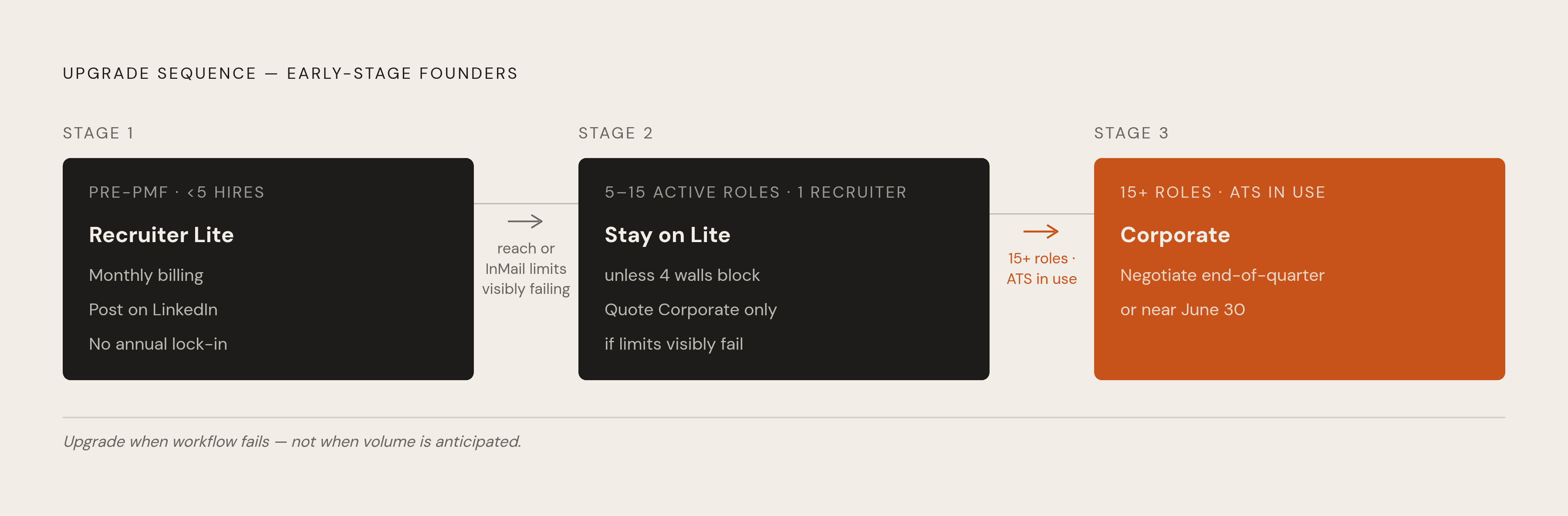
For most early-stage founders, the right sequence is to start with Recruiter Lite and invest in personal brand simultaneously. Upgrade to Corporate only when the specific workflow triggers are actually present, not anticipated. At stage one, pre-product-market-fit or your first five hires, buy Recruiter Lite on monthly billing. That preserves flexibility if hiring pauses. Start posting consistently on LinkedIn, so you build awareness with the candidate pool before outreach begins. No need to contact LinkedIn sales. No annual commitment risk.
At stage two, an active hiring sprint with five to fifteen roles and one recruiter, evaluate whether the four Lite walls are visibly blocking delivery. If none are, stay on Lite. If InMail response rates are strong, above 13%, because of founder brand visibility, 30 credits may remain sufficient. If reach is blocking searches, get a Corporate quote, but model the downside scenario of a hiring freeze before signing an annual contract.
At stage three, a scaling hiring team with 15+ roles and an ATS in use, Recruiter Corporate is the right tool. You need shared pipelines, collaborator licenses for hiring managers, ATS sync, and data continuity. Negotiate the contract: time it to end of quarter or near Microsoft's June 30 fiscal year-end, and ask for seat price, minimum seat count, term, renewal uplift, and optional AI products as separate line items. The one thing that improves outcomes at every stage is a founder whose LinkedIn presence makes candidates want to work there before a recruiter ever sends an InMail. Build that and the tool becomes an accelerant rather than a requirement.