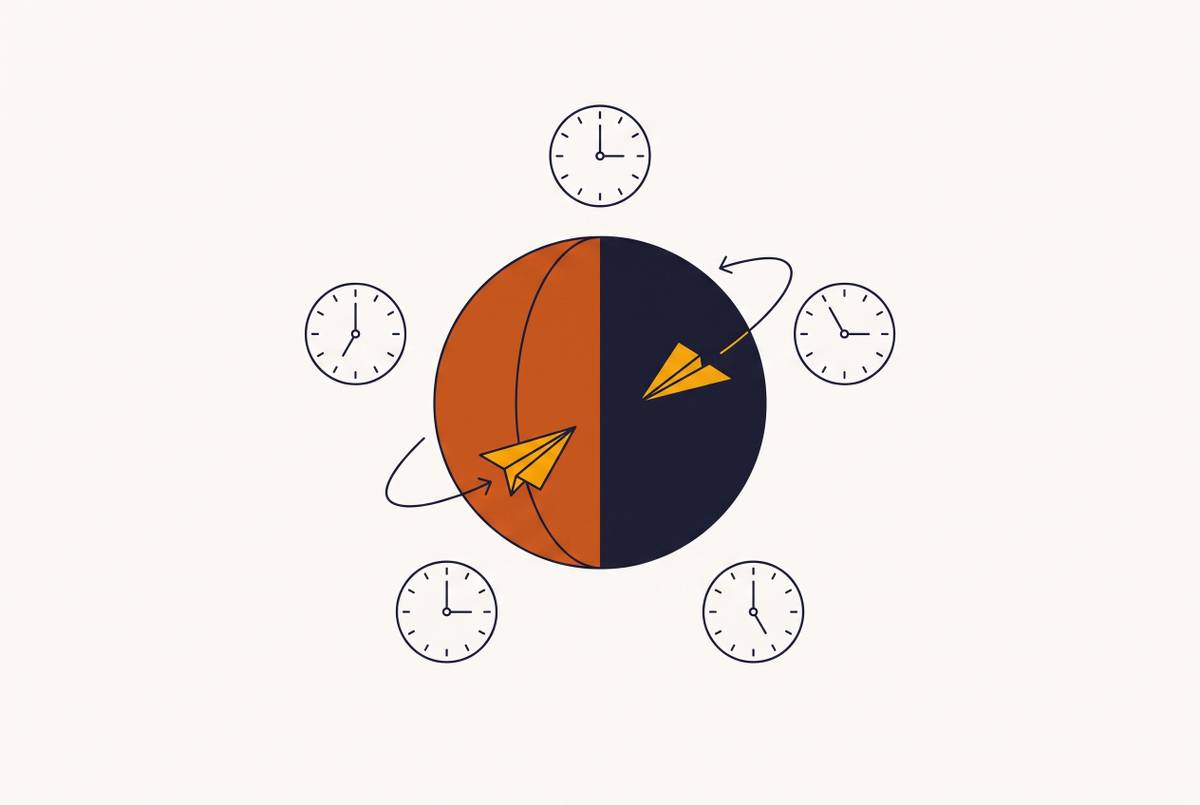
Time Zone Strategy for LinkedIn Posts Targeting US Investors
Post at 7 AM or 6 PM Eastern to catch venture capitalists when they actually read LinkedIn.

LinkedIn tests every post on a small slice of your network before it decides whether anyone else gets to see it. Think of it as a bouncer checking IDs at the door: the first wave of people who see your post, usually a few dozen connections, decides whether the rest of the party ever finds out there's a party. If that initial group scrolls past without liking, commenting, or lingering, the algorithm reads the post as low-value and the distribution stops right there. The post quietly stops existing for anyone outside that first slice, including every investor who wasn't lucky enough to be scrolling at that exact moment.
That makes timing non-negotiable for a founder trying to reach investors. If you post when your actual target audience, venture capitalists and angels, is nowhere near their phones, the test group skews toward people with zero investment mandate. A marketing manager double-tapping your post at 11 AM does nothing for you if no investor ever sees the result. Silence from the wrong crowd gets scored the same way as silence from the right one: as proof the post isn't worth spreading further. There's no retry button. One post, one test, one shot at the algorithm's attention, and the clock starts the second you hit publish.
Investor behavior and the timing problem generic LinkedIn advice doesn't solve
Most "best time to post" research answers a question nobody fundraising actually asked. These studies pool data from millions of LinkedIn users across every industry, role, and time zone, which smooths the numbers into a single average that describes nobody in particular. Buffer's 2026 analysis, built from 4.8 million posts, lands on a broad window of 3 PM to 8 PM as the strongest stretch of the day, with Wednesday at 4 PM topping the chart. Other large studies point to Tuesday through Thursday between 10 AM and noon as the sweet spot. Both are accurate descriptions of the median LinkedIn user. Neither describes a venture capitalist.
The gap matters because investors don't scroll like the median professional. A founder who schedules a post for 10:30 AM because a study recommended it may land squarely in a wave of marketers, recruiters, and sales reps on a coffee break, none of whom have a dollar to deploy. Meanwhile the VC who might have actually cared is four hours deep into back-to-back partner meetings, phone face-down on the table. The research is answering a different question than "when is a VC free to read LinkedIn," which is the only question that matters for a raise.
What the two investor attention windows reward
US investors don't graze on LinkedIn all day. They show up in two concentrated windows, each tied to the rhythm of their actual job, and each rewarding a different kind of content.
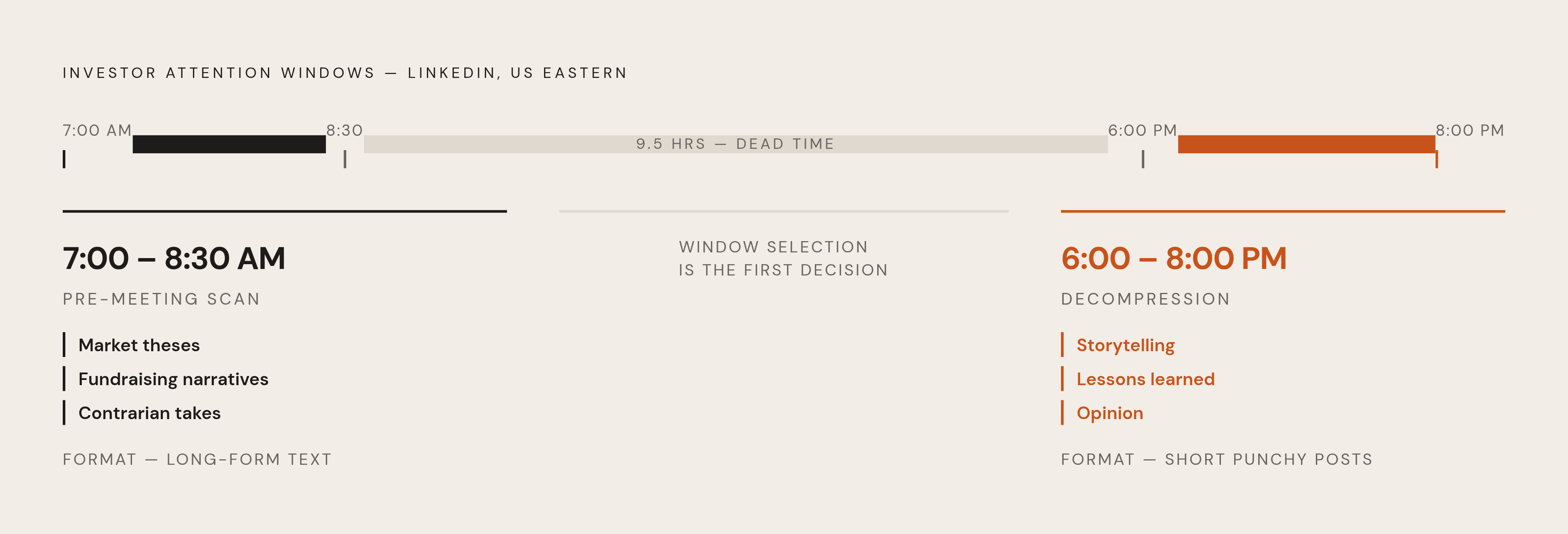
The first window runs 7:00 to 8:30 AM Eastern. This is the pre-meeting scan, the moment VCs and angels are drinking coffee and catching up on industry signal before their calendar fills up with calls. They're not looking for operational minutiae here. They want market theses, fundraising narratives, contrarian takes, build-in-public momentum updates, the kind of post that reads as strategic intelligence. East Coast founders land in this window naturally, since it overlaps with a normal morning routine. Founders on the opposite coast have to work around it: a 7:00 AM ET post goes live in the middle of their night, so it has to be scheduled in advance.
The second window runs 6:00 to 8:00 PM Eastern. This is decompression time: markets have closed, meetings have wrapped, and investors are browsing with no calendar pressure breathing down their neck. That's when longer storytelling posts and lessons-learned narratives get a slower, more generous read. Buffer's large-scale post analysis backs this up from a different angle: the late-afternoon and evening window of 3 PM to 8 PM now shows stronger engagement than in prior years, with Wednesday at 4 PM the single strongest slot in their dataset. That's a general-population finding, but it overlaps neatly with the investor evening window. It also happens to be when founders and early-stage operators, the exact crowd most likely to amplify investor-facing content, are most active themselves, which helps seed the early comments the algorithm is watching for.
These two windows are the two pillars of the same framework. A founder who can swing two posts in a day uses one for each. A founder posting once a day picks whichever window matches the content on hand: strategic and dense in the morning, narrative and reflective in the evening.
Why Tuesday through Thursday is non-negotiable for investor reach
Time of day only works if the day itself cooperates, and for investor-facing content, the week has a clear dead zone on either end. Monday gets eaten by portfolio reviews, internal alignment meetings, and digging out from weekend deal flow. Investors might scroll passively, but they're not stopping to engage. Friday afternoon is worse: the whole professional world starts mentally checking out before the weekend even arrives, and anything posted past midday on Friday fights a losing battle against that drift.
That leaves Tuesday, Wednesday, and Thursday as the real working core of the week, the days investors are actively evaluating deals, swapping opinions in group chats, and forming judgments about the founders they're tracking. This isn't an accident of the data. It mirrors how the venture world actually schedules itself, with partner meetings and deal reviews clustering mid-week.
The studies don't fully agree on which single day wins, and that disagreement is itself informative. Buffer's 2026 data names Wednesday the best overall day, with Thursday and Friday close behind, and Monday and Tuesday trailing at the bottom. A separate practitioner dataset built from 50,000 posts puts Tuesday at the top of its engagement index, with Wednesday most reliable for deep engagement and Thursday pulling the most comments. Rather than trying to crown one winner, treat all three days as strong and let content type break the tie: Tuesday for big strategic announcements, Wednesday for posts built to spark a conversation thread, Thursday for narrative and storytelling pieces that benefit from a slightly more relaxed reading mood heading into the end of the week.
Solving the cross-coast timing problem with a single posting time
A founder trying to reach investors on both coasts runs into a scheduling puzzle that looks a little like trying to plan a dinner party for guests in two time zones who both insist on eating promptly at 7. The fix is simpler than it sounds: post once, between 8:00 and 9:00 AM Eastern, and both coasts end up served.
At that hour, investors on the opposite coast are still hours from waking. West Coast investors are waking up, many of them checking a phone before they're even out of bed, which doesn't count as real engagement yet. By the time they actually open LinkedIn a few hours later in their own morning, the post has already banked two to three hours of engagement from the other coast. It appears in their feed already carrying momentum. That's the mechanism that makes 8:00 to 9:00 AM Eastern a genuine sweet spot: the algorithm's golden-hour test has already run its course on the East Coast audience, and the post that passed that test arrives on West Coast screens with social proof already attached.
If you're posting from outside the US (Europe, Asia, Latin America), you face the same math, just with a bigger offset to manage. Landing a Tuesday post inside that 8:00 to 9:00 AM Eastern window means knowing the exact time difference and using a scheduling tool to queue it up in advance. You won't stick to manually posting at 2:00 AM local time for long. Scheduling in advance is the only way for founders outside the country targeting investors in it to hit the window consistently without wrecking a sleep schedule in the process.
Golden-hour comments and reach beyond your network
Posting at the right time only wins half the game. What happens in the sixty minutes right after publish matters just as much. Posts that pick up substantive comments, longer dwell time, and saves in that first hour get treated by the algorithm as relevant to a wider professional audience, and that's the exact mechanism that pushes a post in front of a VC who has never followed the founder and never will unless the algorithm hands them the introduction.
A founder posts at 8:00 AM Eastern, then walks straight into a two-hour meeting with notifications silenced, wasting good timing. No one replies to the first person who does comment. The golden hour runs its course with nobody home, and the algorithmic test concludes with a flat, forgettable result, regardless of how perfectly the posting time was chosen. Active comment management in that first hour is the second half of the timing strategy. Nailing the posting window and then going dark is only doing half the job, and half a job gets half the reach, or less.
A lever sits just upstream of all this: commenting thoughtfully on investors' own posts before a founder ever publishes anything. That kind of targeted engagement warms the relationship in advance and makes those same investors more likely to show up and comment when the founder's post finally goes live, which is exactly the early momentum the algorithm is scanning for.
Cadence: the posting frequency that sustains algorithmic distribution without burning out
LinkedIn's algorithm has a long memory for consistency. Accounts that publish quality content on a predictable schedule, within a clear topic niche, build what amounts to an algorithmic reputation, and the platform extends a little more initial distribution to each new post as that reputation builds. A founder posting three times a week for six months straight will outperform a founder who posts daily for three weeks and then vanishes for two.
That gap isn't a neutral pause. Three weeks of daily posting followed by a two-week silence does more damage to distribution than a steady three-posts-a-week rhythm sustained over half a year, because the algorithm reads the gap as account dormancy and resets whatever momentum had built up. It's the content equivalent of training for a marathon by sprinting the first five miles and then taking a nap on the curb.
The irony is that the moments founders most need visibility, active fundraising, hiring pushes, building in public through a hard stretch, are exactly when a calendar is already packed solid with operating work. That's precisely when posting cadence tends to slip, which is also precisely when it can least afford to. If founders pair their own voice with outside support for consistent publishing, they tend to hold that cadence through the chaos, while founders flying solo on content burn out and disappear right when an investor might have been watching most closely.
Format choices that interact with posting time to affect how investors engage
Format and timing are one decision wearing two hats. A post's format sets expectations for how much attention a reader is willing to spend, and matching that to the investor's mental state at a given hour is what separates a comment from a scroll-past.
Long-form text posts, the kind that lay out a market thesis or walk through a fundraising story step by step, belong in the early morning window. Investors are reading deliberately before their meetings start, and the 7:00 to 8:30 AM Eastern slot gives them the runway to actually finish a longer piece.
Short, punchy opinion posts, a single contrarian observation or a one-line market take followed by a quick explanation, fit the evening window instead. In decompression mode, investors are reading for a fast hit of something interesting, not settling in for a research memo, and a tight, provocative format matches that mood far better than a wall of text ever could.