LinkedIn Video Post Performance for Founder Accounts
Founder video success hinges on opening seconds and audience quality, not view count alone.
LinkedIn video performance for founder accounts is not a contest to collect the most views. Falling views can hide a more qualified audience, but reaching that audience depends on the opening seconds, format, native posting, and a sustainable mix with text. The opportunity is qualified inbound.
Why raw video view counts are the wrong metric for founder accounts
LinkedIn’s Creative Labs report says platform-wide video viewership grew substantially in 2024, yet average views per post keep falling across every account size. More video watched, fewer views on yours. That contradiction makes a founder’s dashboard hard to read, especially when declining numbers look like a verdict on the effort spent producing each clip. The aggregate and the individual post are telling different stories.
Video engagement rates rose across 2024 and 2025 even as average audiences shrank. Passive scrollers are tuning out, while those who stay take more action per impression. For founders with a narrow ideal customer profile, reach alone is therefore a poor scorecard. Thousands of generalists may be less useful than a few hundred senior B2B buyers who start a conversation.
How LinkedIn's algorithm now distributes video — and why dwell is the governing signal
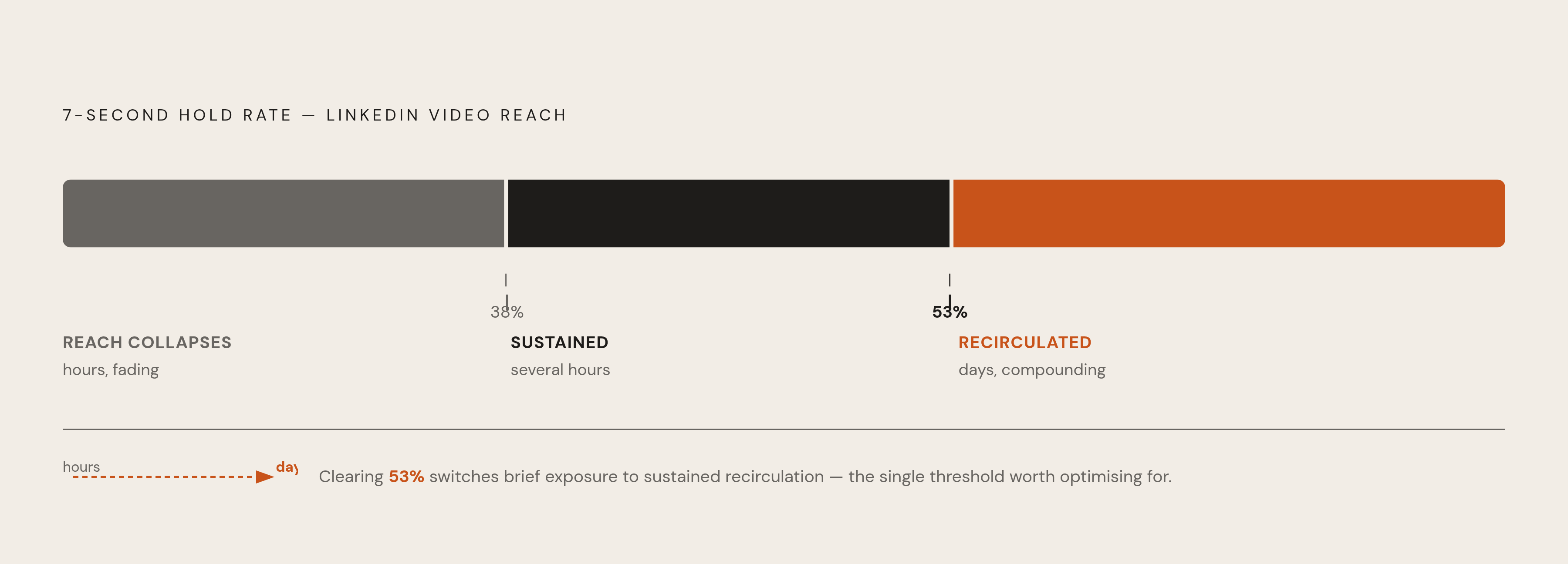
How LinkedIn distributes video now depends on how long people stay, as well as surface engagement. Likes and comments at posting time do not explain whether a clip keeps circulating. The operative threshold is the 7-second hold rate. Below 38%, reach collapses early after posting, while a middle band sustains distribution for several hours. Above the upper threshold, the algorithm keeps sending the video out again for days.
A video does not simply earn a little more reach for each small improvement in its opening. When a video clears the hold threshold, it can go from being shown briefly to being shown again and again. This makes the opening unusually consequential, because the strongest argument in the final minute cannot help viewers who have already left.
Personal profiles get far more impressions than company pages for the same content, so founders have a head start before anyone responds. LinkedIn launched a dedicated vertical video tab in early-to-mid 2024 and has pushed native video impressions into the main feed at a meaningfully higher rate than text in the same dwell-time band. Native upload is therefore a prerequisite for these distribution mechanics. More uploads, however, are not automatically better, because the algorithm appears to protect the feed’s mix.
The first six seconds determine whether a video gets distributed at all
Some common ways to open a video lose viewers before the 7-second gate. They include a talking face without audio context, “Hey guys” or “today I want to talk about,” a brand intro or logo card, and B-roll before any spoken hook. Each spends the opening on something other than the viewer’s reason to stay. The logo has had its moment. The buyer has left.
The practical intervention is to open with the substance. A contradiction directly challenges a widely held belief in the founder’s space. A specific scene gives the viewer a concrete setting or moment, creating both visual and narrative context. An on-camera question names the viewer’s actual problem. These openings give the audience something to engage with before distribution depends on whether they are still watching.
A founder who puts a welcome and logo ahead of the hook risks losing the broader test entirely, regardless of what follows. AI-generated avatars also meaningfully underperform on hold rate, and production quality does not close that gap. For founders experimenting with synthetic presenters, that finding limits how far the opening can be delegated.
Format and length choices — where the data conflicts and what the conflict reveals
Video length is where the evidence resists a neat prescription. Paired-test findings place the sweet spot in the sub-minute range, with completion rate as the dominant signal. But clips under half a minute may give the algorithm too little completion signal to earn a reward. Shorter is not an unlimited advantage. Cutting until nothing is left is best saved for the legal disclaimer.
The broader findings point in two directions. Short-form video under two minutes wins on early hold and distribution signals, while long-form video of 3+ minutes wins on total dwell and ICP-qualified attention. The viewer who finishes a longer argument is making a larger commitment than someone who completes a short clip.
For founders, the decision rule follows the goal. A top-of-funnel program should skew short, while a founder addressing buyers who already understand the problem and need to evaluate the founder’s thinking should skew longer. Length alone does not earn that attention. Tutorial-style videos over a minute and a half underperform without a clear structural hook, so extra time needs a reason to exist.
Format adds another constraint to that choice. Narrated screen recordings and dashboard walkthroughs average a hold rate somewhat below half. Customer or employee clips also average below half, but drive strong profile views through credibility by association. Horizontal video underperformed text in a large majority of paired tests, and external YouTube or Vimeo links lost to text every time on reach in those comparisons. Repurposed podcast clips also show low completion, which makes an available recording a poor substitute for a format suited to the feed.
Where video actually loses to text, and why that matters for pipeline
Video generates more impressions but converts them to profile views at a meaningfully lower rate than text. Watching is not the same as investigating. Video viewers often consume passively, while readers engaging with a written argument are more likely to click through to the founder’s profile. A larger audience at the top can therefore conceal a weaker next step.
Strong opinions and controversy generate substantive disagreement in text threads, while video comments remain more polite and surface-level. Long-form storytelling that needs a lot of background runs into another problem, because LinkedIn’s video duration mechanics punish content that takes too long to make its point. Carousels, meanwhile, earn saves and topical recognition, while text posts generate the DMs that become pipeline conversations.
The posting cadence that sustains distribution without triggering algorithmic decay
When reach goes up and down, it can be tempting to post a video every day. Testing across 8 founders over six weeks showed why that response can backfire, with reach collapsing by week three. The result suggests LinkedIn throttles creators who flood the feed with video. The platform is not an attendance register.
One tested way to run the program mixes video with 3–4 text posts per week on the video’s theme and 1 document or carousel per week as a third anchor. The formats have distinct jobs. Video gets seen by more people, text builds the argument and starts conversations, and the document gives readers something worth saving.
The right mix shifts as a founder’s following grows, and the evidence does not establish one video frequency that fits every account. A pace the founder can keep up avoids a rush of clips followed by silence. Consistency comes from coordinating the formats.
What the self-selecting audience actually does — and where video converts to business outcomes
The smaller audience staying with LinkedIn video is disproportionately made up of senior decision-makers. A senior buyer watching a founder work through a relevant problem is not equivalent to a casual viewer passing through. People across LinkedIn already have a big role in business decisions, so having senior people engage with video is especially useful for B2B founders.
Inbound leads generated through a founder’s content convert to discovery calls at a dramatically higher rate than outbound prospecting because those prospects have already consumed the founder’s thinking. They arrive with some of the qualification done. Video lets serious viewers weigh up that thinking, while text can give them a reason to send a DM. The business result belongs to the content program.
That prior familiarity also changes fundraising conversations. Investors take meetings more readily with founders who have established personal brands, and a visible, consistent presence compresses the trust-building phase. The founder is less of an unknown. The initial meeting can start closer to discussing investment than establishing credibility.
Talent follows a related path through a different kind of evidence. Founders who post regularly about building their company attract meaningfully more inbound candidate interest than those who use LinkedIn only for job listings. A job listing can name the culture. A founder’s video can let a candidate see it.
The execution gap between knowing the mechanics and running a consistent founder video program
The mechanics are learnable in an afternoon. Running them consistently is the harder job, because scripting, recording, drafting, and publishing accumulate beside everything else a founder owns. Knowing the 7-second hold rule does not create time to write the next hook.
A content partner can take on scripting and hook development, format selection, cadence management, caption copy, burned-in captions, and post framing. Scheduling and the publishing rhythm can also be coordinated. Operators who have built audiences using the methods they use for clients bring relevant experience of cadence experiments and algorithm shifts, which can help them adapt a program without waiting for a quarterly strategy review.
The founder still has work that cannot transfer cleanly. The founder still needs to be on camera because AI avatars have weak hold rates. The founder also needs to reply to comments in the first hour, because the algorithm gives early comments a lot of weight and the replies must sound like the person whose account is speaking. A retainer cannot make the founder’s judgment available on demand.
LinkedIn’s User Agreement prohibits account sharing and automated activity. Help with production therefore gives founders no reason to hand over login credentials. The practical authenticity test is equally plain. If the founder can defend every opinion in a live conversation, the post remains the founder’s thinking regardless of who shaped the draft.
Interview-based work is where that division becomes most useful. A good interview gives founders room to be candid in ways polished solo drafting often does not, then turns that candor into usable material. The story about defective units told on a call can become the contradiction that opens a video. The partner extracts and shapes it. The founder supplies the experience and judgment. That is the raw material the first six seconds need, and no logo card can provide it.