Building a Professional Network on LinkedIn From Zero Connections
Start with an optimized profile, then build connections strategically before you post anything.
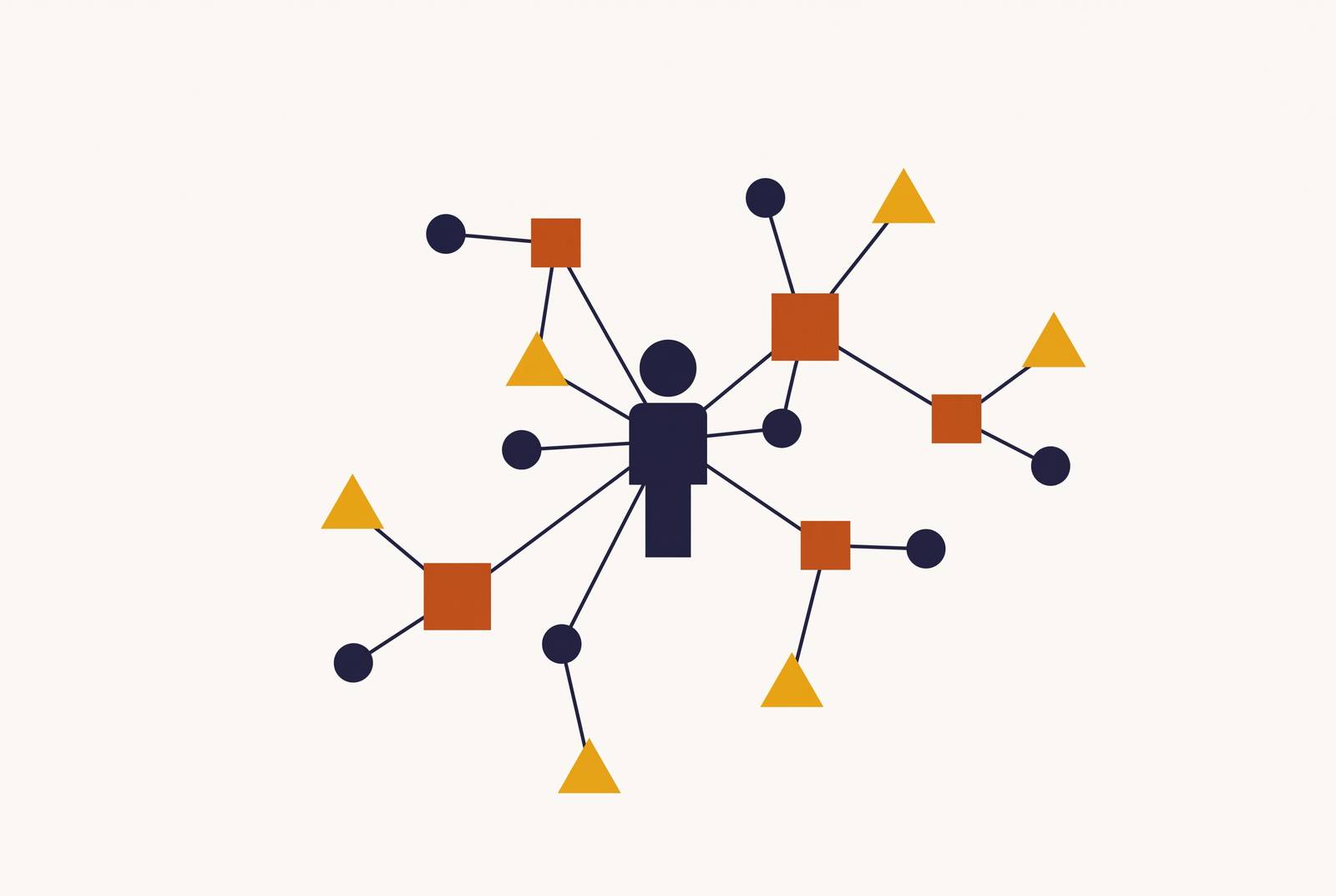
Building a network from zero on LinkedIn now works best as a sequence, not a numbers game: profile first, then the right connections, then content, in that order. The reason that order matters starts with how the platform itself has changed. The feed now hands most of its space to personal profiles, while company pages get a small slice, and the organic reach a company page used to count on has dropped hard since 2024. A post from a founder, word for word the same post from the company page, pulls in far more attention, simply because the platform's wiring favors a face over a logo. That's a hard shift for anyone used to thinking of the company page as the front door.
Part of this traces back to how B2B companies find customers in the first place. Cold outbound, the emails and calls that used to fill a sales pipeline, has gotten less productive, and founder-led growth has stepped in to fill the gap. An audience that already trusts a specific person has become a real business asset. LinkedIn's own growth, with the platform crossed 1B+ users and Gen Z now its fastest-growing demographic, deepens its role as the arena where professional reputations are formed.
Put those two facts together and the takeaway is plain: leaving two or three thoughtful comments on a person's posts over a week before sending a connection request means that by the time the request arrives, the name is already familiar. Nobody builds a factory on a shortcut, and nobody should build a professional reputation on one either.
What the 2026 algorithm rewards and punishes
Before any tactics get laid out, it helps to know the rules of the game LinkedIn is actually playing in 2026. The platform's algorithm has moved away from counting likes and clicks and toward measuring how long someone actually sticks with a post, what the sources call a Depth Score, built from dwell time, comment depth, saves, and private shares. That's a meaningful swap.
What gets rewarded under this system: original ideas, real expertise, an actual human point of view, and comment threads that turn into real conversation. What gets punished: duplicate content recycled across accounts, and engagement bait designed to trick the system rather than say anything. Engagement pods, the old trick where a group of people agree to like and comment on each other's posts to fake momentum, don't work anymore. The algorithm is built to spot manufactured engagement and shut it down.
There's a mechanical detail in here that matters a lot for someone starting from zero. Every post gets shown first to a small test audience, and only the posts that earn real engagement from that group get pushed out wider. That means the first handful of people who see a post, and how they respond, decide whether anyone else sees it. For a brand-new account with no existing audience to prime that first response, chasing more connections or posting more often, without having anything substantial to say, backfires instead of just falling flat. The algorithm isn't neutral about empty volume. It actively buries it.
Building the profile as a credibility asset before adding a single connection
Sending connection requests before the profile is ready wastes the request. Every person who checks out a new profile before accepting a connection is deciding, in a few seconds, whether this person is worth their attention, and a profile that reads like a résumé answers that question badly. The first job is making sure the thing people land on when they click through actually earns the click.
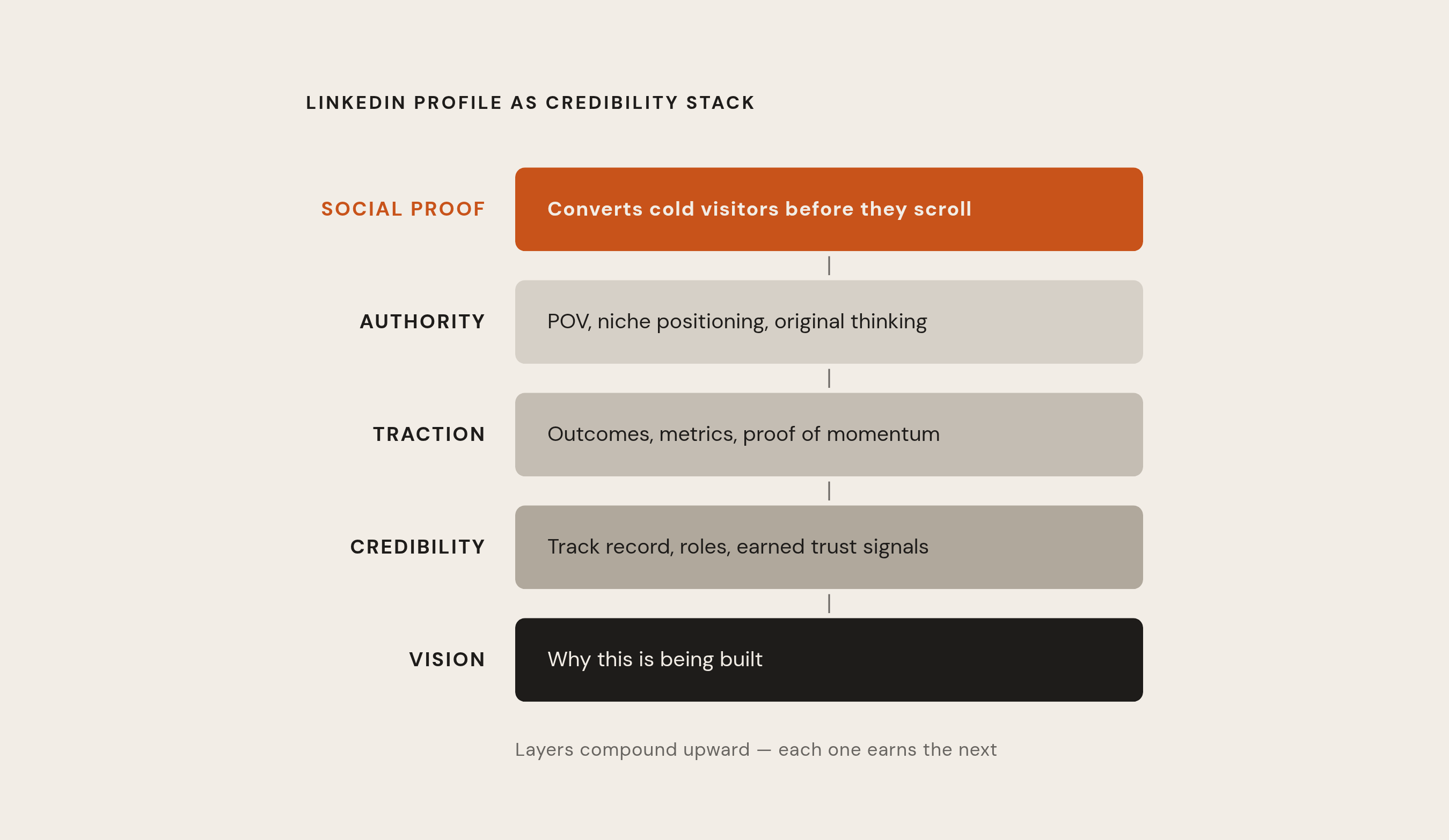
A useful way to think about the profile is as five layers stacked on top of each other: Vision, Credibility, Traction, Authority, and Social Proof. Each part of the profile should carry one of those signals rather than just listing job history.
The headline is the first thing anyone reads, and it needs to carry role, positioning, a value proposition, and one proof point all at once. A headline built around a clear, multi-part brand and specific, high-signal keywords gets indexed by the platform's own search, the way Sahil Bloom's headline works by defining a multi-faceted brand clearly.
The About section should carry a real narrative in four parts: Origin, why this is being built in the first place; Mission, what problem it solves; Traction, what's actually been delivered; and Authority, why anyone should believe any of it, closed out with a clear call to action. Skip the bullet list of adjectives. Tell the story in that order and the reader does the convincing themselves.
Experience entries should read as outcomes and systems built, the kind of writing where someone built or shipped or grew something measurable rather than "responsible for" tasks that could belong to anyone.
The algorithm now reads a profile's language semantically, categorizing expertise by the specific terms used throughout a profile, not just the job title at the top. Using the real, specific language of an industry, consistently, across the headline, About section, and experience bullets, helps the system place a profile in front of the decision-makers actually searching for that expertise.
Photo and banner do real work too. They need to signal authority at a glance, with a clean, professional photo and a banner that states the value proposition outright rather than leaving it for the visitor to guess. A profile with no ambiguity in what it's communicating converts a cold visitor faster than one that requires detective work. The profile should also work as a proof vault, holding case studies, press mentions, or writing samples so a new visitor gets evidence before they ever scroll down to the experience section. Running outreach before any of this is in place is a lot like buying ads that send traffic to a broken landing page: expensive attention, wasted.
Choosing the right first connections rather than collecting the most
Once the profile is ready, the next decision is who to add, not how many. Because distribution now happens mostly inside a person's existing first-degree network, the make-up of that early network shapes who sees every post for months to come. A few hundred of the right people concentrates it.
The sequence matters here too. Warm relationships come first: former colleagues, clients, investors, advisors, the people already inclined to engage because they already know the name attached to the request. These are the connections most likely to comment, share, and signal to the algorithm that this account is worth paying attention to.
From there, the network should expand toward prospects, potential partners, industry peers, and the kind of executive candidates who sit in the exact domain a person wants to be known for. Adding relevant people on a regular, deliberate basis has become part of the strategy, because the algorithm shift rewards a network built around a clear focus rather than a wide, unfocused one.
A smaller, tightly relevant audience inside one industry does more for a reputation than a sprawling, generic one, because authority gets built when a name becomes associated with one specific domain, not when a connection counter ticks upward. Before sending any request, a useful filter is to ask whether this particular person, if they engaged with a future post, would signal real relevance to the algorithm and pull in more people who look like them. If the honest answer is no, that connection request can wait.
The comment-first approach to getting noticed before you ask to connect
The fastest way to make a cold connection request feel warm is to stop sending it cold. Leaving two or three genuinely thoughtful comments on someone's posts over the course of a week, before ever sending a request, makes the name attached to that request already familiar by the time it shows up. It's the professional version of running into someone three times before finally asking for their number. By the third time, it doesn't feel like a stranger asking.
A good comment does double duty. It tells the person being commented on that someone paid real attention to what they said, and it puts a profile in front of that person's whole network through the comment thread itself, all without posting a single thing of one's own. That's reach earned for free, just by showing up in the right conversation.
What doesn't count as a thoughtful comment: "Great post!" or a thumbs-up emoji sitting there alone. The Depth Score logic that governs posts applies just as much to comments, so a comment that adds a real point, a question, or a disagreement gets seen by the algorithm and by other readers in that thread, while a one-word reaction gets ignored by both.
This habit pays off twice. It builds a track record of genuine engagement before there's any original content to show off, and it plants seeds with the exact people most likely to engage back once that first post does go live. Picking the right threads to comment in, the ones where the existing audience overlaps with the audience worth reaching, puts a name in front of the right observers well before any content strategy kicks in.
Starting to post: what to publish first and in what order
The first posts from a new account should aim at recognition, not virality. The goal is for every new connection to understand, fast, what this person actually stands for. Founders in 2026 do best when they're known for one or two core themes, so that when someone hears the name, a clear idea comes to mind immediately, and that clarity compounds over time in a way that raw post volume never does.
Four content types repeat across accounts that build real authority over time. Industry perspective, how a shift in the sector gets interpreted, shows awareness and expertise without turning into a sales pitch. Operational insight, real lessons pulled from hiring decisions, product calls, or a fundraising round, builds trust faster than abstract advice ever does, because it's specific and it's lived. Opinion, a clear, well-argued position on something where most people stay neutral, is what actually makes a founder memorable instead of forgettable. Selective personal narrative, a formative moment or turning point shared sparingly, adds depth to the professional story without turning the feed into a diary.
Balancing those four types matters as much as choosing them. The 5-3-2 rule, splitting posts between curated insights, original writing, and personal or humanizing content, keeps the mix from tipping too far into self-promotion. The most common mistake a new account makes is treating LinkedIn like a company notice board, posting product updates and hiring announcements as if the feed were a press release feed, which reads as job-seeker or PR mode rather than genuine thought leadership. Copying whatever format went viral last week does similar damage if it has no real connection to the person's actual positioning. A reader should get to the end of a post and feel like only this specific person could have written it.
This is where content and connections start working together instead of separately. What gets posted determines who shows up to engage, and who engages shapes which audience the algorithm decides to show the next post to. Get the early connections right and the first posts land in front of people primed to respond. Get the posts right and those responses teach the algorithm who to show the next one to. Neither step does much alone.
Posting frequency and consistency as a compounding mechanism
The question every new account asks is how often to post, and the honest answer is less often than most people assume. One to two posts a week is the right pace for most CEOs and founders, and consistency at that pace matters far more than cranking out content every day. Nobody needs to post daily to build a reputation. They need to show up reliably, week after week, without disappearing for months at a time.
That disappearing act is the real risk. When a founder goes quiet for a few months, the audience's memory of them resets, and all the groundwork from the earlier posts stops carrying forward. Authority comes from staying visible continuously rather than posting in short, intense bursts and then vanishing. A steady drumbeat of posting keeps a name appearing in front of clients, partners, board members, prospects, and future hires who already know that name, reinforcing relevance without a single cold outreach message being sent.
The algorithm backs this up directly: it rewards depth of engagement over sheer frequency, so one post that sparks a real comment thread and gets saved outperforms three posts that only pick up a handful of likes. The founders who keep jumping off the platform every time the algorithm changes, and then try to relaunch from scratch months later, are the ones who lose the most ground. Staying consistent through every algorithm shift is itself a competitive edge.
What a network built this way delivers: fundraising, sales, and hiring
All of this sequencing, the profile work, the selective connections, the comment habit, the paced content, adds up to something concrete: a network built on real credibility and consistent narrative creates inbound pressure in fundraising, sales, and hiring that cold outbound simply can't match.
On the fundraising side, one fintech founder's Series A conversations turned from skeptical to inbound after building a personal brand through Forbes contributions and speaking engagements, which shortened the entire fundraising timeline. VCs back the person as much as the idea, and LinkedIn has become one of the places they look to check whether a founder is worth that bet.
On the sales side, the 2024 Edelman-LinkedIn report found that a majority of B2B buyers said thought leadership led them to research a product or service they hadn't previously been considering. Thought leadership reaches buyers that a sales team's cold calls and demos never touch.
The 2025 Edelman-LinkedIn B2B Thought Leadership Impact Report found that more than half of B2B decision-makers said that when a company's thought leadership is strong, brand recognition matters less, because the founder's credibility carries the weight instead. That's the full arc of the argument closing the loop: the platform favors the individual, the algorithm rewards depth over noise, and a network built in the right sequence turns a single founder's reputation into the asset that used to require an entire brand marketing budget to build.
Sources
- LinkedIn marketing strategy: How to grow in 2026
- LinkedIn Strategy for CEOs in 2026
- LinkedIn Growth Strategy for Founders (2026 Guide)
- LinkedIn Profile Optimization for Founders & CEOs in 2026
- LinkedIn Strategy for SaaS Founders: 2026 Growth Guide
- Executive Personal Branding: Complete Playbook 2026
- How to Increase LinkedIn Company Page Engagement (2026)