Effective Networking Strategies for Seed Stage Founders
Build credibility through LinkedIn before asking anyone for anything.

Effective networking for seed-stage founders now starts before the introduction. As cold outreach loses ground and generic content fills the feed, visible credibility makes investor meetings, recruiting conversations, and customer introductions easier to earn. The practical strategy is to build trust through a focused LinkedIn presence, then use that trust to strengthen human relationships.
Why cold outreach has stopped working for seed founders
The connection requests go out, the InMails follow, and the replies barely arrive. For a seed founder, the obvious response is to rewrite the opening line or send more messages. Neither addresses the underlying problem. High-volume outreach has become a liability because low acceptance rates can reduce the deliverability and reach of what follows. Practitioners call this a “volume tax,” which is an impressively dull name for paying more effort to get less attention.
That penalty changes the economics of the old playbook. Spray-and-pray introductions depend on enough attempts eventually producing a useful conversation, but the attempts themselves now weaken future distribution. As people move toward permission-based contact, that problem gets worse. This is not simply an audience tiring of an awkward sales pitch. It reflects a durable move toward permission-based data structures on the platform.
What actually replaced cold outreach: the inbound trust gap
The Linkboost 2026 State of LinkedIn Report puts inbound conversion at nearly nine times the rate of traditional outbound. That gap makes trust-first networking a resource decision. When an investor, candidate, or customer reaches out after reading a founder’s content, some qualification has already happened. They have encountered the founder’s thinking and found a reason to continue.
For seed founders, that difference is especially useful in investor introductions, first hires, and early enterprise sales. Each asks another person to take a risk on limited evidence. When founders show what they know, those people have something to weigh before giving their time, money, or taking a new job. Founders who build trust in their expertise on LinkedIn say investors read their profiles before meetings, candidates check them before accepting offers, and journalists scan them before interviews.
Warm introductions, conference conversations, and referrals still involve people choosing to help one another. A credible public presence makes those choices easier because the person receiving an introduction can assess more than a name and a job title.
Why LinkedIn is the right platform for a seed founder to build that trust
LinkedIn fits the seed founder’s need for a small, relevant audience rather than a large, indifferent one. Investors, operators, potential customers, and early hires are present on the platform, while personal profiles consistently earn higher engagement than company pages. The platform’s 2026 emphasis on what data scientists describe as “depth score” favors genuine conversation within an existing network. With a targeted first-degree network, a founder can start those conversations without a mass following.
Rethoric’s 2026 founder playbook frames LinkedIn as the highest-ROI channel for founders because the work compounds. A strong content presence remains an asset that can generate inbound, unlike outreach that must be repeated to produce another attempt. Content that people trust and that names its author also gives AI tools material to draw on when answering questions about a category. For a founder, a bylined presence provides discoverable evidence of expertise. The platform’s value is that the right people can find both the founder and the reasoning behind the company.
How the LinkedIn algorithm actually distributes content in 2026 — and what a seed founder should do differently
LinkedIn’s 2026 algorithm treats dwell time as a primary signal, together with saves and comment quality. It tracks how long someone pauses before scrolling, so a person who reads without liking can be valued more highly than someone who taps like and leaves. That helps founders reach investors, C-suite executives, and senior operators who may read without letting anyone know they were there.
Engagement quality adds another layer to distribution. Thoughtful comments receive more algorithmic weight than likes, while shares receive more than comments. For founders, the practical lesson is to publish something worth considering and discussing rather than something designed only to collect applause.
External links in post bodies are penalized, which makes native, “zero-click content” a sensible default. Founders should deliver the full value in the feed or put the link in the first comment. Substantive comments on other people’s posts are also a strong discovery tool and drive more profile views than posts do. Leaving those comments before publishing is a useful habit, but it does not measurably warm up the algorithm’s initial distribution window.
What a seed founder's LinkedIn profile must communicate before a single post goes out
Someone who visits a profile makes up their mind within seconds. The headline is the first element to fix because it appears in search results, comments, and other places where the founder’s name surfaces. It should lead with the problem solved and the outcome created. “Founder” establishes a role, but not a reason to care. A useful headline tells a potential investor, customer, or hire what the work is for.
The about section then needs the story behind the company, specific proof that it works, and a clear call to action. Numbers, outcomes, and milestones supply evidence where broad claims cannot. Two to three short paragraphs are enough. The featured section should pin one lead-capture asset, such as a case study, a free resource, or the founder’s strongest post, rather than leave interested visitors with nowhere useful to go.
Across the profile, the framework is Vision, Credibility, Traction, Authority, and Social Proof. Those signals explain why the founder is building, what qualifies them, what progress exists, how they think, and who lends external validation. Each section should contribute to that argument. The profile must support trust, demand, talent attraction, and credibility at once. No content strategy survives a profile that fails to convert the attention it earns.
The content framework that builds visible credibility week over week
The 4-3-2-1 framework gives that profile a repeatable stream of evidence through four posts per week. The mix is two educational or framework posts, one social-proof or company-milestone post, and one personal story. Each has a different job. Educational content shows what the founder knows, milestones show how far the company has come, and personal stories show who is making the decisions. Together, they earn attention before asking the reader to do anything with it.
Educational posts are a good way to show founder-market fit. Proprietary frameworks, explanations of industry inefficiencies, and a clear argument for the startup’s approach let investors assess the founder’s grasp of the problem. A milestone post adds a different kind of proof by showing what happened. Neither has to turn into a sales pitch wearing a fake moustache. The aim is to make the founder’s competence visible.
Personal stories deserve equal care. A specific decision from a past role, a choice made under pressure, or a failure with a named outcome reveals how the founder reasons. Generic motivation cannot do that job. The useful story belongs to this founder and explains something about their judgment, rather than offering a lesson that could sit beneath anyone’s photograph. This specificity makes personal narrative a trust accelerant and gives readers evidence that polished positioning alone cannot supply.
Three content moats protect that specificity, namely narrative, proprietary data, and physical proof from the company’s actual work. Real photos, faces, and places add evidence that generic content cannot reproduce. The broader rhythm should remain manageable, with three to five high-quality posts per week. Ten substantive comments can outperform a hundred passive likes. Sticking to one or two core themes also helps people think of a clear idea when they hear the founder’s name.
How consistent posting translates into warm investor conversations and recruiting pull
Early-stage investors are evaluating the founder as well as the product, because the product may pivot while the founder remains. The brief says 77% of VCs research founder LinkedIn profiles before meetings, which shows why that public record matters. Content gives them evidence of communication, judgment, and comfort with uncertainty. Stories from past roles and explanations of industry problems also make founder-market fit easier to assess. The pitch has context before the meeting begins.
Founders with active, authentic presences report less due-diligence friction and easier access to meetings once a credibility baseline exists. This does not turn posting into a fundraising guarantee. Recruiting works much the same way, because candidates read what a founder shares to judge the culture, how they lead, and how clear the mission is. Someone who has followed that thinking for weeks arrives with more context than someone encountering the company through a vacancy alone.
To connect that visibility with deliberate outreach, founders should leave two to three substantive comments on a target investor’s or candidate’s posts over a week before sending a connection request. The request gets a warmer welcome when people know the name from comments that added to the discussion. The asset being built is not a follower count, but a credibility archive that compounds across future conversations.
Why most seed founders cannot build this system alone — and what the ghostwriting model actually looks like
The bottleneck is usually not a shortage of opinions. It is the time and writing craft needed to turn those opinions into clear, consistent posts while also building a company. Ghostwriting addresses that execution problem by separating substance from articulation. The founder provides the ideas, experiences, and positions. A writer handles structure, phrasing, and formatting so that useful thinking does not remain trapped in an unfinished draft.
The model described here begins with a recorded conversation about the founder’s thinking. AI transcription produces a first draft within a day, after which the founder reviews and approves the content before publication. The full pipeline takes four days, with roughly 45 minutes of focused founder time. That workflow reduces the writing burden without removing the founder’s responsibility for what appears under their name.
Experiences and positions must genuinely belong to the founder, because invented substance collapses when someone asks a follow-up question. Most B2B founders do not explicitly disclose ghostwriting, though describing the arrangement as help articulating their thinking is an option when transparency is chosen. A ghostwriter can improve the sentence, but cannot supply the judgment it claims to express.
What to build in the first 90 days if you are starting from zero
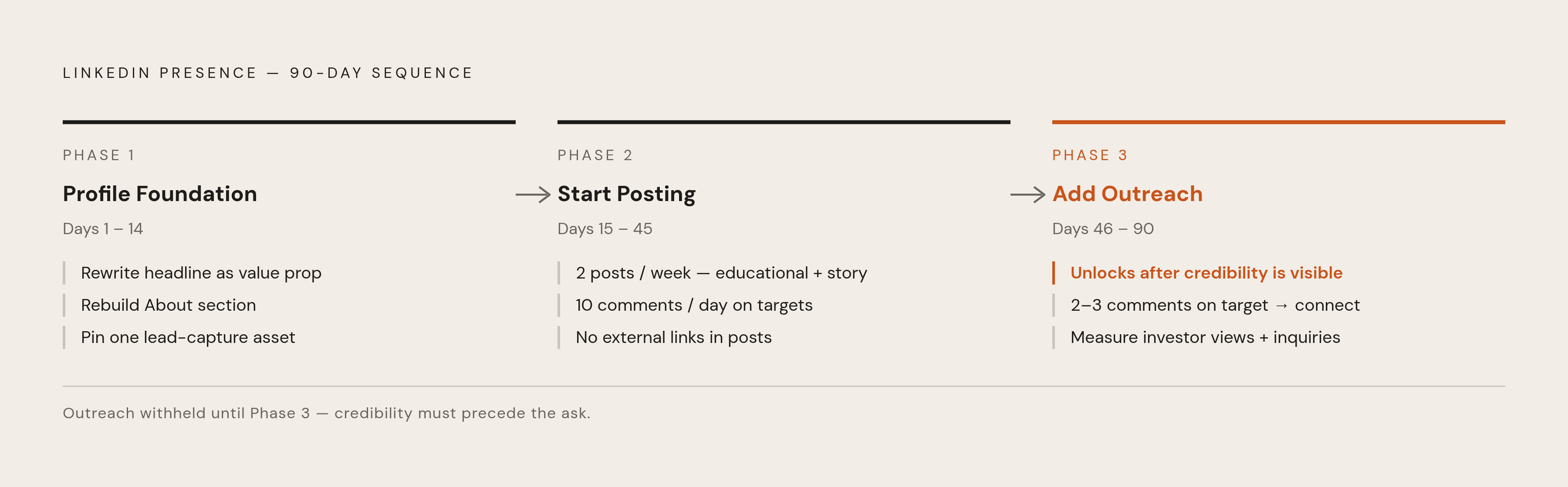
Days 1–14 should go entirely to the profile foundation. That means rewriting the headline as a value proposition, rebuilding the about section around story, proof, and a call to action, and pinning one lead-capture asset. Nothing else starts until that work is done. This sequence gives future visitors a clear account of the founder’s value before comments and posts begin bringing them to the page.
Days 15–45 start with fewer posts than the full weekly framework calls for. Founders should publish two posts per week, starting with one educational post and one personal story. Post bodies should contain no external links, and each post should close with one question that invites a substantive response. In parallel, the engagement habit is ten substantive comments per day on posts by relevant investors, potential hires, and peers, before publishing the founder’s own content. At this stage, comments drive more profile views than posts.
Days 46–90 add connection outreach to that foundation. After two to three meaningful comments on a target’s posts over a week, the founder should send a deliberately short, personalized connection request. Familiarity is the point of the sequence. Progress should be measured through investor profile views, recruiting inquiries, and unsolicited partnership conversations. Those signs show whether LinkedIn is building a pipeline for the long term or has become another campaign that always needs to be fed.